On this page
Use Nについて for a neutral “about N,” and use Nに関して when “regarding N” fits a more formal report, notice, or discussion. Before another noun, the matching forms are Nについての + noun and Nに関する + noun.
That four-part pattern is the practical N3 distinction. The two families overlap in meaning, so sentence position and register usually settle the choice before a subtle difference in scope does.
Four forms fill two sentence positions
The form after the topic depends on what comes next. A following clause takes について or に関して; a following noun takes についての or に関する.
| Position | Neutral | More formal | Example meaning |
|---|---|---|---|
| before a clause | Nについて | Nに関して | talk / investigate regarding N |
| before a noun | Nについての + noun | Nに関する + noun | a question / report about N |
来月の研修について話し合いました。
We discussed next month's training.
来月の研修に関して、部長から説明がありました。
The department head gave an explanation regarding next month's training.
研修についての質問を集めています。
We are collecting questions about the training.
研修に関する資料を配りました。
We distributed materials concerning the training.
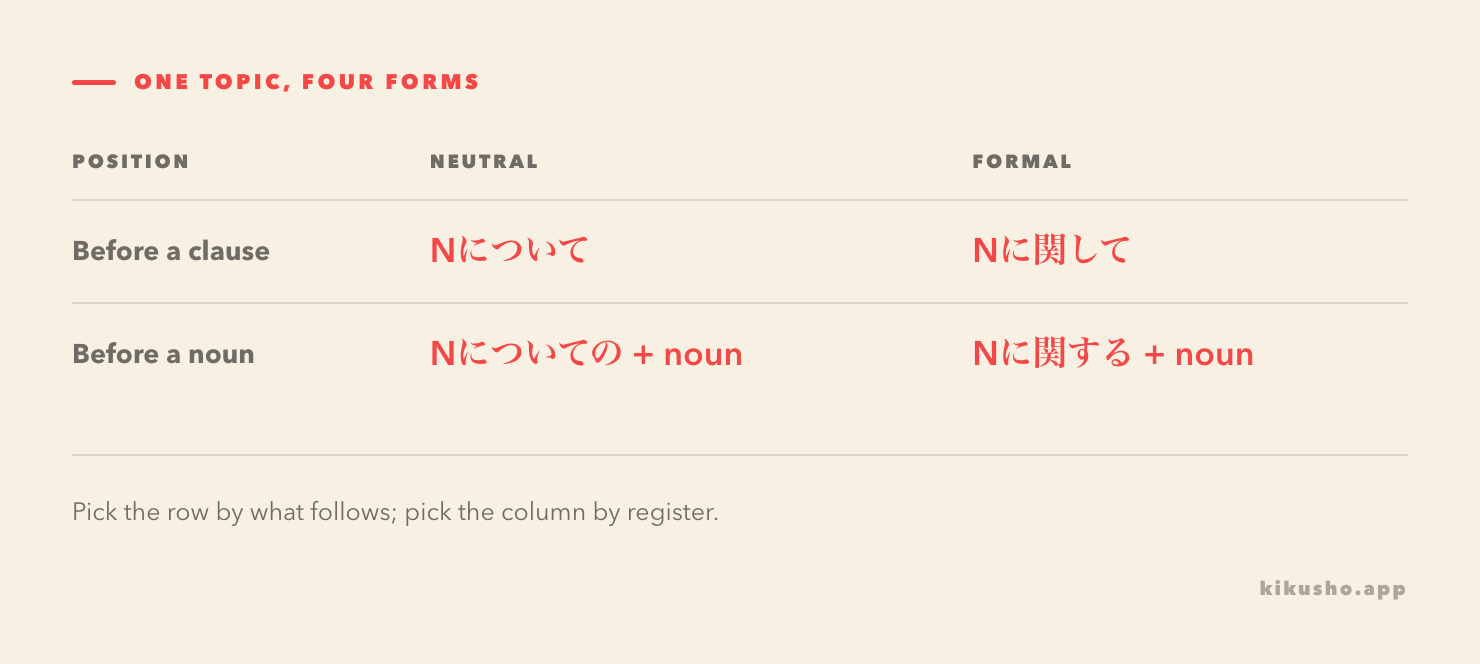
The common structural error is 研修に関する話し合いました. に関する must modify a noun, but 話し合いました is a verb. Either say 研修に関して話し合いました or put a noun after に関する, as in 研修に関する話し合い.
について is the neutral topic marker
について identifies the content of speaking, thinking, learning, asking, writing, or investigating. It works in ordinary conversation as well as writing.
先生に試験について聞きました。
I asked the teacher about the exam.
日本の住宅について調べています。
I am researching Japanese housing.
この問題についてどう思いますか。
What do you think about this problem?
These sentences simply name the topic. The construction does not say that the speaker supports it, acts toward it, or excels in that field. This is why the same marker works naturally with the speech verbs in the N3 lesson: 小説について語る names what the author talks about, while the verb 語る tells us how the content is presented.
Add は when you want to set that topic apart:
日程については、明日お知らせします。
As for the schedule, we will let you know tomorrow.
Here は creates a contrast or narrows the present comment to the schedule. It does not create a new grammar point.
に関して and に関する sound more formal
に関して is common in reports, announcements, surveys, customer service, academic prose, and careful public speech. It presents the following information as connected with the named matter.
新しい制度に関して調査を行いました。
We conducted a survey regarding the new system.
その件に関して、後ほどご連絡いたします。
We will contact you later regarding that matter.
個人情報に関する方針を改定しました。
We revised the policy concerning personal information.
The core meaning still overlaps with について. 新しい制度について調べました is neutral and natural; 新しい制度に関して調査を行いました packages the same general topic in the register of a formal investigation.
Bunpro's N3 reference for に関して and に関する gives the attachment split noun + に関して and noun + に関する + noun, and describes the family as more formal than について. The Japan Foundation teaching reference likewise calls に関して somewhat more typical of writing.
Scope can differ, but register is the safer first test
The Japan Foundation also notes a tendency in scope: に関して can include matters related to the named topic, while について can keep attention on the topic itself. Compare the framing of these two questions:
留学生活について質問があります。
I have a question about study-abroad life.
留学生活に関して相談したいことがあります。
There is something I would like to discuss regarding study-abroad life.
The second can open a broader formal consultation involving housing, paperwork, money, or other connected concerns. The first directly identifies study-abroad life as the question's content.
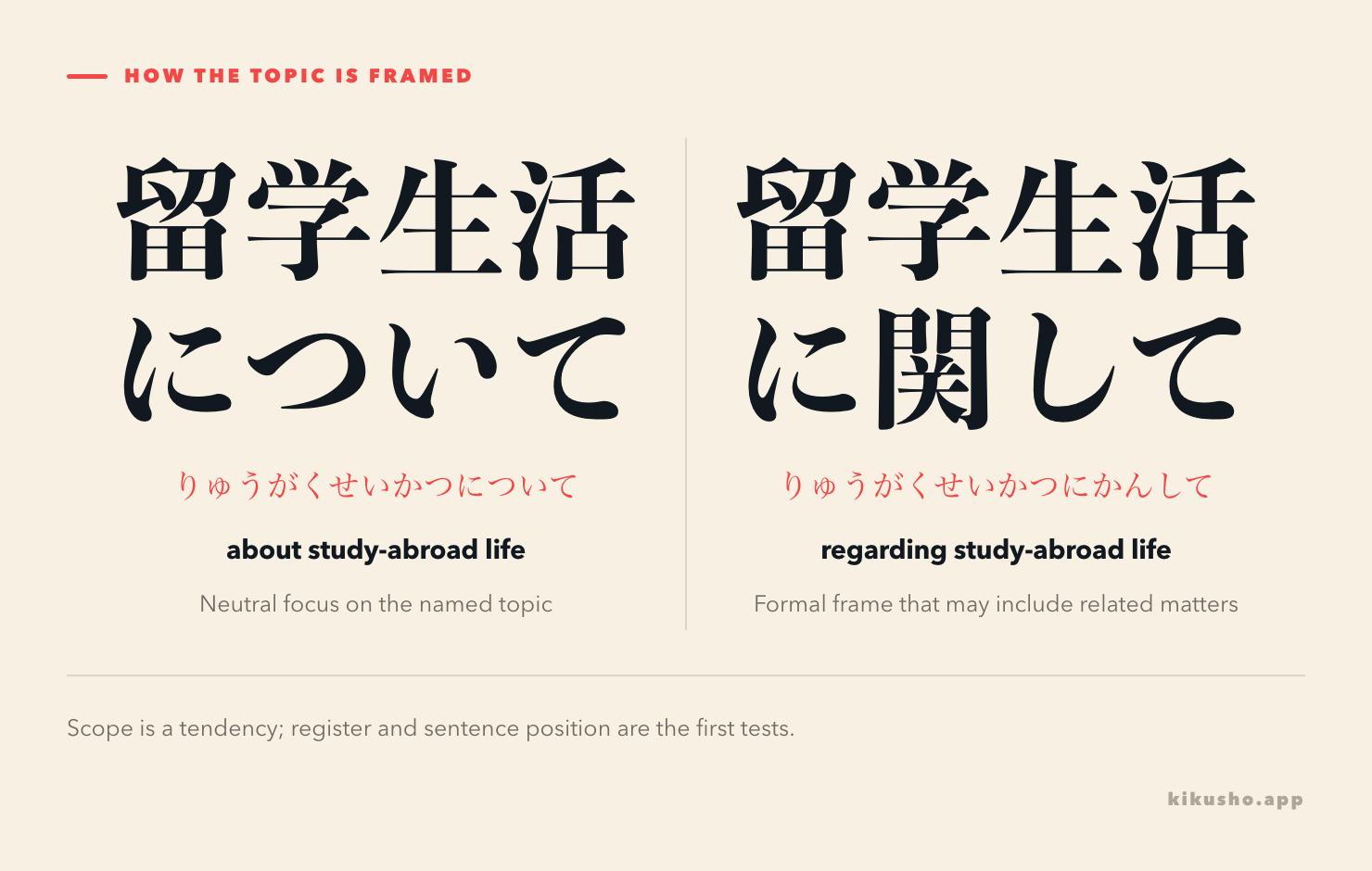
Do not turn this tendency into a ban on substitution. With verbs such as 説明する, 調べる, 話す, and 質問する, both forms are often possible. The intended tone and the surrounding text decide which one sounds better. In casual conversation, について is usually the unmarked choice.
This also separates the pair from にかけては. 料理について話す means “talk about cooking,” whereas 料理にかけては姉が一番だ evaluates the sister as outstanding in that field. The lesson on にかけては and range expressions follows that evaluative use.
Before a noun, one family needs の
The neutral family uses についての before a noun:
防災についての本
a book about disaster preparedness
入学手続きについての説明
an explanation about enrollment procedures
The formal family normally uses に関する directly:
防災に関する本
a book concerning disaster preparedness
入学手続きに関する説明
an explanation regarding enrollment procedures
This is where learners often mix the two patterns. について本 is missing の, while に関するの本 has an extra の. Keep the two complete chunks together:
| Complete chunk | What follows |
|---|---|
| について | a clause |
| についての | a noun |
| に関して | a clause |
| に関する | a noun |
You may encounter に関しての + noun, and the Japan Foundation records it in an example. For production and JLPT questions, に関する + noun is the clearest standard choice. Recognize the longer variant without making it your default.
These markers do not express a target or a judgment
English “regarding” can hide several Japanese relationships. について and に関して name content. They do not replace a marker that points an action or attitude toward someone.
新しい規則について説明しました。
I explained the new rule.
参加者の質問に対して答えました。
I answered the participants' questions.
In the first sentence, the rule is the content of the explanation. In the second, the answer is directed at the questions. 質問について答える can sound like speaking generally about the subject of the question; 質問に答える or 質問に対して答える identifies what receives the answer.
The forms also differ from the expectation judgments in に反して and にしては. 予想に反して means that reality contradicts the forecast. 予想について only makes the forecast a topic.
Practice: choose all seven before checking
Question 1. Complete the neutral conversation: 日本の働き方__友達と話しました。
- ア. について
- イ. に関する
- ウ. についての
- エ. に反して
Question 2. Choose the standard formal form before a noun: 環境問題__報告書を読みました。
- ア. に関して
- イ. について
- ウ. に関する
- エ. に関するの
Question 3. Complete the neutral form before a noun: 留学__説明会に参加しました。
- ア. について
- イ. についての
- ウ. に関して
- エ. に関するの
Question 4. A company notice needs a formal “We will contact you regarding that matter.” Choose the best sentence.
- ア. その件に関して、ご連絡いたします。
- イ. その件に関する、ご連絡いたします。
- ウ. その件についての、ご連絡いたします。
- エ. その件に反して、ご連絡いたします。
Question 5. Which sentence has an attachment error?
- ア. 安全について話し合いました。
- イ. 安全についての資料を読みました。
- ウ. 安全に関する資料を読みました。
- エ. 安全に関する話し合いました。
Question 6. Rewrite 学校の規則に関して説明を聞きました in a more neutral conversational style without changing the topic.
Question 7. Complete both blanks with the standard forms.
会社は新しい制度( ① )調査を行い、制度( ② )報告書を発表した。
- ア. ① に関して / ② に関する
- イ. ① に関する / ② に関して
- ウ. ① についての / ② について
- エ. ① に反して / ② にしては
Answers and explanations
Answer 1: ア, について. A clause ending in 話しました follows, and an ordinary conversation calls for the neutral topic marker. に関する must have a noun after it.
Answer 2: ウ, に関する. 報告書 is a noun, so the formal family takes に関する directly before it. に関して would introduce a following clause instead.
Answer 3: イ, についての. 説明会 is a noun. The neutral family therefore needs の: 留学についての説明会.
Answer 4: ア. に関して introduces the formal clause ご連絡いたします. に関する needs a following noun, and についての cannot stand before the comma without a noun.
Answer 5: エ. 話し合いました is a verb, so に関する cannot attach to it. Say 安全に関して話し合いました for a formal tone or 安全について話し合いました neutrally.
Answer 6: 学校の規則について説明を聞きました。 Both versions identify the school rules as the explanation's topic. について removes the more formal framing without changing the basic content.
Answer 7: ア. 会社は新しい制度に関して調査を行い、制度に関する報告書を発表した。 に関して introduces the survey clause; に関する directly modifies the noun 報告書.
Both construction families are commonly listed at N3, including by Bunpro and JLPT Sensei. That label is a study guide rather than an official exhaustive JLPT syllabus: the present lesson covers the topic-marker senses recorded for に関する/に関して and について, not every expression that can translate as “about.”
Common questions
What is the difference between に関して and について?
Both mark a topic. について is the neutral everyday choice, while に関して is more formal and can frame the topic together with related matters. Context often matters more than the English translation.
What comes before a noun: に関する or に関して?
Use に関する directly before a noun, as in 安全に関する資料. Use に関して when another clause follows. に関しての occurs, but に関する is the standard exam-safe form before a noun.
Can について modify a noun?
Yes, but it needs の: 安全についての資料. The parallel formal pattern is 安全に関する資料, without の.