On this page
にわたって means “across,” “over” or “throughout” an extensive span. Use it when the duration, area, distance, number of occasions or range of fields is itself part of the point.
調査は三年間にわたって行われた。
ちょうさは さんねんかんに わたって おこなわれた。
The survey was conducted over three years.
The sentence does more than locate the survey inside a three-year period. It presents those three years as the scale occupied by the activity.
Ask whether the span deserves to be measured
The noun before にわたって names an extent. If you can naturally answer “How long?”, “How far?”, “How wide?”, “How many occasions?” or “Across how many fields?”, the pattern may fit.
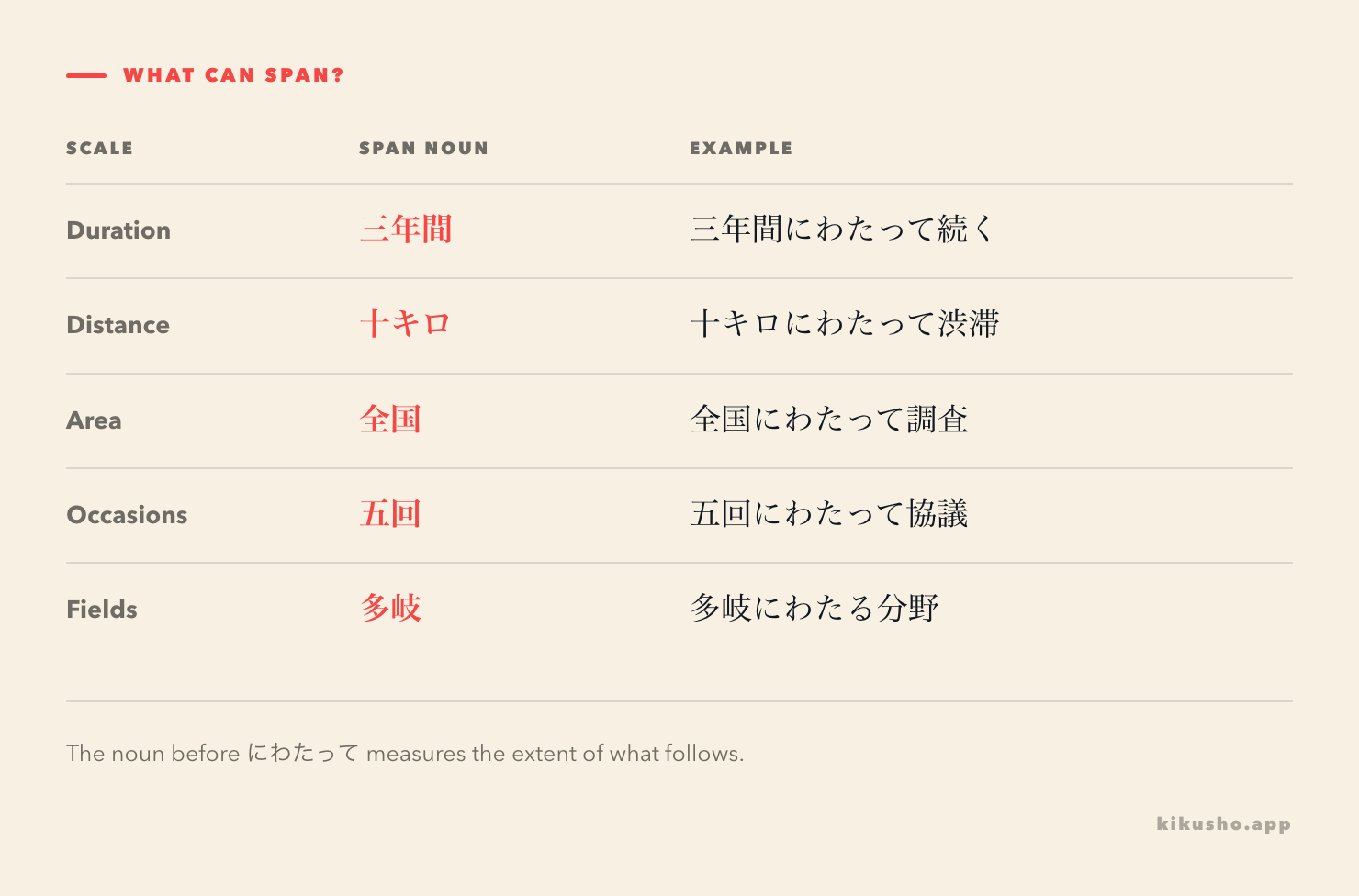
| Kind of span | Typical noun | Example frame |
|---|---|---|
| duration | 三年間, 長年, 数か月 | 三年間にわたって続く |
| distance | 十キロ, 数百メートル | 十キロにわたって渋滞する |
| area | 全国, 全域, 広範囲 | 全国にわたって調査する |
| occasions | 五回, 数回 | 五回にわたって協議する |
| fields or parts | 多岐, 全項目 | 多岐にわたって活躍する |
The construction usually carries a sense of breadth, length or repeated scope. 一分にわたって話した is grammatically interpretable, but it sounds marked unless one minute is unusually long in that context. A public warning, a moment of silence or a broadcasting limit could make the scale relevant.
Bunpro’s にわたって reference places the pattern at N2 and describes a span that extends over a period or area. A Japanese-language-school lesson independently defines it through long time and wide range and records duration, place, field and count examples.
Attach the form to a noun of extent
The basic attachment is N + にわたって. The noun must name the span itself, not the event that happens within it.
道路は約五キロにわたって渋滞していた。
どうろは やく ごキロに わたって じゅうたいしていた。
Traffic was backed up for approximately five kilometers.
大雨は地域全体にわたって被害をもたらした。
おおあめは ちいきぜんたいに わたって ひがいを もたらした。
The heavy rain caused damage across the entire region.
委員会は六回にわたって案を検討した。
いいんかいは ろっかいに わたって あんを けんとうした。
The committee examined the proposal over six meetings.
The count example matters because the activity need not be literally continuous. Six meetings contain gaps, yet together they make an extended series. The pattern measures the whole series rather than promising that discussion never stopped.
The written form に渡って exists, reflecting the verb 渡る, “to cross,” but grammar references and contemporary teaching materials often write the fixed construction in hiragana. Follow the source or house style you are reading; do not treat the kanji as a different grammar point.
Choose にわたって, にわたり or にわたる by syntax
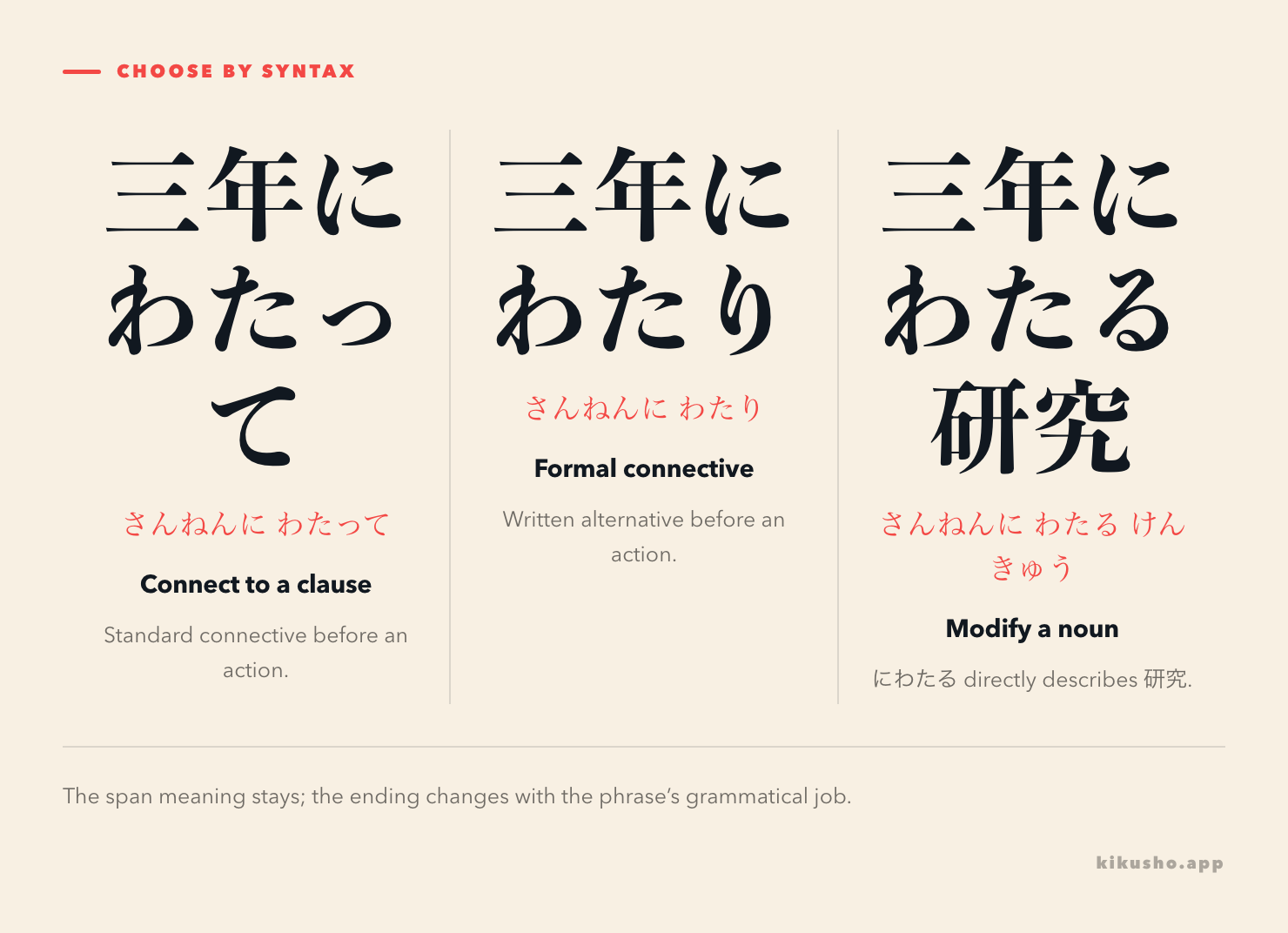
Three surface forms share the same span meaning but occupy different positions.
- Nにわたって + clause is the standard connective.
- Nにわたり + clause is a more formal written connective.
- Nにわたる + noun modifies the noun that follows.
二週間にわたって、各地で聞き取りを行った。
にしゅうかんに わたって、かくちで ききとりを おこなった。
Over two weeks, we conducted interviews in several locations.
二週間にわたり、各地で聞き取りを行った。
にしゅうかんに わたり、かくちで ききとりを おこなった。
Over a period of two weeks, we conducted interviews in several locations.
二週間にわたる調査が終了した。
にしゅうかんに わたる ちょうさが しゅうりょうした。
The two-week survey ended.
The third sentence needs にわたる because the phrase directly describes 調査. 二週間にわたって調査 cannot simply stand before a noun as though the connective were an adjective.
At the end of a sentence, the verb can carry tense:
交渉は三時間にわたった。
こうしょうは さんじかんに わたった。
The negotiations lasted three hours.
This finite にわたった completes the predicate. A past modifier is also possible when the described span is viewed as completed, but Nにわたる + noun is the safest general noun-modifying frame for study.
にほんご部’s teacher materials list Nにわたって/にわたり/にわたるN and apply them to long periods, wide places and many repetitions. The pattern is productive, but the form still has to match its syntactic job.
Time is only one kind of range
Learners often memorize “for a long time” and then miss spatial or abstract examples.
台風の影響は西日本全域にわたった。
たいふうの えいきょうは にしにほんぜんいきに わたった。
The typhoon’s effects extended throughout all of western Japan.
彼女は教育、福祉、環境など多岐にわたる分野で活動している。
かのじょは きょういく、ふくし、かんきょうなど たきに わたる ぶんやで かつどうしている。
She works in a wide range of fields, including education, welfare and the environment.
多岐にわたる is a common collocation. 岐 means a branch or fork, so the phrase presents a subject as branching into many areas. Other useful combinations include 広範囲にわたる, 全国にわたる, 数世代にわたる and 全項目にわたる.
A linguistic study of Nにわたって analyzes the noun as a range whose extent is presented as large, including periods, counts and places. That scale component explains why an arbitrary event noun cannot occupy the slot. 会議にわたって話した is wrong for “spoke throughout the meeting”; 会議の三日間にわたって話し合った names the measurable duration.
Distinguish extent from continuity and endpoints
Several expressions can be translated with “throughout,” but they point the reader toward different features.
三日間にわたって会議が行われた。
The meeting extended over three days.
三日間を通して議論が続いた。
The discussion continued throughout the three days.
The first measures the event’s duration. The second looks through the entire period and stresses that the discussion persisted within it. The dedicated comparison of を通じて and を通して develops that continuity distinction.
から~にかけて names a range between endpoints and can leave their exact boundary loose:
関東から東北にかけて雪が降るでしょう。
Snow is expected from Kanto through Tohoku.
関東から東北にわたって can also describe a broad geographical span, but it views the named stretch as the extensive area covered. The lesson on から~にかけて explains why endpoint ranges do not always make the same whole-span claim.
Plain 間 only locates something within a period unless the sentence adds a stronger continuity or scale claim. Compare 三年間日本にいた, which simply gives the duration, with 三年間にわたって調査を続けた, which presents the length of sustained work as noteworthy.
Read outward from the span noun
In a long sentence, first box the extent noun and the form that follows it. Then decide what the phrase modifies.
- 五回にわたって協議した: the span modifies the action 協議した
- 五回にわたり協議した: the same relation in a more formal connective
- 五回にわたる協議: the span modifies the noun 協議
- 協議は五回にわたった: the span completes the predicate
When you save an example in Kikusho, keep both the measuring noun and the measured event. 数年にわたる alone leaves the scale without a target. 数年にわたる復旧工事 preserves the grammar as a relation you can recall.
The curriculum, JLPT Sensei and Bunpro place this construction at N2, with no disagreement recorded for this item. The JLPT itself does not publish an exhaustive current grammar list, so the level remains a source-backed study estimate.
Practice: identify the span and its target
Question 1 · duration
Complete: 研究チームは十年( )、この病気を調べてきた。
- A. にわたって
- B. について
- C. に際して
- D. に限って
Question 2 · project label
Select the Japanese wording that directly describes a project as spanning three years.
- A. 三年間にわたってプロジェクト
- B. 三年間をわたるプロジェクト
- C. 三年間にわたるプロジェクト
- D. 三年間にわたりのプロジェクト
Question 3 · repeated occasions
Complete: 交渉は計七回( )行われた。
- A. にわたって
- B. の間だけ
- C. に沿って
- D. を通じる
Question 4 · extent or continuity
Which sentence most directly emphasizes that the festival itself occupied a five-day span?
- A. 五日間について祭りが開かれた。
- B. 五日間にわたって祭りが開かれた。
- C. 五日間に際して祭りが開かれた。
- D. 五日間につき祭りが開かれた。
Question 5 · formal connective
Replace the underlined form without changing the span relation: 四か月にわたって、調査を実施した。
- A. 四か月にわたり、調査を実施した。
- B. 四か月にわたる、調査を実施した。
- C. 四か月をわたり、調査を実施した。
- D. 四か月にわたった調査を実施する。
Question 6 · wrong span noun
Which sentence needs correction because the noun before にわたって does not name the intended extent?
- A. 道路は二キロにわたって渋滞している。
- B. 会議にわたって三日間話し合った。
- C. 被害は広い地域にわたって確認された。
- D. 委員会は五回にわたって協議した。
Decide what is being measured in every sentence before opening the explanations.
Answers and explanations
Reading question 1
A. にわたって. 十年 names the long duration occupied by the research. The other choices mark a topic, an occasion or an exceptional case rather than an extensive span.
Reading question 2
C. 三年間にわたるプロジェクト. にわたる directly modifies プロジェクト. にわたって and にわたり connect to a following clause, and 渡る does not take を in this grammar frame.
Reading question 3
A. にわたって. Seven occasions form the extended series over which the negotiations were held. The pattern can measure repeated events even though gaps exist between them.
Reading question 4
B. 五日間にわたって祭りが開かれた. The phrase makes the festival’s five-day extent salient. The other connectors express a topic, an occasion or a per-unit relation.
Reading question 5
A. 四か月にわたり、調査を実施した. にわたり is the formal connective counterpart of にわたって. B incorrectly places the noun-modifying form before a clause, while C has the wrong particle and D changes the syntax and tense.
Reading question 6
B. 会議にわたって三日間話し合った. 会議 names the event, not the intended measure. Say 三日間にわたって会議で話し合った or another sentence in which the span noun directly precedes にわたって.
Common questions
What does にわたって mean in Japanese?
にわたって means across, over or throughout an extensive span. It highlights the scale of a duration, area, distance, number of occasions or field.
What is the difference between にわたって and にわたる?
Nにわたって or the formal Nにわたり connects to a following clause. Nにわたる directly modifies another noun, as in 三年間にわたる研究.
How is にわたって different from を通して?
にわたって foregrounds how long, wide or numerous the span is. を通して looks through the whole period and often foregrounds continuity within it.