On this page
恐れがある(おそれがある) states that an unwanted event may occur and that the risk deserves attention. Its home is formal reporting: weather alerts, safety notices, medical explanations and decisions supported by visible conditions.
The sentence reports a risk rather than a feeling
The noun 恐れ can refer to fear, but the fixed construction does not primarily describe someone feeling afraid. It assesses a possible result.
このまま雨が続くと、川が氾濫する恐れがあります。
このまま あめが つづくと、かわが はんらんする おそれが あります。
If the rain continues, there is a risk that the river will flood.
The speaker does not say “I am scared.” The continuing rain supplies a basis, and the sentence identifies flooding as the adverse possibility. This distance gives 恐れがある its official, measured tone.
Compare a direct emotion:
子どもは雷を怖がっている。
こどもは かみなりを こわがって いる。
The child is afraid of thunder.
That sentence reports fear as a person's reaction. A weather bulletin could instead say 落雷の恐れがあります, “There is a risk of lightning.” The person disappears; the risk remains.
| What the sentence does | Natural form |
|---|---|
| reports a serious possible outcome | V / Nの + 恐れがある |
| describes a person's fear | 怖い, 怖がる, Nを恐れる |
| raises a neutral possibility | 可能性がある, かもしれない |
Verbs attach in the dictionary or negative form
A nonpast verb goes directly before 恐れがある. The outcome may be an event that happens or a needed event that fails to happen.
この電池は高温になると、発火する恐れがあります。
この でんちは こうおんに なると、はっかする おそれが あります。
This battery may catch fire if it becomes hot.
道路が混雑すると、開始時刻に間に合わない恐れがあります。
どうろが こんざつすると、かいしじこくに まにあわない おそれが あります。
If the roads are congested, there is a risk of not arriving by the start time.
| Outcome shape | Attachment | Example |
|---|---|---|
| something may happen | V dictionary form + 恐れがある | 漏れる恐れがある |
| something may fail to happen | Vない + 恐れがある | 届かない恐れがある |
| formal polite ending | 恐れがあります | 事故が起きる恐れがあります |
The negative belongs to the risky outcome. 届かない恐れがある means that non-arrival is the risk. This differs from denying the risk itself:
現在、津波の恐れはありません。
げんざい、つなみの おそれは ありません。
At present, there is no risk of a tsunami.
In the first pattern, ない sits inside the clause before 恐れ. In the second, ありません negates the existence of 恐れ. Reading from the end alone hides that difference.
A noun needs の
When the hazard is named as a noun, connect it with の.
この薬には副作用の恐れがあります。
この くすりには ふくさようの おそれが あります。
This medicine carries a risk of side effects.
濡れた手で触ると、感電の恐れがあります。
ぬれた てで さわると、かんでんの おそれが あります。
Touching it with wet hands carries a risk of electric shock.
On a compact warning label, ある may disappear:
感電のおそれあり
かんでんの おそれ あり
Risk of electric shock.
This is compressed written language, not an ordinary conversational ending. The full 感電の恐れがあります is safer when producing a complete sentence.
The phrase can also modify a noun with 恐れのある:
発火する恐れのある製品を回収します。
はっかする おそれの ある せいひんを かいしゅうします。
We will recall products that may catch fire.
The embedded risk clause ends at ある; 製品 is the noun it modifies. This pattern appears often in product recalls and administrative descriptions.
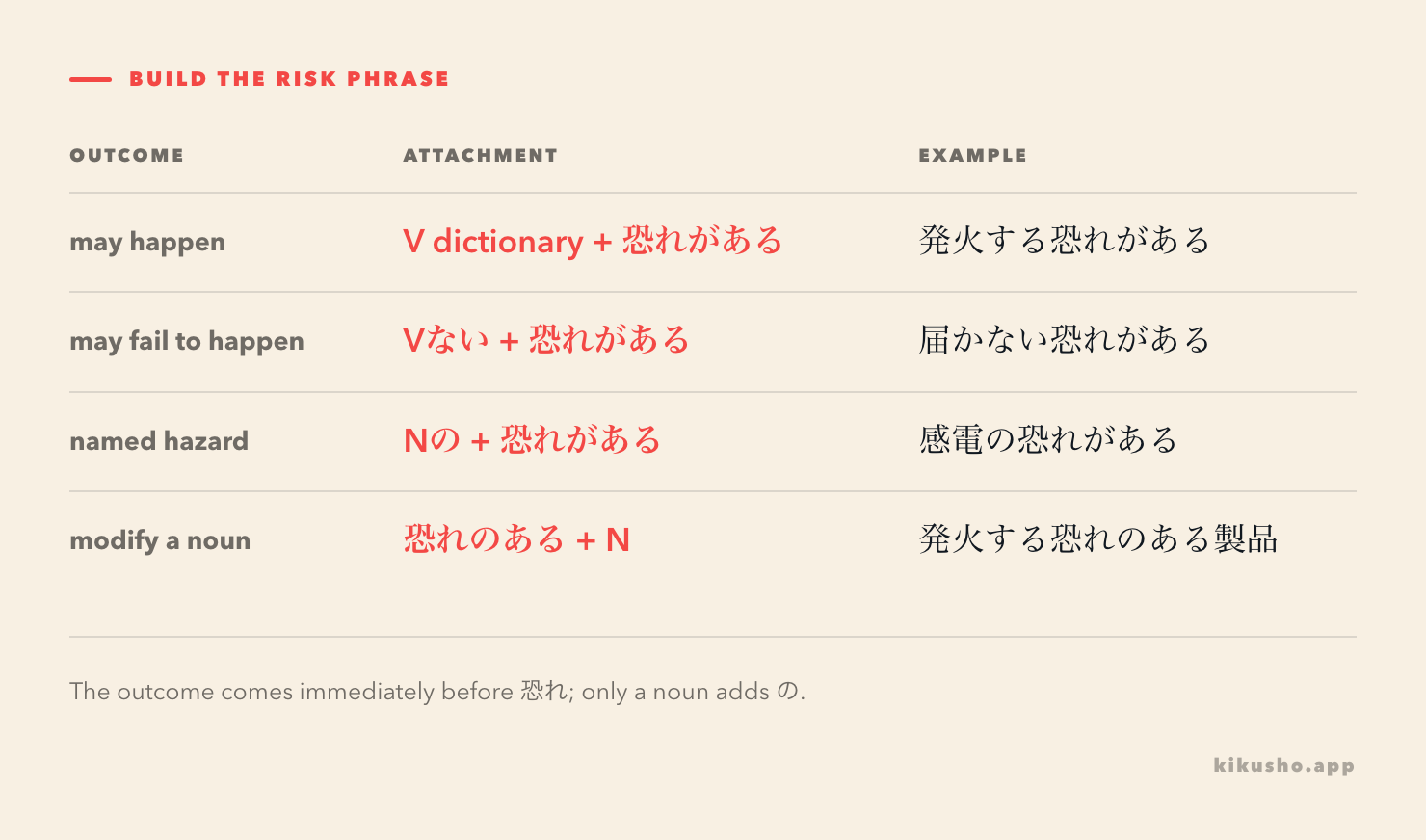
MLC Japanese Language School confirms the verb dictionary and negative forms, noun + の, the formal register and the frequent use in news and notices. Bunpro independently places the construction at N2 and documents its broader plain-form attachment. The JLPT does not publish an exhaustive item-by-item grammar list, so N2 remains a source-backed study estimate.
The outcome must be unwanted in this context
恐れがある does more than say “maybe.” It frames the possibility as damage, danger, failure or another result that the writer wants to prevent.
気温が下がり、路面が凍結する恐れがあります。
きおんが さがり、ろめんが とうけつする おそれが あります。
Temperatures will fall, and there is a risk that the road surface will freeze.
この情報を公開すると、個人が特定される恐れがあります。
この じょうほうを こうかいすると、こじんが とくていされる おそれが あります。
Publishing this information could lead to an individual being identified.
The grammar does not carry a permanent list of bad verbs. Context supplies the evaluation. 雨が降る is unwelcome for an outdoor event but welcome during a drought; 雨が降る恐れがある works when the surrounding situation treats rain as a problem. Without that adverse frame, 雨が降る可能性がある is neutral.
Tanosuke's N2 teaching reference gives the dictionary and negative verb attachments, noun + の, and the restriction to an unwelcome event. Its examples also place the form in forecasts, news and notifications. JLPT Sensei records the reading and the same N2 placement.
恐れがある and かねない overlap without matching
Both forms warn about an adverse possibility:
この説明では、利用者が誤解する恐れがある。
With this explanation, there is a risk that users will misunderstand.
この説明では、利用者の誤解を招きかねない。
This explanation could cause users to misunderstand.
The first packages misunderstanding as a risk assessed in a report-like voice. The second attaches directly to 招く and sounds like a warning about what this wording could lead to.
| Point | 恐れがある | かねない |
|---|---|---|
| core view | there is a risk of outcome X | subject could do or cause X |
| attachment | V dictionary / Vない / Nの | Vます-stem |
| register | formal, objective, notice-like | formal warning or judgement |
| useful shape | 事故が起きる恐れがある | 事故を起こしかねない |
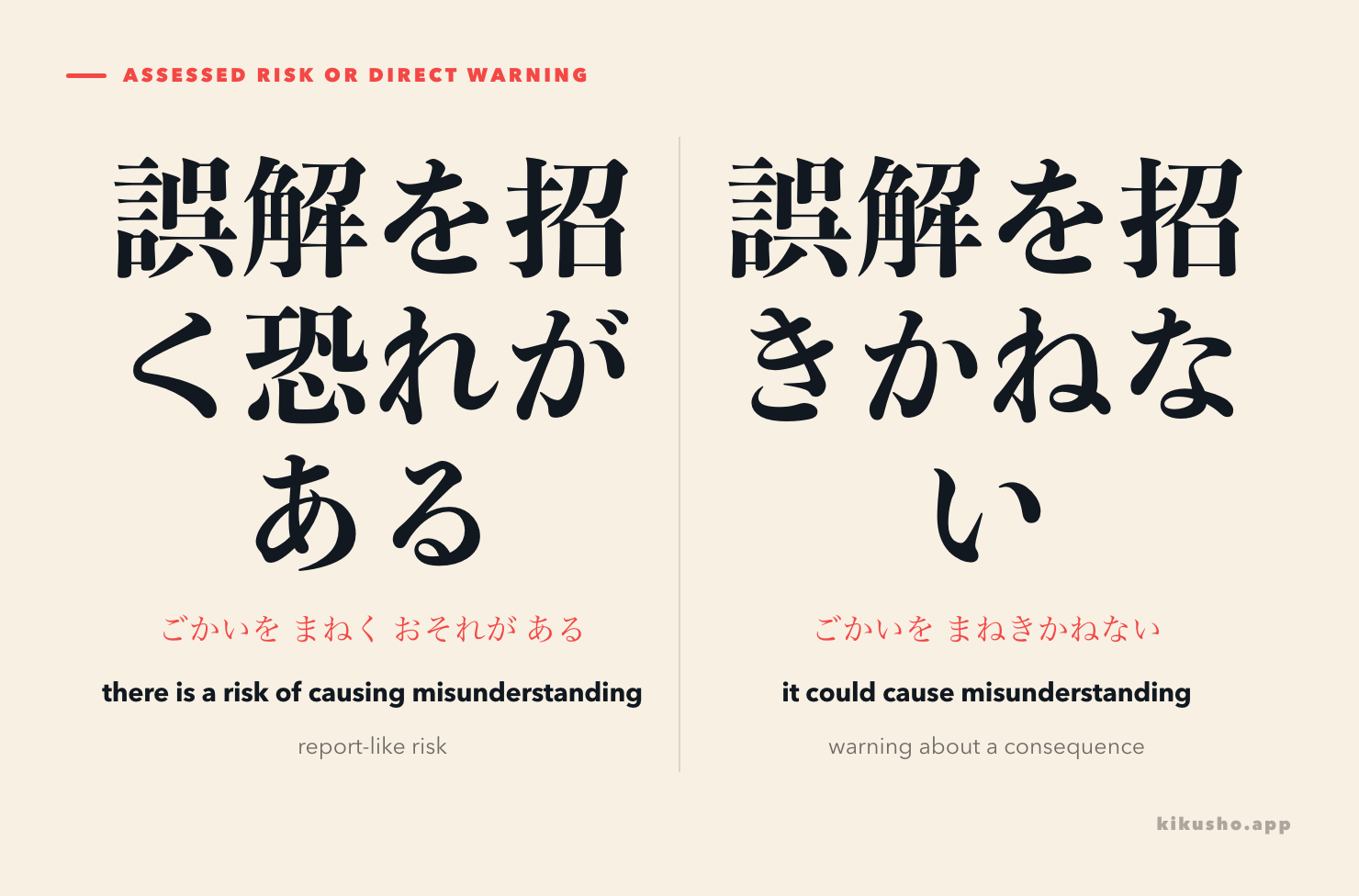
The overlap is real, so context does not always force one answer. Attachment often settles an exam blank first. 起きる恐れがある uses the dictionary form; 起きかねない uses the ます-stem 起き. A noun works directly with the first, as in 事故の恐れがある, but cannot simply take かねない.
The dedicated かねる and かねない lesson develops that form's ます-stem and its contrast with polite refusal. Here it serves only as the boundary of 恐れがある, not as a second inventory item.
Caution language supplies the evidence
A strong 恐れがある sentence usually contains a condition, observation or affected object. That material turns an abstract risk into a useful warning.
換気をしないと、室内の二酸化炭素濃度が高くなる恐れがあります。
Without ventilation, indoor carbon dioxide levels may rise.
保存方法を守らない場合、品質が低下する恐れがあります。
If the storage instructions are not followed, the quality may deteriorate.
The constructions before the comma explain why the warning exists. This evidence-based shape is one reason 恐れがある sounds natural in instructions and technical prose. In casual conversation, 悪くなるかもしれない may carry enough formality; an official notice needs a clearer risk frame.
Do not confuse the construction with 恐れ入りますが, a set polite preface meaning roughly “I am sorry to trouble you, but…”. The shared kanji does not give the two expressions the same syntax or purpose.
For a Kikusho card, capture the condition with the warning. 品質が低下する恐れがある records the outcome, while 保存方法を守らない場合 supplies the reason the sentence belongs on a label. Keeping both clauses makes the register and the risk relationship retrievable together.
Practice: trace the risk before checking the key
Question 1 — attach the noun. Complete この薬には副作用__恐れがあります.
- が
- の
- を
- に
Question 2 — locate the negative. Which sentence means “There is a risk that the package will not arrive today”?
- 荷物が今日届く恐れはない。
- 荷物が今日届かない恐れがある。
- 荷物が今日届かない恐れはない。
- 荷物が今日届く恐れがないことはない。
Question 3 — choose the register. A manufacturer is recalling a battery because it may catch fire. Complete バッテリーが発火する__、製品を回収します with the most suitable formal risk expression.
- つもりがあるため
- 恐れがあるため
- ことにしたため
- わけがないため
Question 4 — compare the frames. Explain the attachment and viewpoint difference between 誤解を招く恐れがある and 誤解を招きかねない.
Question 5 — text grammar. Read: 強い雨が続いています。このままでは川の水位が上がり、住宅地が浸水する__。低い土地では早めに避難してください。 Supply the missing formal warning.
Question 6 — write the notice. Use 保存方法を守らない, 品質, 低下する and 恐れがある to warn that failure to follow the storage instructions may reduce quality.
Answers and explanations
Answer 1: 2, の. A noun attaches as Nの恐れがある, giving 副作用の恐れがあります. The other particles do not connect the named hazard to 恐れ in this construction.
Answer 2: 2. In 届かない恐れがある, the negative belongs to 届く: non-arrival is the possible adverse outcome. Choice 1 denies the risk of arrival, choice 3 denies the risk of non-arrival, and choice 4 creates an unnecessary double negative.
Answer 3: 2, 恐れがあるため. A possible battery fire is the objective adverse risk that motivates the recall. The other choices express intention, decision or impossibility rather than a warning supported by the product condition.
Answer 4. 招く恐れがある uses the dictionary form 招く and packages misunderstanding as a formally assessed risk. 招きかねない uses the ます-stem 招き and warns that the subject could cause that result. Both can fit the same situation, but their attachment and viewpoint differ.
Answer 5. 住宅地が浸水する恐れがあります. Continuing heavy rain and rising water provide the evidence; flooding is the unwanted outcome, and the evacuation instruction confirms the formal warning register.
Answer 6. One natural version is 保存方法を守らないと、品質が低下する恐れがあります。 The condition precedes the comma, and 低下する attaches in the dictionary form before 恐れがあります.
Common questions
What does 恐れがある mean?
恐れがある means that there is a risk or concern that an unwanted outcome may occur. It is a formal expression common in news reports, official notices, product warnings and explanations based on observable circumstances.
How does 恐れがある attach?
Use a dictionary-form or negative-form verb directly before 恐れがある, as in 発火する恐れがある and 間に合わない恐れがある. A noun takes の, as in 感電の恐れがある.
What is the difference between 恐れがある and かねない?
Both warn of an undesirable possibility. 恐れがある presents the risk in an objective, report-like frame and can follow a noun or a verb. かねない follows a verb's ます-stem and more readily sounds like the speaker's warning about what a person, action or situation could lead to.
Can 恐れがある describe a good outcome?
Normally no. The construction presents the possibility as harmful, worrying or otherwise unwanted in context. Use 可能性がある or かもしれない for a neutral possibility.