On this page
~かねる means “cannot” or “find it difficult to,” often in a polite refusal. ~かねない means “might well” or “could,” usually warning of an unwanted result; its ない does not simply cancel the first meaning. Both follow a verb’s ます-stem, so the ending, not the stem, tells you which message the sentence sends.
Ask whether the clause declines an action or warns of a result
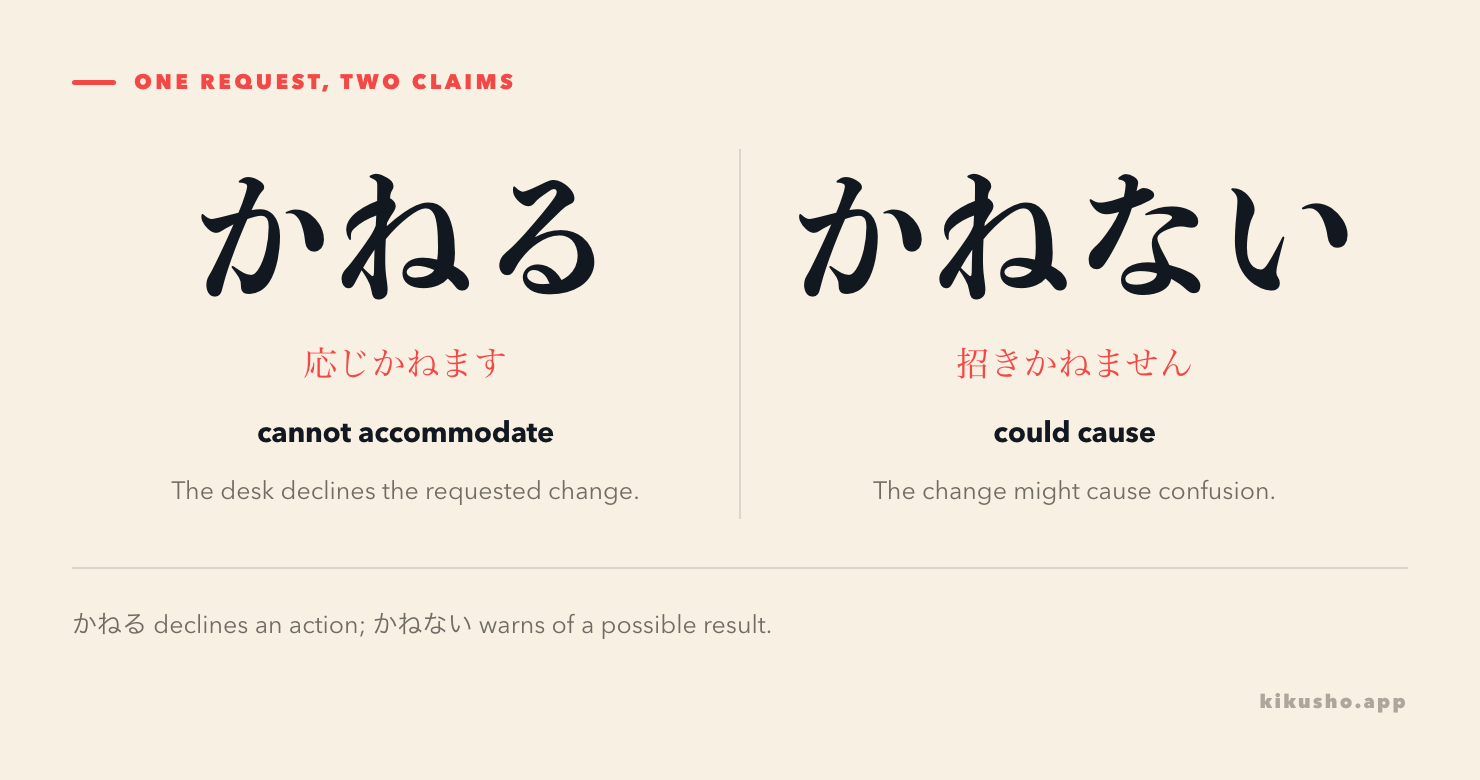
Imagine a service desk replying to a request for a last-minute change:
その変更には応じかねます。
そのへんこうには おうじかねます。
We cannot accommodate that change.
The desk is declining its own action, 応じる (“accommodate”). A second line can explain why:
直前の変更は混乱を招きかねません。
ちょくぜんの へんこうは こんらんを まねきかねません。
A last-minute change could cause confusion.
The change is the subject of 招く (“bring about”). Nobody is declining to cause confusion: the writer is warning that confusion is possible. In connected text, identify whose action is at issue before translating the ending.
| Ending after the ます-stem | Meaning here | Typical setting | Form and reading |
|---|---|---|---|
| ~かねる / ~かねます | Cannot or finds it difficult to act | Considered decision; often a formal refusal | 応じかねます(おうじかねます) |
| ~かねない / ~かねません | Might act or cause a result; often unwelcome | Warning or risk assessment | 招きかねません(まねきかねません) |
The Bunpro page for ~かねる and its ~かねない page give the ます-stem attachment and opposing senses. JLPT Sensei’s ~かねる lesson and ~かねない lesson independently describe the central distinction. The risk ending usually concerns an unwelcome outcome; it is not an absolute “bad things only” rule.
Keep the ます-stem when the meaning turns
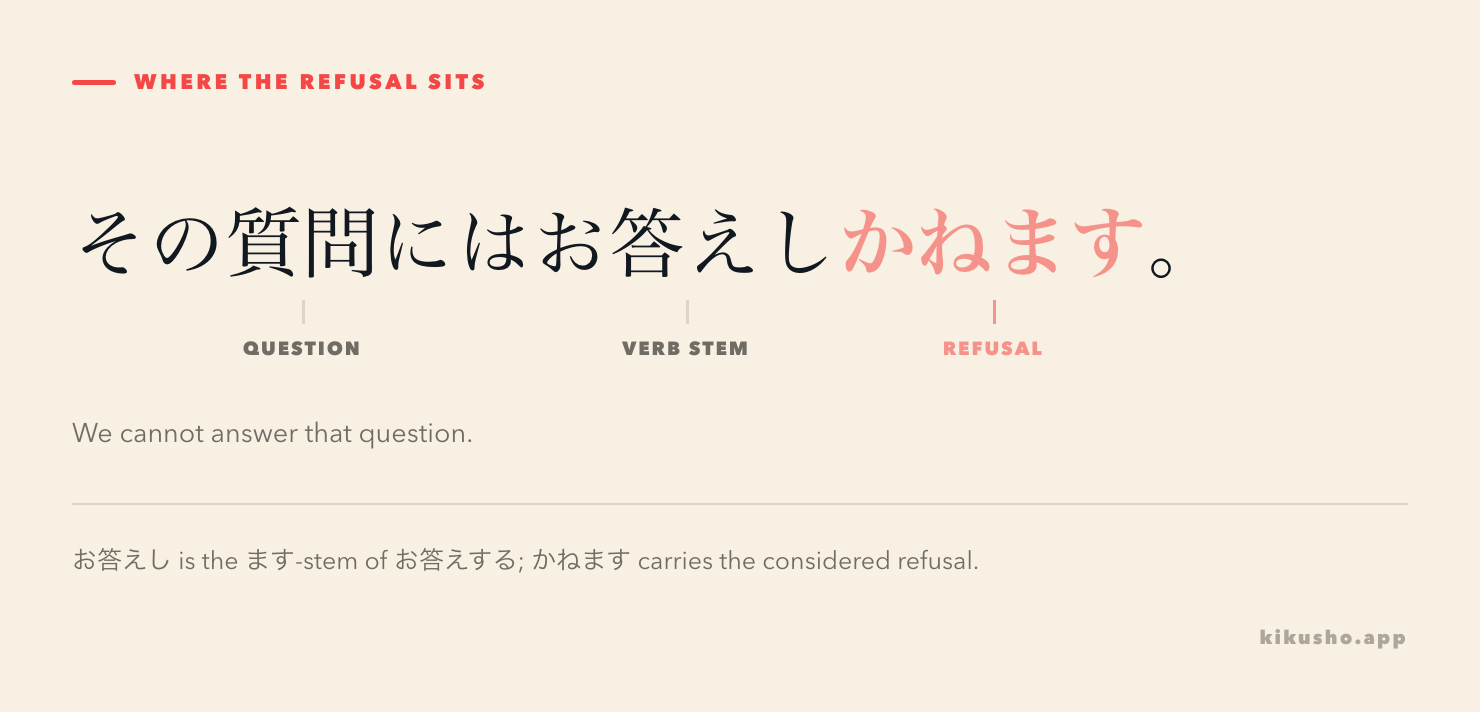
Remove ます from the polite verb before adding either ending. 答える becomes 答えます, then 答えかねます; 招く becomes 招きます, then 招きかねません. The verb-group guide explains how to find the stem.
| Dictionary form | ます-form | Stem | Refusal/difficulty | Risk/possibility |
|---|---|---|---|---|
| 答える(こたえる) | 答えます | 答え | 答えかねます | 答えかねません |
| 招く(まねく) | 招きます | 招き | 招きかねます | 招きかねません |
The last two columns demonstrate form, not a recommendation to use every combination in a notice. A desk may decline to answer, while a change may cause trouble. Choose a natural verb and situation first, then attach the ending.
~かねる has a decision or difficulty behind the refusal
この資料だけでは判断しかねます。
このしりょうだけでは はんだんしかねます。
I cannot make a judgment from this document alone.
The speaker does not lack the physical ability to judge. The available material does not support a responsible decision. その質問にはお答えしかねます(そのしつもんには おこたえしかねます)similarly declines to answer a particular question. JLPT Sensei also gives 決めかねている, a person who is still unable to decide, so the pattern is wider than customer-service replies.
できない is broader. A broken printer gives you 印刷できません, a direct statement of inability to print. A proposed change can elicit 応じかねます, the speaker’s considered limit. Calling every ~かねる “polite できない” loses that difference.
~かねない raises a possibility you want to avoid
確かめずに公開すると、誤解を招きかねません。
たしかめずに こうかいすると、ごかいを まねきかねません。
Publishing it without checking could cause a misunderstanding.
The clause before the comma gives the condition; ~かねません evaluates the possible consequence. It does not say misunderstanding will happen. The writer sees a risk worth mentioning, but the outcome remains open. Bunpro and JLPT Sensei both use this possibility sense with negative consequences in their linked ~かねない lessons.
An ordinary negative reverses the meaning: 混乱を招きません says “it does not cause confusion”; 混乱を招きかねません says “it could cause confusion.” In a notice, that difference can reverse the reader’s understanding of a proposed action.
The same situation allows two claims, not two translations
The service-desk pair illustrates the overlap: a request is declined because the change may cause trouble. ~かねる names the desk’s limit; ~かねない names the possible result. The endings do not substitute for one another while preserving the claim.
This is N2 grammar in the Kikusho curriculum, with a level-label caveat. Bunpro and JLPT Sensei put both forms on N2 pages, while N1et’s teaching comparison places ~かねる at N3. The JLPT FAQ leaves learners without a complete official catalogue of grammar points for each level. The prerequisite is the ます-stem; the skill at either level is reading a refusal and a warning as different claims.
If you save a real reply in Kikusho, keep the whole sentence on the card. The subject and possible consequence tell you why ~かねない is a warning, while a register note preserves where ~かねます suited a desk reply. The formal connectors lesson helps you read the rest of a notice around it.
Practice: choose the claim each sentence needs
Try all six questions before opening the answer section.
Question 1
A staff member has only one page of an application and cannot decide yet. Choose the ending.
この一枚だけでは、合否を判断し___。
- A. かねます
- B. かねません
- C. ません
Question 2
A notice warns that an unchecked translation may mislead readers. Choose the ending.
訳を確認せずに載せると、読者の誤解を招き___。
- A. かねます
- B. かねません
- C. ません
Question 3
Build a formal reply meaning “We cannot accommodate that request at present.” Use every piece once.
現時点では ・ そのご依頼には ・ 応じ ・ かねます
Question 4
Build a warning meaning “If this is left as it is, it could cause confusion.” Use every piece once.
このままにすると ・ 混乱を ・ 招き ・ かねません
Question 5
Read the two-sentence memo, then choose the interpretation.
追加の情報がないため、その質問にはお答えしかねます。推測で説明すると、誤解を招きかねません。
- A. The writer can answer now and promises there will be no misunderstanding.
- B. The writer declines to answer and warns that guessing could mislead.
- C. The writer says it is impossible for anyone to misunderstand.
Question 6
A manager writes この案は混乱を招きかねません in a report. Which replacement would turn the warning into a statement that confusion does not result?
- A. この案は混乱を招きません。
- B. この案は混乱を招きかねます。
- C. この案は混乱を招きかねない。
Answers and explanations
Answer 1
A: かねます. 判断しかねます(はんだんしかねます)presents the staff member’s present difficulty deciding from one page. B says a judgment might occur, often with an unwelcome implication. C makes 判断しません, a direct choice not to judge, without the stated difficulty.
Answer 2
B: かねません. 誤解を招きかねません(ごかいを まねきかねません)warns that an unchecked translation may cause misunderstanding. A says the subject cannot bring one about; C says it does not bring one about. Neither conveys the warning.
Answer 3
現時点では、そのご依頼には応じかねます。(げんじてんでは、そのごいらいには おうじかねます。)The stem 応じ stays directly beside かねます; 現時点では limits the refusal to the present. Replacing the ending with かねません would make a possibility claim.
Answer 4
このままにすると、混乱を招きかねません。(このままにすると、こんらんを まねきかねません。)The condition comes first. 招き, the ます-stem of 招く, takes the possibility ending; ~かねます would describe difficulty causing confusion.
Answer 5
B. お答えしかねます(おこたえしかねます)declines to answer without enough information. 誤解を招きかねません(ごかいを まねきかねません)adds the possible harm of explaining by guesswork. A reverses both endings; C treats the warning as a guarantee that misunderstanding cannot occur.
Answer 6
A. 招きません(まねきません)is an ordinary negative: the plan does not cause confusion. B claims difficulty causing confusion; C is a plain-style version of the original warning. The ending’s ない does not make C reassuring.
Common questions
Does ~かねない mean “can do” because it is the negative of ~かねる?
No. ~かねない warns that something might happen, usually something unwelcome. ~かねる says someone cannot or finds it difficult to do an action. Translate the whole ending, not the negative in isolation.
Is ~かねる just a more polite version of ~できない?
No. ~かねる often presents a refusal or difficulty arising from a decision, role or circumstances; ~できない is a broader statement of inability. Their uses overlap but are not identical.
Are these forms officially assigned to JLPT N2?
N2 is a study-list estimate, not an official exhaustive grammar assignment. Bunpro and JLPT Sensei place both forms at N2; some teachers place ~かねる at N3.