On this page
なくはない and なくもない turn a negative into a guarded yes: “it is not that I cannot” or “it is not entirely impossible.” The speaker leaves a possibility open while holding back because of a condition, difficulty or objection.
Compare 参加できる, a direct “I can participate,” with 参加できなくはない, “it is not that I cannot participate.” The second answer permits participation, but it warns the listener not to treat that possibility as an easy or enthusiastic promise.
A double negative leaves a narrow yes
This N2 grammar lesson covers 〜なくはない(naku wa nai)and 〜なくもない(naku mo nai). JLPT Sensei and Bunpro both place the pattern at N2 and describe its double-negative, partial-affirmation meaning. An independent AIUEO lesson likewise treats it as a mild expression that avoids fully denying a possibility. A Kyoto University study of Japanese double negatives identifies uses that leave occurrence, possibility or existence above zero and uses that soften a direct assertion. The JLPT publishes no exhaustive official grammar list, so N2 is a study placement rather than a promised exam item.
The three statements below do not carry the same commitment:
| Form | Core answer | Practical force |
|---|---|---|
| できない | cannot do it | closes the possibility |
| できなくはない | it is not that I cannot | leaves a qualified possibility |
| できる | can do it | directly affirms ability |
条件が合えば、参加できなくはない。
じょうけんが あえば、さんか できなくはない。
If the conditions work out, it is not that I cannot participate.
条件 means a condition. The ば clause supplies the limit. The speaker has not refused, but has not offered an unconditional 参加できる either.
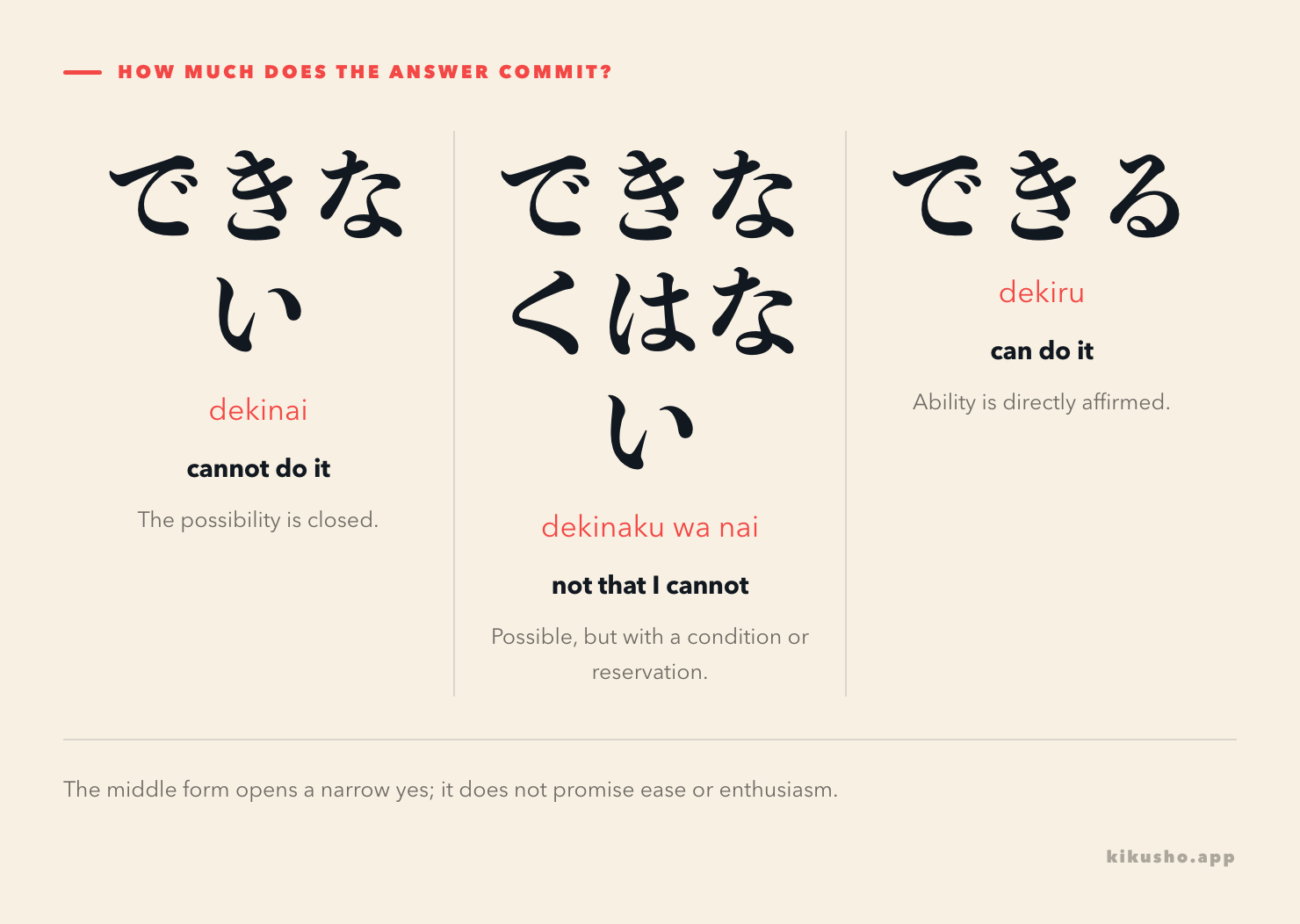
The pattern does not assign a numerical probability. Depending on context, it can admit ability, willingness, partial quality or a defensible interpretation. Its stable feature is the speaker's refusal to make the negative absolute.
Build the negative, then change ない to なく
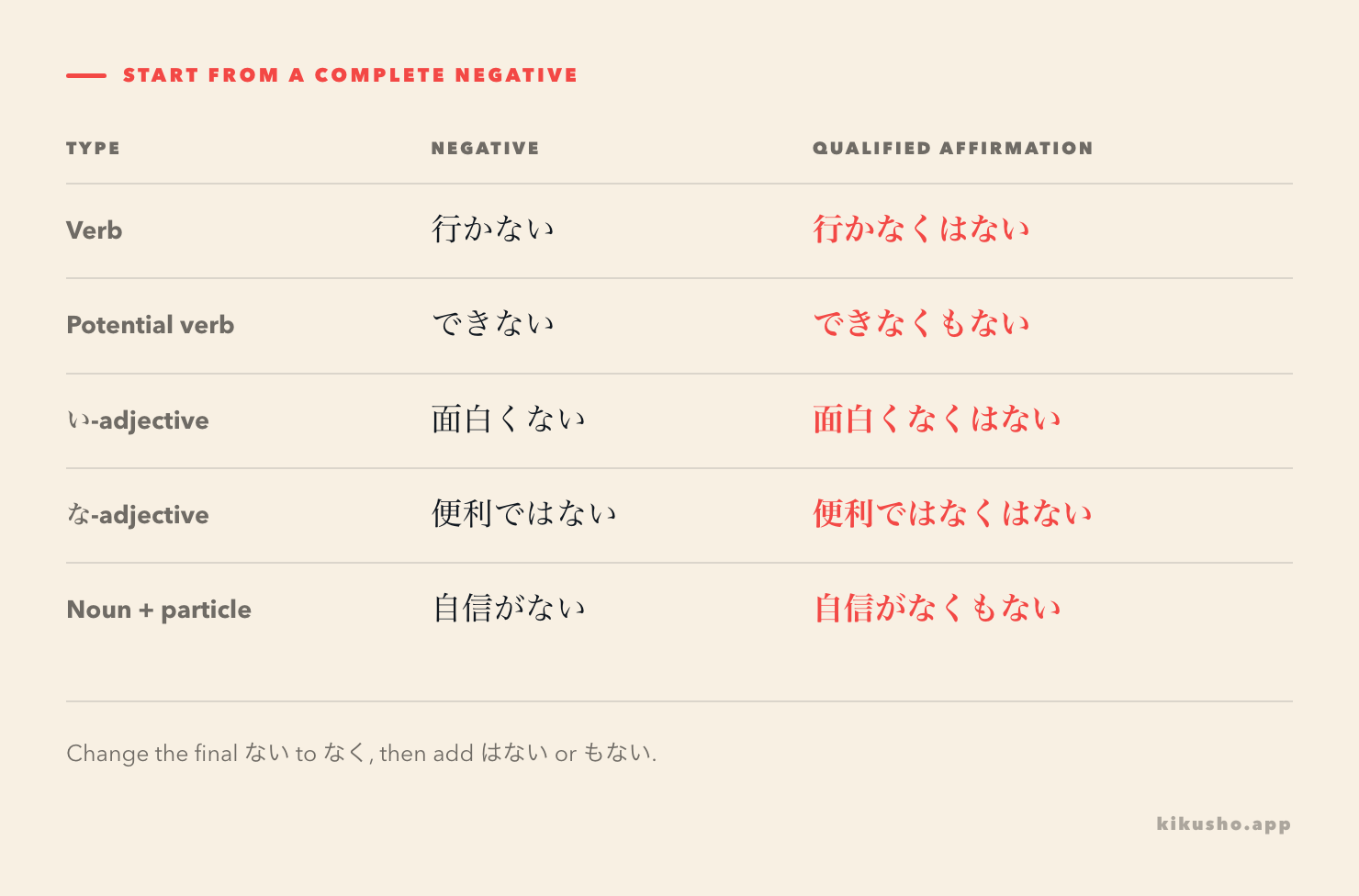
For a verb, begin with its complete plain negative form. Change the final ない to なく, then add はない or もない.
| Dictionary form | Plain negative | With the target pattern |
|---|---|---|
| 行く(いく), go | 行かない | 行かなくはない / 行かなくもない |
| 食べる(たべる), eat | 食べない | 食べなくはない / 食べなくもない |
| する, do | しない | しなくはない / しなくもない |
| できる, be able to | できない | できなくはない / できなくもない |
This sequence matters. 行くなくはない is wrong because the pattern does not attach directly to the dictionary form. 行かないなくはない is also wrong because the first ない must change to its connective なく form.
息子は野菜を食べなくはないが、あまり好きではない。
むすこは やさいを たべなくはないが、あまり すきではない。
My son does eat vegetables, but he does not like them very much.
Here the parent rejects a total refusal to eat vegetables. The following が clause prevents the answer from sounding like an ordinary positive habit.
An い-adjective requires one extra layer. First make its negative, then change that negative ない to なく:
| Starting adjective | Negative | Qualified affirmation |
|---|---|---|
| 面白い(おもしろい), interesting | 面白くない | 面白くなくはない / 面白くなくもない |
| 高い(たかい), expensive | 高くない | 高くなくはない / 高くなくもない |
面白くなくもない means that something is not entirely uninteresting. Do not confuse it with 面白くはない, “it is not particularly interesting.” The first contains the negative 面白くない, changed to 面白くなく, plus another ない. The second is a single negative with contrastive は.
With な-adjectives, forms such as 便利ではなくはない and 便利じゃなくもない are possible, but they can feel heavy. With nouns, the most useful examples often contain an existence or possession negative: 自信がない → 自信がなくはない, “it is not that I have no confidence,” and 可能性はない → 可能性はなくもない, “the possibility is not nonexistent.” Learn the full starting predicate instead of attaching なくはない mechanically to a bare noun.
Potential verbs make the boundary especially clear
Potential verbs such as できる, 行ける and 読める already express ability. Their negative forms make the double-negative logic easy to see.
貯金すれば、このパソコンを買えなくはない。
ちょきん すれば、この パソコンを かえなくはない。
If I save money, buying this computer is not impossible.
買える is the potential of 買う, and 買えない becomes 買えなくはない. Saving money is the condition that makes the purchase possible. The sentence does not say that the price is comfortable or that the purchase has been decided.
説明を読めば、一人で組み立てられなくもない。
せつめいを よめば、ひとりで くみたてられなくもない。
If you read the instructions, assembling it alone is not out of the question.
組み立てる means assemble. The potential 組み立てられる becomes 組み立てられない, then 組み立てられなくもない. The sentence leaves room for difficulty; translating it simply as “you can assemble it” erases that stance.
は and も are close variants
In this pattern, なくはない and なくもない overlap strongly. Both deny the complete negative and admit a limited affirmative. Bunpro notes a slight strengthening with も, which can feel like “that possibility exists too,” but ordinary context often matters more than a fixed English contrast.
転職を考えなくはないが、今すぐではない。
てんしょくを かんがえなくはないが、いますぐではない。
It is not that I never consider changing jobs, but not right now.
転職を考えなくもないが、今すぐではない。
てんしょくを かんがえなくもないが、いますぐではない。
I do sometimes consider changing jobs, but not right now.
The second translation brings out a possible も nuance, but it is not a rule that makes one sentence affirmative and the other negative. Both are guarded admissions. On a test, formation and the surrounding reservation are safer evidence than an exaggerated particle distinction.
The outer ない also carries tense. 気持ちは分からなくもなかった means “it was not that I did not understand the feeling” or, more naturally, “I could understand the feeling to some extent.” The past belongs to the speaker's qualified assessment.
The reservation often follows after が or けど
The construction frequently appears before が or けど, because the speaker is about to state what prevents a full yes.
あなたの考えは分からなくはないが、その方法には賛成できない。
あなたの かんがえは わからなくはないが、その ほうほうには さんせい できない。
It is not that I cannot understand your thinking, but I cannot agree with that method.
Understanding and agreement remain separate. The first clause offers limited recognition; the second gives the real objection. This pattern can therefore soften disagreement, but it is not automatically polite or kind. Tone, relationship and the content after が still control how the sentence lands.
You can also meet the pattern without an explicit contrast clause:
その可能性はなくもないだろう。
その かのうせいは なくもない だろう。
That possibility may not be entirely absent.
The noun 可能性 takes は, followed by the existence negative ない → なくもない. だろう adds the speaker's tentative judgment. The sentence admits a possibility without endorsing it as likely.
Keep neighboring negative patterns separate
Several expressions contain repeated negatives, but they negate different relations.
| Pattern | What it does | Example |
|---|---|---|
| なくはない / なくもない | qualified possibility or affirmation | 行けなくはない, going is possible with reservations |
| ないことはない | qualified affirmation with こと | 行かないことはない, it is not that I never go |
| ないわけにはいかない | inability to avoid an action; duty | 行かないわけにはいかない, I have to go |
| かねない | worrying possibility | 事故が起きかねない, an accident could occur |
| と言えなくもない | a statement is defensible with reservations | 成功だと言えなくもない, it could be called a success |
The lesson on ことは~が and ないことはない teaches another partial-affirmation structure. Its meaning often overlaps with なくはない, but its attachment uses a complete plain form plus ことはない. Do not combine the two templates.
参加しないわけにはいかない means circumstances make non-participation impossible, so the speaker must participate. 参加できなくはない only says participation remains possible. Duty and limited ability are different conclusions.
The N1 formal double-negative lesson includes the fixed ending と言えなくもない. That expression qualifies whether a preceding statement can be said; the general N2 pattern here attaches directly to a negative verb, adjective or existence predicate.
In Kikusho, save the reservation with the target expression. A card containing only できなくはない can tempt you to recall a plain “can.” Keeping 条件が合えば、参加できなくはない preserves the condition and trains the narrower commitment.
Practice questions
Answer all six original questions before opening the explanations below.
Question 1
Change the plain negative into a qualified possibility.
行けない → 行け( )
- A. ないはない
- B. なくはない
- C. ないくはない
- D. なくではない
Question 2
Which Japanese sentence keeps both the mild praise and the complaint “but it was too long”?
- A. 映画は面白くはなかったが、長すぎた。
- B. 映画は面白くなくもなかったが、長すぎた。
- C. 映画は面白いなくもなかったが、長すぎた。
- D. 映画は面白くもなかったが、長すぎた。
Question 3
Arrange the four fragments once each to complete the guarded answer. Identify the fragment at ★.
条件が合えば、__ __ ★ __。
- A. は
- B. 参加でき
- C. ない
- D. なく
Question 4
Which interpretation preserves the difference between the two replies?
A:一人でできますか。
B:できなくはないです。でも、かなり時間がかかります。
- A. B says it is impossible alone.
- B. B directly guarantees an easy success.
- C. B says it is possible, while warning that it will take considerable time.
- D. B says somebody already finished it.
Question 5
Choose the expression that means duty rather than qualified possibility.
- A. 参加できなくはない。
- B. 参加できなくもない。
- C. 参加しないわけにはいかない。
- D. 参加する可能性はなくもない。
Question 6
Read the passage and choose the best completion.
彼の説明は理解(りかい)でき( )が、私はその提案(ていあん)には賛成できない。
- A. なくはない
- B. ないわけにはいかない
- C. かねない
- D. ずに済む
Commit to the six choices, then reveal how each inner negative and outer clause work together.
Answers and explanations
Use the inner negative to check the formation, then use the surrounding clause to measure how much the speaker accepts.
Answer 1: B. The potential negative 行けない changes its final ない to なく, then takes はない: 行けなくはない. A leaves the first negative unconnected; C adds く after the wrong form; D creates a different copular sequence. The result means that going is possible, with some reservation.
Answer 2: B. Start from 面白くない, “not interesting,” change its final ない to なく, and add the past outer form もなかった. 面白くなくもなかった gives a past qualified affirmation: the film was not entirely uninteresting. A and D contain only one semantic negative and therefore describe the film as uninteresting; C attaches ない directly to 面白い.
Answer 3: A at ★. The order is B → D → A → C: 参加できなくはない. The negative of 参加できる is 参加できない; changing ない to なく produces the base before はない. The 条件が合えば clause explains why the possibility is limited.
Answer 4: C. できなくはない leaves ability open, and でも、かなり時間がかかります states the reservation. A ignores the outer denial. B removes the warning and invents ease and certainty. D invents a completed event.
Answer 5: C. 参加しないわけにはいかない says that not participating is not a viable option, so the speaker has to participate. A and B admit qualified ability. D admits that a possibility exists. Repeated negatives do not produce the same meaning across different fixed constructions.
Answer 6: A. 理解できなくはないが means “it is not that I cannot understand, but…,” which supports the later refusal to agree. B would make understanding an obligation. C expresses a worrying possibility and cannot attach as shown. D means that an unwanted action was avoided and does not fit this contrast.
Common questions
What do なくはない and なくもない mean?
They form a double negative that leaves a limited affirmative possibility: “it is not that I do not” or “it is not impossible.” The speaker usually has a condition, difficulty or reservation, so the pattern is weaker than a direct affirmative.
How do you form なくはない with a verb?
Start with the verb's plain negative and change its final ない to なく, then add はない: 行かない becomes 行かなくはない and できない becomes できなくはない. Use もない instead for the close variant なくもない.
Are なくはない and なくもない different?
Their core meaning overlaps: both cautiously reject a complete negative. も can make the concession feel slightly more inclusive or emphatic, but context and the reservation after が or けど usually matter more than a rigid translation difference.