On this page
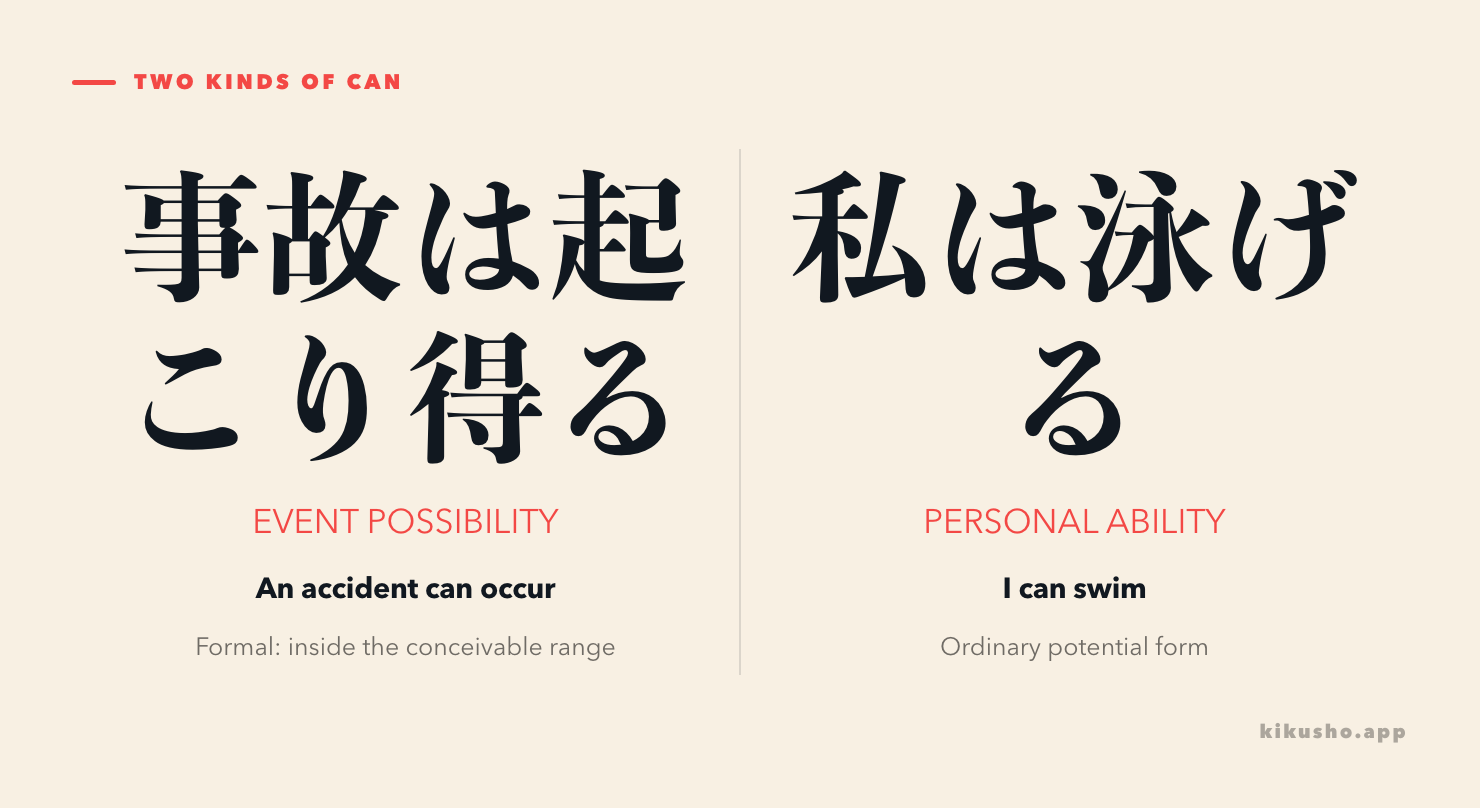
Use V-stem + 得る when a formal sentence judges an action or event possible in principle; use V-stem + 得ない when it rules that possibility out. The affirmative nonpast may be read える or うる, but negative and other inflected forms use the え reading.
小さな誤解が、大きな対立に発展し得る。
ちいさな ごかいが、おおきな たいりつに はってんしうる。
A small misunderstanding can develop into a major conflict.
その変化を正確に予測し得ない。
その へんかを せいかくに よそくしえない。
It is not possible to predict that change accurately.
These are judgements about what may happen or what can reasonably be done, not ordinary claims about someone's skill. This lesson teaches inventory items g-0e0de5e13115, 得る(える/うる), and g-5d262e27272b, 得ない(えない).
Test possibility in principle, not everyday ability
The most useful question is: does the sentence assess whether an event or action belongs to the range of real possibilities? If so, ~得る or ~得ない may fit a formal context.
| Intended claim | Natural form | Example |
|---|---|---|
| an event is conceivable | V-stem + 得る | 事故は起こり得る |
| an outcome is not conceivable | V-stem + 得ない | この結果は予測し得ない |
| a person has a skill | potential form | 彼は日本語が話せる |
The Japan Foundation's teaching resource explicitly separates possibility from ability. It accepts 起こり得る for an event that may occur and rejects 日本語を話し得る when the intended claim is simply that someone knows how to speak Japanese. The potential-form lesson covers that everyday ability system.
This does not mean a human subject is grammatically forbidden. An intentional action can take ~得る when formal prose evaluates its feasibility or outer limit:
現在の資料から、考え得る原因を三つ挙げた。
げんざいの しりょうから、かんがえうる げんいんを みっつ あげた。
From the current evidence, we listed three conceivable causes.
The focus is the range of causes one can reasonably conceive, rather than the thinker's permanent ability. Context and claim type decide, not animacy alone.
Attach 得る and 得ない to the verb stem
Remove ます from the polite form, then add 得る or 得ない.
| Dictionary form | ます form | Stem | Formal possibility |
|---|---|---|---|
| 起こる | 起こります | 起こり | 起こり得る/起こり得ない |
| 防ぐ | 防ぎます | 防ぎ | 防ぎ得る/防ぎ得ない |
| 考える | 考えます | 考え | 考え得る/考え得ない |
| 予測する | 予測します | 予測し | 予測し得る/予測し得ない |
Do not attach the construction to the dictionary form. 起こる得る and 予測する得ない are malformed. For a する verb, retain し: 説明し得る, 否定し得ない, 回避し得た.
MLC Japanese Language School, Tanosuke and Japanese NET all give the same Vます-stem attachment and teach the pair at N2. Their examples cover both events that may occur and deliberate acts assessed as feasible.
Only the nonpast affirmative allows える or うる
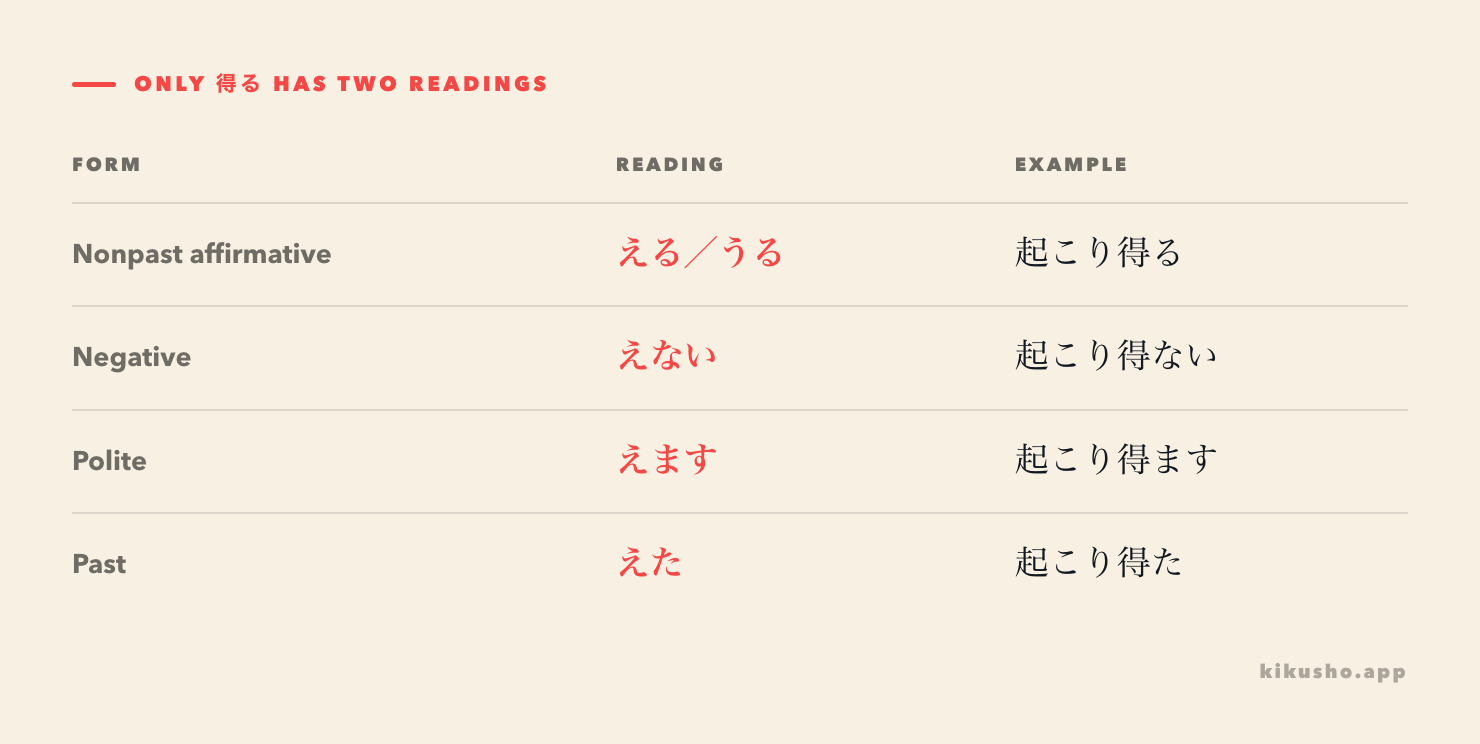
The spelling 得る hides a reading choice. In the affirmative nonpast, える and うる are both possible. The older うる reading is especially associated with literary or weighty prose; える is also current and often easier in modern writing.
| Form | Reading | Example |
|---|---|---|
| nonpast affirmative | える or うる | 起こり得る(おこりえる/おこりうる) |
| negative | えない | 起こり得ない(おこりえない) |
| polite | えます | 起こり得ます(おこりえます) |
| past | えた | 起こり得た(おこりえた) |
The wrong forms 起こりうない, 起こりうます and 起こりうた do not follow the paradigm. The Japan Foundation lists this exact restriction, and Kotobank's dictionary entry records うる as the older form used particularly in formal possibility expressions.
Pronunciation conventions can settle around particular combinations. 考え得る is commonly taught as かんがえうる, while あり得る is heard as both ありえる and ありうる. When a source supplies a reading, learn the whole expression rather than assuming both readings sound equally usual in every compound.
得る opens a possibility without predicting it
~得る places an outcome inside the possible range. It does not say that the outcome is likely or that the speaker expects it.
この方法でも、わずかな誤差は生じ得る。
この ほうほうでも、わずかな ごさは しょうじうる。
Even with this method, a small error can occur.
一つの発言が、交渉全体に影響を与え得ます。
ひとつの はつげんが、こうしょう ぜんたいに えいきょうを あたええます。
A single remark can affect the entire negotiation.
Neither sentence assigns a probability. To say “probably,” Japanese needs separate evidence or modal language. ~得る answers a narrower question: is the result possible at all?
This is why the pattern suits reports, academic prose, policy discussion and careful warnings. NIHONGO NET describes it as a relatively formal expression used in writing or polite speech. Ordinary conversation usually chooses a potential verb, できる, かもしれない or a direct explanation unless the fixed phrase あり得る is natural.
得ない denies conceptual or practical possibility
~得ない says that an action or result falls outside the range the speaker accepts as possible.
現在の技術では、この誤差を完全には除き得ない。
げんざいの ぎじゅつでは、この ごさを かんぜんには のぞきえない。
With current technology, this error cannot be eliminated completely.
当時の記録だけでは、真相を知り得ない。
とうじの きろくだけでは、しんそうを しりえない。
The truth cannot be known from the records of that time alone.
The first concerns practical feasibility under a stated limit. The second concerns what evidence permits anyone to know. Both are more analytical than できない, which can simply report that someone cannot perform an action.
Bunpro contrasts 得ない with personal hesitation and physical failure to finish. That distinction helps with two nearby forms. お答えしかねます is a formal refusal shaped by the speaker's position, while 答え得ない問い describes a question that cannot be answered in principle. 読み切れない focuses on being unable to finish a quantity; 理解し得ない説明 judges comprehension impossible or inconceivable. The かねる and かねない lesson develops the refusal and risk pair.
Keep lexical 得る and ~ざるを得ない separate
得る can also be an independent verb meaning “obtain,” “gain” or “acquire”:
長い交渉の末、全員の同意を得た。
ながい こうしょうの すえ、ぜんいんの どういを えた。
After lengthy negotiations, we obtained everyone's agreement.
Here 同意を is the object of lexical 得た. There is no preceding verb stem. Compare 同意を得る with 理解し得る: the first obtains a noun; the second attaches 得る to 理解し, “can understand.”
The form also appears inside ~ざるを得ない, “have no choice but to do.” That construction contains an old negative before を得ない and yields necessity: 計画を変更せざるを得ない, “We have no choice but to change the plan.” It is not the simple negative of V-stem + 得る. The ~ざるを得ない lesson gives its separate formation rule, including する → せざる.
Finally, あり得る and あり得ない have become common even in conversation:
A: 田中さんが連絡を忘れたのかな。
B: それはあり得るね。
A: Maybe Tanaka forgot to contact us.
B: That's possible.
Colloquial あり得ない! can react with “No way!” or “That's unbelievable!” The emotional force comes from conversation; the underlying construction still rejects the proposition as possible.
Save the claim around the form in Kikusho
A useful card preserves what possibility is being assessed. Save 小さなミスが重大な事故につながり得る rather than an isolated 得る = can. For the negative, keep the limiting evidence in 現在の資料だけでは判断し得ない.
On the editable card, verify the reading of the complete expression. A dictionary-form 得る may allow える or うる, while 得ない and 得た require え. Recording the surrounding clause also keeps formal possibility separate from a personal skill or the lexical verb “obtain.”
Practice: decide what kind of “can” the sentence needs
Complete all six questions before opening the corrections.
Question 1 — event possibility. Choose the formal completion.
どれほど注意していても、事故は__。
- ア. 起こる得ます
- イ. 起こり得ます
- ウ. 起こりうます
- エ. 起これ得ます
Question 2 — personal ability. Which sentence naturally says “Mina can swim 500 metres” as a statement of her ability?
- ア. ミナさんは五百メートル泳ぎ得る。
- イ. ミナさんは五百メートル泳ぐことがあり得る。
- ウ. ミナさんは五百メートル泳ぎ得ない。
- エ. ミナさんは五百メートル泳げる。
Question 3 — negative reading. Which reading is correct for 起こり得ない?
- ア. おこりえない
- イ. おこりうない
- ウ. おこりえるない
- エ. おこりえらない
Question 4 — composition. Arrange every chunk once: 得る / 原因に / 小さな誤解が / なり.
Question 5 — obtain or possibility. Which sentence uses lexical 得る to mean “obtain,” rather than the formal possibility ending?
- ア. 誤解は起こり得る。
- イ. この結果は予測し得ない。
- ウ. 交渉の末、承認を得た。
- エ. 事故は防ぎ得たはずだ。
Question 6 — connected text. Choose the sentence that completes the report.
今回の調査は回答者が二十人だけだった。したがって、この結果だけで全国の傾向を__。
- ア. 判断を得ない
- イ. 判断する得ない
- ウ. 判断しうない
- エ. 判断し得ない
Answers and explanations
Answer 1: イ, 起こり得ます. 起こる becomes the ます-stem 起こり, and polite 得ます is read えます. ア keeps the dictionary ending, ウ incorrectly carries う into an inflected form, and エ attaches 得る to the potential form.
Answer 2: エ, 泳げる. This is a stable personal ability, so the ordinary potential form fits. ~得る would turn the sentence into an unusually formal feasibility judgement rather than a natural statement of Mina's swimming skill.
Answer 3: ア, おこりえない. The affirmative nonpast may use える or うる, but the negative always uses the え stem before ない.
Answer 4: 小さな誤解が原因になり得る. なる supplies the stem なり, followed by 得る. The sentence means that a small misunderstanding can become a cause.
Answer 5: ウ, 交渉の末、承認を得た. 承認 is the object marked by を, and 得た means “obtained.” In the other sentences, 得る or 得ない attaches to a verb stem and evaluates possibility.
Answer 6: エ, 判断し得ない. The limited sample makes a nationwide conclusion impossible to justify. The する verb becomes 判断し, then takes 得ない. ア changes the meaning to “not obtain a judgement,” while イ and ウ use malformed attachments.
N2 is a shared teaching placement
JLPT Sensei, Bunpro, MLC, Tanosuke, Japanese NET and NIHONGO NET all place this construction at N2; the curriculum records no level disagreement for either assigned item. The Japan Foundation's older resource labels it former Level 2 and supplies the same attachment, reading and ability restrictions.
The present JLPT publishes no exhaustive grammar list, so N2 remains an editorial study placement. Codex reviewed the two assigned items, every original example and translation, the reading paradigm, limits on ability claims, all distractors and the distinction from lexical 得る and ~ざるを得ない against the cited sources. No human Japanese review is claimed.
Common questions
What do ~得る and ~得ない mean?
V-stem + 得る says an action or event is possible, conceivable or feasible. V-stem + 得ない denies that possibility. The pattern is formal and common in analysis, news, reports and careful argument.
Is 得る read える or うる?
The affirmative nonpast 得る can be read える or うる, with うる carrying a more literary or weighty tone. Inflected forms use the え reading: 得ない, 得ます and 得た are えない, えます and えた.
Can ~得る express a person's skill?
It is not the ordinary form for a learned skill such as speaking Japanese or swimming. Use the potential form for that. ~得る can describe a person's action when a formal context evaluates whether the action is feasible.
Is あり得ない formal?
The wider V-stem + 得ない pattern is formal, but あり得ない is common in conversation as “impossible,” “unthinkable” or “no way.” It has become a familiar fixed expression.