On this page
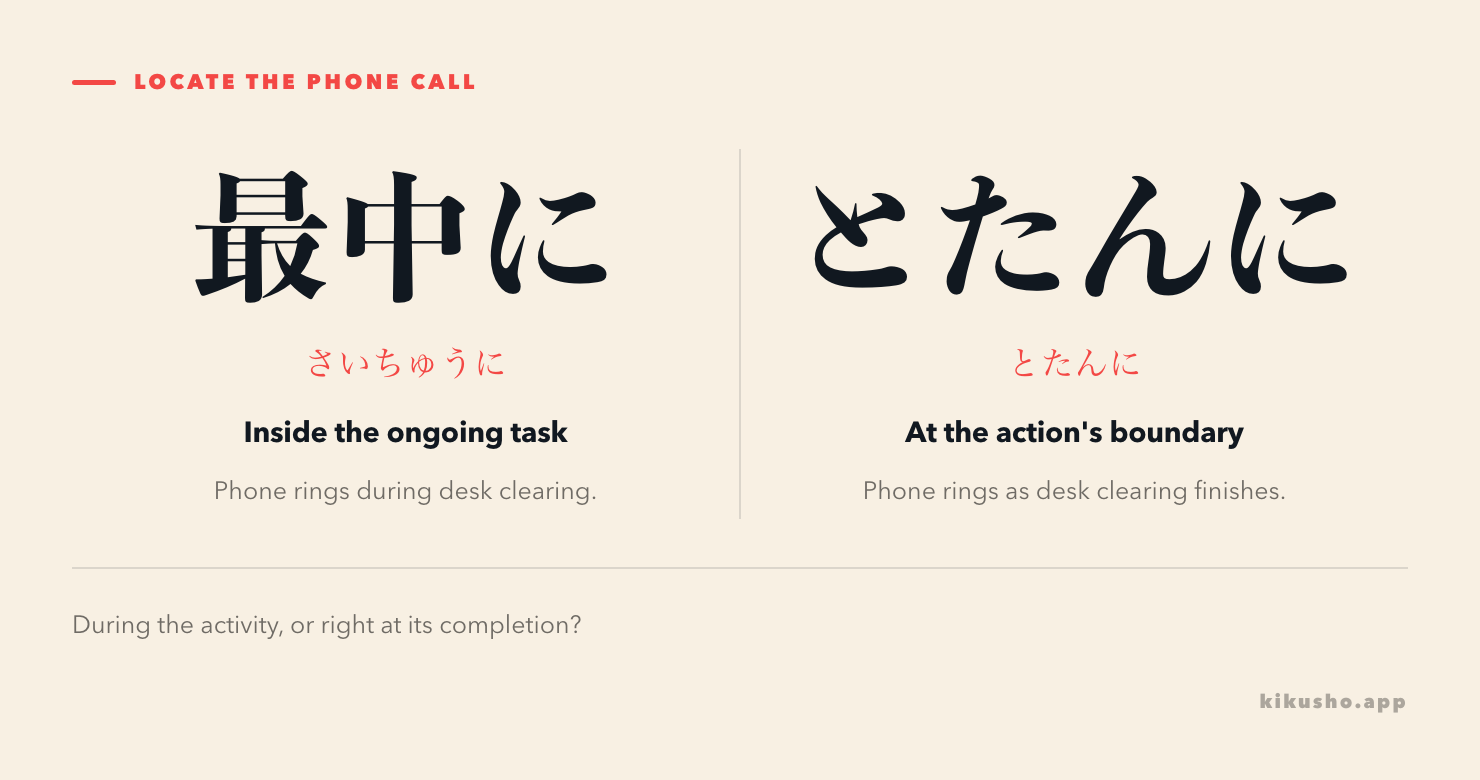
Place the second event inside an activity already underway with 最中に; place it right at an action's boundary with たとたん(に). In a short account, 片づけている最中に means “while I was clearing up”, while 片づけたとたんに means “the moment I finished clearing up”.
The phone call can arrive during the task or at its end
Compare the same desk and the same phone call:
机を片づけている最中に、電話が鳴った。 つくえをかたづけているさいちゅうに、でんわがなった。 The phone rang while I was right in the middle of clearing my desk.
机を片づけたとたんに、電話が鳴った。 つくえをかたづけたとたんに、でんわがなった。 The phone rang the moment I finished clearing my desk.
The first sentence catches the clearing in progress. The second puts the ringing against its completion. Both can describe inconvenient timing, so “an interruption happened” is too broad to choose between them.
This N3 grammar comparison teaches 最中に and verb た-form + とたん(に). Fresh JLPT Sensei and Bunpro references place the latter at N3; their 最中に pages give the same level. A Hanabira-derived lesson labels とたん N2, so source-list placements differ. These estimates do not constitute an official exhaustive JLPT grammar syllabus. The prerequisites are the activity use of ている and the plain affirmative た-form.
最中に follows an activity, not just any form ending in ている
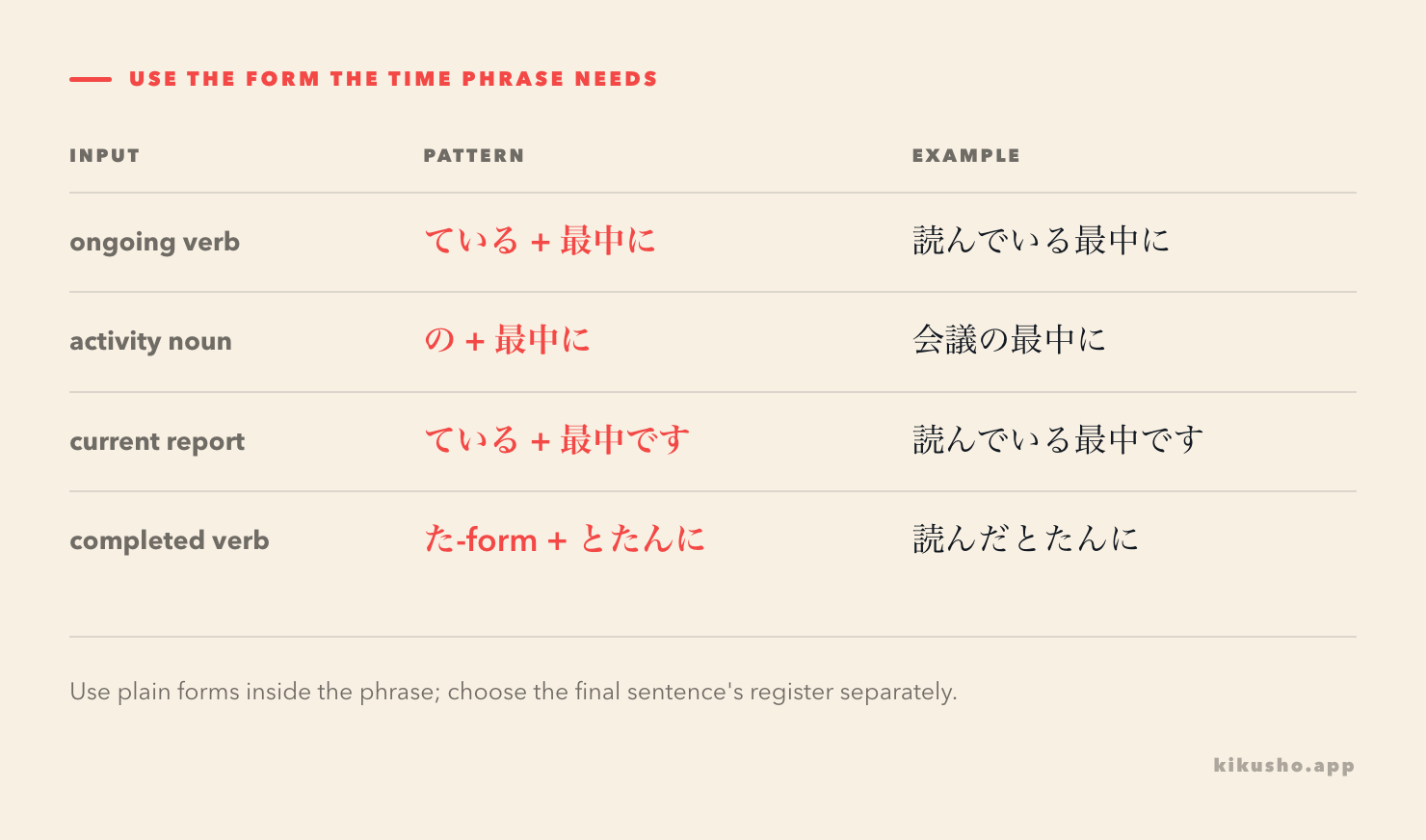
最中 is read さいちゅう here. Its noun meaning is the height or midst of something in progress, as Digital Daijisen explains. Keep these ordinary attachments:
| What precedes it | Construction | Original fragment and reading |
|---|---|---|
| Verb describing ongoing activity | Verb ている + 最中に | 写真を整理している最中に — しゃしんをせいりしているさいちゅうに |
| Activity noun | Noun + の + 最中に | 掃除の最中に — そうじのさいちゅうに |
| A report of being occupied now | Verb ている + 最中です | 整理している最中です — せいりしているさいちゅうです |
| The first action's completion, with とたん | Verb た-form + とたん(に) | 開けたとたんに — あけたとたんに |
写真を整理している最中に、電話がかかってきました。 しゃしんをせいりしているさいちゅうに、でんわがかかってきました。 I received a phone call while I was sorting photos.
整理している describes the sorting underway at the time of the call. Although the account ends in past きました, use the plain ongoing form immediately before 最中に. 整理しています最中に puts a polite ending where this attachment needs the plain form.
The noun route uses の:
掃除の最中に、友達が来ました。 そうじのさいちゅうに、ともだちがきました。 My friend came while I was in the middle of cleaning.
Bunpro's 最中に explanation gives both attachments and identifies its register as standard. It works in ordinary conversation or writing; the final 来た/来ました chooses the report's plain or polite style.
Be careful with a ている form that describes a continuing result or stable state. “Knowing” something is not automatically an activity with a busy middle. Japanese teacher guidance on 最中に explicitly warns against treating state verbs as ongoing activities. The ところ lesson develops the same need to distinguish an action's stage from a continuing state. Learn the activity and scene, rather than adding 最中に to every ている you recognise.
最中です can describe what occupies you now
You can end the report without adding a second event:
今、写真を整理している最中です。 いま、しゃしんをせいりしているさいちゅうです。 I am right in the middle of sorting photos now.
The noun-like 最中 takes です, or だ in plain style. Here there is no に because you are describing the activity's current stage, rather than locating a following event during it. A phone ringing is not part of the meaning of 最中 itself.
An interruption is common with 最中に, but a complaint is not compulsory. 昼休みの最中に、友達からうれしい知らせが届いた。 (ひるやすみのさいちゅうに、ともだちからうれしいしらせがとどいた。) means “During my lunch break, good news arrived from a friend.” The event can be welcome. Nor does 最中に by itself say that you abandoned the first activity.
たとたん introduces the development at that moment
Use the first verb's plain た-form, then とたん or とたんに:
封筒を開けたとたんに、写真が落ちました。 ふうとうをあけたとたんに、しゃしんがおちました。 The moment I opened the envelope, a photo fell out.
開ける becomes 開けた. とたん anchors the falling photo to that opening; it does not merely say that the photo fell at some unspecified later time. Bunpro describes this as an event directly upon, or effectively simultaneous with, the first action. Do not imagine a compulsory measurable gap between A and B.
The first action can itself be a beginning: 話し始めたとたんに, “the moment someone began speaking”, does not wait for the whole speech to finish. The form includes verbs whose affirmative past ends in だ: 読む → 読んだとたん(に). You attach とたん to the existing past form; you do not replace 読んだ with 読んた or add another た.
In this verb construction, 開けますとたん and 開けましたとたん are not the standard attachment. A polite final predicate, such as 落ちました, can still follow the plain 開けた inside the sentence. Likewise, noun + の is the route for 会議の最中に, not a way to build this verb + とたん pattern.
The kanji spelling 途端 is read とたん. 開けた途端に and 開けたとたんに express the same construction. The final に is optional here, as Mango Languages' authored explanation confirms. Omitting it does not make the event less immediate.
The surprise belongs to the development, not a universal bad outcome
たとたん commonly introduces something sudden or unplanned. The second clause should read as a development at that moment, rather than your neutral next step in a timetable.
写真を見たとたんに、昔のことを思い出しました。 しゃしんをみたとたんに、むかしのことをおもいだしました。 The moment I saw the photo, I remembered things from long ago.
The same person can perform the first action and experience the second development. It is the immediate recollection, rather than a change of subject, that makes this example work. Tae Kim's treatment of とたん contrasts such developments with a deliberately chosen next action. Pleasant surprise can fit too; とたん does not mean “something bad happened”.
For a plain plan such as “After the class ends tomorrow, I intend to study at the library”, 明日は授業が終わったら、図書館で勉強するつもりです is a straightforward way to state it. Replacing 終わったら with 終わったとたんに would change the presentation into an immediate development; it is not a neutral translation shortcut for every English “as soon as”.
Also distinguish the required た-form before とたん from the tense of the whole account. A repeated reaction can end in the nonpast:
私が袋を開けたとたんに、この猫は走ってきます。 わたしがふくろをあけたとたんに、このねこははしってきます。 Whenever I open a bag, this cat immediately comes running.
The clause keeps 開けた, while 走ってきます describes the recurring reaction. JLPT Sensei's actual examples include this kind of nonpast habitual account. That is why a blanket “the whole sentence must always be past” rule is too strong. It does not license an ordinary future promise in place of a sudden-development account.
Translate the relationship before choosing an English “just”
| What you want to describe | Form to consider | What the phrase contributes |
|---|---|---|
| Another event during the task | 片づけている最中に… | The task is already underway. |
| A development at its completion | 片づけたとたんに… | The new event is immediate. |
| A task that has just finished | 片づけたところです | The speaker reports the stage after completion. |
| Completion that still feels recent | 片づけたばかりです | The speaker presents the task as recent. |
The ばかり comparison explains why “recent” need not mean a few seconds ago. Neither たばかり nor a sentence-final たところ automatically supplies the second development that とたん introduces. Those are neighbours to the two assigned constructions, rather than extra grammar points newly covered here.
When a subtitle tells you that something rang, fell or changed, preserve the first clause and that development in your Kikusho text capture. Check that the drafted example keeps ている最中に or たとたんに as encountered. A replacement example with only the dictionary verb would discard whether the new event happened during the activity or at its boundary.
Practice: locate the event in eight original tasks
Question 1: keep the activity underway. A voice interrupts someone already writing a note. Select the attachment in メモを__最中に、声をかけられました.
A. 書いている
B. 書いた
C. 書きます
D. 書く
Question 2: link the activity noun. Supply the standard linker in 会議__最中に、隣の部屋から音楽が聞こえました.
A. な
B. を
C. の
D. だ
Question 3: assemble the instant. Arrange every piece once to say “The moment I opened the envelope, a photo fell.” Put the opening clause first and keep 落ちました as the fixed ending. Which piece occupies ★?
__ __ ★ __ 落ちました。
A. 写真が
B. 開けた
C. 封筒を
D. とたんに
Question 4: compose an interruption. Join 手紙を書いている and 電気が消えた with 最中に, then make the final predicate polite past. The meaning is “The light went out while I was writing a letter.”
Question 5: follow the unfinished reading. Read the account and choose the missing phrase.
本を読み始めて二十分ほどたったころ、電話が鳴りました。本はまだ読み終わっていません。読んでいる__に、電話が鳴ったのです。
A. とたん
B. 最中
C. ばかり
D. あと
Question 6: identify the intended plan. A student writes 明日は授業が終わったら、図書館で勉強するつもりです. Why should they retain the ordinary condition here, instead of replacing it with 終わったとたんに?
A. The continuation states a deliberate future study plan, rather than a sudden development at that moment.
B. とたん can never occur in any sentence with a nonpast final predicate.
C. とたん requires every following event to be unpleasant.
D. 最中に would mean that studying must begin after the class.
Question 7: check the extent of the rule. Which claim accurately describes the constructions taught here?
A. 最中に proves that the first activity stopped permanently.
B. Omitting に after とたん allows a long interval before the next event.
C. The person experiencing B must always differ from the person doing A with とたん.
D. A た-form before とたん can occur in an account of a repeated immediate reaction.
Question 8: build a recollection. Complete the sentence using 見る in its required plain form: 写真を__とたんに、昔のことを思い出しました. Write the complete sentence, keeping its final polite past.
Note your choices and composed sentences before continuing to the shared solution block.
Answers and explanations
Answer 1: A. 書いている presents writing in progress at the interruption: メモを書いている最中に、声をかけられました. 書いた would make writing completed; 書く does not give the required ongoing attachment, and 書きます places a polite form inside it.
Answer 2: C. The activity noun takes の: 会議の最中に、隣の部屋から音楽が聞こえました, “Music was audible from the next room during the meeting.” な and だ do not supply this noun link, while を cannot connect 会議 to 最中 as requested.
Answer 3: C → B → D → A; ★ is D. 封筒を開けたとたんに、写真が落ちました. The opening takes the affirmative plain past 開けた; とたんに places the falling photo at that moment. 写真が belongs with the fixed final predicate, so the first three pieces remain together as the time clause.
Answer 4: 手紙を書いている最中に、電気が消えました。 Keep 書いている immediately before 最中に and change the final 消えた to 消えました. The light goes out during the writing, rather than the moment writing ends. No polite います is inserted before 最中.
Answer 5: B. 読んでいる最中に fits reading still underway when the phone rang. The account explicitly puts the call about twenty minutes after reading began, without finishing the book. とたん would also require an appropriate た-form for its verb attachment; ばかり and あと do not express this stated middle-of-reading relationship.
Answer 6: A. つもりです makes the planned study intention explicit. The student is stating what they intend to do after class, rather than recounting a sudden result. B confuses the required preceding た-form with the whole sentence's time reference, C invents a negative-outcome requirement, and D reverses 最中に's during relationship.
Answer 7: D. The bag-and-cat example keeps 開けた before とたん while its nonpast ending describes a repeated reaction. 最中に does not prove permanent abandonment, optional に does not alter immediacy, and a sudden recollection can happen to the same person who saw the photo.
Answer 8: 写真を見たとたんに、昔のことを思い出しました。 見る is ichidan and becomes 見た. Keep that plain form before とたんに, even though the final 思い出しました addresses the listener politely. 見ます or 見ました immediately before とたん would not give the requested standard formation.
Common questions
Is 最中に always an unpleasant interruption?
It places an event inside an activity already in progress. An interruption is common, but the event need not be unpleasant and the sentence does not necessarily say that the first activity stopped.
Can I omit に after とたん?
Yes. Both 開けたとたん and 開けたとたんに can introduce an immediate development. Omitting に does not change the construction into a delayed sequence.
Does the た-form mean the whole sentence must describe the past?
No. It is the required verb form before とたん in this construction. A repeated immediate reaction can have a nonpast final predicate. This does not make とたん a neutral connector for a planned future action.