On this page
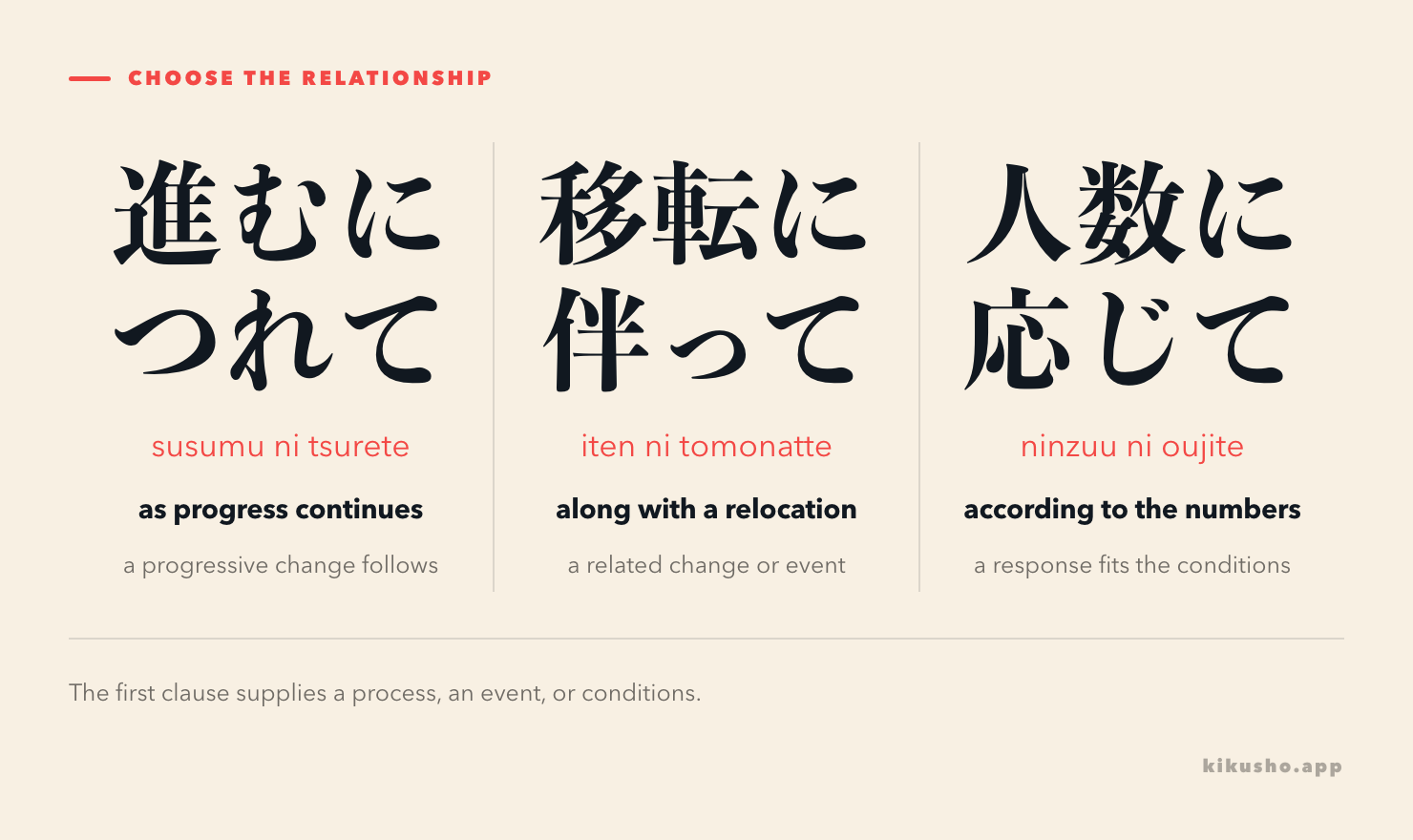
~につれて links a progressive change to another developing change; ~に伴って links an event or change to what accompanies it; ~に応じて matches a response to the relevant conditions. に伴って can describe a single event, while に応じて can compare fixed conditions across different cases, such as choosing tasks for learners of different abilities.
This N2 grammar comparison teaches those three constructions, including their linking variants and the noun phrases ~に伴う + noun and ~に応じた + noun. The reference pages consulted place につれて at N3, and に伴って/に応じて at N2. Sensei's につれて entry and Bunpro's につれて lesson support the earlier placement. Studying it beside the N2 forms helps you distinguish their relationships when you meet them in the same passage. Level labels are study estimates, and the JLPT publishes no exhaustive official grammar syllabus.
The test is progression, accompaniment, or a matching response
Ask what the second clause is doing. Does it report a change unfolding as the first progresses? Does it report a related event or consequence? Or does it describe something chosen to suit the circumstances?
| Construction and reading | Relationship | First part of the sentence |
|---|---|---|
| につれて (ni tsurete) | A progressive change brings another change along | 練習を重ねるにつれて: as practice accumulates |
| に伴って (ni tomonatte) | Something happens or changes in connection with an event or change | 店舗の移転に伴って: along with the store's relocation |
| に応じて (ni oujite) | An action or outcome fits the relevant conditions | 参加者の経験に応じて: according to participants' experience |
The third row can be an instruction. Participants may already have different backgrounds, and you tailor the activity accordingly. No passage of time is required. Japanese NET's に応じて explanation and Bunpro's dedicated lesson both describe this condition-matching relationship.
The preceding word determines the attachment
Keep the complete dictionary form of a verb before につれて or に伴って. に応じて takes a noun in the condition-matching frame taught here. A verb's ます-stem is not the shared attachment for this set.
| Pattern | Checked form | What the first part expresses |
|---|---|---|
| Verb dictionary form + につれて | 練習を重ねるにつれて | Practice developing over time |
| Change/process noun + につれて | 成長につれて (せいちょうにつれて) | Growth |
| Verb dictionary form + (の)に伴って | 利用者が増えるのに伴って | An increase in users |
| Event/change noun + に伴って | 店舗の移転に伴って | A relocation |
| Condition noun + に応じて | 能力に応じて (のうりょくにおうじて) | Ability as the basis for adjustment |
The optional の nominalises the verb clause before に伴って. Bunpro's に伴って structure includes both forms; J-nihongo's explanation demonstrates the nominalised version. This のに is the nominaliser の followed by the construction's に, rather than the concessive “although” ending.
For につれて, choose a verb or noun expressing a process. 暑くなるにつれて uses “become hotter”; 暑いにつれて does not fit that attachment. A noun slot is not permission to insert any object merely because you can put “with” before it in English. 成長, growth, names a change; a book or desk by itself does not. Tanosuke's explanation also restricts the preceding nouns and verbs to change expressions.
につれて follows an unfolding change
作業に慣れるにつれて、確認にかかる時間が短くなりました。
さぎょうに なれるにつれて、かくにんに かかる じかんが みじかく なりました。
“As I became accustomed to the work, the time needed for checking became shorter.”
The speaker is describing their own work. Familiarity develops, and checking time changes along with it. One quantity increases while the other decreases; the construction does not require both changes to move upwards, or establish an exact mathematical ratio.
Japanese NET's につれて lesson requires change in both parts of the sentence. A lone scheduled relocation is not that kind of unfolding progression. Nor does the construction supply a general instruction to match an activity to different people's existing abilities. For that purpose, use the condition-matching frame below.
You can shorten the connector to につれ: 作業に慣れるにつれ、確認にかかる時間が短くなりました. This compact variant is common in writing. The progressive relationship remains the same.
For an explicit “the more …, the more/less …” comparison, the ~ば~ほど lesson gives a different structure. Keep the structures separate even where their English translations overlap.
に伴って includes related events and single changes
店舗の移転に伴って、住所が変わりました。
てんぽの いてんに ともなって、じゅうしょが かわりました。
“The address changed along with the store's relocation.”
Here a relocation brings a related address change. The sentence does not say that the address changed a little each day. This event use is why に伴って reaches beyond につれて. Bunpro explicitly includes both progressive changes and momentary events. Enuncia's explanation also describes related change and co-occurring events.
に伴って often appears in reports or notices about linked changes. A causal connection may be understood, but the connector itself does not prove that A directly controls B. It presents B as connected with A, rather than simply placing two unrelated coincidences side by side.
The compact linking variant is に伴い: 店舗の移転に伴い、住所が変わりました. The final い belongs to a linking form of 伴う; it is not a negative ending. Sensei's に伴って entry lists this variant with the main construction.
に応じて makes the conditions matter
参加者の経験に応じて、練習内容を変えてください。
さんかしゃの けいけんに おうじて、れんしゅうないようを かえてください。
“Adjust the practice content to the participants' experience.”
This instruction asks someone to adapt the activity. It can concern a beginner group and an experienced group on the same afternoon. 経験 is the basis for the response, not a claim that everyone's experience is gradually increasing during the session.
The response can also be reported instead of requested: この講座では、参加者の経験に応じて練習内容が変わります (このこうざでは、さんかしゃの けいけんに おうじて れんしゅうないようが かわります), “In this course, the practice content varies according to participants' experience.” Neither version requires a deliberate action verb in the second clause every time.
に応じ is a compact linking variant: 人数に応じ、資料の部数を決めます (にんずうに おうじ、しりょうの ぶすうを きめます), “We decide how many handouts to prepare according to the number of people.” Here the organisers are the implied decision-makers. The omitted て does not change the conditions being matched.
Before a noun, use に伴う or に応じた
Compare the clause connector with the phrase that describes a noun. The relationship can sit inside a noun phrase instead of linking two clauses.
| Construction | Linking a clause | Describing a following noun |
|---|---|---|
| に伴って | 移転に伴って住所が変わる | 移転に伴う費用 (いてんに ともなう ひよう): costs associated with a relocation |
| に応じて | 能力に応じて課題を選ぶ | 能力に応じた課題 (のうりょくに おうじた かだい): tasks suited to ability |
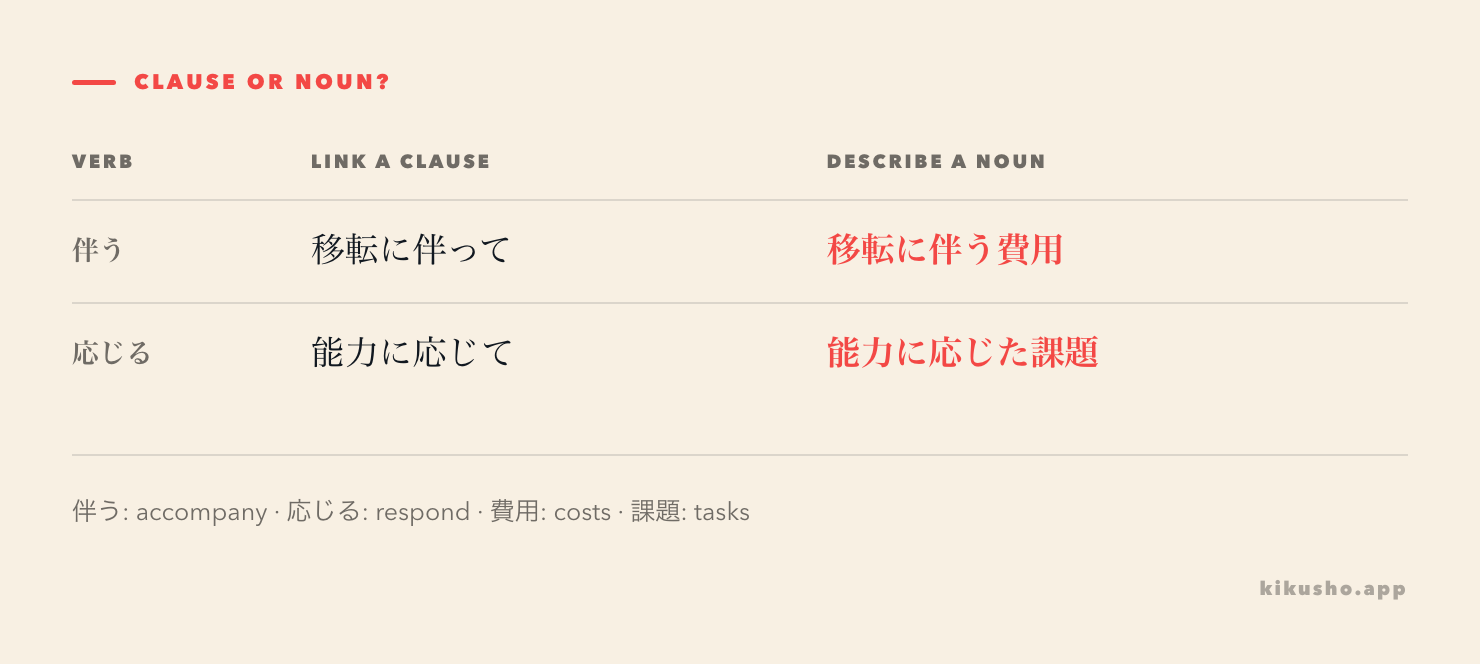
これは移転に伴う費用です identifies “costs associated with the relocation.” 能力に応じた課題を用意します says “We will prepare tasks suited to ability.” The た in the second noun phrase describes suitability; it does not force the main action 用意します into the past. Bunpro's に応じて page gives the noun-modifying に応じた frame.
When a course notice or work announcement contains one of these noun phrases, the ending is easy to lose if you save only the noun. Kikusho's text capture can draft a card from that passage. Inspect the proposed example and edit it before saving, keeping 課題 with the ability it suits or 費用 with the relocation it accompanies. Those links explain the phrase; a translation of the noun alone leaves them out.
Gradual change is the overlap
Both of these sentences work:
- 利用者が増えるにつれて、必要な席の数も増えてきた。 “As the number of users has grown, the number of seats needed has grown too.”
- 利用者が増えるに伴って、必要な席の数も増えてきた。 “Along with the growth in users, the number of seats needed has grown too.”
につれて foregrounds the unfolding changes. に伴って presents the growing need for seats as a related development. A quiz offering only those two endings in this context would need an additional constraint; neither is automatically wrong. Their English glosses cannot settle the choice by themselves.
By contrast, 利用者の人数に応じて席を用意します (りようしゃの にんずうに おうじて せきを よういします), “We will prepare seats according to the number of users,” describes a matched response. It tells you how to allocate seats, rather than reporting the trajectory of an increasing population.
Finally, ~つつある can report a single change underway. 利用者が増えつつある, “The number of users is increasing,” does not itself connect that trend to a second development. The discussion of written and conversational wording helps place formal connectors beside alternatives you might hear, while preserving each sentence's relationship.
Practice: follow the stated relationship
There are six questions. Complete the selection, assembly and passage tasks before opening the shared solution block below them.
Question 1
Two tour groups have participants of different ages. Select the instruction asking the guide to adapt the tour route to those existing differences.
- A. 参加者の年齢が上がるにつれて、見学コースが短くなりました。
- B. 施設の移転に伴って、見学コースが変わりました。
- C. 参加者の年齢について、説明してください。
- D. 参加者の年齢に応じて、見学コースを変えてください。
Question 2
Choose the standard noun modifier for “tools suited to their intended use.” Keep the purpose attached to the tools being selected.
用途に( )道具を選びます。
用途(ようと): intended use; 道具(どうぐ): tool.
- A. 応じて
- B. 応じた
- C. 応じな
- D. 応じます
Question 3
Place the four pieces into a complete sentence; report the letter occupying ★.
__ __ ★ __。
- A. につれて
- B. 練習を
- C. 動きが滑らかになってきた
- D. 重ねる
Question 4
This time assemble a noun phrase inside an announcement, using every piece exactly once. Give the letter at ★ after arranging the announcement.
これは __ __ ★ __ お知らせです。
- A. 移転に
- B. 住所変更の
- C. 伴う
- D. 店舗の
Question 5
Interpret the selection rule in this fictional reading group's policy.
この読書会では、参加者の経験に応じて、読む本を選びます。全員に同じ本を渡すわけではありません。
読書会(どくしょかい): reading group; 経験(けいけん): experience.
What relationship does the first sentence establish?
- A. Everyone becomes more experienced over time, and the books naturally grow longer.
- B. The books are selected to suit participants' differing experience.
- C. The reading group's relocation causes its book selection to change.
- D. All participants receive the same book as they arrive.
Question 6
Compare the two connections in this invented library notice. Identify the summary that preserves both.
町の図書館は、来月別の建物へ移転します。移転に伴い、電話番号も変わります。利用者の数が増えるにつれて、これまでの建物では席が足りなくなってきました。
図書館(としょかん): library; 移転(いてん): relocation; 利用者(りようしゃ): user.
- A. The relocation gradually grows, and the library chooses its phone number to suit each user.
- B. The phone number depends on users' abilities; the passage describes an adjustment policy.
- C. The shortage of seats first appears in a single step after next month's move.
- D. The phone number changes in connection with the move; the seat shortage has developed as user numbers grew.
Answers and explanations
Answer 1. D. 参加者の年齢に応じて、見学コースを変えてください (さんかしゃの ねんれいに おうじて、けんがくコースを かえてください) asks the guide to match the route to participants' ages. A reports a route becoming shorter as participants grow older. B connects a route change with a facility relocation. C requests an explanation about ages, with について. All three alternatives express another relationship instead of the requested adaptation between the two groups.
Answer 2. B. 用途に応じた道具を選びます (ようとに おうじた どうぐを えらびます), “We choose tools suited to their intended use,” uses に応じた + noun. The main action remains 選びます; the た describes the tools' suitability. A supplies the linking 応じて in a noun-modifying position. C invents 応じな. D ends a polite clause and does not fit directly before 道具 in this ordinary relative phrase.
Answer 3. A. The order is B → D → A → C: 練習を重ねるにつれて、動きが滑らかになってきた (れんしゅうを かさねるにつれて、うごきが なめらかに なってきた), “With repeated practice, the movements have gradually become smoother.” 重ねる is the intact dictionary form; につれて links accumulating practice with the developing change in movement. The third fragment is A. The other letters occupy positions one, two and four respectively.
Answer 4. C. The sequence is D → A → C → B: これは店舗の移転に伴う住所変更のお知らせです (これは てんぽの いてんに ともなう じゅうしょへんこうの おしらせです), “This is a notice of the address change associated with the store's relocation.” に伴う describes 住所変更, and の connects that change with お知らせ. A noun follows, so the noun-modifying form occupies ★. D, A and B fill the remaining positions in that order.
Answer 5. B. 経験に応じて makes experience the condition for selecting books. The second sentence reinforces that the same book is not given to everyone. A adds an unstated time trend and book length; C invents a relocation; D reverses the second sentence and adds an arrival event. The policy can compare participants on the same day.
Answer 6. D. 移転に伴い connects the phone-number change with the scheduled relocation. 数が増えるにつれて connects the growing number of users with a seat shortage that has developed in the old building, expressed by 足りなくなってきました. A wrongly treats the relocation as growing and invents an allocation rule. B invents abilities and a phone-number policy. C moves the already developing shortage into the future and makes it a single event after the move. The passage distinguishes a forthcoming event from a process already observed.
Common questions
What is the difference between に伴って and につれて?
につれて presents a gradual change followed by another change. に伴って presents a related event or change that accompanies the first; it can also describe a single event such as a relocation. They overlap when both clauses describe a developing change.
Does に応じて require two things to change over time?
No. It matches an action or outcome to conditions. 能力に応じて課題を選ぶ means choosing tasks suited to ability; different learners can have different abilities without anyone changing during the sentence.
Is に伴い the negative form of に伴って?
No. に伴い is a linking form of 伴う, often used in written explanations. A negative form of the verb would be 伴わない. に伴って and に伴い both link the first event or change to the following clause.
Which endings go directly before a noun?
Learn 移転に伴う費用, costs associated with a relocation, and 能力に応じた課題, tasks suited to ability. The clause-linking に伴って and に応じて do not simply replace those noun-modifying endings.