On this page
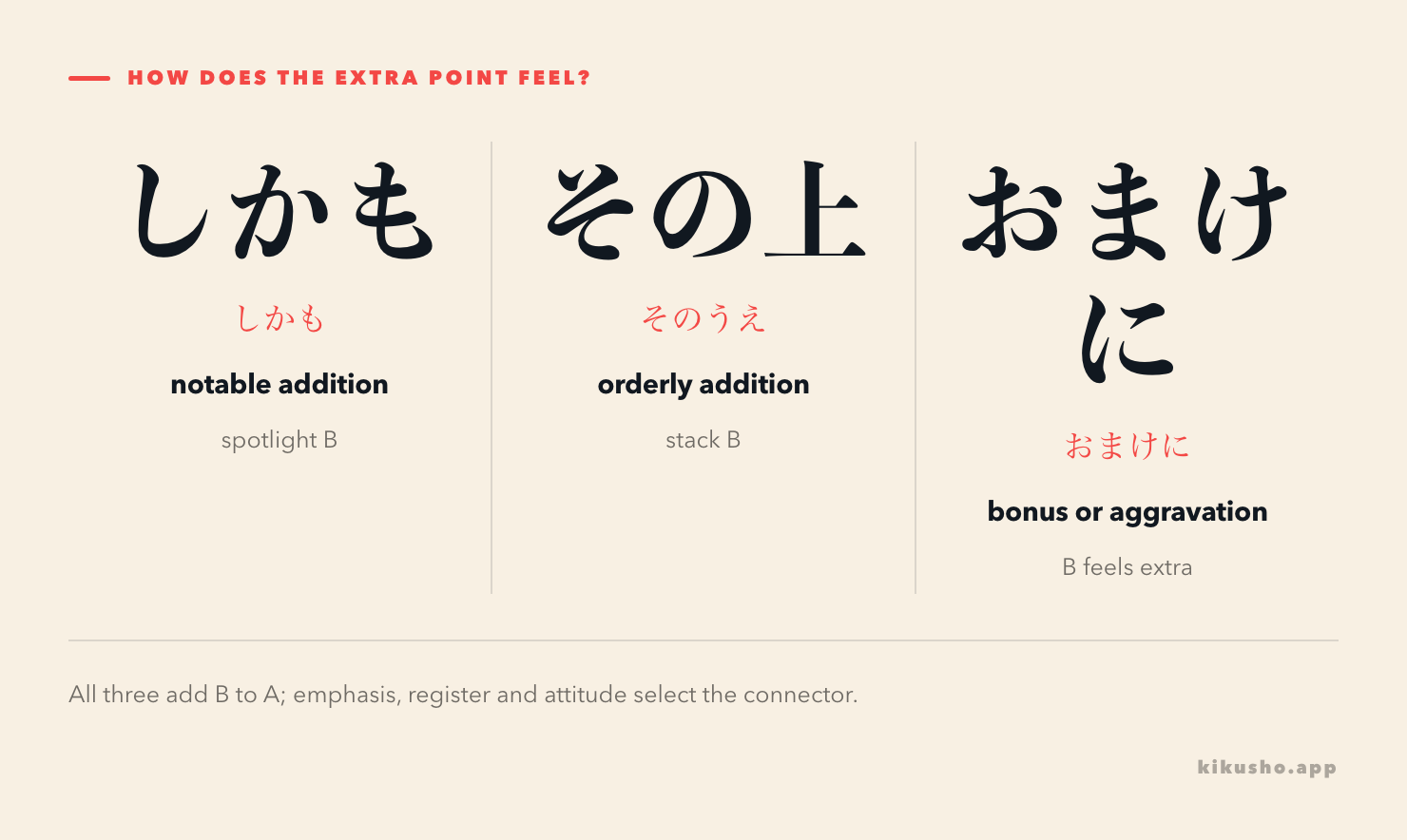
All three expressions add a second point, but they give that point a different weight. しかも makes it notably stronger or surprising, その上 stacks it in a neutral and somewhat formal way, and おまけに presents it as an extra bonus or one more aggravation.
この店は安い。しかも、料理が出てくるのも早い。
This restaurant is inexpensive. What is more, the food arrives quickly.
この店は安い。その上、駅から近い。
This restaurant is inexpensive. In addition, it is close to the station.
この店は安い。おまけに、デザートまで無料だった。
This restaurant is inexpensive. To top it off, even dessert was free.
The facts can overlap. The choice shows how the speaker wants you to receive the addition.
Decide how B sits on top of A
These connectors build the same broad structure: A + connector + B. B supports the direction already established by A, but each connector frames the extra layer differently.
| Connector | What B becomes | Typical register | Useful English cue |
|---|---|---|---|
| しかも | a notable or emphatic addition | standard; common in speech and writing | moreover; what is more |
| その上 | another point stacked on the first | somewhat formal and orderly | furthermore; in addition |
| おまけに | an extra beyond what was already enough | conversational and evaluative | to top it off; to make matters worse |
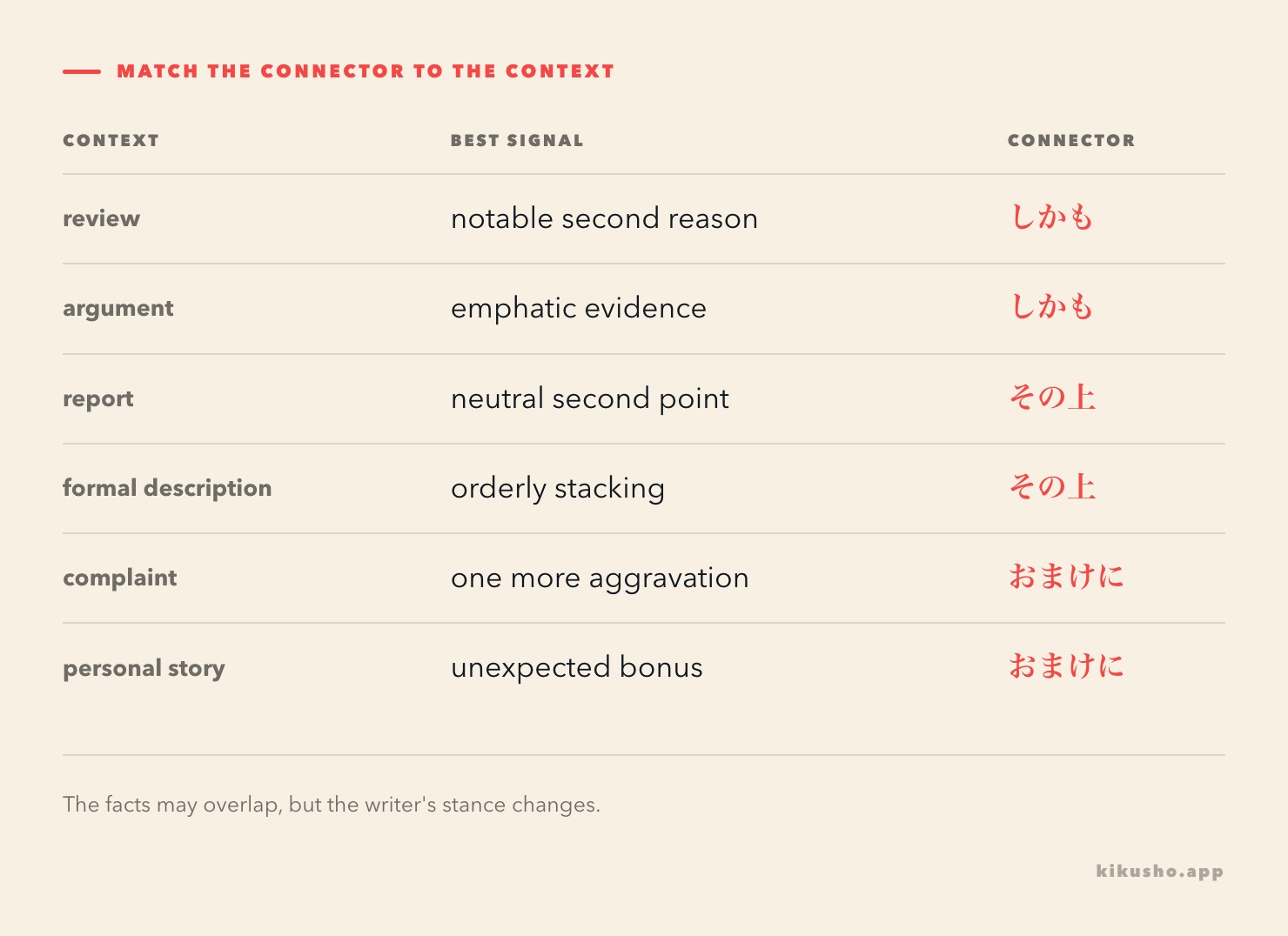
The distinction is not a hard border. In many sentences, more than one connector is grammatical. A good N2 answer depends on the writer's stance, the surrounding register and whether B feels merely additional or like the final extra.
しかも spotlights the added fact
しかも tells the listener that A is not the whole story. B deserves attention because it strengthens, sharpens or unexpectedly expands the description.
彼の説明は短い。しかも、要点がはっきりしている。
His explanation is short. Moreover, the main point is clear.
Both facts praise the explanation. B is not simply the next item on a list; しかも makes clarity a notable second reason for the positive judgment.
電車が遅れた。しかも、車内はひどく混んでいた。
The train was delayed. What is more, it was terribly crowded.
Now the same emphasis reinforces a negative assessment. しかも itself is not positive or negative.
It can begin a sentence or sit between two coordinated phrases:
このかばんは軽く、しかも丈夫だ。
This bag is light and, moreover, durable.
The second form is compact and suits descriptions, recommendations and arguments. しかも is standard Japanese: it appears naturally in conversation, reviews, reports and explanatory prose. Bunpro's しかも entry identifies the A-plus-B structure and the stronger emphasis compared with a plain それに. JLPT Sensei lists the form at N2.
Sometimes English uses “and yet” because B is surprising beside A:
彼は忙しい。しかも、毎日欠かさず運動している。
He is busy, and yet he exercises every day without fail.
Japanese still presents B as an added fact. The apparent contrast comes from our expectation that a busy person lacks time, not from しかも functioning like しかし. If B directly reverses A, use a contrast connector such as しかし or それでも.
その上 builds an orderly stack
その上 points back to the preceding statement and places B “on top of that.” It is neutral enough for factual explanation and slightly more formal than the ordinary conversational それに.
この制度は手続きが複雑だ。その上、必要な書類も多い。
This system has complicated procedures. Furthermore, it requires many documents.
The writer accumulates two reasons for the same assessment. B can be important, but その上 does not give it the “extra blow” personality of おまけに.
この講座では文法を学べる。その上、会話の練習もできる。
In this course, you can learn grammar. In addition, you can practise conversation.
The connector works with positive and negative facts. It is especially comfortable when a report, review or explanation needs a second distinct point.
その上 usually introduces a fact or assessment, not the next desired action or command. A sequence such as “finish the report, then do the workbook” normally calls for それから, 次に or another sequencing expression. The Japanese-language teaching comparison by 旅する応用言語学 likewise notes the formal tendency of その上, its focus on a noteworthy added point and its poor fit before requests, commands and expressions of intention.
Do not confuse the connector with その上で:
| Form | Relationship | Example |
|---|---|---|
| その上、B | B is one more fact | 条件を確認した。その上、費用も調べた。 |
| その上でB | B follows after A or rests on A | 条件を確認し、その上で申し込むか決める。 |
The first says, “I checked the conditions; in addition, I checked the cost.” The second says, “After checking the conditions, I will decide whether to apply.” The particle で changes addition into a basis or stage for what follows.
Bunpro's その上 entry treats it as a conjunctive expression between statements and contrasts it with clause-linking 上に. JLPT Sensei also places その上 at N2.
おまけに makes B feel like the final extra
The noun おまけ can mean a free extra or bonus. As a connector, おまけに keeps that image: A already establishes the situation, and B is piled on beyond it.
朝から頭が痛かった。おまけに、帰りの電車まで止まった。
I had a headache since morning. To make matters worse, even my train home stopped.
The stopped train feels like the last straw. The connector lets the speaker's frustration show.
部屋を無料で広い部屋に変えてもらった。おまけに、朝食券までいただいた。
They upgraded me to a larger room for free. To top it off, I even received breakfast vouchers.
Positive おまけに is equally possible. Here B feels like icing on the cake. The negative use is simply frequent because complaints naturally build toward one aggravation too many.
おまけに commonly starts the second sentence or clause. It is more conversational and openly evaluative than その上. That makes it vivid in personal stories, reactions and complaints, but less suitable for a detached report.
Bunpro's おまけに entry explains the “bonus” relation: A is already enough to establish the situation, while B adds icing on the cake or insult to injury. JLPT Sensei independently records both positive and negative use at N2.
Keep both points moving in one direction
The safest shared rule is that B reinforces the evaluation created by A. Two advantages, two problems or two remarkable features form a coherent stack.
このアプリは操作が簡単だ。しかも、表示も見やすい。
このアプリは操作が簡単だ。その上、表示も見やすい。
このアプリは操作が簡単だ。おまけに、広告までない。
All three are possible. しかも highlights visibility as notable evidence. その上 lists it as another advantage. おまけに makes the absence of ads feel like the unexpected bonus.
If the second fact changes direction, mark the reversal explicitly:
この店は安い。しかし、駅から遠い。
This restaurant is inexpensive. However, it is far from the station.
Using おまけに here would force the listener to search for a viewpoint in which being far away somehow reinforces the first evaluation. The problem is the logic between A and B, not the grammar inside either clause.
The earlier さらに and さて lesson separates continued addition from a topic shift. For additions inside a noun phrase or clause, the に加えて and のみならず lesson gives the attachment patterns these sentence-level connectors do not have.
When saving an example in Kikusho, keep the sentence before the connector on the card. A card containing only おまけに、電車まで止まった hides the fact that makes the train stoppage an extra blow. Capturing the two-sentence unit preserves the discourse relation you will need to recall.
Practice: choose the added weight
Question 1 — neutral report
A written report adds a second factual disadvantage without sounding personal. Choose the best fit.
申請方法が複雑だ。__、審査にも時間がかかる。
ア) その上
イ) その上で
ウ) それでも
エ) さて
Question 2 — final aggravation
The speaker is complaining and presents the lost wallet as one more disaster.
電車に乗り遅れた。__、財布までなくしてしまった。
ア) しかし
イ) おまけに
ウ) その上で
エ) つまり
Question 3 — compact emphasis
Complete the description: “This material is light and, moreover, durable.”
この素材は軽く、__丈夫だ。
ア) その上で
イ) しかし
ウ) しかも
エ) さて
Question 4 — sentence composition
Arrange the chunks to say, “After checking the conditions, I will decide whether to apply.”
- 申し込むか決める
- 条件を確認し
- その上で
- 。
Question 5 — follow the evaluation
Which sentence keeps A and B moving in the same evaluative direction?
ア) この店は安い。おまけに、料理もおいしい。
イ) この店は安い。おまけに、駅から遠い。
ウ) この店は安い。その上で、味は普通だ。
エ) この店は安い。さて、料理もおいしい。
Question 6 — connected text
Choose the pair that preserves the writer's stance.
新しい図書館は席が多い。( ① )、夜九時まで利用できる。昨日は本を三冊借りた。( ② )、開館記念のしおりまでもらった。
ア) ①その上 ②おまけに
イ) ①その上で ②しかし
ウ) ①おまけに ②その上で
エ) ①しかし ②しかも
Answers and explanations
Answer 1
ア) その上. The report stacks a second disadvantage in a neutral, orderly way. その上で would make the first fact a basis or prior stage for the second.
Answer 2
イ) おまけに. Missing the wallet is the final extra in an already bad sequence, so the connector carries the speaker's aggravation.
Answer 3
ウ) しかも. 軽く、しかも丈夫だ compactly coordinates two simultaneous advantages and places emphasis on durability.
Answer 4
2 → 3 → 1 → 4. 条件を確認し、その上で申し込むか決める。 The decision follows after and rests on the check, so その上で is required.
Answer 5
ア. Low price and good food are both advantages. Choice イ changes from an advantage to a disadvantage without a contrast marker; ウ misuses その上で; エ shifts topic instead of adding support.
Answer 6
ア) ①その上 ②おまけに. The first connector neutrally stacks two library advantages. The commemorative bookmark then feels like an unexpected bonus beyond borrowing the books, which suits おまけに.
Common questions
What is the difference between しかも, その上 and おまけに?
しかも emphasizes a notable added fact, その上 stacks another point in a neutral and somewhat formal way, and おまけに treats the last point as an extra bonus or further aggravation.
Can しかも, その上 and おまけに be interchangeable?
Often, because all three add a second fact in the same evaluative direction. The choice still changes the emphasis, register and amount of speaker attitude.
Can おまけに introduce something positive?
Yes. It can add icing on the cake as well as insult to injury. Negative examples are common, but the essential idea is that the added fact feels extra.
Is その上 the same as その上で?
No. その上 adds another fact. その上で usually means after doing that or on that basis, so it establishes a sequence or condition for the following action.