On this page
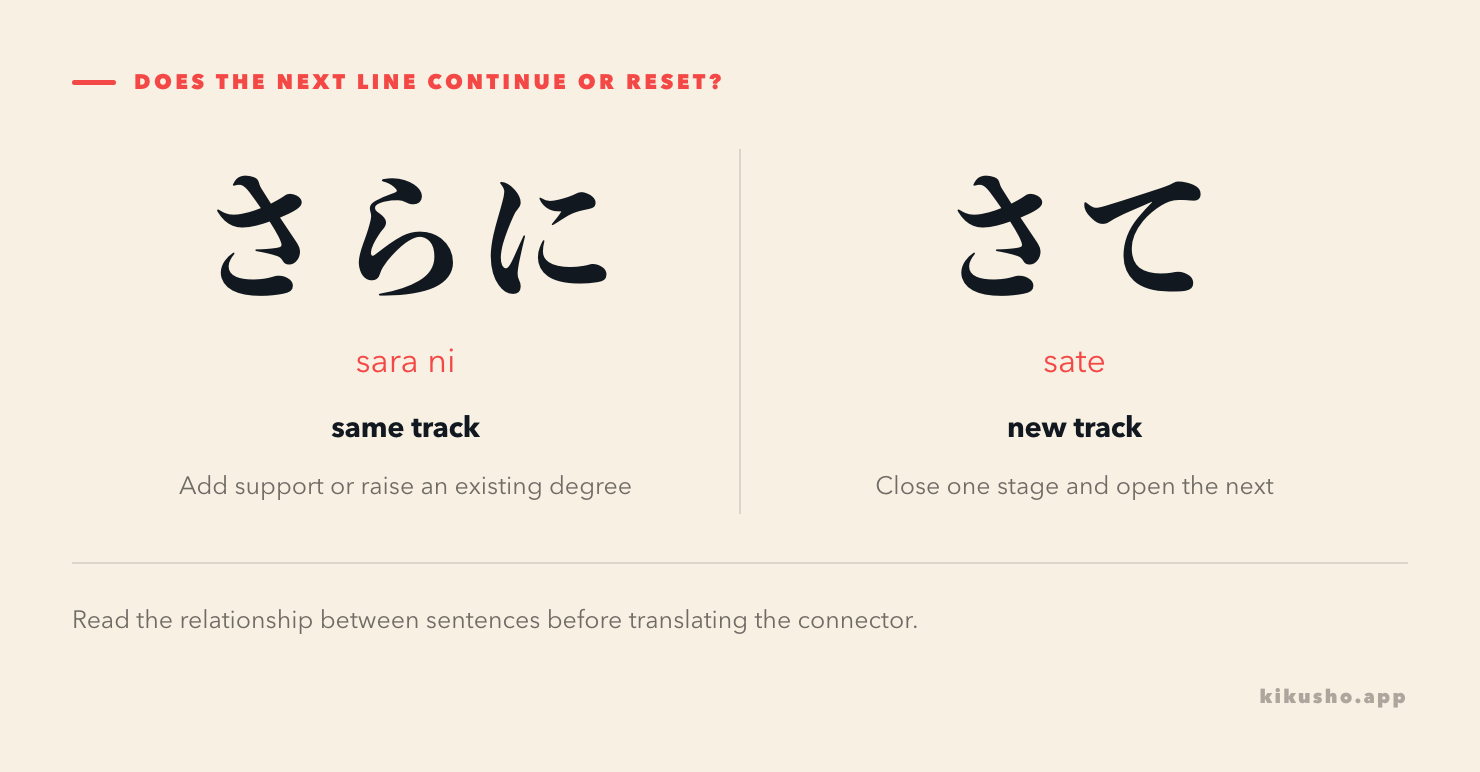
Use さらに to continue the same line with another fact or a higher degree. Use さて to close that line and begin a new topic, question or stage: one extends the argument, while the other resets its direction.
The deciding test is whether the next sentence stays on the same track
Imagine a speaker describing a town:
この町は交通が便利です。さらに、家賃も安いです。 This town has convenient transport. Furthermore, the rent is inexpensive.
Both facts support the same description of the town. さらに tells the listener to add the second fact to the first.
Now the speaker has finished describing the town and wants to discuss a school:
この町は交通が便利で、家賃も安いです。さて、学校について見てみましょう。 This town has convenient transport and inexpensive rent. Now then, let us look at the school.
さて does not add one more advantage of the town. It signals that the current stage is complete and directs attention to what comes next. English “now” or “well then” can suggest that turn, but the useful meaning is the boundary itself.
さらに has two positions and one idea of addition
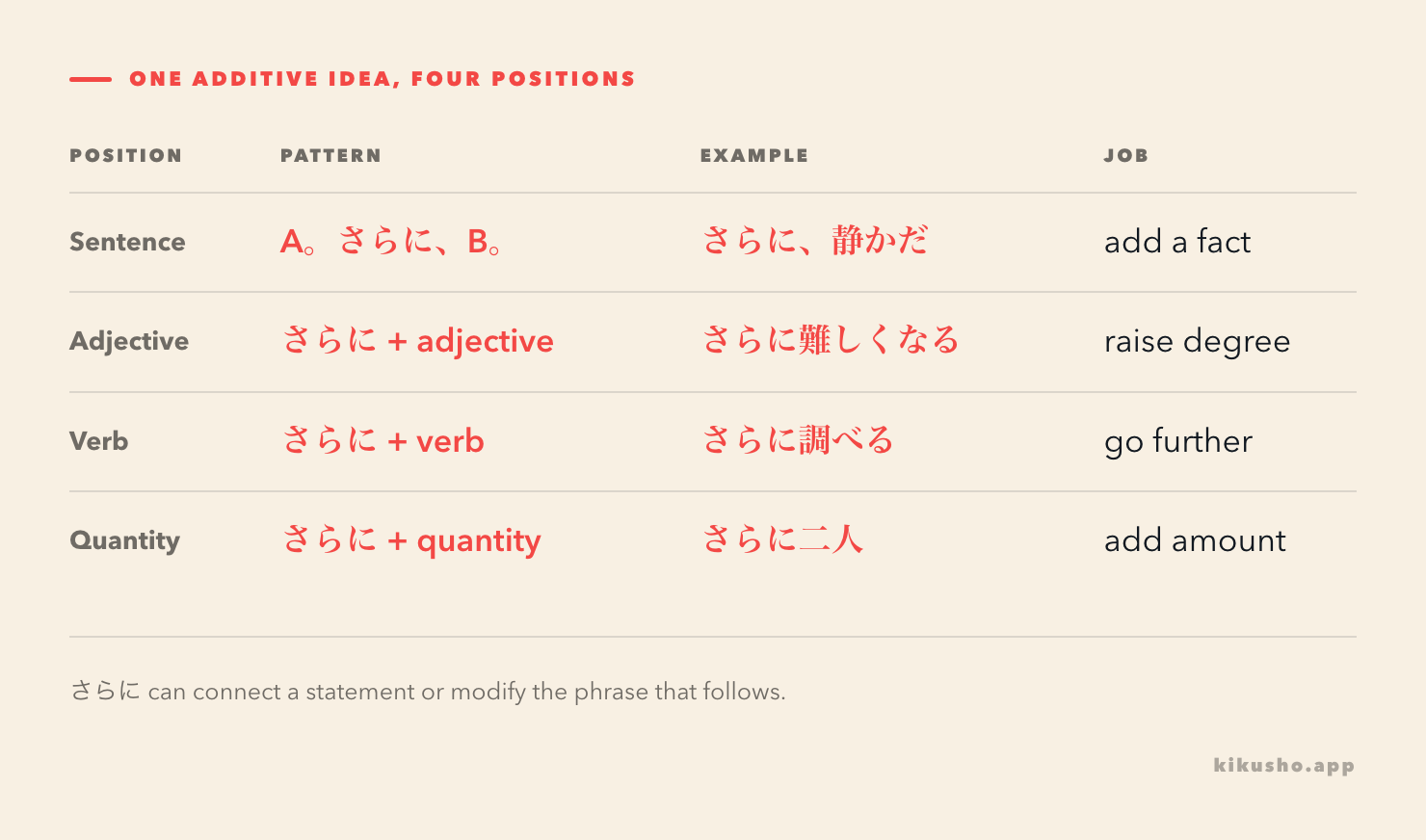
さらに(更に)works both as a sentence connector and as an adverb inside a sentence. In both positions, something already exists and the following material takes it further.
| Position | Pattern | Example | Function |
|---|---|---|---|
| Sentence opening | A。さらに、B。 | 駅に近い。さらに、静かだ。 | Add another supporting fact |
| Before an adjective | さらに + adjective | さらに難しくなる | Raise the degree |
| Before a verb | さらに + verb | さらに調べる | Carry the action further |
| Before a quantity | さらに + quantity | さらに二人が参加した | Add another amount |
At a sentence boundary, it often translates as “furthermore” or “in addition”:
この案は費用が少ない。さらに、準備にも時間がかからない。 This plan costs little. Furthermore, it does not take long to prepare.
Inside a clause, “further” or “even more” is usually closer:
来月は気温がさらに高くなるでしょう。 Temperatures will probably become even higher next month.
結論を出す前に、さらに調べる必要があります。 We need to investigate further before reaching a conclusion.
Shogakukan's dictionary entry records both addition to an existing fact and an increase in degree over time. Bunpro's さらに lesson connects those uses through the same idea: the next phrase goes beyond a base that has already been established.
さて belongs at the entrance to a new stage
さて is a conjunction or interjection-like transition placed at the beginning of a sentence or turn. It can launch a lesson, move a presentation to its next section, turn from a greeting to the purpose of an email, or prompt the next action:
さて、次の問題に進みましょう。 Now then, let us move on to the next question.
さて、今日のテーマは何でしょうか。 Well then, what is today's topic?
さて、先日ご相談いただいた件ですが、資料をお送りします。 Now, regarding the matter you consulted us about recently, I am sending the documents.
Bunpro describes さて as a sentence-initial signal for a new topic or next point. ARC Tokyo Japanese Language School gives the same three settings: starting something, changing topic, and moving from an email greeting to its business. This deliberate transition sounds natural in teaching, presentations, prepared conversation and correspondence. In quick casual chat, じゃあ or それで may be more common depending on the relationship between the turns.
さて is normally written in hiragana. Rare spellings such as 扨 and 偖 exist, but recognizing them is not part of the useful N3 control of this connector.
Replacing one with the other changes the paragraph's architecture
Consider a short presentation:
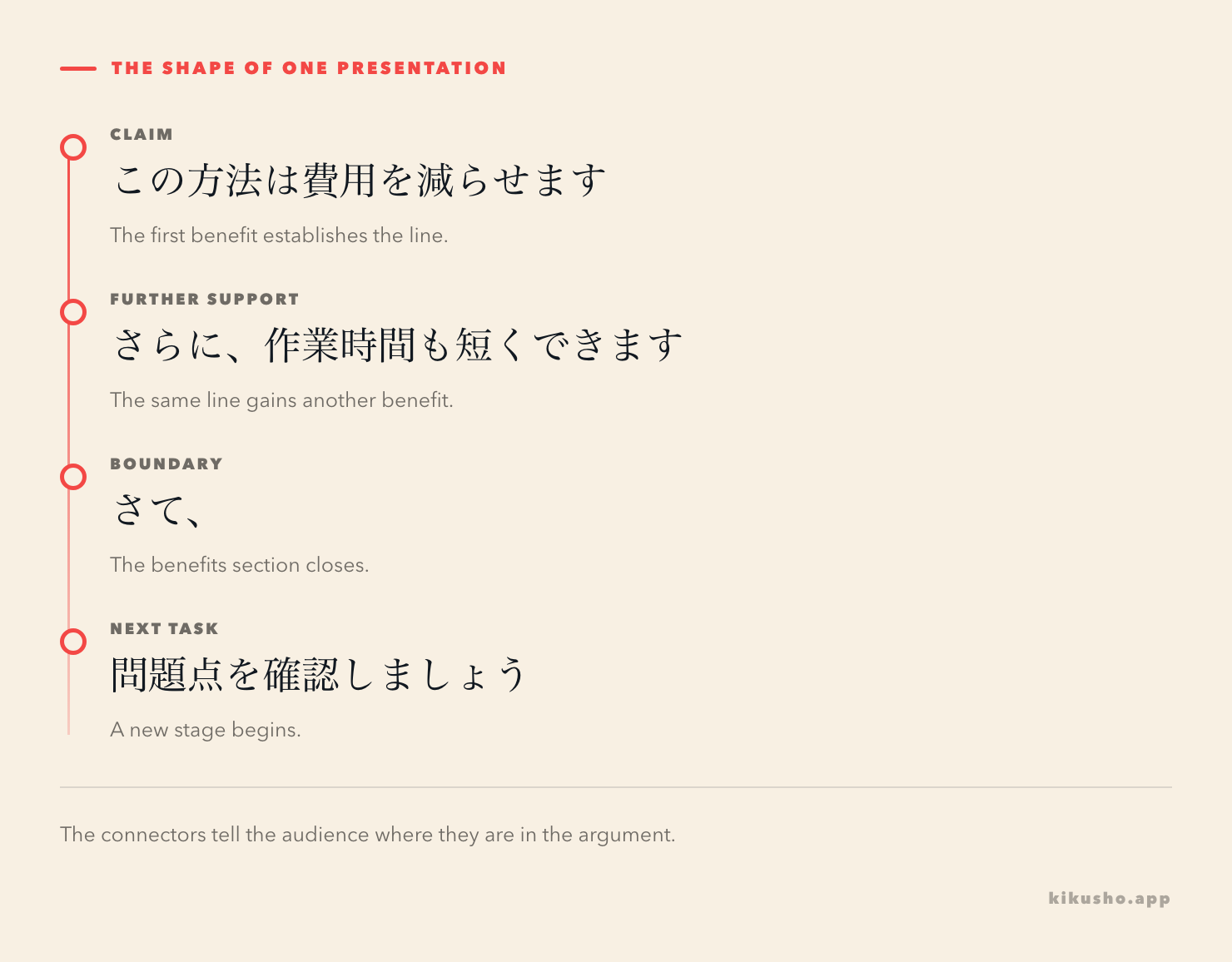
この方法は費用を減らせます。さらに、作業時間も短くできます。さて、次に問題点を確認しましょう。 This method can reduce costs. Furthermore, it can shorten working time. Now then, let us check the problems next.
The first connector gathers a second benefit under the same claim. The second closes the benefits section and opens the problems section. Their order sketches the presentation before you translate a single noun.
Replace さらに with さて after the first sentence and the listener expects a new section. 作業時間も短くできます then arrives as if “shorter working time” were a fresh topic rather than another benefit. Replace the final さて with さらに and 問題点 sounds like one more supporting feature of the method, even though it reverses the evaluation. The individual sentences remain understandable, but the map between them is wrong.
This is the same reading skill used with everyday sentence connectors such as それに and それで. Do not translate the connector alone. Identify the relationship it announces between the pieces around it.
さらに adds; it does not merely mean “next”
さらに can occur before a later event, but it does not by itself establish a chronological sequence. It says that the event, amount or point is additional or intensified.
受付を済ませた。次に、面接を受けた。 I completed registration. Next, I had an interview.
次に is the plain sequence marker here. If you write さらに、面接を受けた, the interview is presented as an additional item, perhaps one more burden or step under discussion. That may fit a context, but it is not a neutral replacement for “next.”
The same limit separates さらに from さて. さて can move a speaker to the next stage, yet it does not claim that one event happened after another in the story. It announces the speaker's decision to proceed. A narrator who only wants to list events would use それから or 次に.
さて changes direction more deliberately than ところで
Both さて and ところで can change the subject. ARC Tokyo draws a useful boundary: さて may introduce a topic related or unrelated to what came before, while ところで normally advertises an unrelated turn. Compare:
ここまで、申込方法を説明しました。さて、必要な書類を確認しましょう。 So far, I have explained how to apply. Now, let us check the required documents.
The application remains the broad subject, but the lesson advances to its next section. さて fits that planned progression.
申込方法は分かりました。ところで、駅から会場まで何分ですか。 I understand how to apply. By the way, how many minutes is it from the station to the venue?
The travel question breaks away from the application instructions. ところで makes that side turn explicit. Real conversation permits overlap, but this distinction explains why さて is so common in lectures and written notices: it can move the whole discourse forward without pretending the previous material never existed.
For more formal additions, conclusions and restrictions in notices, the formal written connectors guide extends the same relationship-first method to なお, したがって and ただし.
N3 and N2 references disagree only on さらに
JLPT Sensei lists both さらに and さて as N3 grammar. Bunpro places さて at N3 but teaches さらに at N2. The disagreement does not change either word's form or meaning. It reflects where two publishers sequence a common connector with both discourse and adverbial uses.
The JLPT does not release an exhaustive official grammar list. A practical N3 target is to read the discourse boundary correctly and use the common sentence-initial patterns. Finer comparisons with その上, しかも, ますます and ところで can continue beyond that core.
When saving one of these connectors in Kikusho, keep at least two sentences. A card containing only さて = “well” loses the topic boundary; a pair showing the sentence before it preserves the reason the word is there.
Practice
Question 1. A guide is adding a second advantage of the same museum. Choose the natural connector.
この美術館は駅に近いです。__、入場料も安いです。
a) さて b) さらに c) ところで d) しかし
Question 2. Where does さて fit best?
a) この町は海が近い。__、魚も新鮮だ。 b) 今日は昨日より__寒くなった。 c) ここまで原因を見てきた。__、解決方法を考えよう。 d) 参加者が__三人増えた。
Question 3. Which sentence uses さらに as an adverb of degree rather than as a connector between two statements?
a) この店は安い。さらに、駅にも近い。 b) 練習すれば、さらに上手になる。 c) 説明は以上です。さて、質問はありますか。 d) さて、会議を始めましょう。
Question 4. Arrange the pieces into a sentence meaning “We need to investigate this point further.”
必要があります ・ この点を ・ さらに ・ 調べる
Question 5. Read the two-sentence passage. What does さて tell the audience?
以上で新しい制度の利点を説明しました。さて、導入までの日程を確認しましょう。
a) Another advantage will be added. b) The schedule caused the advantages. c) The advantages section is closing and the schedule section is beginning. d) The speaker doubts that the system has advantages.
Question 6. Choose the pair that completes the presentation coherently.
この案なら費用を二割減らせます。__、準備期間も短くできます。__、最後に実施上の注意点を説明します。
- First pair: さて / さらに
- Second pair: さらに / さて
- Third pair: しかし / さらに
- Fourth pair: さて / ところで
Answers and explanations
Answer 1: b) さらに. Proximity to the station and low admission are two advantages supporting the same description. さらに keeps the discourse on that line and adds the second point.
Answer 2: c). The discussion of causes has ended, and the speaker deliberately opens the next stage, solutions. In (a), another feature of the same town calls for an additive connector. In (b) and (d), the blank sits inside a clause where さらに can modify a degree or quantity.
Answer 3: b) 練習すれば、さらに上手になる. さらに directly modifies 上手になる and raises the degree: “become even better.” In (a) it opens a new sentence and adds another feature. The other two sentences use さて.
Answer 4: この点をさらに調べる必要があります。 さらに sits before 調べる and means that the investigation must go further. この点を is the object of 調べる, and the whole verb phrase modifies 必要があります.
Answer 5: c). 以上で explicitly closes the explanation of advantages. さて then guides the audience into the schedule, the next section of the same broader presentation.
Answer 6: the second pair, さらに / さて. A shorter preparation period is a second benefit of the proposal, so さらに adds it to the cost reduction. The final sentence opens a new section on cautions, so さて marks that boundary.
Common questions
What is the difference between さらに and さて?
さらに adds another fact in the same direction or raises an existing degree. さて marks a discourse boundary: the speaker closes one stage and starts a new topic, question or action.
Can さらに appear inside a sentence?
Yes. At the start of a sentence it can mean “furthermore.” Before a verb, adjective or quantity, it can mean “further,” “even more” or “another,” as in さらに調べる and さらに二人が参加する.
Is さらに N3 or N2 grammar?
Study references disagree: JLPT Sensei lists さらに at N3 while Bunpro teaches it at N2. Both place さて at N3. These are editorial estimates because the JLPT does not publish an exhaustive official grammar list.