On this page
に加えて neutrally adds B to an existing item or factor A. のみならず means “not only A but B too,” with a formal tone and a stronger sense that the claim extends beyond A's original range.
Compare two sentences about the same project:
人手不足に加えて、予算も足りない。
ひとでぶそくに くわえて、よさんも たりない。
In addition to a staff shortage, the budget is insufficient.
この問題は一社のみならず、業界全体に影響する。
この もんだいは いっしゃのみならず、ぎょうかいぜんたいに えいきょうする。
This problem affects not only one company but the entire industry.
The first sentence places two problems side by side. The second expands the affected range from one company to a whole industry. That addition versus scope distinction settles most choices between the two forms.
Ask whether B is another item or a wider reach
Use Aに加えて、Bも when A and B behave like two entries on a list. Use Aのみならず、Bも when the sentence denies that A is the limit and carries the same claim into B.
| What the sentence does | Pattern | Natural setting |
|---|---|---|
| adds one more factor | Aに加えて、Bも | reports, explanations, neutral descriptions |
| expands a claim beyond A | Aのみならず、Bも/まで/さえ | essays, news, speeches, formal argument |
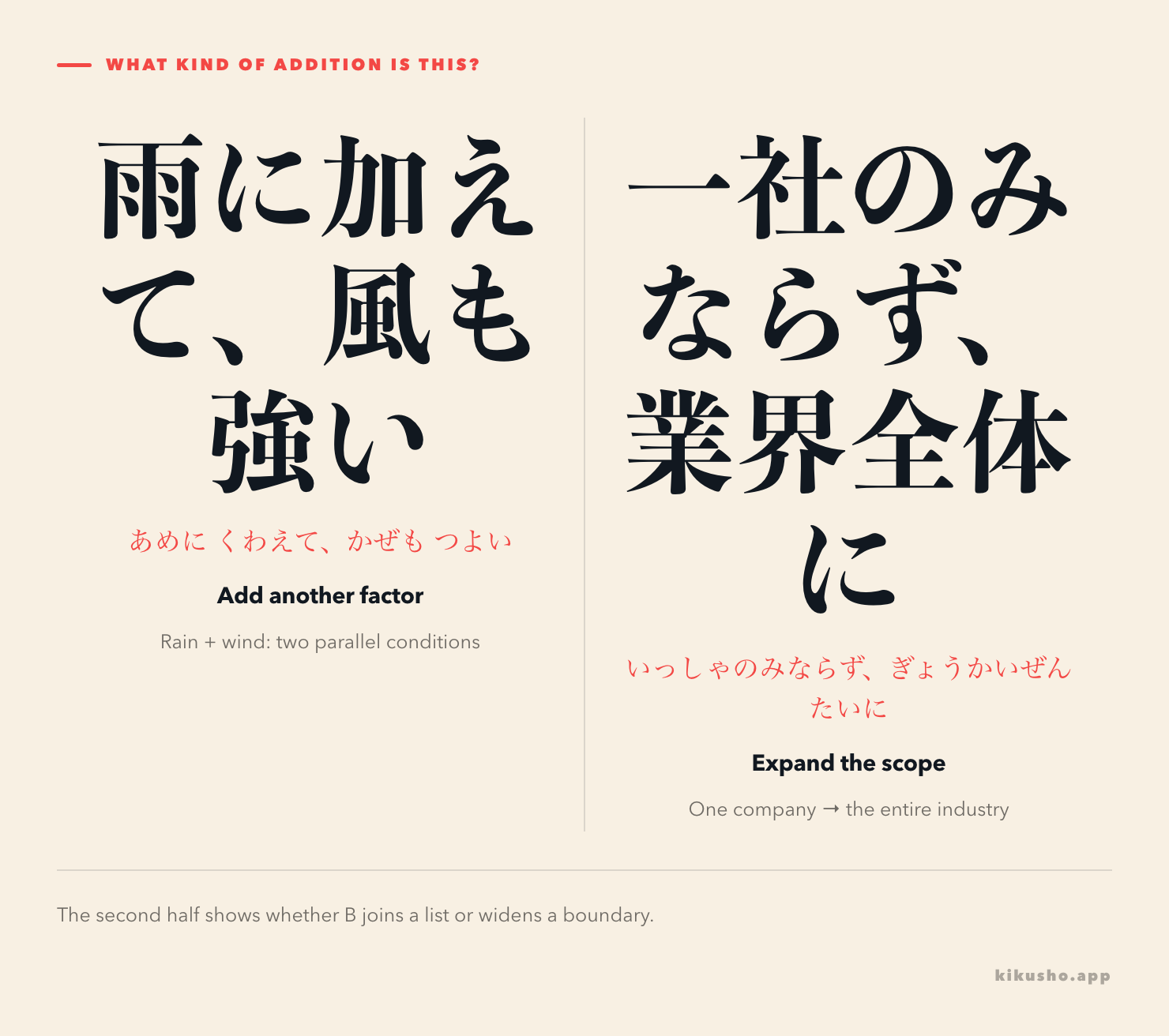
The distinction is about how the writer organizes the information. A sentence with に加えて can still describe a surprising problem, and a sentence with のみならず can list two nouns. The test is whether the wording simply accumulates factors or presents B as evidence that A was too narrow a boundary.
に加えて adds to a noun already on the list
に加えて(にくわえて, ni kuwaete) follows a noun. The noun names the first condition, feature or item; the rest of the sentence supplies another.
雨に加えて、風も強くなった。
あめに くわえて、かぜも つよくなった。
In addition to the rain, the wind grew stronger.
この仕事には経験に加えて、忍耐も必要だ。
この しごとには けいけんに くわえて、にんたいも ひつようだ。
This job requires patience in addition to experience.
Bunpro's に加えて reference gives the attachment as noun + に加え(て) and describes the expression as formal. JLPT Sensei independently lists the same noun attachment and places it at N2. Both labels serve as study guidance; the exam organizer does not define a complete official grammar list.
The shorter に加え has the same job and often sounds still more compressed or written:
原材料費に加え、輸送費も上昇した。
げんざいりょうひに くわえ、ゆそうひも じょうしょうした。
In addition to raw-material costs, transport costs also rose.
A finite verb cannot normally stand directly before に加えて. Turn the action or property into a noun-like unit first:
- 経験が不足していることに加えて、時間もない。 In addition to lacking experience, there is no time.
- 部屋が狭いのに加えて、駅からも遠い。 In addition to being small, the room is far from the station.
The の in the second example nominalizes 部屋が狭い. It is separate from the contrasting connector のに.
のみならず carries the claim beyond A
のみならず(nomi narazu) is a formal “not only.” It attaches to nouns and to plain-form predicates, then commonly pairs with も, まで or さえ in the second part.
この制度は学生のみならず、社会人も利用できる。
この せいどは がくせいのみならず、しゃかいじんも りようできる。
This system can be used not only by students but by working adults too.
彼は約束を破ったのみならず、謝ろうともしなかった。
かれは やくそくを やぶったのみならず、あやまろうとも しなかった。
He not only broke his promise but did not even try to apologize.
この方法は難しいのみならず、時間もかかる。
この ほうほうは むずかしいのみならず、じかんも かかる。
This method is not only difficult but also takes time.
N1et's のみならず lesson documents noun, verb and adjective attachment and notes its formal register. Its examples also show the construction carrying one claim across parallel members. Bunpro and JLPT Sensei both list the form at N2.
With な-adjectives, である is the reliable formal bridge:
彼女は有能であるのみならず、誠実でもある。
かのじょは ゆうのうで あるのみならず、せいじつでも ある。
She is not only capable but also sincere.
Nouns can appear directly before のみならず, as in 学生のみならず. Nであるのみならず is also possible when the sentence explicitly presents the first nominal claim.
Their attachment patterns are not interchangeable
The two forms overlap most easily after nouns. Beyond that shared row, their grammar separates.
| Before the connector | に加えて | のみならず |
|---|---|---|
| noun | 費用に加えて | 費用のみならず |
| verb | 遅れたことに加えて | 遅れたのみならず |
| い-adjective | 高いのに加えて | 高いのみならず |
| な-adjective | 複雑であることに加えて | 複雑であるのみならず |
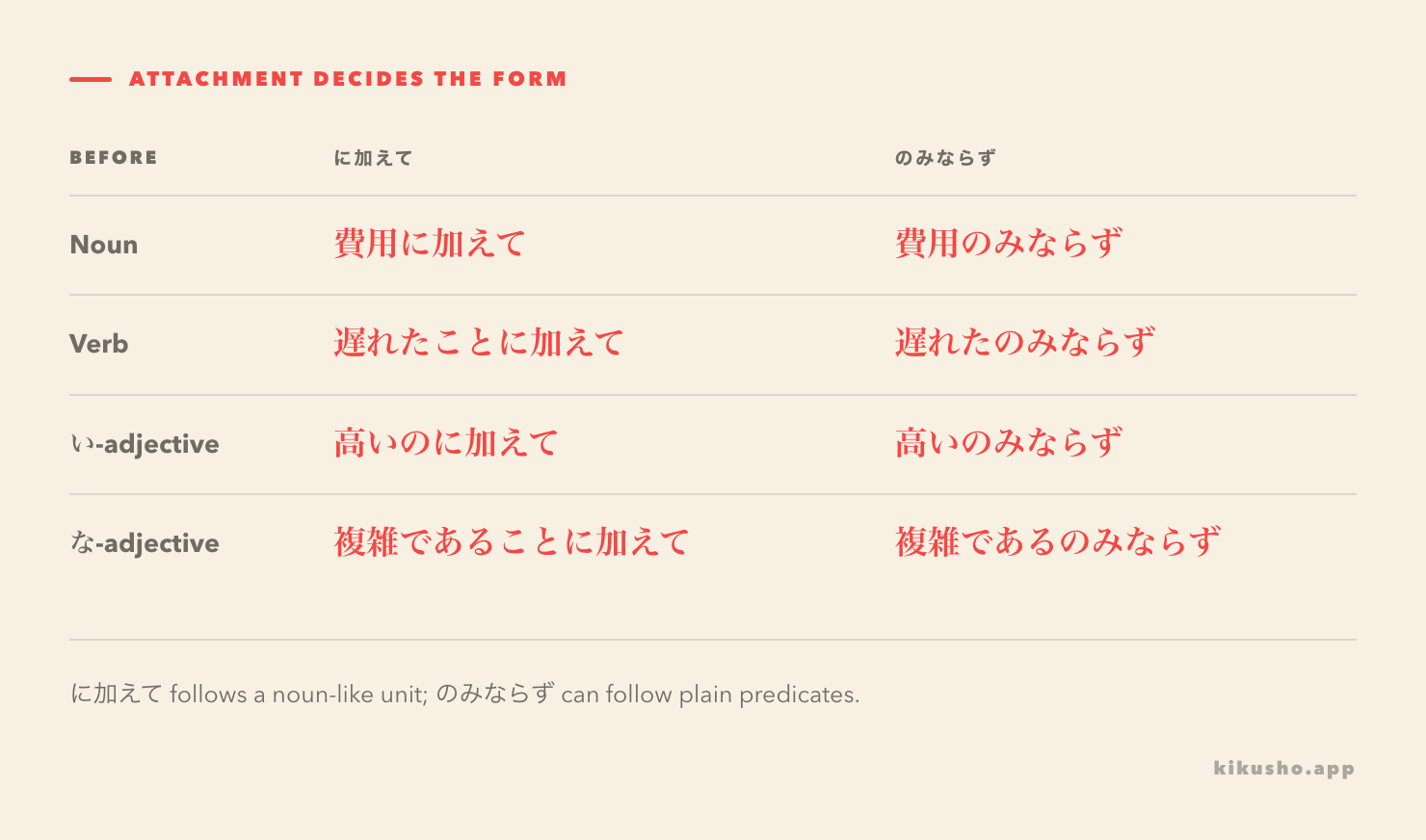
This difference creates a common exam trap. 高いに加えて is missing nominalization; use 高いのに加えて. 高いのみならず needs no の because のみならず can follow the plain い-adjective directly.
The second half does not mechanically require も, but も makes the added member easy to read. まで and さえ can mark a stronger extension: 子どものみならず、大人まで夢中になった, “Not only children; even adults became absorbed.”
The overlap changes how the reader groups the facts
Both forms can be grammatical with the same pair of nouns:
日本語に加えて、中国語も勉強している。
I study Chinese in addition to Japanese.
日本語のみならず、中国語も勉強している。
I study not only Japanese but Chinese too.
The first sounds like a neutral addition to a study plan. The second rejects “Japanese only” as an incomplete description and sounds more formal. In ordinary conversation, だけでなく is a more natural way to express the second relationship.
Do not use のみならず merely to make any two-item list sound advanced. Its register should fit the surrounding sentence. A policy report can naturally say 若者のみならず、高齢者にも影響がある. A casual comment about lunch is more likely to use だけでなく.
The related はもちろん treats A as an obvious member before adding B. The lesson on はもちろん and ~で有名 shows how that presupposition differs from simply denying an A-only limit.
When you save either construction in Kikusho, keep both halves of the sentence. A card ending at 予算に加えて or 学生のみならず preserves the setup but loses the added point that gives the connector its function. Capturing A, the connector, B and the shared predicate makes the contrast visible during review.
Practice: choose the relationship and the attachment
Question 1 · neutral addition
Complete: この計画には、資金( )、十分な人員も必要だ。
- A. に加えて
- B. のみならずに
- C. を加えての
- D. でのみならず
Question 2 · wider scope
Complete: 大雨の影響は九州( )、本州にも広がった。
- A. に加えて
- B. のみならず
- C. のに加えて
- D. で加えて
Question 3 · verb attachment
Which sentence correctly means “He not only arrived late but forgot the documents too”?
- A. 彼は遅れて到着に加えて、書類も忘れた。
- B. 彼は遅れて到着のみならず、書類も忘れた。
- C. 彼は遅れて到着したのみならず、書類も忘れた。
- D. 彼は遅れて到着したに加えて、書類も忘れた。
Question 4 · adjective attachment
Complete: この機械は操作が複雑である( )、修理にも費用がかかる。 The writer is neutrally adding a second drawback.
- A. のみならず
- B. ことに加えて
- C. に加えて
- D. のみ加えて
Question 5 · register
Which sentence is the most natural casual comment to a friend?
- A. この店は安いのみならず、量も多いよ。
- B. この店は安いに加えて、量も多いよ。
- C. この店は安いだけでなく、量も多いよ。
- D. この店は安いことでのみならず、量も多いよ。
Question 6 · meaning in context
A report says: この変更は利用者の手間を増やすのみならず、運営側の費用も押し上げる。 What does のみならず contribute?
- A. It limits the effect to users' effort.
- B. It replaces users' effort with operating costs.
- C. It extends the negative effect beyond users' effort to operating costs.
- D. It says operating costs caused the change.
Answers and explanations
Answer 1
A. に加えて. 資金 and 十分な人員 are two parallel requirements. The noun 資金 can attach directly to に加えて. The other choices do not form the required connector.
Answer 2
B. のみならず. The report expands the affected area from Kyushu to Honshu, so “not only Kyushu but Honshu too” fits. に加えて would present regions as list items rather than foregrounding the widening reach.
Answer 3
C. 彼は遅れて到着したのみならず、書類も忘れた. のみならず follows the plain past verb 到着した. に加えて would require a noun-like unit such as 遅れて到着したことに加えて.
Answer 4
B. ことに加えて. 複雑であること packages the property as a noun-like first factor before に加えて. A is grammatical Japanese, but it presents a formal “not only” scope relationship rather than the neutral addition requested by the prompt.
Answer 5
C. この店は安いだけでなく、量も多いよ. だけでなく suits casual conversation and attaches directly to 安い. のみならず is too formal for this chatty setting, while に加えて needs nominalization after the adjective.
Answer 6
C. It extends the negative effect beyond users' effort to operating costs. The first consequence remains true; the construction denies that it is the full extent of the effect and adds a second consequence. It neither limits nor replaces A.
Let the second half reveal the writer's move
When a sentence is long, locate B and the shared claim before translating the connector. A simple Bも after に加えて usually completes a list of factors. A move from one group to a broader group after のみならず shows that the writer is stretching the boundary of the claim. That reading habit works even when English renders both sentences with “also.”
Common questions
What is the difference between に加えて and のみならず?
に加えて neutrally adds a parallel item or factor to a noun already mentioned. のみならず formally rejects A as the limit and extends the same claim to B, often across a wider or less expected scope.
What can come before に加えて?
A noun comes directly before に加えて. To add a full action or property, first package it as a noun phrase, commonly with こと or の.
Is のみならず used in conversation?
It is grammatical but markedly formal and is most at home in reports, essays, speeches and formal explanations. だけでなく is the usual everyday alternative.