On this page
Both せめて and 少なくとも can become “at least” in English, but they do different work. せめて names the minimum the speaker still hopes to obtain; 少なくとも gives the lowest reasonable quantity, condition or claim.
せめて一日だけ休みたい。
I want at least one day off.
この作業には少なくとも三日かかる。
This work will take at least three days.
The first sentence reveals a disappointed wish: more time off would be better, but one day is the minimum the speaker longs for. The second estimates a lower boundary. It does not tell us whether the speaker feels happy, frustrated or resigned about those three days.
Choose between a wished-for minimum and a lower bound
Ask what the sentence is doing with its minimum.
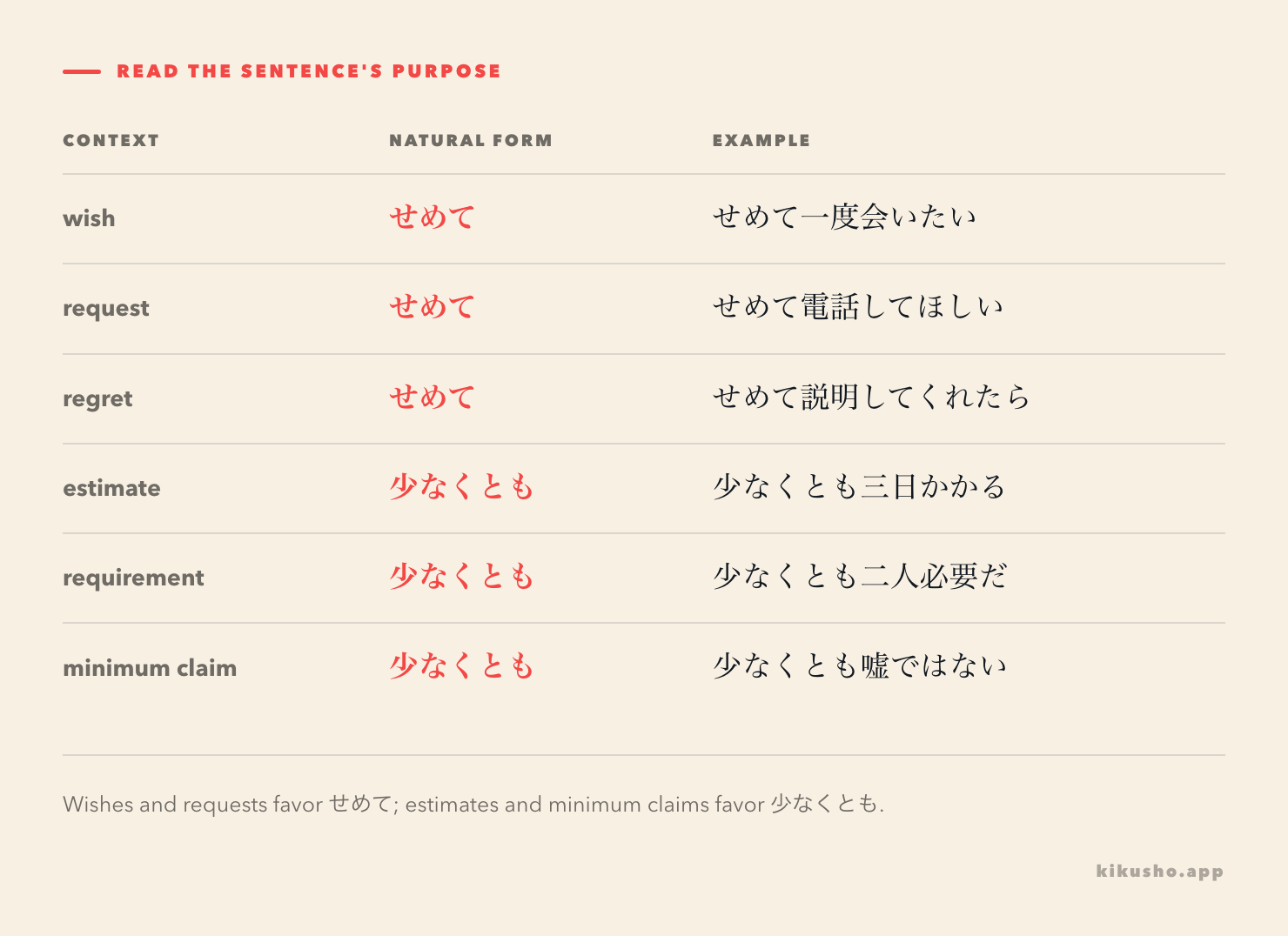
| Intended message | Choose | Natural companions |
|---|---|---|
| “If I cannot have the ideal, I still want this much” | せめて | 〜たい, 〜てほしい, requests, wishes, regret |
| “The amount cannot reasonably be lower than this” | 少なくとも | numbers, time, requirements, estimates |
| “Even under a cautious claim, this much is true” | 少なくとも | judgments such as 〜ではない, 〜と言える |
This is a difference in viewpoint, not simply a difference between emotional and emotionless sentences. A factual situation can frustrate the speaker, and 少なくとも can appear in personal opinions. The deciding question is whether the minimum is being requested or wished for, or set as a boundary.
せめて keeps one modest hope alive
せめて appears when the preferred result is unavailable, unlikely or already lost. The speaker lowers the target and identifies the one result that would still provide some satisfaction.
全部は読めなくても、せめて結論だけは理解したい。
Even if I cannot read all of it, I want to understand at least the conclusion.
The ideal is understanding the whole text. 結論だけは理解したい is the reduced hope the speaker refuses to give up.
来られないなら、せめて電話をしてください。
If you cannot come, at least please call.
The request is not a calculation of the minimum number of phone calls. It is a fallback: coming would be preferable, but calling is the least the speaker asks.
Common shapes include:
| Shape | What follows | Example |
|---|---|---|
| せめて + noun + だけでも | one small substitute | せめて名前だけでも教えてください |
| せめて + amount + は | desired minimum quantity | せめて二時間は寝たい |
| せめて + noun + くらい | a modest request, sometimes reproachful | せめて返事くらいしてほしい |
| せめて + clause | minimum action or state | せめて無事でいてほしい |
Particles such as だけでも, は and くらい help show what counts as the reduced target, but none is compulsory. せめて一度会いたい is complete and natural.
The emotional force depends on the ending. せめて五分待ってください is a plea; せめて五分は待つべきだ presents the speaker's idea of the least acceptable conduct; せめて五分待ってくれたらよかったのに expresses regret. In each case, a better outcome remains visible in the background.
This is why せめて can sound accusatory in a request. せめて連絡してほしかった does more than state that contact was absent. It implies that contacting the speaker was a very modest expectation and that the other person failed even that standard.
Digital Daijisen's entry defines the modern adverb as a minimum wish the speaker wants realised despite dissatisfaction. JLPT Sensei and Bunpro both place the studied use at N2.
少なくとも draws the bottom line
少なくとも literally directs the listener to consider the smallest reasonable amount or scope. It often modifies quantities:
駅まで少なくとも二十分はかかります。
It takes at least twenty minutes to the station.
Twenty minutes is the lower estimate. The real journey may take longer, but the speaker does not expect it to take less.
応募には少なくとも三年の経験が必要です。
The application requires at least three years of experience.
Here the phrase states a minimum condition. Unlike せめて三年の経験がほしい, it does not present three years as a reduced personal hope.
少なくとも can also limit the scope of a claim rather than a number:
少なくとも、彼が故意にうそをついたわけではない。
At least, it is not the case that he lied deliberately.
The speaker may be uncertain about the whole situation but protects one conclusion. English “at any rate” or “at least this much is true” often captures this use.
この案が完璧でないとしても、少なくとも前の案より具体的だ。
Even if this proposal is not perfect, it is at least more concrete than the previous one.
The statement sets the minimum claim the evidence supports. It need not contain an explicit number.
The same number can express two different minimums
A number does not automatically select 少なくとも. Compare these sentences:
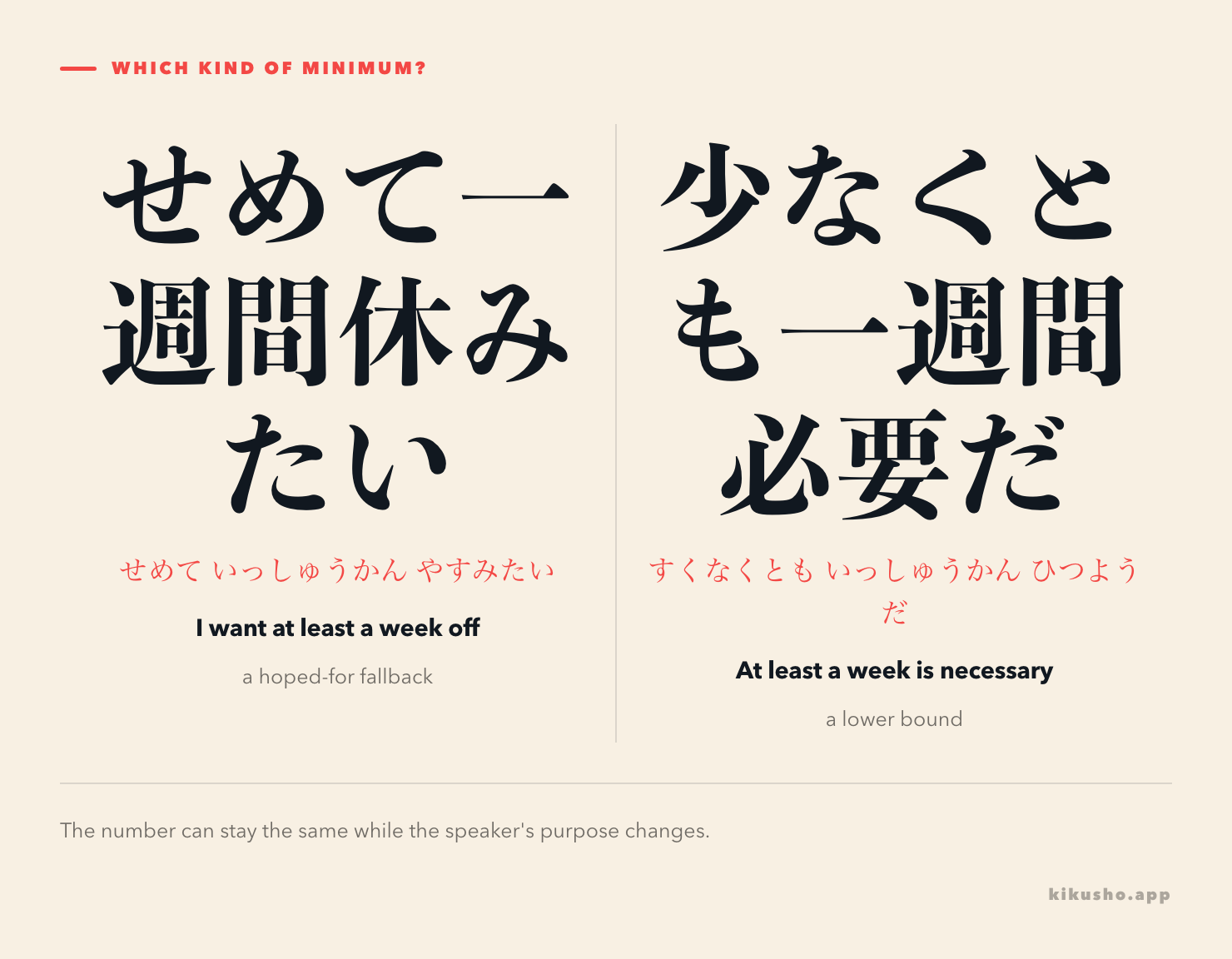
せめて一週間休みたい。
I want to take at least a week off.
回復には少なくとも一週間の休みが必要だ。
Recovery requires at least a week of rest.
In the first, one week is the speaker's reduced wish. In the second, one week is the lower boundary of a requirement. The quantity remains the same; the communicative job changes.
The two can even occur in one situation:
完成まで少なくとも三日はかかる。それなら、せめて明日までに最初の部分だけ見せてほしい。
Completion will take at least three days. In that case, I would like you to show me at least the first part by tomorrow.
少なくとも三日 estimates the schedule. せめて最初の部分だけ lowers the speaker's request after accepting that schedule.
Substitution therefore changes the message. 少なくとも一度会いたい can be understood as “I want to meet once at a minimum,” with attention on the count. せめて一度会いたい more clearly evokes an unrealised ideal and a heartfelt fallback. Conversely, 会議は少なくとも一時間かかる is a normal duration estimate; 会議はせめて一時間かかる is awkward if no wish or desired standard makes an hour meaningful.
The academic corpus study 副詞「少なくとも」の意味と用法 analyses 少なくとも as the speaker's minimum estimate across quantities and broader scopes, while contrasting it with せめて. This supports a more precise rule than treating either word as an interchangeable translation of “at least.”
Do not confuse 少なくとも with 少なくても
The one-kana difference changes the grammar.
| Form | Structure | Meaning |
|---|---|---|
| 少なくとも | fixed adverb | at least; at the lowest estimate |
| 少なくても | 少ない → 少なく + ても | even if it is small; even if there are few |
参加者が少なくても、予定どおり開催します。
Even if there are few participants, we will hold it as planned.
参加者は少なくとも十人必要です。
We need at least ten participants.
The first sentence accepts a condition of low attendance. The second fixes ten as the minimum number. Pronunciation alone may make the distinction easy to miss, so read the whole clause: 少なくても normally sets up a concessive condition, while 少なくとも directly qualifies the minimum.
Nearby words point in other directions. 最低でも gives an explicit, often forceful lower limit. せいぜい commonly estimates an upper limit: “at most.” たった treats an amount as surprisingly small. For limits and approximation with だけ, くらい and ぐらい, see the dedicated N3 comparison.
The だけましだ and まだしも lesson now links its consolation contrast back to this minimum-choice problem. For a more formal conceded minimum built with a noun, compare ないまでも and なりとも.
Practice: identify what the minimum is doing
Question 1 — grammar choice
The speaker wanted a visit but will accept a call. Choose the natural sentence.
ア) 来られないなら、少なくても電話してください。
イ) 来られないなら、せめて電話してください。
ウ) 来られないなら、せいぜい電話してください。
エ) 来られないなら、少なく電話してください。
Question 2 — grammar choice
Complete the neutral travel estimate.
空港までは__四十分かかります。
ア) せめて
イ) たった
ウ) 少なくとも
エ) 少なくても
Question 3 — sentence composition
Arrange the chunks to say, “I would like to understand at least the conclusion.”
- 理解したい
- せめて
- 結論だけは
- 。
Question 4 — grammar choice
Which sentence means “Even if there are few applicants, we will conduct the interviews”?
ア) 応募者が少なくても、面接を行います。
イ) 応募者が少なくとも、面接を行います。
ウ) 応募者がせめても、面接を行います。
エ) 応募者が少なくと、面接を行います。
Question 5 — repair shop decision
The repair shop gives a lower time estimate; the customer then reduces the request. Which pair preserves that change of viewpoint?
A: 修理は今日中に終わりますか。
B: いいえ、( ① )二日はかかります。
A: では、( ② )必要なデータだけでも先に取り出してもらえませんか。
ア) ①せめて ②少なくとも
イ) ①少なくても ②せいぜい
ウ) ①少なくとも ②せめて
エ) ①せめて ②少なくても
Question 6 — text grammar
Which sentence makes a cautious minimum claim rather than a request or wish?
ア) せめて誤解だけは解きたい。
イ) せめて理由を説明してほしい。
ウ) 少なくとも、この結果が偶然ではないことは分かる。
エ) せめてもう一度試せたらいいのに。
Answers and explanations
Answer 1
イ. Visiting is unavailable, and calling is the reduced request the speaker still wants fulfilled. 少なくても would mean “even if it is few,” so it cannot modify 電話 this way.
Answer 2
ウ. 少なくとも四十分 marks forty minutes as the lowest reasonable duration estimate. No wish or fallback calls for せめて.
Answer 3
2 → 3 → 1 → 4. せめて結論だけは理解したい。 The desired ending 〜たい and だけは present understanding the conclusion as the minimum hope.
Answer 4
ア. 少なくても is the ても form of 少ない and creates the concessive condition “even if there are few.” 少なくとも would need to state a lower bound, such as 少なくとも五人.
Answer 5
ウ. The repair duration is a lower estimate, so ① takes 少なくとも. Extracting only the necessary data is the customer's reduced request, so ② takes せめて.
Answer 6
ウ. The speaker limits what can safely be concluded: at minimum, the result is known not to be accidental. The other three sentences express a wish, request or regret with せめて.
Common questions
What is the difference between せめて and 少なくとも?
せめて presents the minimum that the speaker still wishes for when the ideal is unavailable. 少なくとも states a lower bound for an amount, requirement or claim.
Can せめて and 少なくとも both mean “at least”?
Yes, but they frame the minimum differently. せめて carries hope, regret or compromise, while 少なくとも gives an estimate, factual boundary or minimum condition.
Is 少なくても the same as 少なくとも?
No. 少なくとも is the adverb “at least.” 少なくても is 少ない in the ても form and means “even if it is small” or “even if there are few.”
Are せめて and 少なくとも N2 grammar?
The Kikusho reference inventory places both at N2 based on JLPT Sensei, with Bunpro and Tanos also supporting せめて at N2. The JLPT does not publish a complete official grammar list.