On this page
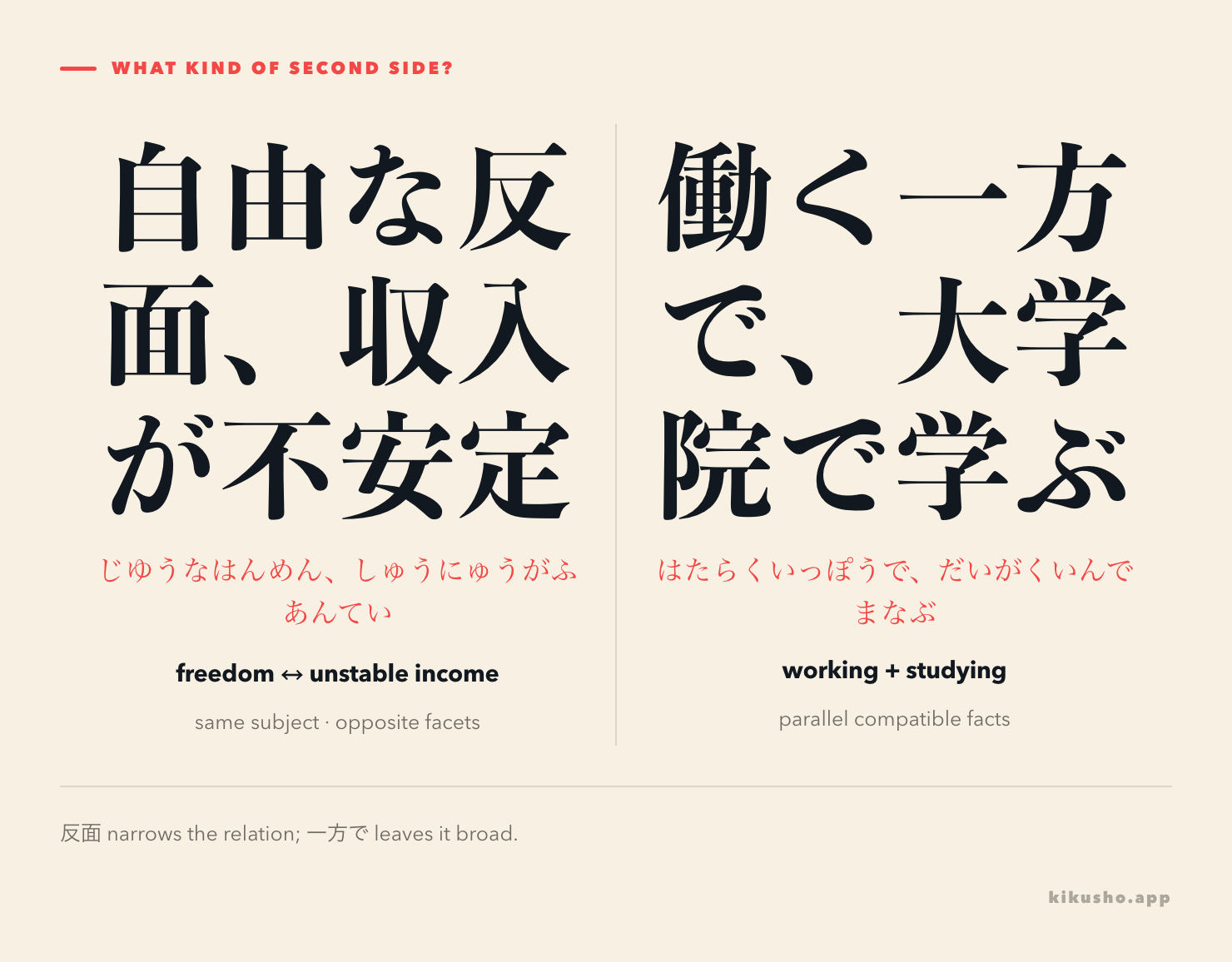
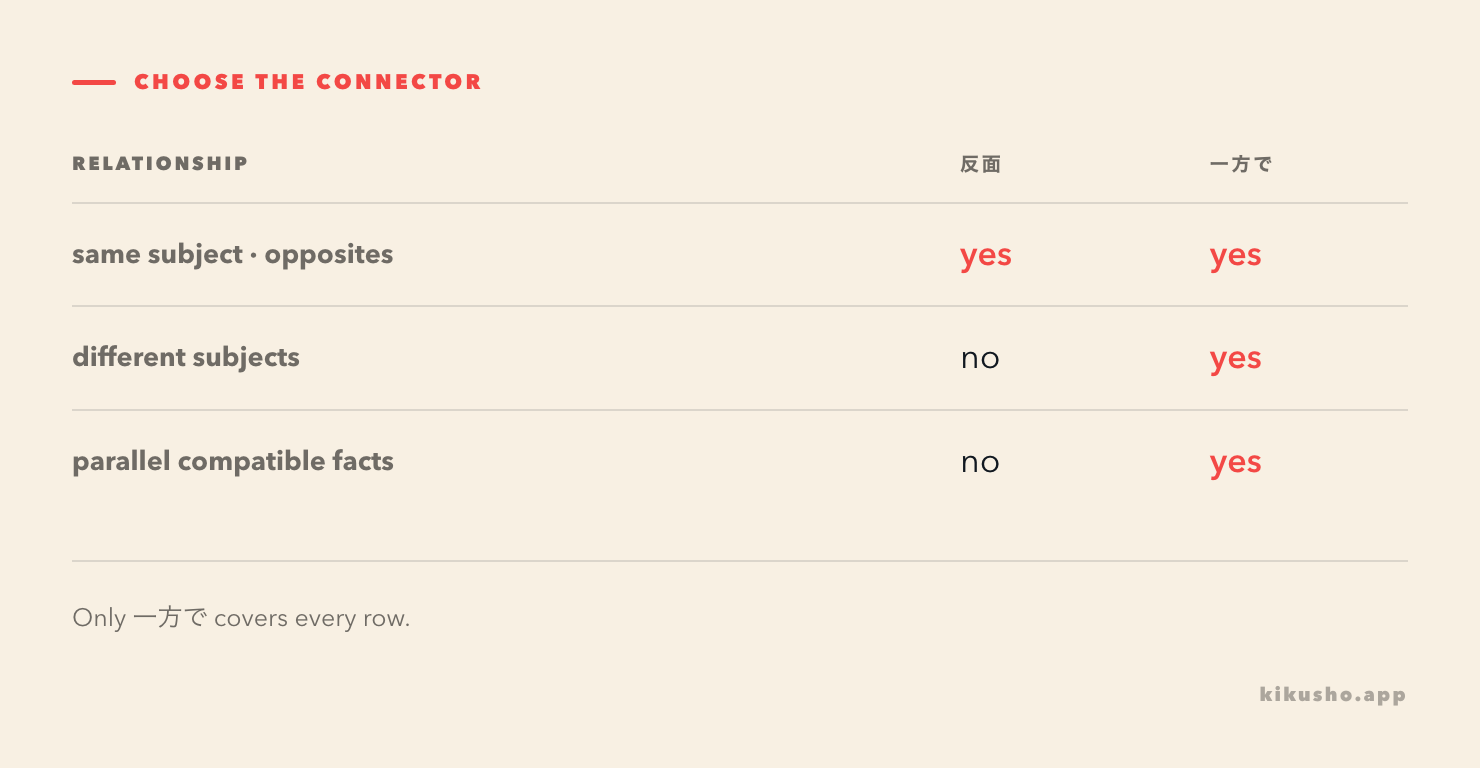
Use 反面(はんめん) when two genuinely opposing facets belong to the same person, thing or situation. Use 一方で(いっぽうで) for the wider job of placing two related facts side by side: they may oppose each other, belong to different subjects, or simply coexist.
この仕事は自由な反面、収入が安定しない。
このしごとはじゆうなはんめん、しゅうにゅうがあんていしない。
This job offers freedom, but its income is unstable.
兄は会社で働く一方で、大学院でも学んでいる。
あにはかいしゃではたらくいっぽうで、だいがくいんでもまなんでいる。
My older brother works at a company while also studying in graduate school.
Both forms can become “on the other hand” in English. The useful test is therefore not the translation but the relationship: opposite facets of one subject, or a broader pairing of facts?
反面 requires a real two-sided contrast
The noun 反面 literally points to the reverse or other side. In this grammar, the first clause describes one property of a subject and the second exposes a contrary property of that same subject.
オンライン授業は場所を選ばない反面、集中しにくいこともある。
オンラインじゅぎょうはばしょをえらばないはんめん、しゅうちゅうしにくいこともある。
Online classes can be taken anywhere, but on the other hand they can be hard to concentrate on.
彼は慎重な反面、決断に時間がかかる。
かれはしんちょうなはんめん、けつだんにじかんがかかる。
He is cautious, but the flip side is that he takes time to make decisions.
The contrast is often a merit against a drawback, but it need not be a simple “good versus bad” judgment. 明るい反面、寂しがり屋だ contrasts an outwardly cheerful side with a lonely side. What matters is that the reader can understand them as opposing facets of one whole.
JapaneseNET's N2 lesson defines the pattern as viewing one matter from another side and gives ordinary-form attachment. Bunpro's 反面 entry makes the restriction explicit: it links conflicting sides of one person or thing and does not naturally pair two positive facts or two negative facts merely because both are true.
That makes this sentence unsuitable in the intended “two abilities” reading:
× 彼は英語を話せる反面、スペイン語も話せる。
Speaking two languages gives two compatible abilities, not reverse sides. Choose 一方で:
彼は英語を話せる一方で、スペイン語も話せる。
かれはえいごをはなせるいっぽうで、スペインごもはなせる。
He speaks English and also speaks Spanish.
一方で covers contrast and coexistence
一方で can also compare opposite properties of one subject:
この薬はよく効く一方で、副作用の心配もある。
このくすりはよくきくいっぽうで、ふくさようのしんぱいもある。
This medicine works well, while there is also concern about side effects.
Here 反面 is possible too. 一方で neutrally lays out the two facts; 反面 makes the medicine's benefit and drawback feel more like two faces of one trade-off.
The wider range of 一方で becomes clear in two situations where 反面 does not fit.
First, the subjects may differ:
都市部では人口が増えている一方で、地方では減少が続いている。
としぶではじんこうがふえているいっぽうで、ちほうではげんしょうがつづいている。
The population is increasing in urban areas, while it continues to decline in rural areas.
Second, the facts may be simultaneous or parallel rather than opposite:
彼女は研究を続ける一方で、若い技術者の指導もしている。
かのじょはけんきゅうをつづけるいっぽうで、わかいぎじゅつしゃのしどうもしている。
She continues her research while also mentoring young engineers.
Mikke's direct comparison separates these two uses: 一方で may replace 反面 for opposing sides of one subject, but it also presents two things proceeding in parallel. YatoMonkey's teacher account independently shows both different-subject contrast and same-subject parallel action. Japan Foundation teacher material likewise describes 一方(で) as a way to present two matters contrastively and asks readers to identify exactly what is being compared.
Attach both forms to an attributive clause
Both expressions are nouns inside the construction, so the preceding material uses a form that can modify a noun.
| Before the pattern | 反面 | 一方で |
|---|---|---|
| verb | 働く反面 | 働く一方で |
| い-adjective | 安い反面 | 安い一方で |
| な-adjective | 便利な反面 / 便利である反面 | 便利な一方で / 便利である一方で |
| noun | 学生である反面 | 学生である一方で |
For nouns, Nである is the clearest dependable form in formal prose. With a な-adjective, both な and である occur. Do not put plain だ directly before either pattern.
この地域は交通が便利である反面、家賃が高い。
このちいきはこうつうがべんりであるはんめん、やちんがたかい。
This area has convenient transport, but rents are high.
田中さんは医師である一方で、作家としても活動している。
たなかさんはいしであるいっぽうで、さっかとしてもかつどうしている。
Tanaka is a doctor and also works as a writer.
一方(で) can omit で. It can also begin a new sentence after the first fact has been stated:
都市では空き家が増えている。その一方で、新築住宅も建てられている。
としではあきやがふえている。そのいっぽうで、しんちくじゅうたくもたてられている。
Vacant homes are increasing in cities. At the same time, new homes are also being built.
The connector その一方で points back to the previous statement. This sentence-level flexibility is another reason 一方で appears often in analytical writing.
Keep 一方で separate from 一方だ
The ending で does not automatically make these the same pattern. Contrastive 一方で means “on one side / at the same time.” Dictionary-form verb + 一方だ describes a development continuing in one direction.
物価は上がる一方だ。
ぶっかはあがるいっぽうだ。
Prices keep rising.
物価が上がる一方で、賃金はほとんど変わっていない。
ぶっかがあがるいっぽうで、ちんぎんはほとんどかわっていない。
Prices are rising, while wages are hardly changing.
The first sentence follows one trend. The second compares the movement of prices with the lack of movement in wages. The full 一方だ lesson explains its change-verb requirement and the misleading conjunctive form 一方で that can appear when an 一方だ clause continues.
Do not confuse either pattern with に反して, which says that a result goes against an expectation, plan or prediction. 反面 presents two coexisting sides; it does not mean that the second side violated what the first led you to expect.
Use the narrowest test that decides
Ask three questions in order:
- Do the clauses describe opposing facets of one person, thing or situation? 反面 and 一方で may both work.
- Do the clauses have different subjects? Choose 一方で.
- Are the facts compatible roles, actions or properties rather than opposites? Choose 一方で.
This test also explains why 反面 feels sharper. It asks the reader to reinterpret the first property by exposing its reverse side. 一方で only asks the reader to hold another related fact alongside the first.
When saving either form in Kikusho, capture both clauses. A card containing only 反面 = on the other hand hides the restriction that matters. Save a pair such as 自由な反面、収入が不安定だ, then add “same subject, opposing facets” as the usage note. For 一方で, mark whether the example expresses contrast or parallel coexistence.
Practice: decide whether the second fact is a reverse side
Answer all six questions before opening the explanations. The solutions are collected in one block below Question 6.
Question 1 — same subject, opposing facets. Which completion most strongly presents a trade-off?
この仕事はやりがいがある__、責任が重い。
- ア. 反面
- イ. 一方だ
- ウ. に反して
- エ. ばかりだ
Question 2 — parallel abilities. Complete the sentence naturally.
彼は中国語を教える__、通訳としても働いている。
- ア. 反面
- イ. に反して
- ウ. 一方で
- エ. 一方だ
Question 3 — different subjects. Which form fits the comparison?
姉は慎重である__、弟はすぐに行動する。
- ア. 反面
- イ. 一方で
- ウ. 一方だ
- エ. 反して
Question 4 — attachment. Which sentence uses 反面 correctly?
- ア. この町は便利だ反面、騒音が多い。
- イ. この町は便利で反面、騒音が多い。
- ウ. この町は便利反面、騒音が多い。
- エ. この町は便利な反面、騒音が多い。
Question 5 — sentence composition. Arrange these four chunks into “She is a researcher while also running a company.” Use each chunk exactly once.
- 研究者である
- 一方で
- 会社も
- 経営している
Question 6 — connected text. Choose the pair that completes the passage.
この薬は効果が高い( )、副作用も強い。また、国内では広く使われている( )、海外ではまだ承認されていない国もある。
- ア. 一方だ/反面
- イ. 反面/一方で
- ウ. に反して/一方だ
- エ. 反面/に反して
Answers and explanations
Answer 1. ア, 反面. Reward and heavy responsibility are opposing facets of the same job. 一方で could also state the contrast neutrally, but 反面 is the choice that most clearly foregrounds the trade-off.
Answer 2. ウ, 一方で. Teaching Chinese and interpreting are compatible parallel activities. 反面 would incorrectly present one as the reverse side of the other.
Answer 3. イ, 一方で. The two clauses have different subjects, the older sister and younger brother. 一方で can compare them; 反面 normally keeps two opposing facets within one person or thing.
Answer 4. エ, この町は便利な反面、騒音が多い. A な-adjective takes な before 反面. 便利である反面 would also be correct, but plain だ, bare 便利 and connective で do not fit this noun-modifying slot.
Answer 5. 研究者である一方で、会社も経営している. The noun 研究者 takes である before the pattern. The sentence presents two simultaneous roles, so 一方で is appropriate.
Answer 6. イ, 反面/一方で. High effectiveness and strong side effects are opposing facets of the same medicine, which makes 反面 apt. The second comparison changes from domestic use to overseas approval, so the broader different-context contrast takes 一方で.
Why study providers place these forms differently
JapaneseNET, JLPT Sensei and Bunpro place 反面 at N2. JLPT Sensei also places 一方で at N2, while Bunpro and YatoMonkey teach it at N3. That disagreement reflects study sequencing rather than two different surface forms; the neutral contrast and coexistence uses belong to the same construction taught here.
These labels are external study estimates. According to the official JLPT FAQ, current test-content specifications do not enumerate every grammar form, word and kanji. The useful N2 skill is to read the relationship between clauses: identify the subject or subjects, decide whether the facts truly oppose each other, and separate contrastive 一方で from the one-direction trend 一方だ.
OpenAI Codex served as the AI reviewer for the target contrast, Japanese examples, translations and six answer explanations. No human reviewer took part.
Common questions
What is the difference between 反面 and 一方で?
反面 presents opposing facets of the same person, thing or situation, often a benefit against a drawback. 一方で is broader: it can contrast different subjects, and its two facts can coexist without being opposites.
Can 反面 and 一方で be interchangeable?
Yes, when two genuinely opposing facets belong to the same subject. 一方で sounds more neutral, while 反面 makes the two-sided trade-off more prominent.
Can 一方で connect two positive facts?
Yes. It can present parallel roles or actions, such as being a researcher while also teaching. 反面 is unsuitable unless the two facts form opposing sides.
Is 一方で the same as 一方だ?
No. 一方で compares or juxtaposes two sides, while dictionary-form verb + 一方だ describes a change continuing in one direction, such as prices continuing to rise.