On this page
Use それなのに when the next result goes against what the previous sentence made you expect. Use それにしても when you accept the previous situation and then judge its degree or quality as remarkable.
この店はいつも混んでいる。それなのに、今日は客が一人もいない。
この みせは いつも こんでいる。それなのに、きょうは きゃくが ひとりも いない。
This shop is always crowded. And yet today there is not a single customer.
この店は人気がある。それにしても、二時間待ちは長すぎる。
この みせは にんきが ある。それにしても、にじかんまちは ながすぎる。
This shop is popular. Even so, a two-hour wait is far too long.
The first B overturns the prediction “there should be customers.” The second speaker grants that popularity explains some waiting, but still reacts to how long the wait is. That difference—unexpected outcome versus remarkable evaluation—is more reliable than an English gloss such as “nevertheless.”
Follow the logic from A to B
Both expressions normally begin a new sentence or independent turn and point back to a situation already established as A. The job of B separates them.
| Relationship | Connector | What the speaker does in B |
|---|---|---|
| A suggests one result, but the opposite or incompatible result occurs | それなのに | reports the expectation-breaking result |
| A may explain the situation, but its degree still deserves comment | それにしても | accepts A and gives an evaluation |
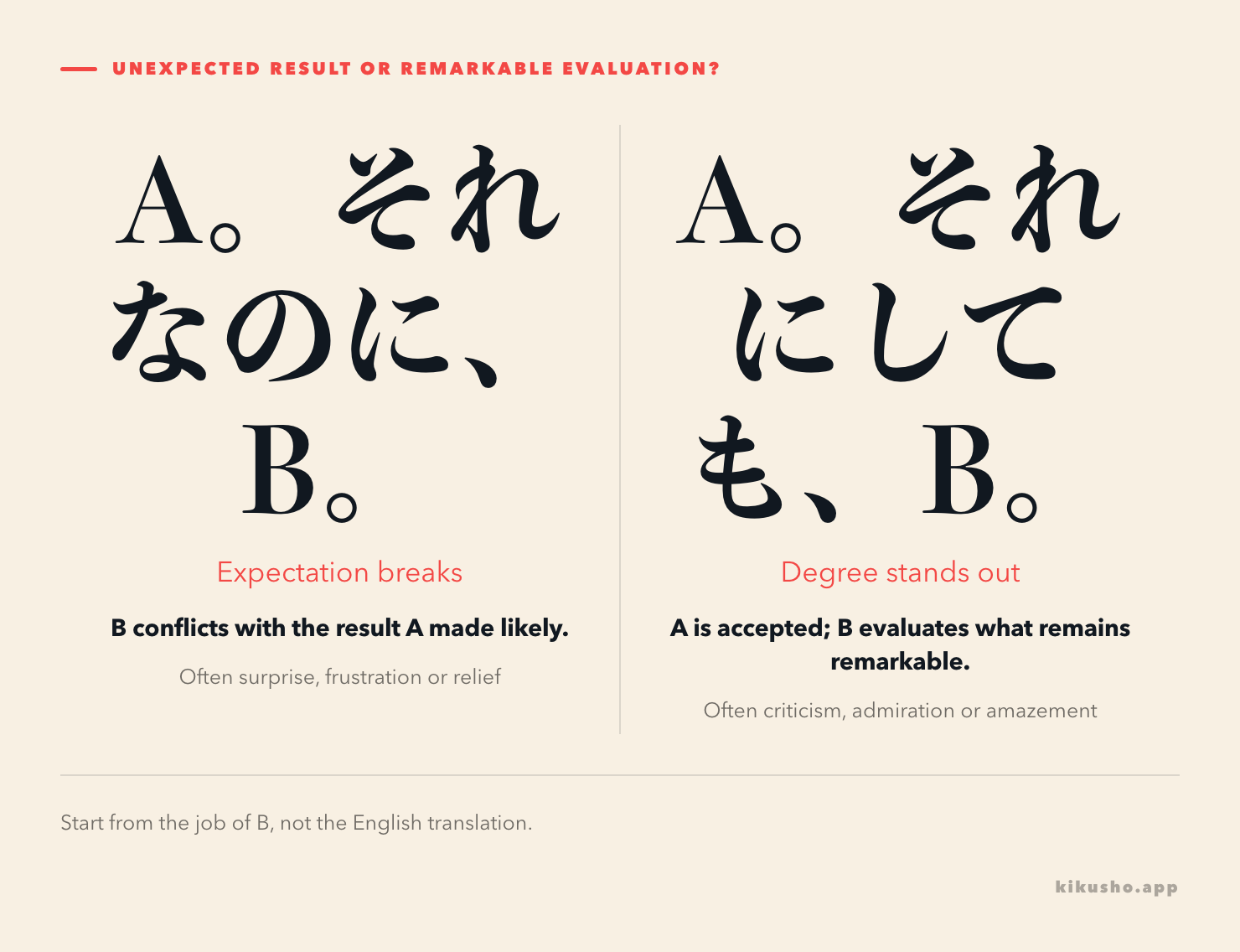
The emotional colour follows from this logic. それなのに often carries disappointment, frustration or surprise because an expectation has failed. それにしても often carries admiration, criticism or amazement because the speaker is evaluating something as unusually good, bad, large, fast or intense. Those reactions are common effects, not fixed translations.
それなのに presents the result that should not have happened
それなのに is a sentence-opening connector built around concessive のに. It treats A as established and presents B as incompatible with the normal expectation from A.
薬を飲んで早く寝た。それなのに、熱が下がらなかった。
くすりを のんで はやく ねた。それなのに、ねつが さがらなかった。
I took medicine and went to bed early. Despite that, my fever did not go down.
The expected chain is “medicine and rest → improvement.” B denies that improvement. The connector therefore does more than place two facts side by side.
何度も地図を確認した。それなのに、駅と反対の方向へ歩いていた。
なんども ちずを かくにんした。それなのに、えきと はんたいの ほうこうへ あるいていた。
I checked the map several times. And yet I was walking in the opposite direction from the station.
Here the preparation should have prevented the mistake. The contrast can also be positive:
準備する時間はほとんどなかった。それなのに、発表は大成功だった。
じゅんびする じかんは ほとんど なかった。それなのに、はっぴょうは だいせいこうだった。
There was almost no time to prepare. Even so, the presentation was a great success.
The result is welcome, but it still defeats the expectation created by A. Anger is therefore possible but never required.
JLPT Sensei's それなのに entry and Bunpro's separate entry both support this “despite that / and yet” relationship and place it at N2. The examples here are original; the references verify the construction and level estimate.
それにしても grants the situation before judging it
With それにしても, the speaker does not simply replace the expected result with its opposite. A is accepted as relevant, then B says that the actual degree or impression still stands out.
山の上だから寒いとは思っていた。それにしても、九月に雪が降るとは驚いた。
やまの うえだから さむいとは おもっていた。それにしても、くがつに ゆきが ふるとは おどろいた。
I expected it to be cold because we are on a mountain. Even so, I was surprised that it snowed in September.
The mountain explains cold weather, so the speaker grants that premise. Snow in September exceeds the expected degree.
初めて作ったそうだ。それにしても、形がきれいだ。
はじめて つくったそうだ。それにしても、かたちが きれいだ。
Apparently this was their first time making it. Still, the shape is beautiful.
B is an appraisal, not an event that cancels A. This makes それにしても natural with evaluative language such as 暑すぎる, 上手だ, ひどい, 大きい, よくできた and 驚いた.
絵でわかる日本語 explains that sentence-opening それにしても accepts the preceding matter and then expresses the speaker's surprise or evaluation. 日本語教師たのすけ also gives the contrastive evaluation use alongside attached ~にしても. Both identify the grammar as N2.
A quick substitution test
Imagine a hotel room that costs ¥30,000 a night.
一泊三万円もする。それなのに、部屋が掃除されていなかった。
It costs ¥30,000 a night. And yet the room had not been cleaned.
The high price creates an expectation of adequate service. An unclean room violates it.
一泊三万円もする。それにしても、この部屋は狭すぎる。
It costs ¥30,000 a night. Even so, this room is far too small.
The speaker acknowledges the situation and evaluates the room's size as extreme. The two thoughts are close enough that either connector may sometimes be defensible after a richer context. The chosen wording tells the listener which relation the speaker wants to foreground.
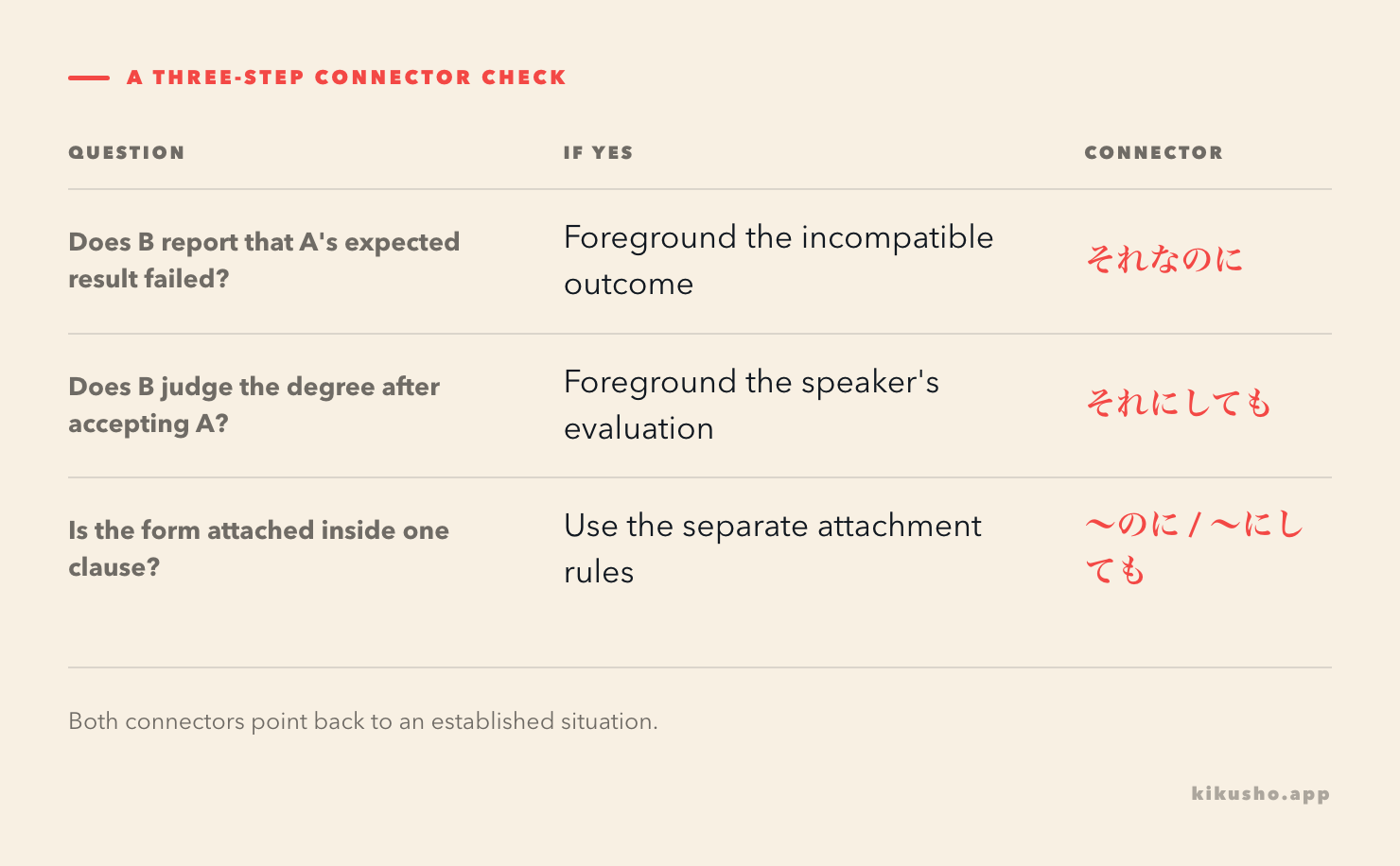
Use this three-step check:
- Identify the expectation produced by A.
- Ask whether B reports the failure of that expectation. If yes, choose それなのに.
- If B instead comments that the actual degree or impression is remarkable even after granting A, choose それにしても.
Degree words are useful clues for step 3, but they are not a mechanical rule. A sentence such as それにしても、彼はよく働く evaluates an impressive amount without an explicit すぎる. The surrounding conversation supplies the accepted premise.
These connectors point backward; their shorter relatives attach differently
In this lesson, それ points back to the preceding sentence or situation:
A。それなのに、B。
A。それにしても、B。
Do not treat either expression as a suffix to attach directly to a verb. Clause-linking ~のに and ~にしても have their own patterns.
薬を飲んだのに、熱が下がらなかった。
Although I took medicine, my fever did not go down.
冗談にしても、その発言は許せない。
Even granting that it was meant as a joke, that remark is unacceptable.
The ~ても and ~のに comparison teaches how attached のに follows verbs, adjectives and nouns. The にしても and は別として lesson shows how attached にしても grants one case without changing the conclusion. At N2, the sentence-opening forms let you manage the relationship across complete sentences.
This also distinguishes それにしても from それにしては. The latter measures a result against an A-based benchmark: 初めてにしては上手だ says the skill exceeds what a first attempt would normally suggest. それにしても sounds more like the speaker pauses over the whole situation and adds an evaluation: 初めてだそうだ。それにしても上手だ, “Apparently it is their first time. Still, they are good.”
Register and JLPT placement
Both connectors work in conversation and ordinary writing. それなのに can sound emotionally charged when a promise, effort or rule has failed. それにしても is common when a speaker steps back and reacts: それにしても暑いね, “Still, it is hot, isn't it?” The shared situation can be obvious enough that A remains unspoken.
JLPT Sensei and Bunpro place both target expressions at N2, and the curriculum records no disagreement for either item. That agreement supports the study order, but no complete official JLPT grammar list exists. Treat N2 as a practical learning label and focus on the discourse relation the test sentence builds.
When saving either connector in Kikusho, capture A and B together. A card with only それなのに = and yet cannot test the expectation that failed. A card with only それにしても = even so cannot preserve the premise being granted or the evaluation that follows.
Practice: choose the relation across sentences
Question 1 — failed expectation
Choose the connector that best completes the context.
この店には予約して来た。__、一時間も待たされた。
ア) それにしても
イ) それなのに
ウ) ちなみに
エ) それなら
Question 2 — remarkable degree
Choose the connector that best completes the context.
冬の北海道だから寒いのは分かる。__、今日は寒すぎる。
ア) それなのに
イ) それにしても
ウ) そう言えば
エ) それから
Question 3 — positive surprise
Choose the connector that foregrounds an expectation-breaking result.
彼には練習時間がほとんどなかった。__、試合で優勝した。
ア) それなのに
イ) それにしても
ウ) なお
エ) そこで
Question 4 — rebuild the evaluation
Put the four pieces in order to express, “It is a popular restaurant. Even so, three hours is too long to wait.”
- 三時間は\
- それにしても\
- 人気の店だ\
- 待ちすぎだ
Put the two sentences together and add Japanese punctuation where natural.
Question 5 — connector or attached grammar
Which sentence correctly uses sentence-opening それなのに?
ア) 雨それなのに、出かけた。
イ) 雨だった。それなのに、試合は中止にならなかった。
ウ) 雨だったにそれなのに、出かけた。
エ) それなのに雨、試合をした。
Question 6 — two gaps in one exchange
Choose the pair that best completes the exchange.
A: 田中さんは毎日十時間も練習したそうです。
B: __、予選で負けてしまったんですね。
A: ええ。でも、__、十時間とはすごい集中力ですね。
ア) ①それにしても / ②それなのに
イ) ①それなのに / ②それにしても
ウ) ①ちなみに / ②それなら
エ) ①それなら / ②なお
Answers and explanations
Answer 1
イ, それなのに. A reservation should prevent a long wait, but the speaker was kept waiting for an hour. B reports the failure of that expectation.
Answer 2
イ, それにしても. The speaker accepts that Hokkaido in winter will be cold, then evaluates today's cold as excessive. 寒すぎる makes that degree judgment explicit.
Answer 3
ア, それなのに. Almost no practice time predicts difficulty, while winning the match overturns that prediction. A positive outcome can still form the contrast.
Answer 4
人気の店だ。それにしても、三時間は待ちすぎだ。 The first sentence establishes popularity as a reason some wait is understandable. The second accepts that premise but judges three hours as excessive.
Answer 5
イ. それなのに opens a new sentence and points back to 雨だった. The other choices incorrectly insert the full connector inside a noun phrase or scramble the sentence structure. Attached concessive grammar would instead be 雨なのに、出かけた.
Answer 6
イ: ①それなのに / ②それにしても. Ten hours of daily practice creates an expectation of qualifying, so losing is the failed result. The final sentence then accepts the practice fact and evaluates the amount of concentration as impressive.
The translation overlap disappears once you reconstruct the speaker's move. Find the expectation in A, then decide whether B breaks it or pauses to judge what still feels remarkable.
Common questions
What is the difference between それなのに and それにしても?
それなのに introduces a result that clashes with the expectation created by the previous situation. それにしても accepts that situation, then adds the speaker's evaluation, often that the degree is surprising or excessive.
Can both expressions be translated as “even so”?
Sometimes, but the English overlap hides the Japanese decision. Ask whether the next sentence contradicts an expected result or comments on how remarkable the accepted situation is.
Is それにしても the same as ~にしても?
They are related but have different sentence shapes. Sentence-opening それにしても points back to a whole situation. Attached ~にしても follows a noun or plain predicate and means that the conclusion still holds even when that case is granted.
Are それなのに and それにしても N2 grammar?
JLPT Sensei and Bunpro place both expressions at N2. The JLPT does not publish an exhaustive official grammar list, so these labels are useful study estimates rather than guaranteed test assignments.