On this page
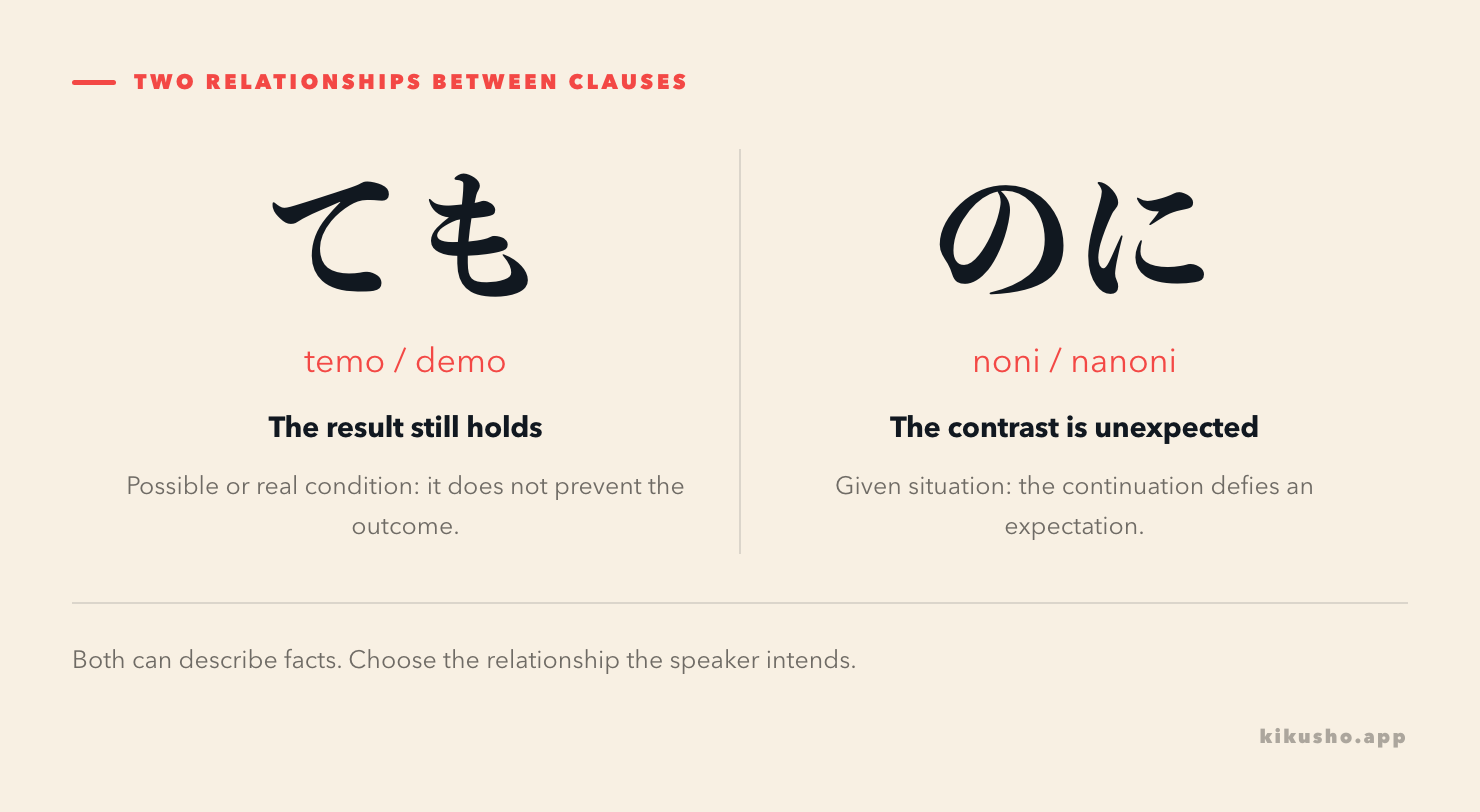
安くても買いません says that even a low price will not make you buy it; 安いのに買いません presents not buying it as unexpected given its low price. Choose ても when a condition fails to change the outcome, and のに when you want to point out a contrast against an expectation.
Both can describe facts. Learning them as “imaginary versus real” leaves you unable to explain an ordinary ても sentence about something that happened.
Ask whether the condition changes the result or makes it surprising
Try these two questions before choosing an English translation:
- Does the result hold despite this condition? Start with ても/でも.
- Am I treating the first situation as given, then pointing out an unexpected contrast? Start with のに.
This N4 grammar comparison teaches ても, including its でも attachment, and the concessive のに, including なのに. It assumes you can already make the verb て-form. It does not cover every expression containing either string.
The JLPT Sensei ても entry and Bunpro's concession entry place these uses at N4. Our reference inventory also retains a Tanos N3 observation for ても. Bunpro's separate N3 のに lesson teaches purpose, rather than a harder version of this same concession. These labels guide study order; they are not an exhaustive official JLPT syllabus.
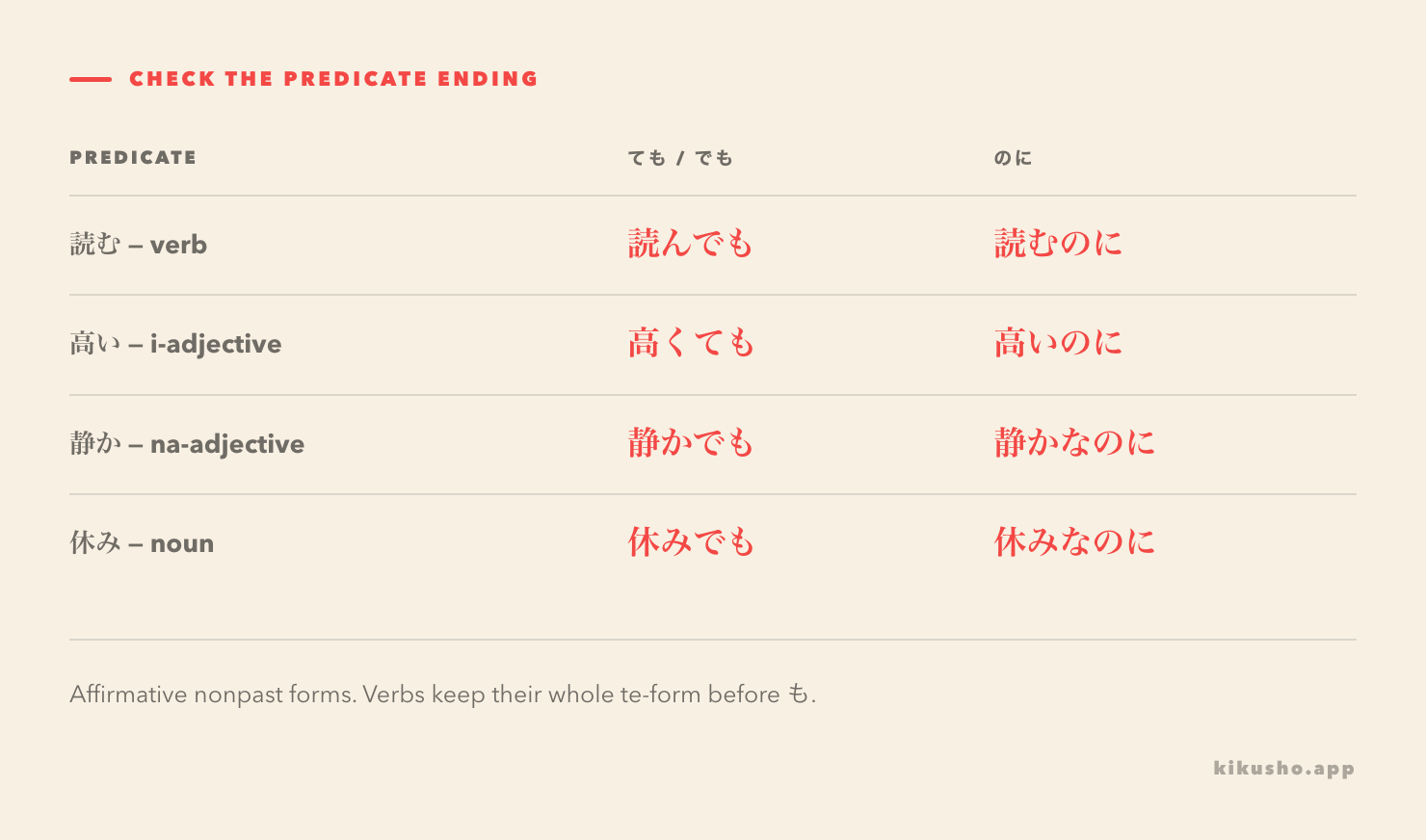
ても uses a connecting form; のに keeps the plain predicate
First identify the word ending the first clause. Its word class determines the attachment.
| First predicate | With ても/でも | With のに |
|---|---|---|
| 読む(よむ), read | 読んでも | 読むのに |
| 行く(いく), go | 行っても | 行くのに |
| 高い(たかい), expensive | 高くても | 高いのに |
| 静か(しずか), quiet | 静かでも | 静かなのに |
| 休み(やすみ), a day off | 休みでも | 休みなのに |
For verbs, make the entire て-form, then add も. A form ending in で keeps it: 読む → 読んで → 読んでも. With an い-adjective, replace its final い with くて, then add も. With an affirmative noun or な-adjective, use でも.
For のに, use a plain verb or い-adjective form. An affirmative nonpast noun or な-adjective needs な before のに. That gives 静かなのに, rather than 静かのに. The い in the spelling of きれい does not make it an い-adjective: きれいでも/きれいなのに follows the な-adjective row. The JLPT Sensei attachment table for のに and Bunpro's ても structures verify these patterns.
Negative and past forms keep the distinction
ない → なくても makes a negative concession: 買わなくても, “even if you don't buy it,” and 高くなくても, “even if it isn't expensive.” For a negative noun or な-adjective predicate, じゃなくても is a conversational option: 休みじゃなくても, “even if it isn't a day off.” Bunpro's ても page includes these negative attachments.
With のに, keep the plain negative or past ending intact:
| Given situation | Concessive form |
|---|---|
| 読まない, does not read | 読まないのに |
| 読んだ, read | 読んだのに |
| 高かった, was expensive | 高かったのに |
| 静かだった, was quiet | 静かだったのに |
| 休みじゃない, is not a day off | 休みじゃないのに |
Do not insert another な after だった or じゃない. Maggie Sensei's formation lesson demonstrates plain past verbs, past adjectives and noun predicates. To report a past event with ても, the later predicate and the setting can supply the time: the connecting form itself does not become 読んだも.
ても allows a possibility, a habit or an unsuccessful attempt
Imagine you have not yet seen tomorrow's weather:
明日、風が強くても、歩いて駅へ行きます。
あした、かぜが つよくても、あるいて えきへ いきます。
Even if the wind is strong tomorrow, I will walk to the station.
The strong wind is a possibility. It will not change the travel plan. You are not announcing that tomorrow's wind has already been observed.
A regular decision uses the same logic:
父は休みでも、六時に起きます。
ちちは やすみでも、ろくじに おきます。
My father gets up at six even on days off.
Days off really occur. でも says they do not remove the early start. Hiroko's JapanesePod101 comparison distinguishes a general pattern from a particular surprising scene. “Even when” is often a useful English translation for that pattern.
ても can also report an attempt that has already failed:
昨日は何度電話しても、誰も出ませんでした。
きのうは なんど でんわしても、だれも でませんでした。
Yesterday, however many times I called, nobody answered.
昨日 and 出ませんでした place this in the past. The calls occurred; they did not produce an answer. Masaru Mito's Mango lesson explicitly includes factual ても. Do not change a factual ても merely because “even though” seems like a possible translation.
のに presents a contrast that the speaker did not expect
Now describe a completed errand:
店は近いのに、着くまで三十分かかりました。
みせは ちかいのに、つくまで さんじゅっぷん かかりました。
Even though the shop is nearby, it took thirty minutes to get there.
The nearby shop is given. A short journey would seem reasonable, yet that was not the outcome. のに makes the mismatch relevant.
The expectation belongs to the speaker or the context. It is not a rule that every nearby destination must be quick to reach. Nor must the contrast express anger:
このかばんは小さいのに、たくさん入ります。
この かばんは ちいさいのに、たくさん はいります。
Although this bag is small, it holds a lot.
This can be pleased surprise. のに identifies the contrast; the setting tells you whether the reaction is admiration, disappointment or something milder. Maggie Sensei explains the expected-versus-observed relationship, while Bunpro classifies the construction as standard register. A sentence ending in ます can still carry that reaction.
Both can fit the same facts while presenting them differently
Suppose you are discussing a particular inexpensive bag. Compare:
| Sentence | What the speaker makes relevant |
|---|---|
| このかばんは安くても、買いません。 | Even its low price does not change my decision. |
| このかばんは安いのに、買いません。 | Given that it is cheap, not buying it is presented as unexpected. |
Both sentences can concern a bag whose price is already known. The ても version might explain that you have no space for another bag. The のに version needs an expectation that a low price would encourage a purchase; someone describing their own decision could use it to acknowledge that mismatch.
This is why a quiz saying only “The bag is cheap; choose ても or のに” has no single reliable answer. You need the speaker's intended stance. The English word although cannot supply that information for you.
A request or a familiar string needs its own check
For a request that should hold under an adverse condition, ても is useful:
忙しくても、連絡してください。
いそがしくても、れんらくして ください。
“Even if you're busy, please get in touch.”
Do not mechanically replace it with 忙しいのに. An ordinary concessive のに sentence describes a given contrast; it is not the default way to introduce a new request. A surprised question or an admonition can nevertheless use のに. For instance, 休みなのに、働いているんですか (やすみなのに、はたらいて いるんですか) means “It's your day off, yet you're working?” Mango's comparison notes such exceptions, so “のに can never precede a question” is too broad.
If you need an ordinary “if” clause instead, continue with the N4 comparison of ば and なら.
There are two further boundaries:
- 読むのに時間がかかります means “Reading takes time.” Here のに concerns the activity and its required time, rather than an unexpected contrast. Bunpro teaches this purpose/resource use separately at N3. That use needs its own explanation; this comparison focuses on concession.
- 読んでもいいです accepts reading or grants permission. The permission and prohibition lesson teaches that full ending. It does not mean that every ても sentence grants permission.
When you collect a sentence in Kikusho, keep the continuation that settles this choice. Pasted text becomes an editable card with an example and a nuance note; check that the saved phrase preserves whether the speaker is describing a stubborn result or pointing out a mismatch. Saving 安い alone would lose the decision the sentence was making.
Practice: make eight decisions before checking the answers
All questions are original. Use standard forms, the given setting and the requested meaning; some real situations allow both constructions with a different stance.
Question 1: complete the form. You want to say that a high price will not change your decision to buy. Complete このかばんは__、買います。
- A. 高いでも
- B. 高くても
- C. 高いても
- D. 高くのに
Question 2: keep the noun attachment. Today is a day off. The speaker finds the number of work calls unexpected. Complete 今日は休み__、仕事の電話が多いです。
- A. のに
- B. だのに
- C. なでも
- D. なのに
Question 3: assemble a concession. Keep 明日、 first and 行きます。 last. Arrange these chunks in between to mean “Even if the wind is strong tomorrow, I will walk to the station.” Write the sentence and identify the third inserted chunk, ★.
明日、(1)(2)★(4)行きます。
- A. ても、
- B. 風が
- C. 歩いて駅へ
- D. 強く
Question 4: join the observations. Combine この部屋は静かです and よく眠れませんでした to express surprise that the quiet room did not lead to good sleep. Keep この部屋は first and the polite past ending of the second clause. Use concessive のに with affirmative nonpast 静か.
Question 5: follow a connected account. Read:
昨日、何度電話しても、店の人は出ませんでした。今日は直接店へ行きます。
Which interpretation fits the whole account?
- A. The calls happened, but none got an answer; today the speaker will go in person.
- B. The speaker has not called yet and is only imagining a call.
- C. Someone answered each call, so there is no reason to visit.
- D. ても gives permission to make exactly one call.
Question 6: read the intended stance. A friend sees a small bag holding many things and expresses pleased surprise: このかばんは小さいのに、たくさん入りますね。 What does のに contribute?
- A. It proves that no small bag can hold many things.
- B. It treats the bag's size as an unknown future possibility.
- C. It points out a contrast against the expectation associated with its small size.
- D. It instructs the listener to buy the bag.
Question 7: check the claim. A learner says, “If the first condition is known to be true, ても is always wrong.” Choose the accurate correction.
- A. Correct: ても can only describe events that never happened.
- B. Incorrect: ても may concede a known condition while stressing that the result holds despite it.
- C. Incorrect: ても must always express anger about that condition.
- D. Correct: the final verb can never be past with ても.
Question 8: compose the requested message. You want someone to contact you even if they are busy. Begin with 忙しい, make a concession with ても, then add 連絡してください. Write the complete sentence.
Finish your eight responses before continuing to the explanations below.
Answers and explanations
Answer 1: B. このかばんは高くても、買います。 (この かばんは たかくても、かいます) preserves the buying decision despite the price. 高い supplies 高くて + も. A uses noun-style でも after an い-adjective; C does not make its connecting form; D uses neither its plain のに attachment nor its ても attachment.
Answer 2: D. 今日は休みなのに、仕事の電話が多いです。 (きょうは やすみなのに、しごとの でんわが おおいです) treats the day off as given and presents many work calls as unexpected. An affirmative nonpast noun needs な + のに. A omits な, C confuses the attachments, and B is not the standard form taught here; regional だのに forms are outside this lesson.
Answer 3: B → D → A → C; ★ is A. 明日、風が強くても、歩いて駅へ行きます。 The clause 風が強くても comes before the main action. Assemble 風が + 強く + ても, then keep the supplied 歩いて駅へ chunk together. 強い becomes 強くても, rather than 強いでも. Splitting the adjective's connecting ending tests its formation as well as the clause order.
Answer 4: この部屋は静かなのに、よく眠れませんでした。 (この へやは しずかなのに、よく ねむれませんでした) puts な between 静か and のに. The first state remains affirmative nonpast as requested; the second clause reports the past failure to sleep well. 静かでも would form a different concession, while 静かのに misses the required な.
Answer 5: A. 昨日 and 出ませんでした locate unsuccessful calls in the past; 何度電話しても says repeated attempts did not change the outcome. The second sentence states today's plan. B wrongly makes the calls unperformed, C reverses the result, and D invents permission and a numerical limit. 直接 is ちょくせつ, “directly”; 店の人 is みせのひと, the person at the shop.
Answer 6: C. The size is accepted, and the capacity exceeds the friend's expectation. That can be appreciative surprise. A turns an expectation into an absolute law, B invents uncertainty about the size, and D adds an instruction. 入ります is はいります, “fits inside” here; the example is about capacity, rather than the bag physically entering another place.
Answer 7: B. A condition can be acknowledged as real and still fail to affect an outcome. A excludes ordinary factual uses, C assigns an emotion that ても does not require, and D conflicts with past reports such as the calls in Question 5. The intended relationship between clauses matters alongside what is known.
Answer 8: 忙しくても、連絡してください。 (いそがしくても、れんらくして ください) makes 忙しい → 忙しくて → 忙しくても, then keeps the requested contact. 忙しいのに would introduce an accepted contrast, so it cannot be substituted merely because English also uses “although.” The request here is deliberately phrased to remain applicable under a possible busy condition.
Common questions
Is ても only for hypothetical situations?
No. It can describe possible conditions, repeated situations or facts. The point is that the first condition does not prevent the outcome. のに instead presents a contrast against an expectation based on an accepted fact in an ordinary two-clause concession.
Do nouns take のに or なのに?
An affirmative nonpast noun predicate takes なのに: 休みなのに means even though it is a day off. な-adjectives use the same attachment. Verbs and い-adjectives take のに after their plain form, as in 読んだのに and 安いのに.
Does のに always express anger?
No. It can convey surprise, disappointment or a milder unexpected contrast. Context supplies the reaction; のに alone does not prove that the speaker is angry. A polite sentence ending can still carry that stance.
Are these constructions N4 grammar?
JLPT Sensei and Bunpro place the concessive uses taught here at N4. The inventory also records an N3 observation for ても in Tanos. Bunpro's N3 のに page teaches purpose, a separate use. Level lists are editorial study guides rather than an official exhaustive exam syllabus.