On this page
Use ちなみに when you deliberately add a related aside, なお when a formal notice or explanation supplies another point, and そう言えば(そういえば) when the situation makes you remember something. The English phrase “by the way” can translate all three, so the deciding clue is why the extra information appears.
この店は九時に閉まります。ちなみに、日曜日は休みです。
この みせは くじに しまります。ちなみに、にちようびは やすみです。
This shop closes at nine. By the way, it is closed on Sundays.
受付は五時までです。なお、必要書類は二階でも提出できます。
うけつけは ごじまでです。なお、ひつようしょるいは にかいでも ていしゅつできます。
Reception is open until five. Please also note that the required documents can be submitted on the second floor.
A: 来週、京都に行くんです。 B: そう言えば、京都に新しい美術館ができましたね。
A: らいしゅう、きょうとに いくんです。 B: そういえば、きょうとに あたらしい びじゅつかんが できましたね。
A: I am going to Kyoto next week. B: Come to think of it, a new museum opened in Kyoto.
The first speaker chooses a useful side fact. The second text gives readers a formal note. The third speaker retrieves a thought because Kyoto has just been mentioned.
Ask what caused the extra sentence to appear
The three connectors do not change the truth of B. They tell the listener how B entered the discourse.
| Reason for adding B | Connector | Typical setting |
|---|---|---|
| B is a related aside the speaker chooses to add | ちなみに | conversation, explanation |
| B is a supplementary point readers should also know | なお | notices, instructions, formal prose |
| A or the situation makes the speaker recall B | そう言えば | conversation, reflective narration |
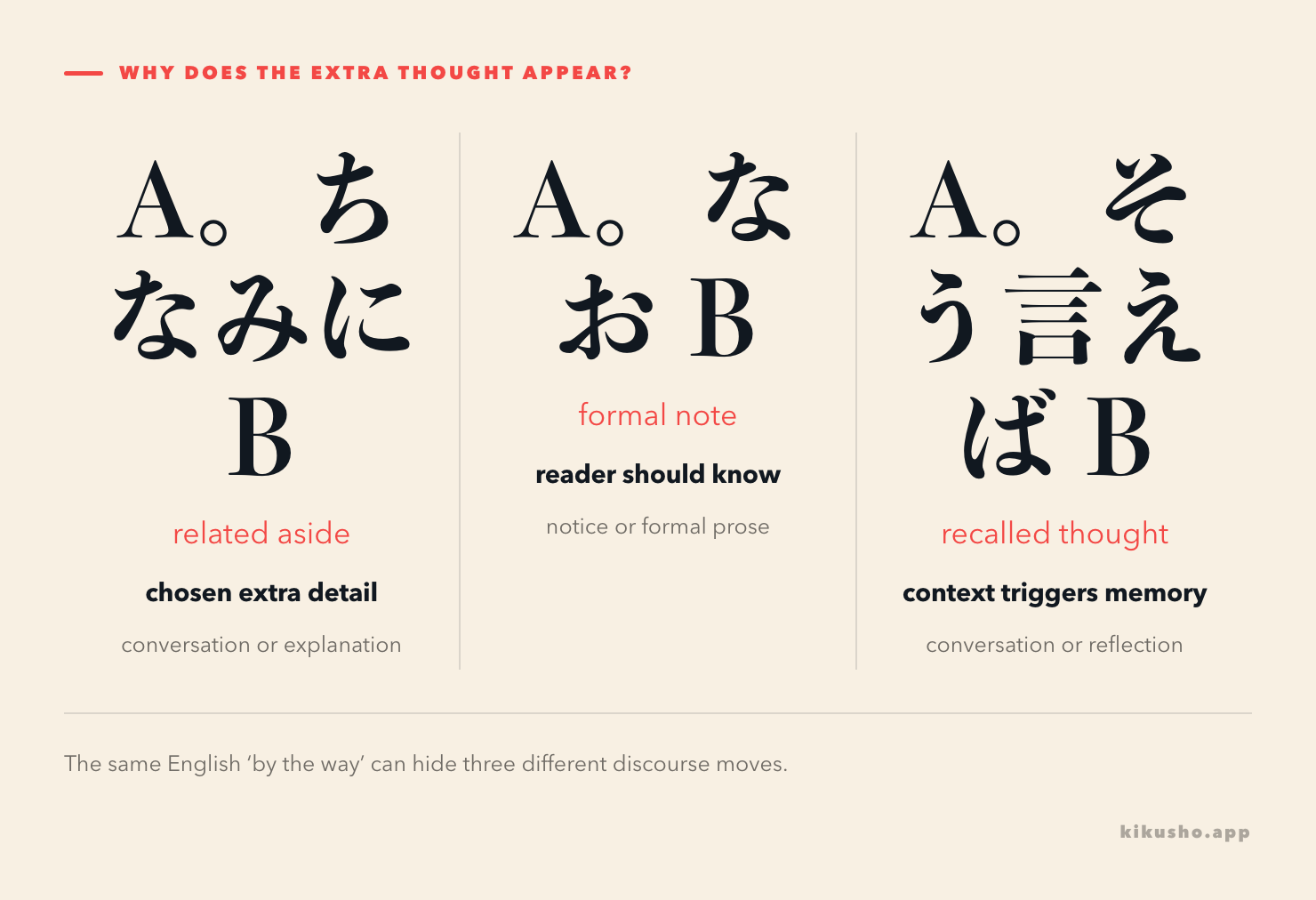
All three commonly open a sentence after the main point has been stated. Their attachment is therefore simple: A。connector、B。 The difficult part is discourse. Ask whether B is an aside, an announced note or a remembered association.
ちなみに adds a related aside
ちなみに adds information connected to what has just been said without making that information the main line of the explanation.
この講座は六月に始まります。ちなみに、申し込みは無料です。
この こうざは ろくがつに はじまります。ちなみに、もうしこみは むりょうです。
This course begins in June. Incidentally, registration is free.
The fee belongs to the same practical topic as the start date, but it is not a result, contrast or condition. It is an extra fact the speaker has chosen to attach.
ちなみに can also introduce a related question:
A: この町には外国人が千人ほど住んでいます。
B: ちなみに、そのうち留学生は何人ぐらいですか。
A: About one thousand foreign residents live in this town.
B: By the way, roughly how many of them are international students?
The phrase そのうち keeps the question tied to the figure already mentioned. If B changed to an unrelated holiday plan, ところで would mark that larger break more clearly.
Digital Daijisen defines ちなみに as adding a short supplement to something already stated. It also records the expanded forms ちなみに言えば and ちなみに申しますと. The kanji spelling 因みに exists, but hiragana is the ordinary modern choice.
なお presents a formal supplementary note
Sentence-opening なお asks the reader to keep attention on another point that belongs with the preceding notice or explanation.
会場内では飲食できません。なお、飲み物はロビーでお召し上がりいただけます。
かいじょうないでは いんしょくできません。なお、のみものは ロビーで おめしあがりいただけます。
Food and drink are not allowed inside the venue. Please note that drinks may be consumed in the lobby.
The second sentence is not a casual afterthought. It is part of the information the organiser intends to communicate. This is why なお appears often in rules, schedules, letters, announcements and administrative prose.
The register separates it from ちなみに more reliably than an English translation does:
| Setting | More natural choice |
|---|---|
| friend adds a small fact about a restaurant | ちなみに |
| venue notice adds information about the entrance | なお |
| report adds a procedural detail | なお |
| speaker asks a related side question | ちなみに |
なお has another use inside a clause: “still” or “even now.”
その橋は百年前に造られ、今もなお使われている。
その はしは ひゃくねんまえに つくられ、いまもなお つかわれている。
That bridge was built one hundred years ago and is still in use.
Here 今もなお describes the continuation of one state. It does not open an additional note. Digital Daijisen's entry separates this adverbial continuation from the conjunction that adds another point, and Bunpro treats the continuation use as formal N2 grammar. The formal written connectors lesson compares supplementary なお with ただし, which introduces a condition, restriction or exception.
そう言えば marks a recalled association
そう言えば contains conditional 言えば, but as a discourse expression it means “now that you mention it” or “come to think of it.” Something in the current conversation or scene acts as a cue.
A: 最近、佐藤さんを見ませんね。
B: そう言えば、来月から大阪で働くと言っていました。
A: We have not seen Sato lately.
B: Come to think of it, he said he would be working in Osaka from next month.
B did not plan to announce the Osaka job as a formal supplement. The mention of Sato brings the earlier remark back to mind.
The cue can be visible rather than spoken:
雨が降ってきた。そう言えば、今朝の天気予報でも雨だと言っていた。
あめが ふってきた。そういえば、けさの てんきよほうでも あめだと いっていた。
It has started raining. Come to think of it, the forecast this morning also said it would rain.
The rain itself triggers the recollection. The expression therefore sounds natural when the speaker discovers the connection in the moment.
Both そう言えば and そういえば are used. JLPT Sensei records the two spellings and the recollection meaning. This fixed expression is broader than ordinary Nと言えば, which takes a named topic and means “speaking of N.” The と言えば, と言うと and と言ったら lesson covers that attached topic-association family.
Deliberate addition differs from sudden recall
The most useful contrast is between ちなみに and そう言えば. Both keep a connection to the current topic, and both sound natural in conversation. What changes is the speaker's mental path.
明日の会議は十時からです。ちなみに、田中さんはオンラインで参加します。
Tomorrow's meeting begins at ten. Incidentally, Tanaka will join online.
The speaker presents the participation detail as part of the planned information.
明日の会議は十時からです。そう言えば、田中さんに資料を送りましたか。
Tomorrow's meeting begins at ten. Come to think of it, did you send the materials to Tanaka?
The meeting prompts a remembered task. Replacing そう言えば with ちなみに would make the question sound like a deliberate side point rather than something just recalled.
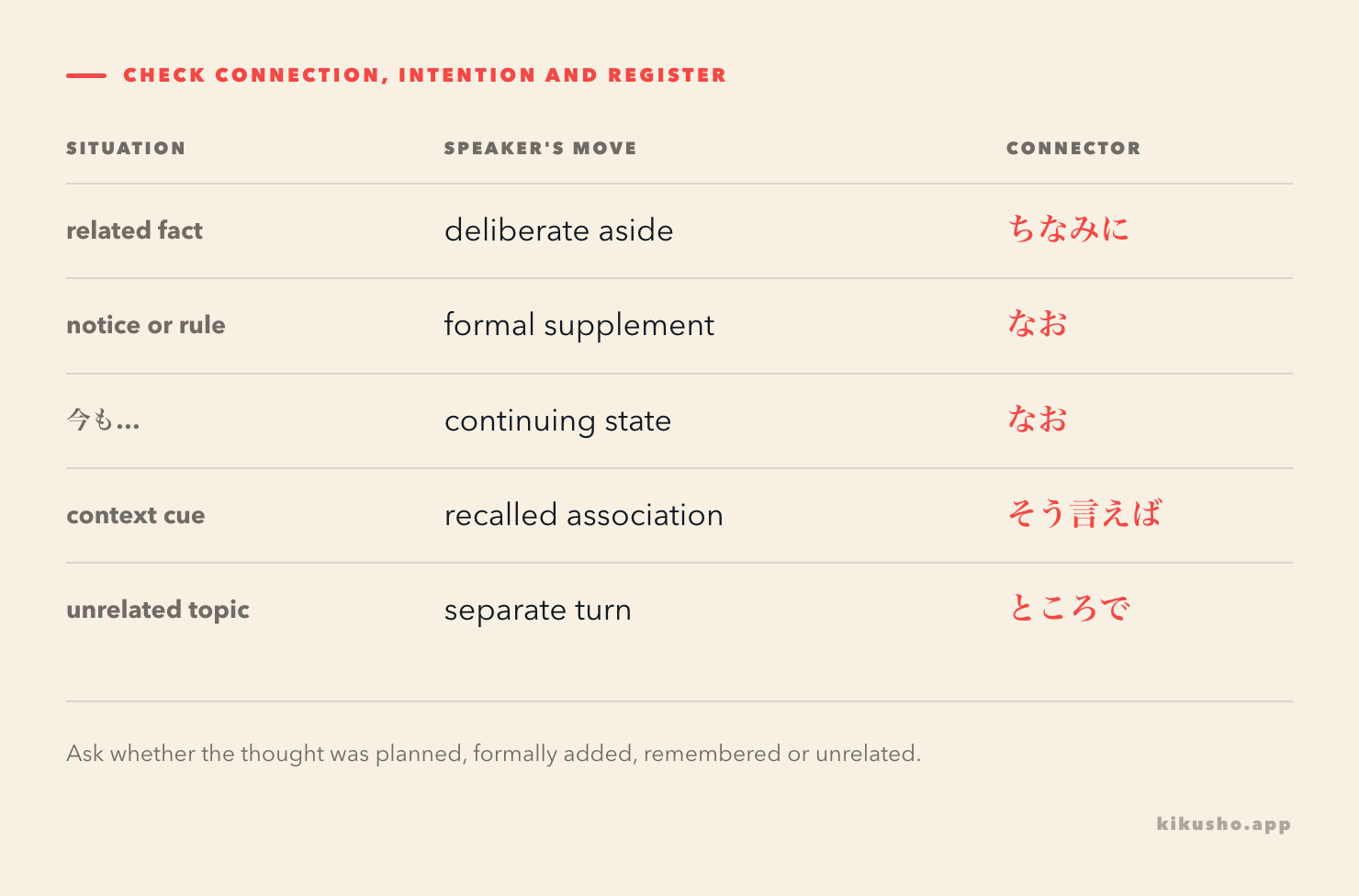
That last boundary matters. ところで can close the current subject and open another. そう言えば claims a cue, and ちなみに claims at least a useful relation. The ところで and ところが comparison gives the separate-topic test and distinguishes it from a recalled association.
The level label is a study estimate
JLPT Sensei's ちなみに, なお and そう言えば pages place all three at N2. Bunpro also places both its continuation and supplementary entries for なお at N2. The curriculum records no disagreement for these three items.
That agreement is useful for sequencing, but it is not an official exhaustive syllabus. The present JLPT does not publish a complete grammar list by level. What the exam can test here is the relationship across sentences: whether the next line is a related aside, a formal note or a thought retrieved by context.
When you capture one of these expressions in Kikusho, keep the sentence before it. A card containing only そう言えば = come to think of it loses the cue that made the recollection natural. A two-sentence text capture preserves the relation and leaves the example editable if you want to replace it with your own memory.
Practice: identify how the new thought entered
Question 1 — a related aside
A friend adds one useful fact about the café already under discussion. Choose the connector.
このカフェは朝七時から開いています。__、Wi-Fiも無料ですよ。
ア) なお
イ) そう言えば
ウ) ちなみに
エ) ところが
Question 2 — a formal note
Choose the connector for a museum notice.
館内での撮影は禁止です。__、大きな荷物は受付にお預けください。
ア) ちなみに
イ) なお
ウ) そう言えば
エ) それなら
Question 3 — a recollection
A: 鈴木さん、最近忙しそうですね。
B: __、来月海外へ引っ越すと言っていました。
ア) そう言えば
イ) なお
ウ) ちなみに
エ) したがって
Question 4 — rebuild the recollection
Put the five pieces in order to express, “Come to think of it, I haven't replied to that email yet.”
- まだ
- そう言えば
- 返信していない
- あのメールに
- 。
Question 5 — connector or adverb
Which sentence uses なお to mean “still” rather than to introduce a supplementary note?
ア) 受付は終了しました。なお、資料はウェブサイトで公開します。
イ) 予約が必要です。なお、電話でも申し込めます。
ウ) その制度は改正後もなお残っている。
エ) 会議は三時からです。なお、会場は二階です。
Question 6 — connected text
Select the two connectors that keep the notice and the recollection distinct.
説明会は午後二時に始まります。( ① )、受付は一階です。駅前の会場ですね。( ② )、駅の改札工事はもう終わったのでしょうか。
ア) ①なお ②そう言えば
イ) ①そう言えば ②なお
ウ) ①ちなみに ②したがって
エ) ①それなら ②ちなみに
Answers and explanations
Answer 1
ウ) ちなみに. Free Wi-Fi is an optional fact connected to the café topic and presented in ordinary conversation. なお would impose a more formal notice-like register, while そう言えば would signal a recollection.
Answer 2
イ) なお. The museum notice formally adds an instruction about luggage. ちなみに is too conversational for the intended register, and そう言えば would treat the instruction as something just remembered.
Answer 3
ア) そう言えば. Hearing about Suzuki's recent busyness cues the remembered remark about moving abroad. The connector shows the information returning to the speaker's mind.
Answer 4
2 → 4 → 1 → 3 → 5. そう言えば、あのメールにまだ返信していない。 The present conversation or situation prompts the speaker to remember an unfinished reply.
Answer 5
ウ. In 改正後もなお残っている, なお modifies the continuing state: the system remains even after revision. The other three examples begin a new sentence with a supplementary note.
Answer 6
ア) ①なお ②そう言えば. The reception location is a formal practical note attached to the event announcement. Mentioning the station then prompts a question about the remembered construction work.
Common questions
What is the difference between ちなみに, なお and そう言えば?
ちなみに adds an optional detail related to the topic, なお marks a formal supplementary note, and そう言えば signals that the preceding context has made the speaker remember something.
Can ちなみに and なお both mean “incidentally”?
Yes, but their settings differ. ちなみに is common in conversation and informal explanation, while なお is at home in notices, instructions and formal prose.
Does なお always introduce an additional note?
No. As an adverb inside a clause, especially in 今もなお, it means “still.” At the beginning of a new sentence, it can introduce a supplementary note.
Is そう言えば the same as ところで?
No. そう言えば presents the next thought as an association or recollection prompted by the current context. ところで can leave that context for a separate topic.