On this page
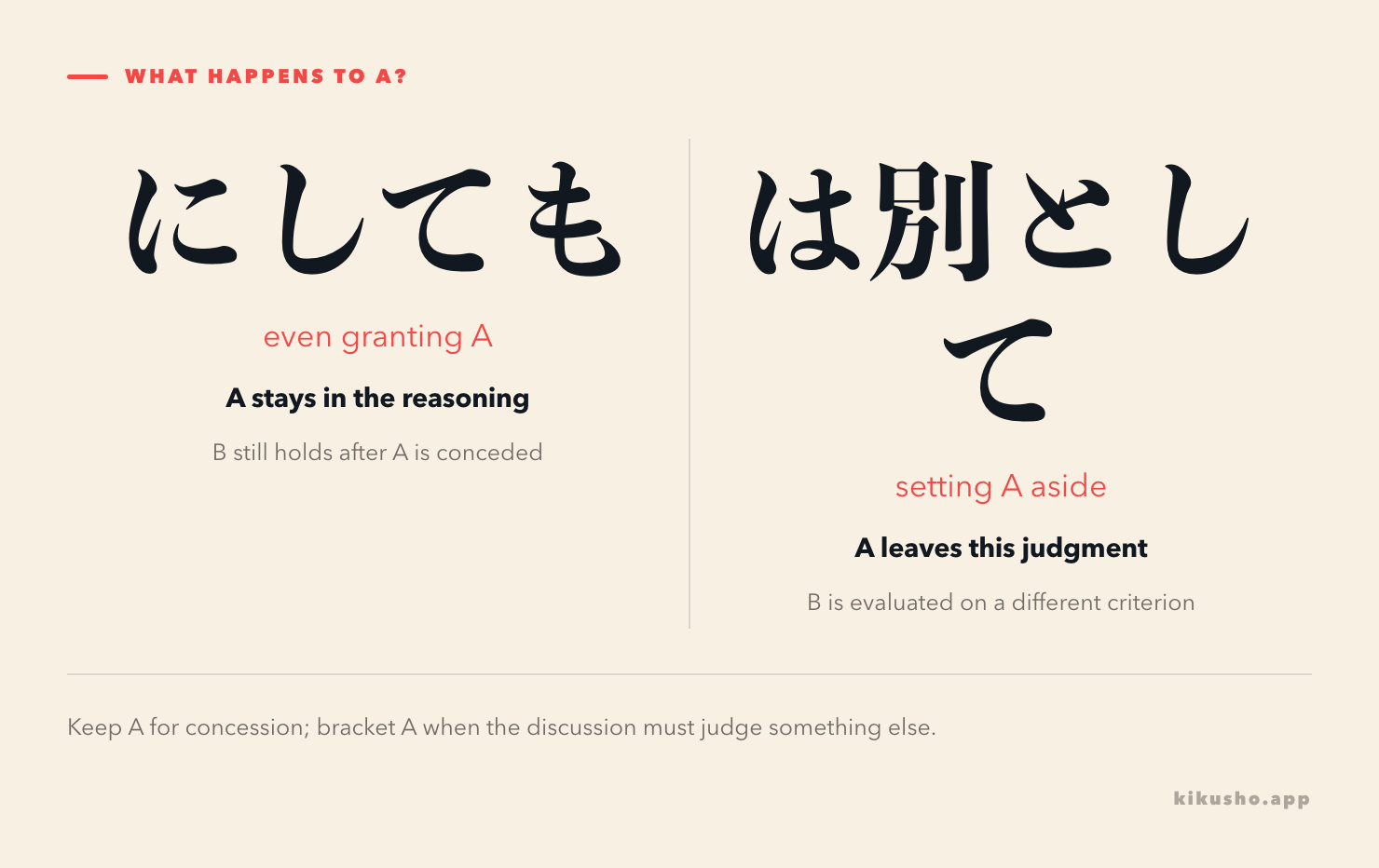
Use にしても when you grant A and still reach B. Use は別として when you put A outside the current judgment and evaluate B instead. In 冗談にしても、その言い方はひどい, the possibility of a joke does not excuse the wording; in 冗談は別として、今後の計画を話そう, the joke is dropped so the plan can become the topic.
The English translations “even if,” “regardless of,” and “setting aside” can overlap. The reliable test is what happens to A: does it remain a conceded case, or does the speaker deliberately stop judging it?
Decide whether A stays in the argument
| Relationship | Pattern | What the speaker does |
|---|---|---|
| A is granted, but B still holds | A にしても B | keeps A inside the reasoning |
| A is excluded from this judgment | A は別として B | sets A aside and evaluates B |
冗談にしても、その言い方はひどい。
じょうだんにしても、その いいかたは ひどい。
Even if it was a joke, that way of saying it was awful.
冗談は別として、今後の計画を話そう。
じょうだんは べつとして、こんごの けいかくを はなそう。
Joking aside, let us discuss the plan from here.
The first sentence still evaluates the joke: “I grant that explanation, and my criticism survives it.” The second refuses to evaluate the joke for the moment. It changes the subject to the future plan.
Bunpro's にしても lesson describes the form as “even considering A,” followed by a result that is unexpected or unaffected. Its は別として lesson says A is disregarded before the main point is discussed. Those descriptions support the keep-or-remove test.
にしても grants a case without cancelling the conclusion
Attach にしても to a plain verb, an い-adjective, a な-adjective or a noun. Nouns and な-adjectives may also take である before にしても in careful writing.
| Before にしても | Example | Reading |
|---|---|---|
| verb | 行くにしても | even if one goes |
| い-adjective | 高いにしても | even if it is expensive |
| な-adjective | 静かにしても / 静かであるにしても | even if it is quiet |
| noun | 冗談にしても / 冗談であるにしても | even if it is a joke |
忙しいにしても、一言ぐらい連絡できるでしょう。
いそがしいにしても、ひとことぐらい れんらくできるでしょう。
Even if you are busy, you can probably send a short message.
The speaker accepts busyness as a possible fact. That concession does not change the minimum expected action. This often gives にしても a critical, reserved, or corrective tone, but criticism is not part of the grammar itself.
新しい方法にしても、準備には時間がかかる。
あたらしい ほうほうにしても、じゅんびには じかんが かかる。
Even with a new method, preparation takes time.
Here the conclusion is neutral. The method may change, but the need for preparation remains.
JLPT Sensei gives the N3 placement and lists the same predicate classes. Its examples include both a hypothetical reading and cases where an unknown choice cannot change the conclusion.
Repeating にしても covers alternatives
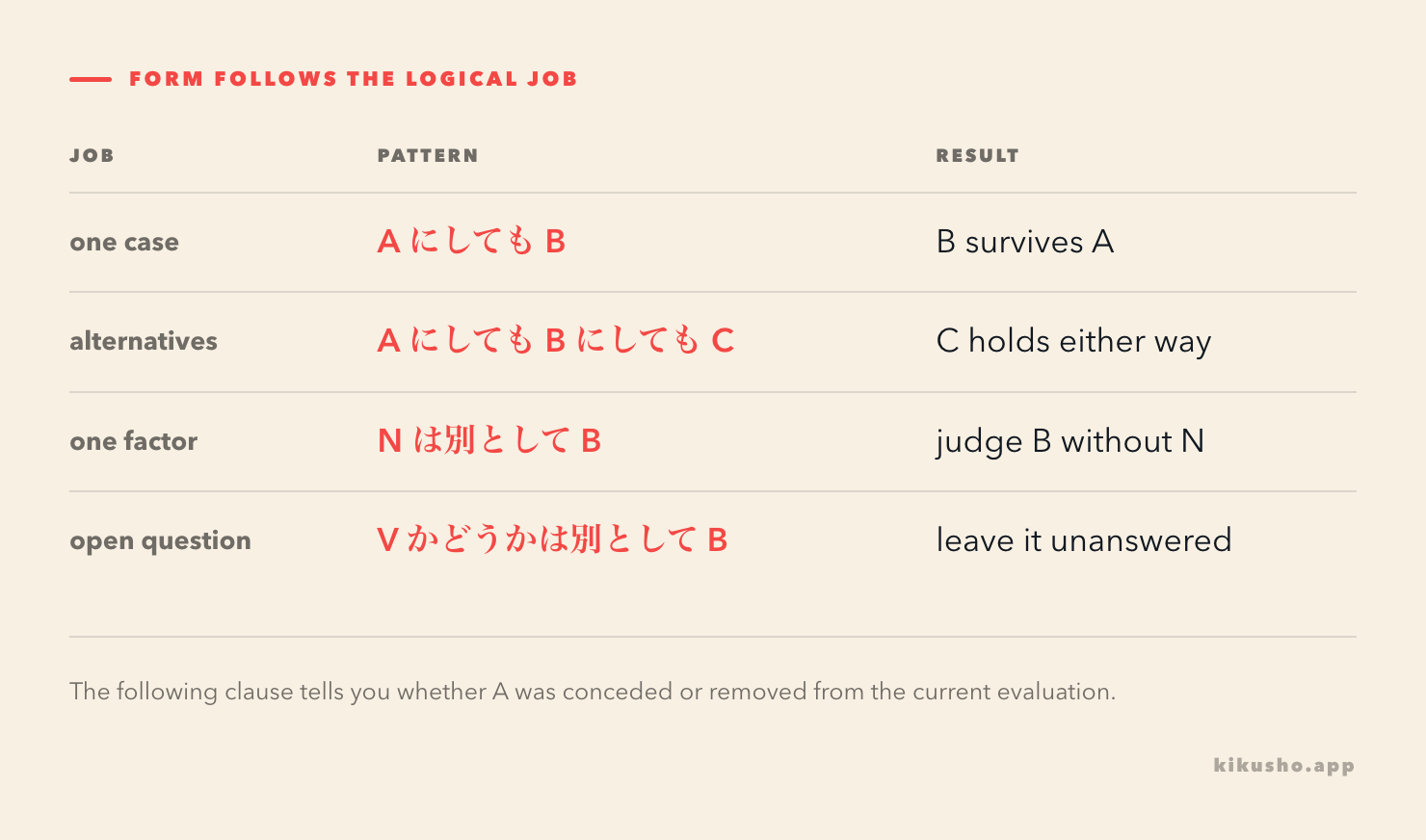
The paired pattern A にしても B にしても C means that C holds whichever alternative is chosen. A and B normally form a useful contrast, including a positive and negative pair.
行くにしても行かないにしても、今日中に返事をしてください。
いくにしても いかないにしても、きょうじゅうに へんじを してください。
Whether you go or not, please reply by the end of today.
電車にしてもバスにしても、一時間以上かかる。
でんしゃにしても バスにしても、いちじかんいじょう かかる。
Whether by train or bus, it takes more than an hour.
Both options stay inside the comparison. The unchanged deadline or travel time is the point. Do not read the first にしても as one abandoned topic and the second as another.
は別として sets one factor outside the current judgment
The simplest attachment is noun + は別として.
値段は別として、このかばんは丈夫で使いやすい。
ねだんは べつとして、この かばんは じょうぶで つかいやすい。
Setting the price aside, this bag is durable and easy to use.
The speaker has not said that the price is good, bad, high, or irrelevant forever. Price is simply outside this evaluation of durability and ease of use.
For a whole proposition, use plain clause + かどうかは別として: “leaving aside whether…”
成功するかどうかは別として、挑戦する価値はある。
せいこうするか どうかは べつとして、ちょうせんする かちは ある。
Leaving aside whether it succeeds, it is worth trying.
The success question remains unanswered. The speaker evaluates a different point: the value of trying. Positive and negative alternatives can also appear explicitly, as in 成功するかしないかは別として.
は別にして is a close variant. The Japanese-teacher reference 毎日のんびり日本語教師 gives noun and かどうか attachments for both forms and explains that the first matter is left unconsidered while the following point is addressed.
Similar English does not make the logic interchangeable
Compare the same topic in both frames.
値段が高いにしても、必要なら買う。
ねだんが たかいにしても、ひつようなら かう。
Even if the price is high, I will buy it if I need it.
値段は別として、この製品の安全性を確認しよう。
ねだんは べつとして、この せいひんの あんぜんせいを かくにんしよう。
Setting the price aside, let us check this product's safety.
The first sentence keeps a high price as an obstacle and says it may fail to change the purchase. The second sentence suspends the price question so safety can be examined. Translating both with “regardless of the price” hides that difference.
The earlier どんなに, いくら and たとえ~ても lesson covers concessions built around degree, accumulated effort, and a specific hypothetical case. にしても also concedes A, but it readily evaluates one proposed case or contrasts alternatives. は別として performs a different discourse move by withholding judgment on A.
Three mistakes that change the message
Do not use は別として to mean that A failed to change B
雨が降るにしても、試合は行う。
あめが ふるにしても、しあいは おこなう。
Even if it rains, the match will be held.
雨は別として、風の強さを確認しよう。
あめは べつとして、かぜの つよさを かくにんしよう。
Setting rain aside, let us check the wind strength.
The second sentence does not promise a match in rain. It postpones the rain question.
Do not confuse にしても with にしては
にしては evaluates something against the standard expected for A: 初めてにしては上手だ, “It is good for a first attempt.” にしても concedes A and keeps the following conclusion: 初めてにしても、説明を読む必要がある, “Even if it is your first attempt, you need to read the instructions.” Changing one particle changes the relation.
Do not invent an answer to かどうか
In 成功するかどうかは別として, the speaker neither predicts success nor dismisses it as unimportant. The sentence brackets that question for the present purpose. Translate the following clause before deciding what attitude the context suggests.
Register and JLPT placement
Both patterns work in ordinary careful speech and writing. にしても can sound firm when it introduces a minimum expectation, while the paired form is useful for decisions and instructions. は別として is common in structured discussion because it explicitly controls which criterion is being judged. は別にして and はともかく are close neighbours, but they deserve their own contextual comparison rather than a claim that every occurrence is identical.
The level labels disagree. JLPT Sensei presents both target forms as N3. Bunpro presents にしても as N3 but は別として as N2, and the Japanese-teacher source above also files は別として under N2. Kikusho keeps this comparison in the planned N3 sequence because one assigned source explicitly supports that placement and because the decision rule is useful at this stage. No complete official JLPT grammar catalogue settles this publisher disagreement, so treat the label as a study order rather than a prediction about one test paper.
Practice
Attempt the seven items before opening the solution section below.
Question 1 — grammar choice. You accept that Ken is busy, but you still think he can send one message. Complete:
健さんは忙しい( )、一言ぐらい連絡できるでしょう。
- ア. は別として
- イ. にしても
- ウ. にしては
- エ. かどうかは別として
Question 2 — grammar choice. You want to discuss quality without deciding whether the price is acceptable. Complete:
値段( )、品質はとてもいい。
- ア. にしても
- イ. にしては
- ウ. は別として
- エ. かどうかにしても
Question 3 — sentence composition. Arrange the chunks to mean “Whether we go or do not go, we must decide today.”
今日決めなければならない / 行くにしても / 行かないにしても
Question 4 — clause formation. Complete with the form that means “Leaving aside whether it succeeds”:
成功する( )、挑戦する価値はある。
- ア. にしては
- イ. かどうかは別として
- ウ. にしてもにしても
- エ. は別かどうかとして
Question 5 — meaning choice. What does the speaker leave unresolved here?
デザインは別として、この椅子は丈夫だ。
- ア. Whether the chair is durable
- イ. Whether the design is good
- ウ. Whether the chair has a design
- エ. Whether durability matters
Question 6 — sentence composition. Write one Japanese sentence meaning: “Even if it was a joke, that comment was rude.” Use 冗談, にしても, その発言, and 失礼だった.
Question 7 — text grammar. Read the meeting note and choose the pair that preserves its logic.
発表を延期するかどうか( 甲 )、準備は続けよう。延期する( 乙 )予定どおり行うにしても、金曜日までに資料が必要だ。
- ア. 甲: にしても / 乙: は別として
- イ. 甲: は別として / 乙: にしても
- ウ. 甲: にしては / 乙: かどうかは別として
- エ. 甲: は別にしても / 乙: にしては
Answers and explanations
Answer 1. イ. にしても. The sentence grants busyness but keeps the judgment that one short message is possible. は別として would remove busyness from the current evaluation, and にしては would compare Ken with a standard expected of a busy person.
Answer 2. ウ. は別として. Price is the criterion being set aside so quality can be evaluated. にしても would require a conclusion that survives the conceded price, such as 値段が高いにしても買う.
Answer 3. 行くにしても行かないにしても、今日決めなければならない。 The two にしても phrases present opposite alternatives. The decision deadline holds under either one.
Answer 4. イ. かどうかは別として. 成功するかどうか packages the unresolved success question, and は別として removes it from the present judgment about whether trying has value.
Answer 5. イ. Whether the design is good. The sentence asserts durability. It mentions design only to suspend that evaluation; it does not state that the design is good or bad.
Answer 6. One natural answer is 冗談にしても、その発言は失礼だった。 (じょうだんにしても、その はつげんは しつれいだった) The speaker grants the possibility that it was a joke, yet the negative judgment of the comment remains.
Answer 7. イ. 甲: は別として / 乙: にしても. 延期するかどうかは別として postpones the decision about delaying while preparation continues. 延期するにしても予定どおり行うにしても then places both alternatives inside one rule: the materials are needed by Friday either way.
Keep the relation when you save an example
A card containing only にしても or は別として cannot test the decision that matters. Keep A and B together: one side should show whether A remains a concession or leaves the current evaluation.
When you save 行くにしても行かないにしても、今日中に返事をしてください, preserve both alternatives and the unchanged deadline. For 成功するかどうかは別として、挑戦する価値はある, keep the unanswered question beside the new criterion. That context turns a translation into a usable grammar choice.
Common questions
What does にしても mean in Japanese?
It means “even if,” “even though,” or “even considering.” The speaker grants a case, then says the judgment or required action still holds: 忙しいにしても、連絡はできる means “Even if you are busy, you can still contact me.”
What does は別として mean?
It means “setting aside,” “apart from,” or “leaving aside whether.” The speaker removes one factor from the current evaluation and turns to another: 値段は別として、品質はいい means “Setting the price aside, the quality is good.”
What is the difference between にしても and は別として?
にしても keeps A in the argument as a concession: even granting A, B remains true. は別として temporarily removes A from the judgment so the speaker can evaluate B.
Are にしても and は別として N3 grammar?
JLPT Sensei places both at N3. Bunpro places にしても at N3 and は別として at N2; Japanese teacher materials also commonly teach は別として at N2. These are study placements because the JLPT does not publish an exhaustive grammar list.