On this page
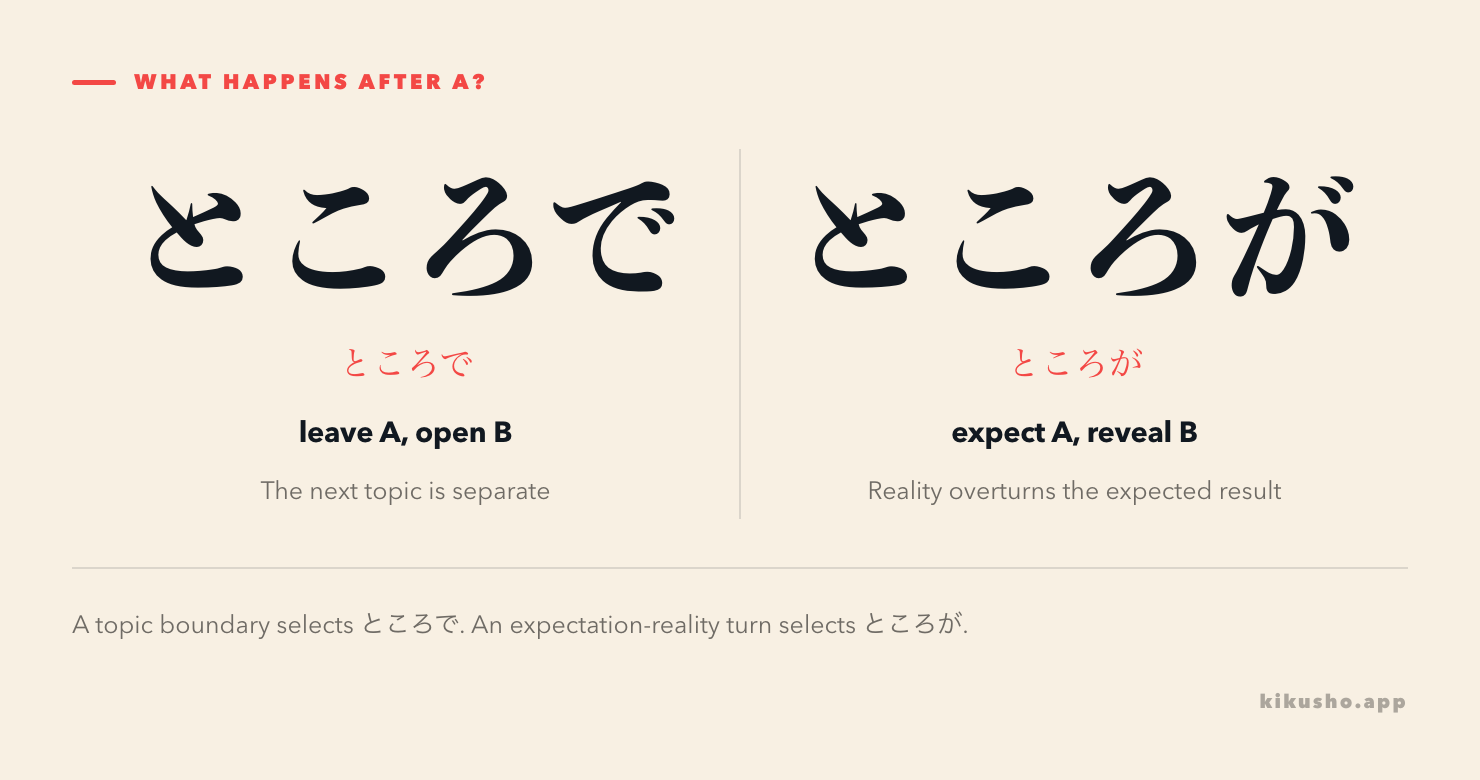
Use ところで when you are finished with one topic and want to open another: “by the way.” Use ところが when the topic stays in place but reality turns out differently from what the listener was led to expect.
会議の資料は完成しました。ところで、週末は何をする予定ですか。
かいぎの しりょうは かんせいしました。ところで、しゅうまつは なにを する よていですか。
The meeting materials are finished. By the way, what are you planning to do this weekend?
午後は晴れる予報だった。ところが、昼から雪が降り始めた。
ごごは はれる よほうだった。ところが、ひるから ゆきが ふりはじめた。
The forecast said it would be sunny in the afternoon. However, it began to snow at noon.
The first connector breaks the line between A and B. The second depends on that line: the forecast creates an expectation, and the snow overturns it. This lesson teaches inventory items g-44e15896b502, ところで, and g-91e5b26df460, ところが.
Decide whether B leaves A or reverses it
Both forms usually stand at the beginning of a sentence or turn, and both can become “however” or “by the way” in loose translation. Their jobs in the paragraph are different.
| Relationship between A and B | Connector | Shape |
|---|---|---|
| A ends; B opens a separate subject | ところで | A。ところで、B。 |
| A creates an expectation; B gives surprising reality | ところが | A。ところが、B。 |
With ところで, you should be able to put a visible topic boundary between the sentences. With ところが, you should be able to write expected: X / actual: Y. If neither test works, another connector is probably needed.
These are fixed conjunctions in this use. They do not attach to a particular word class. The preceding sentence supplies the discourse context, and the connector announces how the next sentence relates to it.
ところで opens a separate topic
ところで tells the listener that the current line is complete enough to leave. It often introduces a question because a speaker changes subject in order to ask for information.
新しい部屋は駅に近くて便利です。ところで、田中さんは最近どうしていますか。
あたらしい へやは えきに ちかくて べんりです。ところで、たなかさんは さいきん どうして いますか。
My new apartment is convenient and close to the station. By the way, how has Tanaka been lately?
説明は以上です。ところで、来週の会議には参加できますか。
せつめいは いじょうです。ところで、らいしゅうの かいぎには さんかできますか。
That concludes the explanation. By the way, can you attend next week's meeting?
The second topic may have been prompted by something in the situation, but it does not continue the argument made in the first sentence. ARC Tokyo Japanese Language School describes ところで as a signal that an unrelated new topic is beginning. Bunpro gives the same core restriction and contrasts it with そういえば, which recalls something connected to the current subject.
Because ところで announces a departure, it needs a discourse point to depart from. Dropping it into the first greeting of an exchange can sound unmotivated. Let one topic exist first, then use the connector when you actually turn away from it.
ところが reveals reality against an expectation
ところが does not abandon A. It asks the listener to use A as the expectation that makes B surprising.
店は空いていると思った。ところが、入口には長い列ができていた。
みせは すいていると おもった。ところが、いりぐちには ながい れつが できていた。
I thought the shop would be quiet. However, a long line had formed at the entrance.
試験はとても難しいと聞いていた。ところが、問題は意外に簡単だった。
しけんは とても むずかしいと きいていた。ところが、もんだいは いがいに かんたんだった。
I had heard that the exam was very difficult. Yet the questions were unexpectedly easy.
The surprise can be unwelcome or welcome. The connector does not mean “bad result.” It means that the actual result resists what the preceding context made plausible.
An expectation can be explicit through と思った, つもりだった, はずだった or a forecast. It can also be inferred:
彼は毎日練習していた。ところが、本番では力を出せなかった。
かれは まいにち れんしゅうしていた。ところが、ほんばんでは ちからを だせなかった。
He practised every day. Even so, he could not perform at his best in the real event.
Daily practice supports an expectation of a good performance. ところが makes the failure a narrative turn rather than a neutral second fact.
ところが is not a general-purpose “but”
でも, しかし, けど and が can link many kinds of contrast. ところが is narrower: it stages an expectation and then reveals what actually happened. It is especially at home when one speaker or narrator controls the unfolding account.
The Society for Teaching Japanese as a Foreign Language's English grammar reference gives a useful style boundary. When a narrator leads the listener from a prediction to the actual outcome, ところが fits. In an equal exchange where one person simply objects to another person's suggestion, でも is more natural.
A: 日曜日、キャンプに行こうよ。
にちようび、キャンプに いこうよ。
Let's go camping on Sunday.
B: でも、雨だったら大変だよ。
でも、あめだったら たいへんだよ。
But it will be a problem if it rains.
B is raising a concern, not revealing an actual outcome after A's expectation failed. ところが would give the reply a narrator-like structure that this ordinary negotiation does not support.
The same test separates ところが from のに. 安いのに買わなかった builds the unexpected contrast inside one sentence. 安いと思って店へ行った。ところが、値段は高かった unfolds an expectation and later reality across sentences.
ところで differs from さて and そういえば
さて can open a planned next stage, whether related or unrelated to what came before. A teacher may finish one section and say さて、次の問題を見ましょう, “Now then, let us look at the next question.” The larger lesson continues.
ところで marks a more distinct side turn. ここまで申込方法を説明しました。ところで、駅から会場まで何分ですか leaves application procedure for a travel question. The さらに and さて lesson shows why さて is natural in lessons, presentations and correspondence where the speaker advances through planned stages.
そういえば means “speaking of that” or “come to think of it.” It presents the new thought as an association triggered by the current topic. ところで does not claim that associative link.
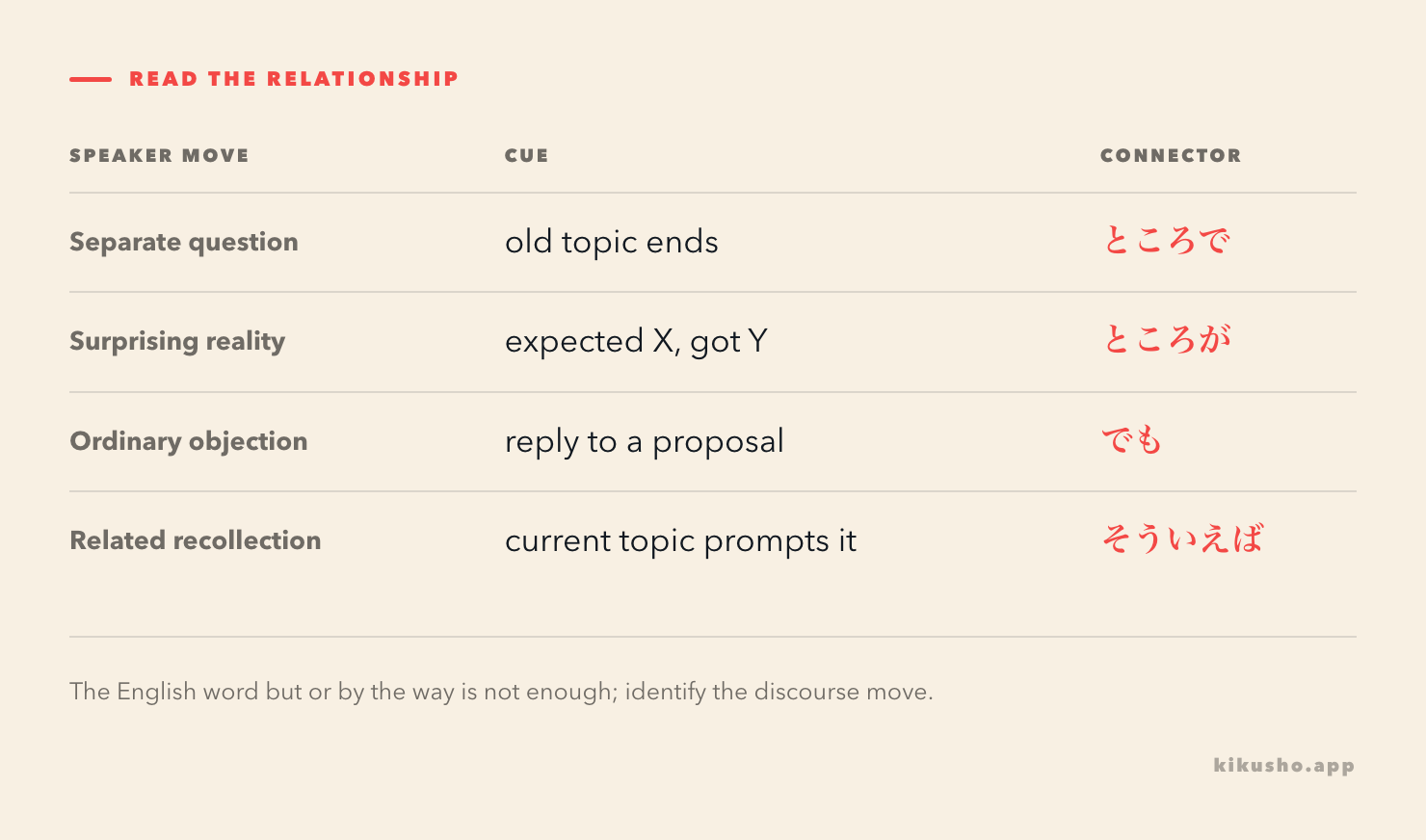
| Speaker's move | Natural opening |
|---|---|
| move to the next planned section | さて |
| break into a separate topic | ところで |
| recall something related | そういえば |
The boundaries can soften in real conversation, but the distinction gives you a dependable reading test: planned progression, separate turn or recalled association.
Do not confuse the conjunctions with verb plus ところ
The hiragana string can appear inside other constructions. Punctuation and what comes immediately before it matter.
| Surface form | Structure | Meaning |
|---|---|---|
| ところで、週末は… | fixed conjunction at sentence opening | by the way |
| 帰ろうとしたところで、電話が鳴った | verb phrase + ところ + で | at the point when |
| 何度説明したところで、分からないだろう | Vた + ところで | even if; despite doing |
| この店のいいところが分かった | noun ところ + subject が | the good point is/was… |
In 帰ろうとしたところで, the verb directly modifies ところ, and で marks the stage where another event happened. In sentence-opening ところで, no verb modifies the connector and the previous sentence has already closed.
Similarly, この店のいいところが分かった contains the ordinary noun “good point” plus subject particle が. It does not introduce an unexpected result. The conjunction ところが begins its own clause and refers back to the expectation carried by the preceding discourse.
Kikusho is most useful here when the card keeps both sides of the boundary. Paste the two-sentence pair rather than saving only ところが = “however”; the retained example and nuance show whether the connector shifted topic or overturned the result.
Practice: trace the relationship between the sentences
Question 1. Choose the connector that opens a separate topic.
この本の内容はよく分かりました。( )、来月の旅行について相談してもいいですか。
- A. ところで
- B. ところが
Question 2. Choose the connector that reveals an unexpected result.
今日は一日中晴れるはずだった。( )、午後から激しい雨が降った。
- A. ところで
- B. ところが
Question 3. Which response is natural in an ordinary exchange?
A: 明日、公園で昼ご飯を食べよう。
B: ( )、雨が降ったらどうする?
- A. ところが
- B. でも
- C. ところで
- D. さて
Question 4. Put the pieces in order to make an expectation-reality turn.
ところが ・ 客は一人も来なかった ・ 店は混むと思っていた
Question 5. Which sentence uses the fixed topic-shifting conjunction rather than verb plus ところ?
- A. 急いだところで、電車には間に合わない。
- B. 家を出るところで、電話が鳴った。
- C. ところで、次の休みはいつですか。
- D. この店のいいところが分かった。
Question 6. Choose the sentence in which ところが is appropriate.
- A. コーヒーを飲みます。ところが、お茶も飲みます。
- B. 安いと思って買った。ところが、修理代が高くついた。
- C. 東京に住んでいます。ところが、趣味は何ですか。
- D. 明日は休みです。ところが、映画を見たいです。
Question 7. Complete both blanks from the context.
ホテルは駅のすぐ前だと聞いていた。(甲)、実際には駅から二十分も歩いた。(乙)、今回の旅行ではどの町が一番よかったですか。
- ア. 甲 ところで / 乙 ところが
- イ. 甲 ところが / 乙 ところで
- ウ. 甲 さて / 乙 ところが
- エ. 甲 ところが / 乙 しかし
Answers and explanations
Answer 1. A, ところで. The discussion of the book ends, and the speaker opens a separate question about next month's trip. No expectation is overturned.
Answer 2. B, ところが. The forecast creates the expectation of sunshine. The heavy afternoon rain is the actual result that conflicts with it.
Answer 3. B, でも. B is raising a possible problem with A's suggestion. No actual surprising result has occurred, so narrator-like ところが is unsuitable. ところで would abandon the camping topic, and さて would announce a new stage.
Answer 4. 店は混むと思っていた。ところが、客は一人も来なかった。 The first sentence states the expectation. The second gives the surprising reality, with ところが at its opening.
Answer 5. C. Sentence C begins a new topic with the fixed conjunction. A is the separate Vたところで concessive pattern, B uses ところ as a stage modified by 家を出る, and D makes ところ the noun-like subject marked by が.
Answer 6. B. The low purchase price created a favourable expectation, but the repair cost produced an unwelcome reality. A needs an additive connector, C needs a topic shift such as ところで, and D states a future wish rather than a realised reversal.
Answer 7. イ. The promised location creates an expectation, so ところが introduces the unexpectedly long walk. The final question leaves that hotel result and opens a broader topic about the best town, so ところで marks the shift.
JLPT Sensei and Bunpro place both conjunctions at N3, and the curriculum records no level disagreement. The harder part is not their level label but their scope: one asks the listener to release the old topic, while the other asks the listener to remember its expectation long enough to feel the turn.
Common questions
What is the difference between ところで and ところが?
ところで closes the current topic and opens a separate one, like “by the way.” ところが keeps the same situation and introduces a result that conflicts with an expectation.
Where do ところで and ところが appear in a sentence?
As conjunctions, they normally stand at the beginning of a new sentence or turn: A。ところで、B。 and A。ところが、B。
Is ところが the same as でも or しかし?
No. でも and しかし can mark a general contrast. ところが normally presents reality as surprising when compared with an expectation created by the preceding context.
Are ところで and ところが N3 grammar?
JLPT Sensei and Bunpro place both conjunctions at N3. That is an editorial study estimate because the current JLPT publishes no exhaustive grammar list by level.