On this page
ではないか and じゃないか often ask the listener to accept something the speaker already believes: “isn't it?” or “didn't I tell you?” The main difference between them is register. ではないか is fuller and formal or written; じゃないか is its conversational contraction and can sound direct when the speaker presses for agreement.
The negative shape usually checks a positive claim
Read the proposition before the ending. In 君が言ったじゃないか, the speaker is not denying that the listener spoke. The speaker treats 君が言った, “you said it,” as true and asks the listener to recognize that fact.
君が行きたいと言ったじゃないか。
きみが いきたいと いったじゃないか。
You said you wanted to go, didn't you?
この方法が一番安全ではないか。
この ほうほうが いちばん あんぜんではないか。
Isn't this method the safest?
The first line can be a reminder or a challenge. The second has the tone of a formal argument or careful discussion. Both endings resemble a negative question, but their conversational job is to seek recognition of the preceding proposition.
| Form | Speaker's position | Likely English |
|---|---|---|
| P + じゃないか | “I take P to be true; recognize it.” | P, isn't it? / Didn't P? |
| P + ではないか | the same stance in a formal or written register | Is it not the case that P? |
| P + じゃない | plain denial when the predicate itself is negative | is not P |
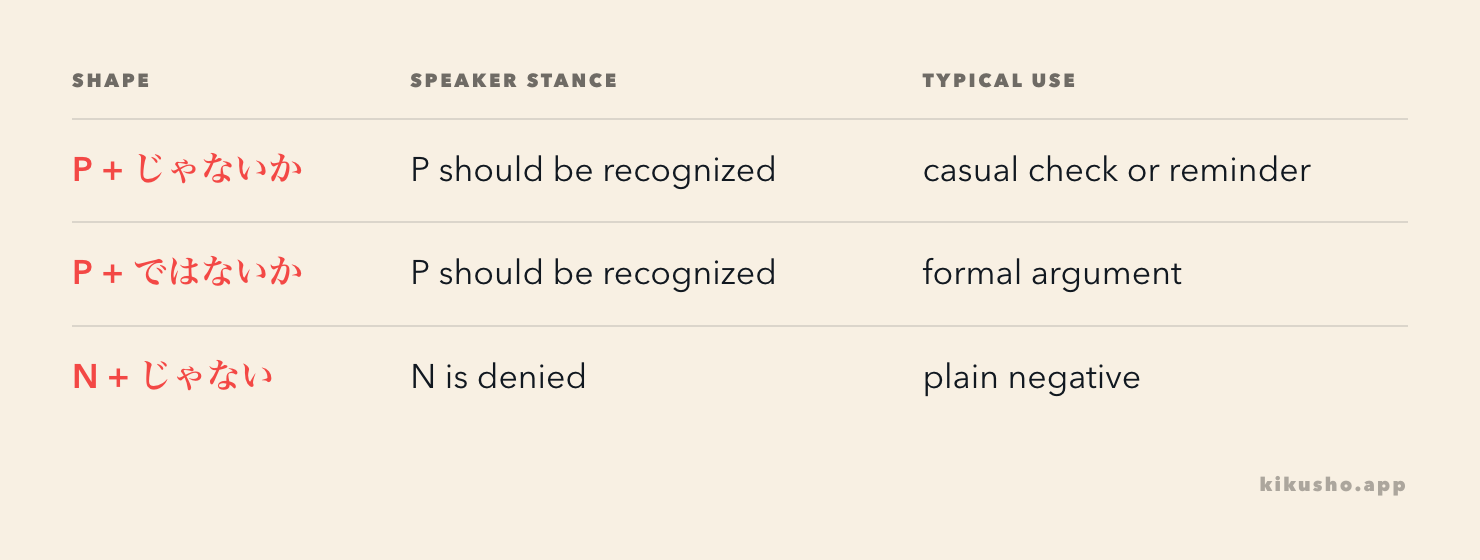
The distinction matters because English translations can hide it. “Didn't you say that?” may be an open request for information, a reminder of shared knowledge, or an accusation. Japanese intonation and context reveal which one the speaker intends.
では and じゃ change register, not the central meaning
じゃ is the spoken contraction of では. That makes じゃないか the natural member of the pair in casual conversation, while ではないか fits speeches, essays, formal debate, and deliberately weighty dialogue.
あれ、田中さんじゃないか。
あれ、たなかさんじゃないか。
Oh, isn't that Mr Tanaka?
今こそ制度を見直すべきではないか。
いまこそ せいどを みなおすべきではないか。
Is this not the time to reconsider the system?
The second sentence sounds like a public argument. Replacing ではないか with じゃないか keeps the broad claim but changes its setting and tone. Conversely, using ではないか in an ordinary chat can sound stiff, rhetorical, or theatrical.
Formality is not the same as politeness. Both assigned forms are plain style:
| Setting | Common ending | Example |
|---|---|---|
| casual conversation | じゃないか | 今日は休みじゃないか |
| polite conversation | じゃないですか | 今日は休みじゃないですか |
| formal plain argument | ではないか | これは必要ではないか |
| formal polite question | ではありませんか | これは必要ではありませんか |
Do not add です after the final か. じゃないかです is not the polite version; choose じゃないですか instead.
Attach the ending to a complete plain proposition
The pattern can follow a verb, an い-adjective, a な-adjective stem, or a noun. The material before it states what the speaker wants recognized.
| Predicate type | Proposition plus じゃないか | Reading and meaning |
|---|---|---|
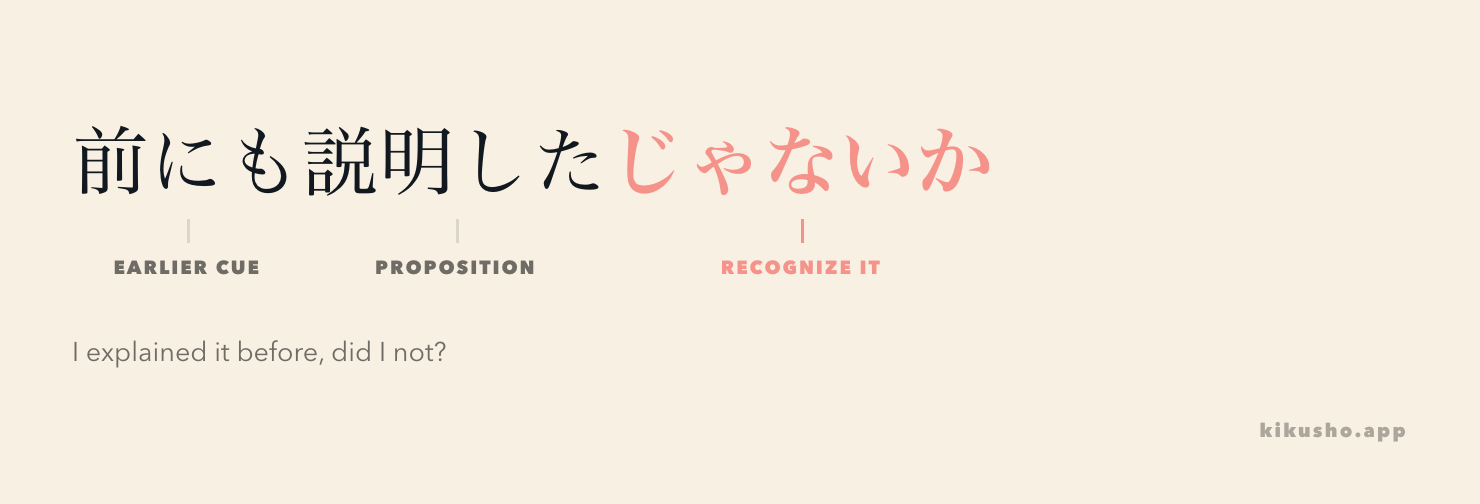
| verb | 前にも説明したじゃないか | まえにも せつめいしたじゃないか, I explained it before, didn't I? |
| い-adjective | この店は安いじゃないか | この みせは やすいじゃないか, This shop is cheap, isn't it? |
| な-adjective | ここは静かじゃないか | ここは しずかじゃないか, It is quiet here, isn't it? |
| noun | あれは田中さんじゃないか | あれは たなかさんじゃないか, Isn't that Mr Tanaka? |
After verbs and い-adjectives, do not insert a copula: 安いじゃないか, not 安いだじゃないか. Nouns and な-adjective stems connect directly to じゃないか because じゃない already contains the contracted copular material.
The fuller form follows the same predicate types: 説明したではないか, 安いではないか, 静かではないか, and 田中さんではないか. These direct forms can sound literary or forceful after verbs and い-adjectives. In ordinary speech, じゃないか is usually the useful choice.
Delivery separates a check from a challenge
A rising, genuinely questioning delivery can ask the listener to confirm remembered information. A falling or forceful delivery often asserts the proposition and reminds, rebukes, or challenges the listener.
会議は三時からじゃないか?
かいぎは さんじからじゃないか。
The meeting starts at three, doesn't it?
だから、昨日も説明したじゃないか。
だから、きのうも せつめいしたじゃないか。
That's why I explained it yesterday, didn't I?
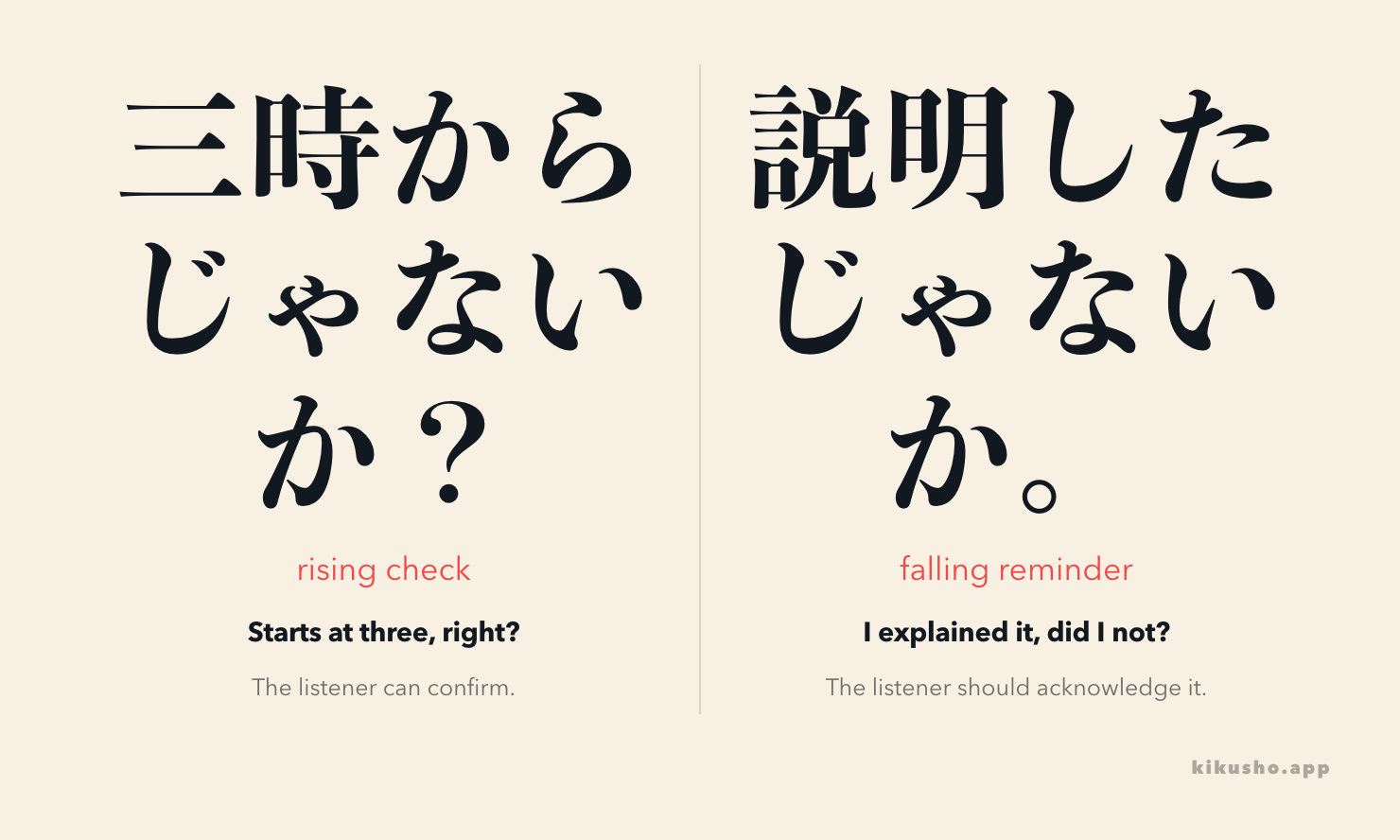
Question marks can suggest the first reading in writing, but punctuation is not the grammar. Words such as 確か, “if I remember correctly,” support an information check. だから, ほら, or a repeated past fact often supports a pointed reminder. The relationship between speakers determines how strong that reminder feels.
This is why translating every example as a neutral “right?” loses information. A manager saying 前にも言ったじゃないか is not merely collecting an answer. The sentence pressures the listener to update or acknowledge what they should already know.
Surprise turns the ending into an exclamation
When the speaker suddenly notices something, じゃないか can mark recognition or impressed surprise.
なかなか上手じゃないか。
なかなか じょうずじゃないか。
You're quite good!
あれは私の傘じゃないか!
あれは わたしの かさじゃないか。
Why, that's my umbrella!
The speaker is not waiting for a careful yes-or-no reply. The negative-question shape dramatizes the discovery. Shogakukan's dictionary entry groups surprise, agreement-seeking, questioning, and reproach under this construction; the final particle か also has an exclamatory use in examples such as なかなかやるじゃないか.
Formal ではないか can perform the same rhetorical discovery, especially in writing or stylized speech. In daily conversation, じゃないか is more likely.
A volitional form creates a spirited invitation
After a volitional verb, Vようではないか or Vようじゃないか invites the listener to join an action. The formal version is common in speeches and collective appeals.
一緒に考えようではないか。
いっしょに かんがえようではないか。
Let us think about it together.
もう一度やってみようじゃないか。
もう いちど やってみようじゃないか。
Let's give it another try.
This is not the ordinary negative of 考える or やってみる. The volitional 考えよう / やってみよう already proposes action; the ending seeks shared commitment and gives the invitation rhetorical force. For a simple everyday suggestion, the bare volitional 行こう may be enough.
Three neighbouring shapes need separate decisions
The visible string ないか appears in several constructions. Keep their boundaries clear.
First, ordinary negation states that something is not the case:
田中さんは先生ではない。
Mr Tanaka is not a teacher.
Adding か can create a negative question or a request for expected agreement:
田中さんは先生ではないか。
Is Mr Tanaka not a teacher? / Mr Tanaka is a teacher, isn't he?
Context decides whether the speaker is testing the negative possibility or pressing the positive identification. The N5 guide to じゃない and ではない covers the underlying noun and な-adjective negation.
Second, のではないか / んじゃないか contains explanatory の / ん:
雨が降るんじゃないか。
あめが ふるんじゃないか。
Might it rain? / Isn't it going to rain?
This form often presents an inference, suspicion, or explanation for confirmation. It is related but not interchangeable in every context with direct P + じゃないか. The lesson on explanatory んです and のです shows what the inserted の contributes.
Third, でしょう / だろう can seek confirmation with less of the “you should recognize this” pressure:
会議は三時からでしょう?
The meeting starts at three, right?
The でしょう and だろう comparison also covers inference. Neither family is always softer; voice and relationship still matter. The useful distinction is that じゃないか readily becomes a reminder, discovery, or challenge.
The N4 label is a teaching estimate
JLPT Sensei lists both ではないか and じゃないか at N4. Bunpro's じゃないか reference independently supports the casual confirmation pattern and the more formal ではないか alternative.
Shogakukan's dictionary entry for ない records attachment after verbs, adjectives, な-adjective stems, and nouns, along with surprise, agreement, questioning, reproach, and the volitional invitation. A National Institute for Japanese Language and Linguistics handbook treats ではないか / じゃないか as confirmation-request expressions and shows that they cannot simply replace だろう or よね in every context.
Because the JLPT no longer releases a complete grammar syllabus, N4 here identifies a useful study stage rather than predicting one exact exam sentence.
Kikusho can preserve the part a gloss misses: who spoke, what fact was supposed to be shared, and whether the line checked or challenged. Capture the whole exchange, then edit the example note before saving it. On review, that surrounding turn tells you why “isn't it?” was formal, friendly, surprised, or sharp.
Practice: identify stance before register
Question 1 — grammar choice. Two friends are speaking casually. One reminds the other: “You said that yesterday, didn't you?” Complete 昨日、そう__。
① 言ったじゃないか
② 言ったではありません
③ 言うじゃありませんかでした
④ 言ったじゃない
Question 2 — grammar choice. Choose the ending for a formal written argument: 今こそ、この制度を変えるべき__。
① じゃない
② ではないか
③ じゃなかった
④ ではなくて
Question 3 — sentence composition. Use 一緒に, 考える, and ではないか to write the formal, spirited invitation “Let us think about it together.”
Question 4 — grammar choice. Which sentence sounds like ordinary polite conversation asking for expected agreement?
① 今日は休みじゃないですか。
② 今日は休みじゃないかです。
③ 今日は休みではないでしたか。
④ 今日は休みじゃありませんかでした。
Question 5 — sentence composition. Turn 前にも説明した into a casual pointed reminder using じゃないか.
Question 6 — text grammar. Read: あれ、山田さんじゃないか!こんな所で会うとは思わなかった。 Is the first sentence an ordinary denial, a neutral information question, or surprised recognition? Which part of the context decides?
Question 7 — text grammar. Compare 会議は三時からでしょう? with 前にも三時からだと言ったじゃないか。 Which line is the lighter confirmation, and which line pressures the listener to acknowledge earlier information?
Answers and explanations
Answer 1: ①, 言ったじゃないか. The past proposition 言った is followed by the casual confirmation ending. The speaker treats the earlier statement as known and reminds the listener. ④ lacks か and reads as a different negative or expressive shape; ② and ③ do not form the requested casual reminder.
Answer 2: ②, ではないか. べきではないか suits a formal rhetorical argument asking whether the system should be changed. じゃない is the contracted negative without か; じゃなかった is past negative; ではなくて links a negative form to something that follows.
Answer 3: 一緒に考えようではないか。 Change 考える to the volitional 考えよう, then add ではないか. The result is a collective invitation with formal rhetorical force.
Answer 4: ①, 今日は休みじゃないですか. Polite conversational speech puts です before the final か: じゃないですか. じゃないかです places です outside the question ending, while ③ and ④ combine tense and politeness endings incorrectly.
Answer 5: 前にも説明したじゃないか。 The completed past proposition 説明した remains intact. じゃないか asks the listener to recognize it and can sound like a reproach when delivered forcefully.
Answer 6: It is surprised recognition. あれ, the exclamation mark, and こんな所で会うとは思わなかった, “I did not expect to meet him in a place like this,” show that the speaker has suddenly identified Yamada. The sentence is not claiming that the person is not Yamada.
Answer 7: 会議は三時からでしょう? is the lighter check for expected agreement. 前にも三時からだと言ったじゃないか recalls an earlier statement and pressures the listener to acknowledge information they were already given. The past verb 言った and 前にも make the reminder reading clear.
The ending alone does not tell you how confrontational a sentence is. Recover the speaker's prior belief, the listener's knowledge, and the delivery; only then choose the English question, reminder, exclamation, or invitation that fits.
Common questions
What is the difference between ではないか and じゃないか?
They share the same main functions: seeking agreement, reminding or challenging someone, and reacting with surprise. ではないか is the fuller, more formal or written form. じゃないか contracts では to じゃ and is common in casual conversation.
Does ではないか make a sentence polite?
No. ではないか is formal or stiff, but it remains a plain-style ending. ではありませんか is the formal polite question, while じゃないですか is common in polite conversation.
Why does じゃないか not always make the sentence negative?
The negative-looking ending often asks the listener to recognize a proposition the speaker expects to be true, like English “isn't it?” A falling or forceful delivery can turn that expectation into a reminder, objection, or exclamation.
What is the difference between じゃないか and んじゃないか?
Direct じゃないか often seeks recognition of a proposition or presses a reminder. The explanatory ん in んじゃないか can frame the proposition as an inference or suspicion, as in 雨が降るんじゃないか, “Might it rain?”