On this page
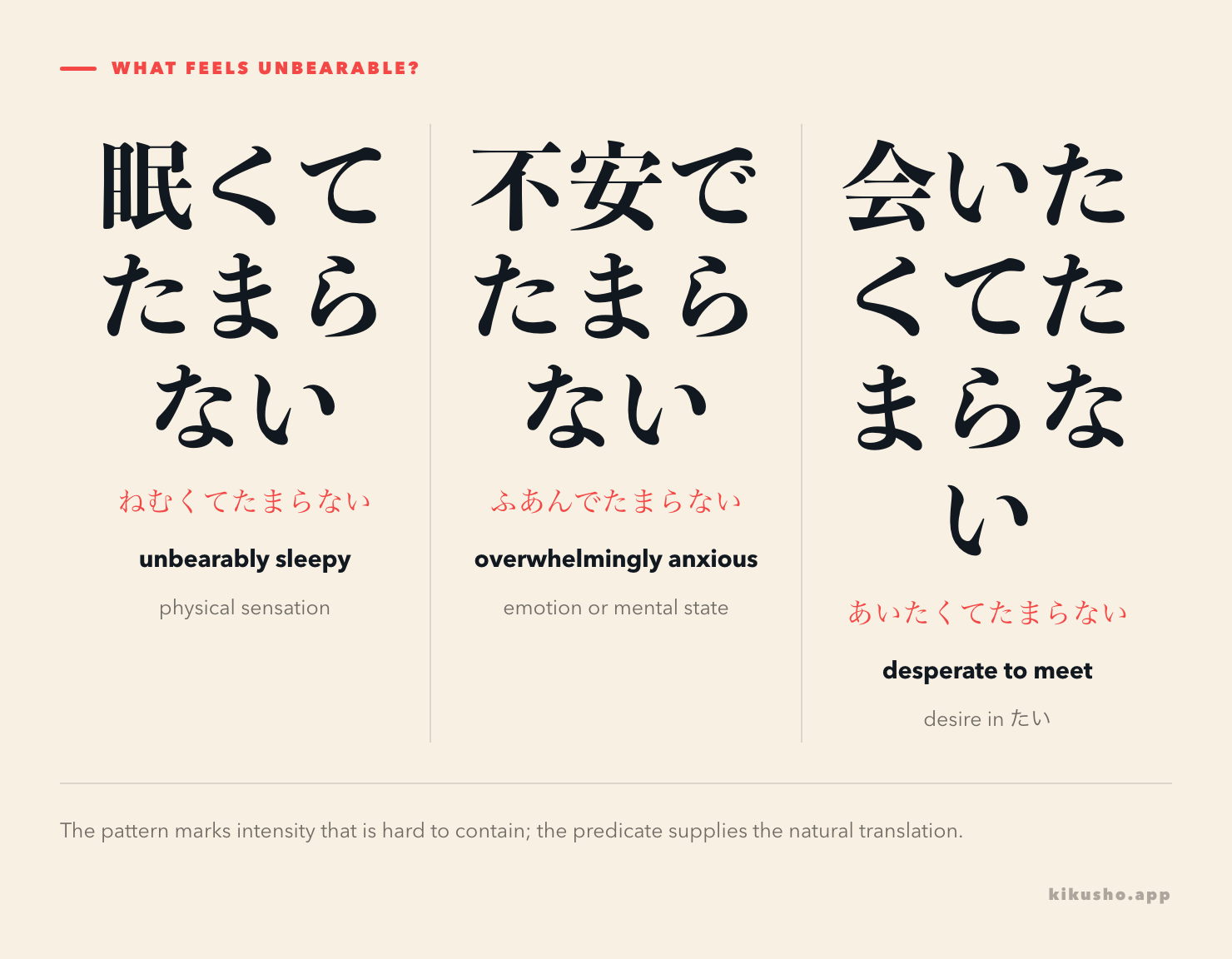
Use ~てたまらない when a sensation, feeling or desire is so strong that it feels unbearable: 眠くてたまらない, “I am unbearably sleepy,” or 家族に会いたくてたまらない, “I desperately want to see my family.” The pattern expresses the experiencer's intense inner state; it does not simply make any action “very.”
The core image comes from たまらない, “cannot bear/endure it.” The English translation changes with the predicate, but the Japanese judgment stays consistent: the feeling has reached a point that is hard to contain.
This lesson covers inventory item g-a9475c72fd95, てたまらない. JLPT Sensei, Bunpro and Nihongo-bu place it at N2. Yatta places the form at N3, so the level is a study-order estimate rather than a universal fact. The JLPT does not publish an exhaustive grammar syllabus.
Three common kinds of intensity
| Kind | Example | Natural English |
|---|---|---|
| physical sensation | 眠くてたまらない | unbearably sleepy |
| emotion or mental state | 不安でたまらない | overwhelmingly anxious |
| desire in ~たい | 会いたくてたまらない | desperate to see someone |
暑くてたまらないので、窓を開けてもいいですか。
あつくて たまらないので、まどを あけても いいですか。
It is unbearably hot, so may I open the window?
明日の結果が不安でたまらない。
あしたの けっかが ふあんで たまらない。
I am terribly anxious about tomorrow's result.
久しぶりに祖母に会いたくてたまらない。
ひさしぶりに そぼに あいたくて たまらない。
I am desperate to see my grandmother after so long.
The feeling can be unpleasant or pleasant. 嬉しくてたまらない describes joy that is hard to contain. 欲しくてたまらない describes an overpowering desire to have something. The construction marks intensity, not negativity.
Build the connector from the word class
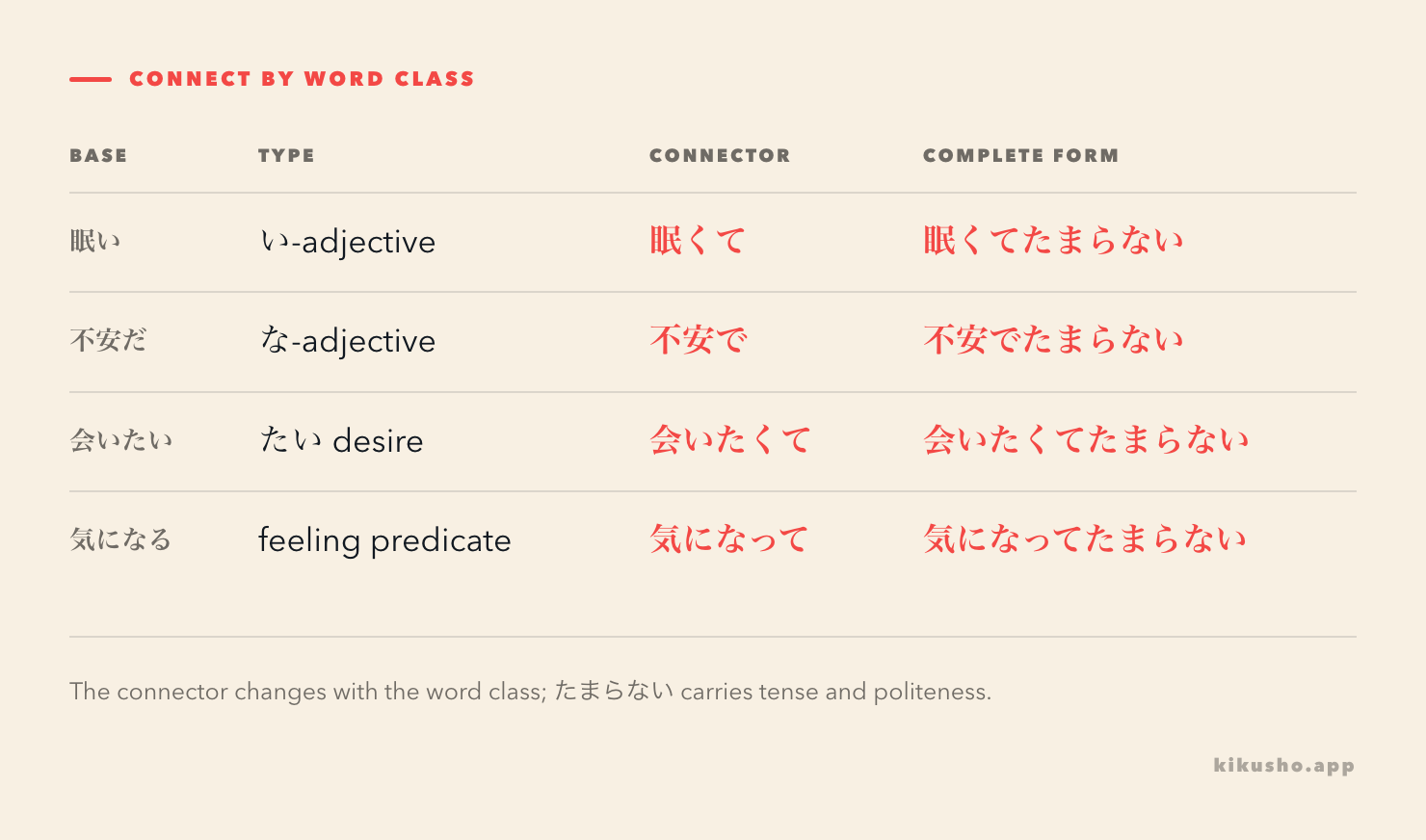
The part before たまらない must use the right connective form.
| Base | Connection | Complete pattern |
|---|---|---|
| 眠い | 眠くて | 眠くてたまらない |
| 痛い | 痛くて | 痛くてたまらない |
| 不安だ | 不安で | 不安でたまらない |
| 心配だ | 心配で | 心配でたまらない |
| 会いたい | 会いたくて | 会いたくてたまらない |
| 気になる | 気になって | 気になってたまらない |
For an い-adjective, replace final い with くて: 眠い → 眠くて. For a な-adjective or noun-like feeling word, use で: 不安だ → 不安で. A desire in ~たい behaves like an い-adjective: 帰りたい → 帰りたくて.
Verbs are more restricted than the table might suggest. A predicate such as 気になる already names a state that arises in the experiencer, so 気になってたまらない works. A deliberate action such as 勉強する does not become an intense inner state merely by adding the ending. If the meaning is “I desperately want to study,” use the desire form 勉強したくてたまらない.
Choose the English from the predicate
A fixed translation such as “cannot stand” can distort positive examples. Translate the combination rather than the ending alone.
昨日は背中が痛くてたまらなかった。
きのうは せなかが いたくて たまらなかった。
My back hurt unbearably yesterday.
合格の知らせを聞いて、嬉しくてたまらなかった。
ごうかくの しらせを きいて、うれしくて たまらなかった。
I was overwhelmed with happiness when I heard that I had passed.
新しいカメラが欲しくてたまらない。
あたらしい カメラが ほしくて たまらない。
I want the new camera desperately.
The first is physical discomfort, the second joy, and the third desire. “Cannot stand” fits the pain but sounds wrong for happiness and wanting. “So X I can hardly contain it” is a useful mental paraphrase across all three.
Tense and politeness sit on たまらない. Use たまらなかった for a past state and たまりません for polite speech. The connected predicate stays unchanged: 痛くてたまりません, 不安でたまりません, 会いたくてたまりません.
Respect the experiencer's point of view
Japanese usually avoids presenting another person's private feeling as direct, certain knowledge. A first-person statement is straightforward:
私は眠くてたまらない。
わたしは ねむくて たまらない。
I am unbearably sleepy.
For another person, show how you know:
弟は眠くてたまらないと言っている。
おとうとは ねむくて たまらないと いっている。
My younger brother says he is unbearably sleepy.
娘はその犬が欲しくてたまらないようだ。
むすめは その いぬが ほしくて たまらないようだ。
My daughter seems desperate to have that dog.
と言っている, そうだ, らしい and ようだ mark report or inference. A question addressed to the experiencer is also natural: そんなに帰りたくてたまらないの?, “Do you want to go home that badly?” Fiction and internal narration may enter a character's viewpoint directly, but adding evidence is the safest default in ordinary description.
Compare てたまらない, てしょうがない and てならない
These forms overlap, so rigid one-word translations create false distinctions.
| Pattern | Reliable center | Typical feel |
|---|---|---|
| ~てたまらない | intensity is hard to endure or contain | strongly subjective; very natural with physical sensation and desire |
| ~てしょうがない/しかたがない | the state cannot be helped or put aside | common in conversation; broad feelings, desires and sensations |
| ~てならない | a feeling or thought arises involuntarily | more formal; common with 気がする, 思える, 気になる |
眠くてたまらない and 眠くてしょうがない are both natural. The first foregrounds unbearable intensity; the second presents the sleepiness as something the speaker cannot help. 将来が不安でならない suits a serious, more formal expression of anxiety, while 眠くてならない is less typical than the everyday alternatives.
The てしょうがない lesson contrasts an overwhelming state with an action someone cannot resist. The てならない comparison develops involuntary feelings and thoughts. Treat the three forms as overlapping choices with different centers, rather than as a strict scale that always predicts the only correct sentence.
Keep the resulting action separate
てたまらない describes the state before any response. A second clause may show what the speaker does because of it:
のどが渇いてたまらなかったので、水を二杯飲んだ。
のどが かわいて たまらなかったので、みずを にはい のんだ。
I was unbearably thirsty, so I drank two glasses of water.
The grammar describes thirst. It does not mean “could not help drinking.” To say that an action itself was irresistible, use ~ずにはいられない/~ないではいられない: 水を飲まずにはいられなかった, “I could not refrain from drinking water.”
Likewise, 会いたくてたまらない names desire. It does not guarantee that the meeting happens. 会わずにはいられない says the subject cannot resist meeting the person, which presents the action as the outcome.
Do not confuse てたまらない with てはたまらない
The particle は creates a different pattern.
| Form | Meaning | Example |
|---|---|---|
| 暑くてたまらない | the heat feels unbearable | 今日は暑くてたまらない。 |
| 毎日残業させられてはたまらない | it would be intolerable if this happened | 毎日残業させられてはたまらない。 |
こんなミスを何度もされてはたまらない。
こんな ミスを なんども されては たまらない。
I cannot have this kind of mistake made repeatedly.
Here されては introduces a condition or repeated event that the speaker says would be intolerable. It is not the connective form of a feeling word followed directly by たまらない. Check whether は is present before deciding which structure you are reading.
Build a useful Kikusho card
Save the trigger and the experiencer with the form. 明日の面接が不安でたまらない is more useful than 不安でたまらない alone because it preserves what causes the anxiety. For desire, keep the object: 日本にいる友達に会いたくてたまらない.
Kikusho lets you edit the meaning and example before saving. Use that step to record a natural translation for the predicate: “unbearably itchy,” “overwhelmingly happy,” or “desperate to return,” instead of forcing every card into “cannot stand.”
Practice
1. Form the い-adjective connection
Complete 今日は眠__たまらない。
ア. いて イ. くて ウ. で
2. Form the な-adjective connection
Complete 試験の結果が不安__たまらない。
ア. くて イ. にて ウ. で
3. Express an overwhelming desire
Which sentence means “I desperately want to see my family”?
ア. 家族に会ってたまらない。
イ. 家族に会いたくてたまらない。
ウ. 家族に会わなくてたまらない。
4. Report another person's state safely
Choose the sentence that explicitly marks inference.
ア. 娘はその犬が欲しくてたまらないようだ。
イ. 娘はその犬が欲しくてたまらない。
5. Change the sentence to the past polite form
Change 背中が痛くてたまらない to “My back hurt unbearably” in polite Japanese.
6. Distinguish the state from the resulting action
Match the sentence to its meaning.
- 水が飲みたくてたまらない。
- 水を飲まずにはいられない。
ア. The desire to drink is overwhelming.
イ. The subject cannot refrain from drinking.
7. Read the interview context
明日は大切な面接だ。結果が__ので、何度も準備したメモを確認している。
ア. 不安でたまらない
イ. 不安してたまらない
ウ. 不安ではたまらない
Answers and explanations
- イ. くて. Remove the final い from 眠い and add くて: 眠くてたまらない.
- ウ. で. 不安だ is a な-adjective, so its connective form is 不安で.
- イ. 家族に会いたくてたまらない. 会いたい changes like an い-adjective: 会いたくて. The ordinary て-form 会って names an action, not the desire.
- ア. 娘はその犬が欲しくてたまらないようだ. ようだ shows that the speaker is inferring the daughter's private desire. Sentence イ can work in a narrative with direct access to her viewpoint, but it does not explicitly mark evidence.
- 背中が痛くてたまりませんでした. The connector 痛くて remains in place; polite past marking appears on たまる as たまりませんでした.
- 1–ア; 2–イ. 飲みたくてたまらない names an overpowering desire. 飲まずにはいられない presents drinking as the action the subject cannot resist.
- ア. 不安でたまらない. The noun-like な-adjective 不安だ uses で before たまらない. イ incorrectly treats 不安 as a する verb here, and ウ creates the separate てはたまらない shape.
The exact search results repeatedly teach this construction at N2, while one current reference places it at N3. The practical gap is not the translation “very”; it is learning which predicates can express an unbearable inner state, how viewpoint changes third-person sentences, and why てはたまらない is a separate condition.
This lesson was reviewed for all connector types, positive and negative feelings, past and polite forms, experiencer viewpoint, the neighboring intensity patterns and the てはたまらない boundary. AI-assisted comparison and editing were used to verify the examples and ensure each exercise has one intended answer.
Common questions
What does てたまらない mean?
It says a sensation, feeling or desire is so intense that the experiencer can hardly bear or contain it. Depending on context, English may use unbearably, desperately or cannot stop feeling.
How do you form てたまらない?
Use an い-adjective's くて form, a な-adjective or noun-like feeling word plus で, a たい form changed to たくて, or the て-form of a suitable feeling predicate, then add たまらない.
Can てたまらない describe positive feelings?
Yes. 嬉しくてたまらない means overwhelmingly happy, and 会いたくてたまらない means desperate to see someone. The intensity is central, not whether the feeling is pleasant.
Can てたまらない describe another person's feelings?
Direct statements most naturally report the speaker's own inner state. For another person, add evidence such as そうだ, ようだ or と言っている unless the narrative context gives access to that person's viewpoint.