On this page
今から歩いては、会議に間に合いません。 (いまから あるいては、かいぎに まにあいません) means “If we walk from here now, we won't make the meeting in time”: ては presents walking as a condition with an unwelcome result. たら can introduce the same warning, but also accepts favourable or neutral outcomes; it does not carry the warning interpretation by itself.
The second clause tells you what goes wrong. It need not say いけない, and its verb need not be grammatically negative.
Read ては as a condition followed by an assessment
This lesson teaches conditional ては・では: “if things are like this, the result is a problem.” It compares that use with familiar たら, then separates it from elementary prohibitions and from repeated-event ては. It does not attempt a complete catalogue of every expression containing these two particles.
The opening sentence predicts a missed meeting. It does not say that walking is forbidden everywhere. You could solve the problem by taking a train, leaving earlier or changing the appointment. The warning belongs to that situation.
そんなに強く押しては、ボタンが壊れます。
そんなに つよく おしては、ボタンが こわれます。
“If you press that hard, the button will break.”
壊れます is affirmative: the button will break. The result is unfavourable even though there is no ない. Look for the speaker's evaluation, rather than hunting for a negative ending. Bunpro's conditional ては explanation describes this expectation of an undesirable outcome.
The N3 grammar section is an editorial position in this series. Both JLPT Sensei's ては・では reference and Bunpro label the broader construction N2. Bunpro places てはいけない at N5 and たら at N4. Learn the distinction without treating those estimates as an official inventory: the JLPT FAQ explains why vocabulary and grammar specifications are no longer published.
The form before は depends on the predicate
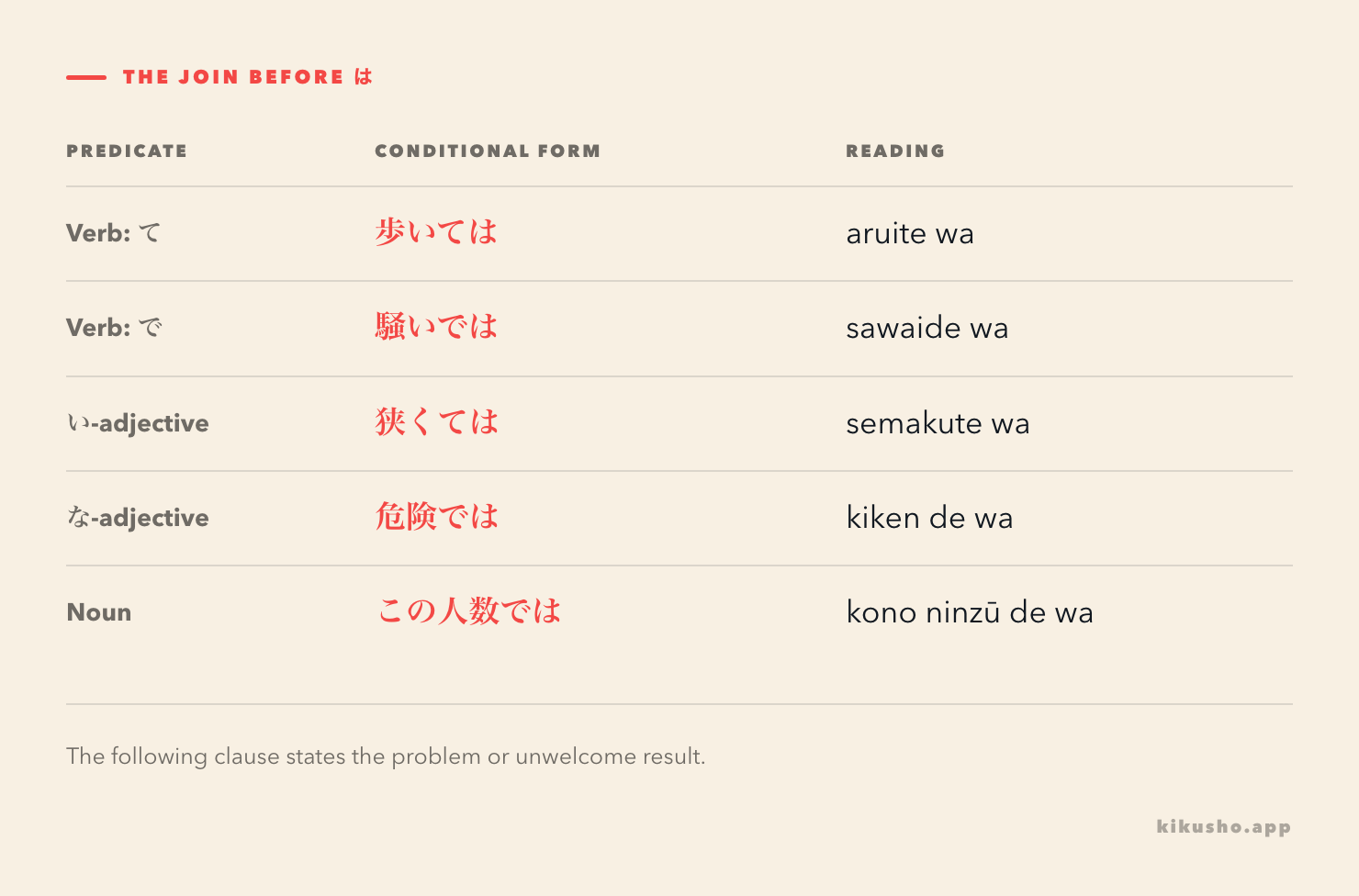
For a verb, build its actual て-form, then add は. A verb whose linking form ends in で keeps that sound. Adjectives and nouns have their own joins:
| Predicate | Conditional form | Reading | Meaning of this fragment |
|---|---|---|---|
| 歩く | 歩いては | あるいては | If we walk |
| 騒ぐ | 騒いでは | さわいでは | If someone makes noise |
| 狭い | 狭くては | せまくては | If it is cramped |
| 危険だ | 危険では | きけんでは | If it is dangerous |
| この人数だ | この人数では | この にんずうでは | With this number of people |
The patterns are verb て/で + は, い-adjective minus い + くては, and な-adjective stem or noun + では. Do not attach ては to the unchanged dictionary verb. 歩くては and 騒ぐでは do not form these conditions. 狭いては also keeps the adjective in the wrong shape.
部屋が狭くては、荷物を全部置けません。
へやが せまくては、にもつを ぜんぶ おけません。
“If the room is this cramped, we can't put all the luggage in it.”
危険では、子どもを連れて行けません。
きけんでは、こどもを つれて いけません。
“If it is dangerous, I can't take the children there.”
この人数では、今日中に終わりません。
この にんずうでは、きょうじゅうに おわりません。
“With this number of people, we won't finish today.”
The last two are assessments of a state or available resources, rather than a sequence of actions. Depending on context, English “with” or “being” may fit better than a mechanical “if.” Maggie Sensei's explanation separates this unfavourable-assessment use from repetition and suggestions.
たら can keep the warning or lead somewhere welcome
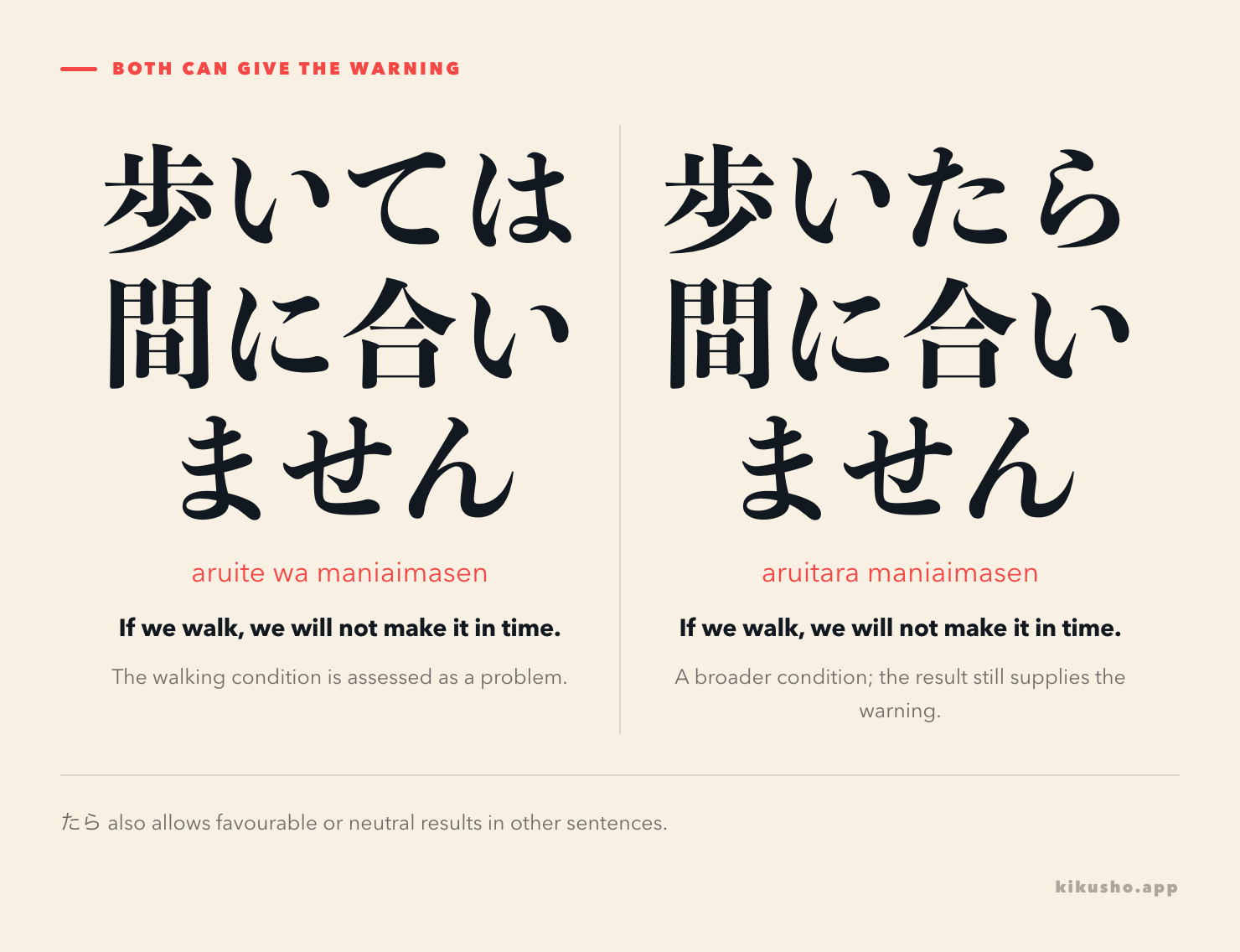
Compare the meeting warning in two forms:
| Japanese | Reading | Interpretation here |
|---|---|---|
| 今から歩いては、会議に間に合いません。 | いまから あるいては、かいぎに まにあいません | Walking now is assessed as a problem. |
| 今から歩いたら、会議に間に合いません。 | いまから あるいたら、かいぎに まにあいません | If we walk now, we won't arrive in time. |
Both can warn against walking in this situation. The broader たら condition does not erase 間に合いません. It is misleading to mark one wrong solely because the other is also possible.
Build たら from the plain past form plus ら: 歩く → 歩いた → 歩いたら, 騒ぐ → 騒いだ → 騒いだら. The apparent past form does not force a past-time meaning. 今から in this comparison points forward. For states, 狭かったら, 危険だったら and この人数だったら use the corresponding adjective or copula forms. Tofugu's たら formation guide sets out these joins and the distinction between form and time.
時間があったら、写真を見せてください。
じかんが あったら、しゃしんを みせてください。
“If you have time, please show me the photographs.”
This is a request after a condition, with no predicted bad outcome. Use たら for this reading. The warning ては construction presents an assessment or consequence, rather than attaching an ordinary “please do this” instruction. The NKG conditional-clause reference, printed page 189 explicitly distinguishes the declarative result after conditional ては from imperative or volitional endings.
That restriction belongs to the conditional use. It is not a ban on every longer expression containing ては. The broader と・たら comparison covers other situations where たら carries a request or a plan.
いけない makes a prohibition, not just a prediction
この端末を勝手に使ってはいけません。
この たんまつを かってに つかっては いけません。
“You must not use this terminal without permission.”
Here the result is a judgement: using it without permission is unacceptable. てはいけない and polite てはいけません express a prohibition; てはだめ gives a conversational version. てはならない is a more formal alternative. Mayumi Ito's Mango Languages guide explains the rule and the register differences.
The polite ending does not turn a prohibition into a gentle request. With another adult, the issue may be whether you have a reason to state a rule, rather than how many polite syllables you add. A warning about a consequence, such as 壊れます, makes a different claim from declaring an action unacceptable.
Keep the negative condition separate: 使ってはいけない forbids using something, while 使わなくてはいけない requires using it. The latter says that not using it is unacceptable. The obligation lesson teaches that negative route; it is not another spelling of “must not.”
Spoken ちゃ and じゃ need their full ending back
触ってはだめ → 触っちゃだめ (さわっては だめ → さわっちゃ だめ): “You mustn't touch it.” 飲んではいけない → 飲んじゃいけない (のんでは いけない → のんじゃ いけない): “You mustn't drink it.” The ては → ちゃ and では → じゃ contractions are used in conversation. Bunpro's prohibition reference checks both routes.
触っちゃった (さわっちゃった), “I ended up touching it,” expands differently: 触ってしまった. That reports an action; it does not prohibit touching. The same ちゃ sound is insufficient evidence. Read the tail and recover the whole expression. Completion and regret belong to the existing てしまう lesson.
If you record 触っちゃだめ by voice in Kikusho, retain the prohibition in the editable meaning and example, then note the setting in the register field. A card that silently turns it into “touched” has lost the warning. Checking that short phrase before saving is more useful than collecting ちゃ without its ending.
Repeated-event ては does not require anything to go wrong
祖父は昔の写真を見ては、楽しそうに笑っていた。
そふは むかしの しゃしんを みては、たのしそうに わらっていた。
“My grandfather would look at old photographs and laugh happily.”
This describes a recurring pair of events. It does not predict that looking at a photograph will cause a problem. Verb ては can introduce what happens repeatedly; the following event can be pleasant. Both Maggie Sensei and JLPT Sensei distinguish this from the conditional warning use.
Likewise, 少し休んではどうですか (すこし やすんでは どうですか), “How about resting a little?”, is a suggestion pattern. It is not a warning with a missing bad consequence. Recognising these boundaries prevents a useful warning rule from becoming a false rule about every ては you meet. Alternating sequences with repeated ては~ては, and progressive ていては warnings, need their own fuller treatment.
Try seven questions before reading the explanations
These original exercises use grammar choice, sentence composition and connected-text grammar. Those are task types in the official JLPT item structure, not copied exam questions. 端末 is たんまつ, “terminal/device”; 電源 is でんげん, “power”; 保存 is ほぞん, “saving.”
Question 1 — grammar choice. Build the conditional ては form of 泳ぐ (およぐ, “swim”). Which fragment has the correct join?
- A. 泳ぐでは
- B. 泳いでは
- C. 泳ぎては
- D. 泳いだでは
Question 2 — grammar choice. Complete the たら condition in 駅に着いた__、メッセージを送ってください。 (えきに ついた__、メッセージを おくってください), “When you reach the station, please send a message.”
- A. では
- B. は
- C. ら
- D. ても
Question 3 — grammar choice. Compare 今から歩いては、会議に間に合いません and 今から歩いたら、会議に間に合いません. Which account is accurate?
- A. Both can give the warning; たら does not make the stated result favourable.
- B. Only ては is possible because たら always introduces a favourable result.
- C. Only たら is possible because ては cannot be used in speech.
- D. The たら sentence must describe a walk that happened yesterday.
Question 4 — grammar choice. A workplace rule prohibits using a terminal without permission. Complete この端末を勝手に__。
- A. 使わなくてはいけません
- B. 使わなくてもいいです
- C. 使ってもいいです
- D. 使ってはいけません
Question 5 — sentence composition. Arrange all four pieces to say “If this room is cramped, we can't put a large desk in it.” In この部屋が __ __ ★ __。, which piece goes in the third position, ★?
- A. 机を
- B. 狭くては
- C. 置けません
- D. 大きな
Question 6 — text grammar. An application has no automatic saving and the work has not been saved manually either. Choose the continuation that states the relevant warning:
このアプリには自動保存機能がありません。まだ手動でも保存していません。今パソコンの電源を切っては、__。
この アプリには じどうほぞんきのうが ありません。まだ しゅどうでも ほぞんしていません。いま パソコンの でんげんを きっては、__。
- A. 今日の仕事は終わりました
- B. このアプリには自動保存機能があります
- C. 保存していない内容が消えてしまいます
- D. 明日はもっと早く来てください
Question 7 — grammar choice. In 祖父は昔の写真を見ては、楽しそうに笑っていた, what does 見ては do?
- A. It states a rule forbidding the grandfather to look at photographs.
- B. It presents looking and laughing as recurring past events.
- C. It predicts a future problem that has not occurred yet.
- D. It says the grandfather looked at a photograph exactly once.
Answers and explanations
Answer 1. B: 泳いでは (およいでは). 泳ぐ → 泳いで → 泳いでは keeps the で of this verb's linking form. A attaches では to the unchanged dictionary verb. C uses the wrong linking form. D starts from past 泳いだ, rather than 泳いで.
Answer 2. C: ら. 着く → 着いた → 着いたら (つく → ついた → ついたら) supplies the requested condition. The complete sentence asks for a message after arrival. A and B do not make this condition from 着いた; D incorrectly attaches ても to that past form. 着いたら can point to an arrival still in the future.
Answer 3. A. Both sentences keep 間に合いません, “won't make it in time.” ては foregrounds the troublesome situation; たら is a broader condition, but the consequence still makes this a warning. B invents a positive-result restriction. C invents a speech restriction. D mistakes the shape 歩いたら for a requirement that the whole sentence be past.
Answer 4. D: 使ってはいけません (つかっては いけません). This forbids the action. A requires using the terminal, the opposite instruction. B removes the obligation to use it; it does not forbid using it. C gives permission. The closing polite form in D keeps the rule a prohibition.
Answer 5. A: 机を (つくえを). The order is B–D–A–C: この部屋が狭くては、大きな机を置けません。 (この へやが せまくては、おおきな つくえを おけません). 狭くては completes the condition; 大きな modifies 机, and 机を supplies the object of 置けません. The third piece is therefore 机を, rather than the condition or the final verb.
Answer 6. C: 保存していない内容が消えてしまいます (ほぞんしていない ないようが きえてしまいます), “The unsaved contents will be lost.” That gives the bad consequence of cutting the power in the stated situation. A reports work already finished, not that consequence. B contradicts the first sentence. D is a request about tomorrow, rather than the declarative warning result needed here. The affirmative 消えてしまいます still expresses an unwanted event.
Answer 7. B. The grandfather repeatedly looks at photographs and laughs happily. Nothing in 見ては by itself requires a prohibition or an unhappy outcome. A imports いけない even though it is absent. C loses the past 笑っていた and the recurring-event reading. D loses the repetition. The pleasant result is the clue that a rule learned for warnings cannot account for this whole sentence.
Common questions
Does conditional tewa always mean must not?
No. Conditional ては or では frames a situation for an unfavourable assessment or consequence. A prohibition such as 触ってはいけない adds the judgement いけない. Other consequences include 困る, 間に合わない or an unwanted event expressed by an affirmative verb.
Can tara also introduce a warning?
Yes. たら can introduce favourable, neutral or unfavourable consequences. 歩いたら間に合いません is a warning too. Replacing ては with たら does not automatically make the result positive or change it into the past.
Is tewa N3 or N2 grammar?
This lesson is placed in Kikusho's N3 sequence, but JLPT Sensei and Bunpro list the broader conditional ては・では construction at N2. Bunpro lists elementary てはいけない prohibitions at N5 and たら at N4. These are study-list estimates for particular uses, not an exhaustive official JLPT syllabus.
Does every tewa sentence have a bad result?
No. The warning use taught here has an unfavourable assessment, but verb ては can also describe repeated events. A sentence about someone repeatedly looking at photographs and laughing is not necessarily a warning. Suggestions such as 休んではどうですか are another use.