On this page
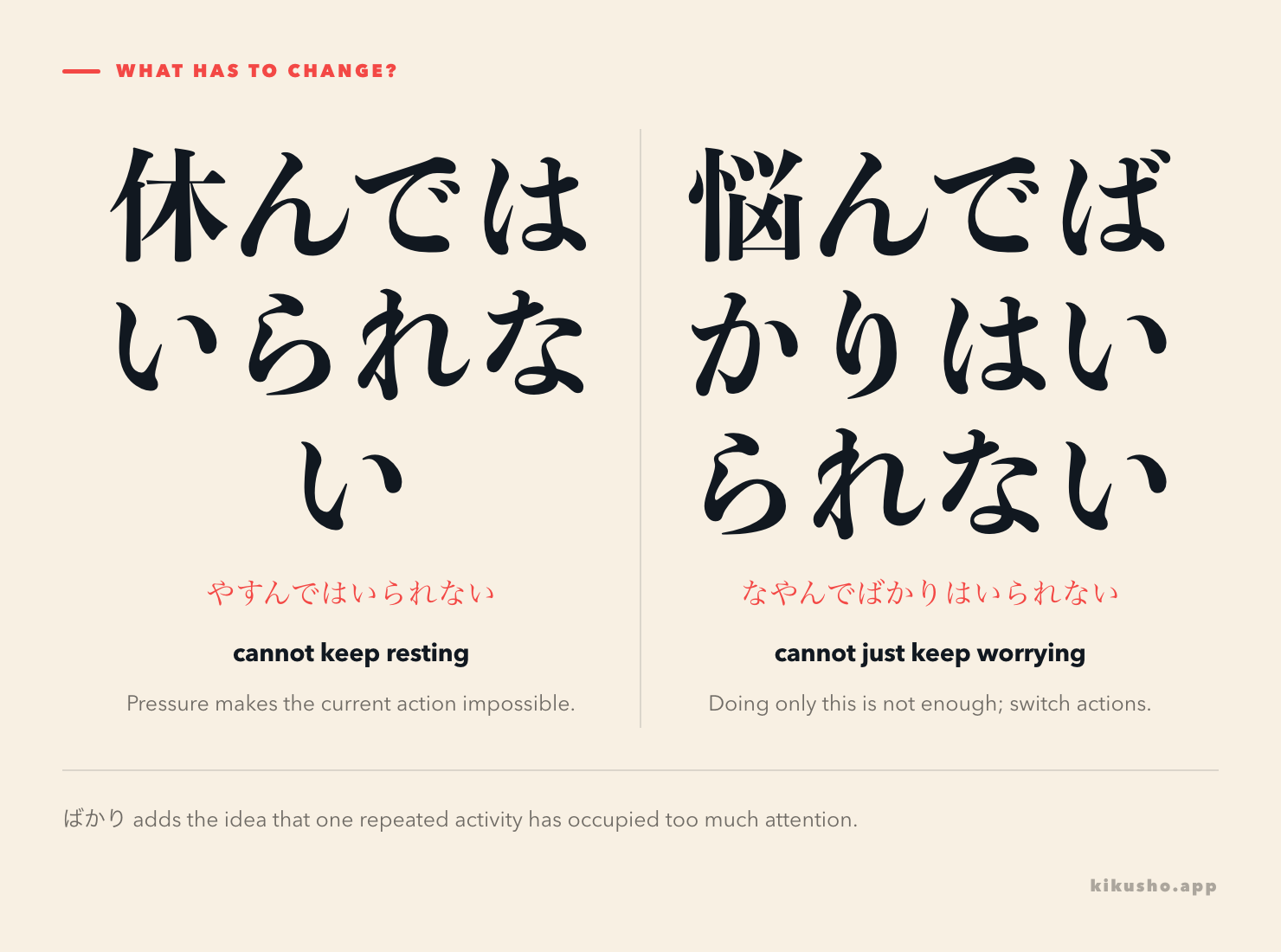
Use Vてはいられない when pressure makes it impossible to continue an action or state: 締め切りが近いから、休んではいられない, “The deadline is close, so I cannot afford to keep resting.” Add ばかり when the problem is doing only that action: 失敗を悔やんでばかりはいられない, “I cannot just keep regretting the failure.”
The decision is about what must change. With てはいられない, the current action itself cannot continue. With てばかりはいられない, continuing to devote yourself only to that action is inadequate, and another action is normally implied.
This lesson covers inventory items g-7ff6d7165f8a, てばかりはいられない, and g-662fcee8d2c2, てはいられない. Bunpro, JLPT Sensei and Nihongo Kyoshi Net teach てはいられない at N2. JLPT Sensei also places てばかりはいられない at N2. These are study classifications; the JLPT does not publish an exhaustive grammar list.
The contrast in two sentences
| Pattern | Speaker's judgment | Natural continuation |
|---|---|---|
| Vてはいられない | continuing V is impossible now | stop V and respond to the pressure |
| Vてばかりはいられない | doing only V is not enough | move from V to another useful action |
試験は明日だ。のんびりしてはいられない。
しけんは あしただ。のんびりしてはいられない。
The exam is tomorrow. I cannot afford to take it easy.
一度負けたが、落ち込んでばかりはいられない。次の試合の準備をしよう。
いちど まけたが、おちこんでばかりはいられない。つぎの しあいの じゅんびを しよう。
We lost once, but we cannot just keep feeling down. Let’s prepare for the next match.
In the first example, the approaching exam makes のんびりする impossible. In the second, feeling down is understandable, but doing nothing else is no longer productive. The explicit next sentence confirms the change of action that ばかり suggests.
Form both patterns from the て-form
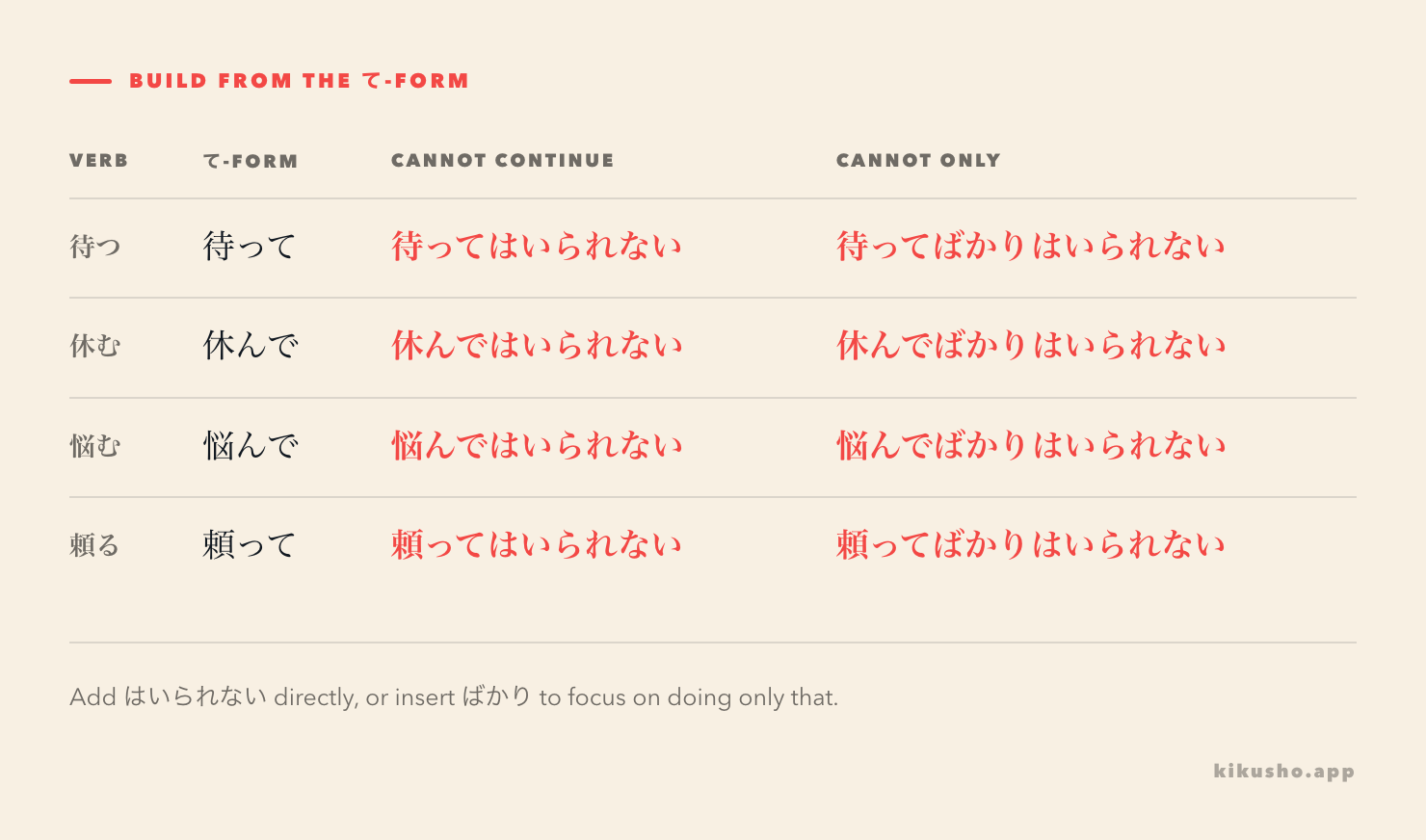
Begin with the verb's て-form. Add はいられない directly, or insert ばかり before it.
| Dictionary form | て-form | Cannot continue | Cannot just keep doing only that |
|---|---|---|---|
| 待つ | 待って | 待ってはいられない | 待ってばかりはいられない |
| 休む | 休んで | 休んではいられない | 休んでばかりはいられない |
| 悩む | 悩んで | 悩んではいられない | 悩んでばかりはいられない |
| 頼る | 頼って | 頼ってはいられない | 頼ってばかりはいられない |
| する | して | してはいられない | してばかりはいられない |
The sequence in てはいられない is historically transparent: the て-form presents an ongoing action or state, は marks it as the topic under contrast, and いられない says one cannot remain that way. For practical use, learn the whole pattern as “cannot afford to keep V-ing.” It normally expresses the speaker's judgment about pressure, time or circumstances rather than physical inability.
てはいられない: the present action cannot continue
Use てはいられない when a deadline, danger, responsibility or strong reaction leaves no room to remain as you are.
電車が止まっている。ここで待ってはいられないから、バスで行こう。
でんしゃが とまっている。ここで まってはいられないから、バスで いこう。
The trains have stopped. We cannot keep waiting here, so let’s go by bus.
困っている人を見たら、黙ってはいられない。
こまっている ひとを みたら、だまってはいられない。
When I see someone in trouble, I cannot remain silent.
まだ仕事が残っているので、ゆっくり休んではいられない。
まだ しごとが のこっているので、ゆっくり やすんではいられない。
There is still work left, so I cannot afford to rest leisurely.
These examples contain different kinds of pressure: disrupted transport, conscience and unfinished work. What they share is the conclusion that the current action or state must end.
This is also why てはいられない often appears with a reason before it and a new plan after it: 時間がないから、迷ってはいられない。今決めよう, “We have no time, so we cannot keep hesitating. Let’s decide now.” The second sentence states the response that the grammar already prepares us to expect.
ばかり changes the focus to “only that”
The particle ばかり highlights an action as repeated, excessive or practically the only thing being done. The speaker does not necessarily reject the action itself. They reject allowing it to occupy all the available time or attention.
いつまでも親に頼ってばかりはいられない。
いつまでも おやに たよってばかりはいられない。
I cannot keep doing nothing but relying on my parents forever.
心配してばかりはいられない。必要な情報を集めよう。
しんぱいしてばかりはいられない。ひつような じょうほうを あつめよう。
We cannot just keep worrying. Let’s gather the information we need.
去年の成功を喜んでばかりもいられない。次の目標を決める時だ。
きょねんの せいこうを よろこんでばかりもいられない。つぎの もくひょうを きめる ときだ。
We cannot only celebrate last year’s success. It is time to set the next goal.
The variant てばかりもいられない replaces は with も. It gives a similar meaning: the speaker cannot go on doing only that. The も version can feel like “nor can we just keep doing that” in a wider discussion. For a first productive pattern, use てばかりはいられない.
A minimal pair with 待つ
The same verb shows the difference clearly.
救急車が必要だ。もう待ってはいられない。
きゅうきゅうしゃが ひつようだ。もう まってはいられない。
We need an ambulance. We cannot wait any longer.
The problem is continued waiting. Urgency demands that it stop immediately.
返事を待ってばかりはいられない。こちらからも連絡しよう。
へんじを まってばかりはいられない。こちらからも れんらくしよう。
We cannot just keep waiting for a reply. Let’s contact them from our side too.
Waiting may still happen, but it cannot be the only strategy. ばかり contrasts waiting with another available action. A useful test is to add “we should do something else.” If that continuation expresses your intended point, てばかりはいられない is likely the better choice.
What you will hear in conversation
In speech, てはいられない often contracts. The full form remains safest in careful writing.
| Full form | Conversational form | Example |
|---|---|---|
| 待ってはいられない | 待っていられない | もう待っていられない。 |
| 待ってはいられない | 待ってられない | そんなに待ってられないよ。 |
| 待ってはいられない | 待っちゃいられない | 返事を待っちゃいられない。 |
| 遊んではいられない | 遊んでいられない | 明日は試験だから、遊んでいられない。 |
| 遊んではいられない | 遊んじゃいられない | 今は遊んじゃいられない。 |
The reductions do not change the core judgment. 待ってられない is simply a casual reduction of 待っていられない. In ちゃ/じゃいられない, ては becomes ちゃ and では becomes じゃ.
A related state pattern appears after nouns and な-adjectives: もう子供ではいられない, “I cannot remain a child any longer,” or この状況では冷静ではいられない, “In this situation I cannot remain calm.” This uses N/な-adjective + ではいられない, while the target patterns in this lesson begin with a verb's て-form.
Do not reverse the meaning with ないではいられない
Another similar-looking condition is Vていては B: 待っていては間に合わない means “If we keep waiting, we will not make it in time.” The ていては and ようでは lesson contrasts that predicted bad result with an inability to continue.
Vてはいられない and Vないではいられない look similar but produce opposite action outcomes.
| Pattern | Meaning | Outcome |
|---|---|---|
| 笑ってはいられない | cannot keep laughing | the laughing must stop |
| 笑わないではいられない | cannot refrain from laughing | the person laughs |
状況は深刻だから、笑ってはいられない。
じょうきょうは しんこくだから、わらってはいられない。
The situation is serious, so we cannot keep laughing.
この動画は面白くて、笑わないではいられない。
この どうがは おもしろくて、わらわないではいられない。
This video is so funny that I cannot help laughing.
Look immediately before ではいられない. A negative verb such as 笑わない means the person cannot remain in the “not laughing” condition, so they laugh. Our ないではいられない lesson develops that uncontrollable-action pattern and contrasts it with involuntary feelings.
Also keep てはいられない separate from てはいけない. ここで遊んではいけない prohibits playing here: “You must not play here.” ここで遊んではいられない is the speaker's judgment that continuing to play is impossible or irresponsible under the circumstances.
Finally, わけにはいかない often points to a social, moral or personal reason that prevents an action: 約束したから、行かないわけにはいかない, “I promised, so I cannot avoid going.” てはいられない instead presents the current action or state as unsustainable. See the わけにはいかない lesson for that distinction.
A quick production routine
When speaking, build the sentence in three steps:
- Name the action or state now: 待つ, 悩む, 休む.
- Decide whether that action itself must stop, or whether doing only that is the problem.
- Use てはいられない for the first meaning and てばかりはいられない for the second, then state the new action if useful.
For example, imagine a project deadline. If there is no time left for rest, say 休んではいられない. If the team has spent all morning discussing problems and must begin fixing them, say 問題について話してばかりはいられない。作業を始めよう, “We cannot just keep talking about the problems. Let’s start working.”
Kikusho turns this contrast into short retrieval choices. First identify the pressure, then decide whether ばかり is needed to mark “only that,” and finally produce the complete て-form. This order trains the meaning decision before the surface form.
Practice
1. Choose the best completion
締め切りまであと一時間だ。のんびり____。
ア. してばかりはいられない イ. してはいられない ウ. しないではいられない
2. Choose the sentence that emphasizes a change of activity
ア. 失敗を悔やんではいられない。
イ. 失敗を悔やんでばかりはいられない。
3. Build the form
Change 休む into “cannot afford to keep resting.”
4. Match each sentence to its meaning
- 返事を待ってはいられない。
- 返事を待ってばかりはいられない。
ア. We cannot make waiting our only approach.
イ. We cannot continue waiting because action is urgent.
5. Translate into Japanese
“I cannot keep doing nothing but relying on my parents.” Use 頼る.
6. Choose the form that means “cannot help laughing”
ア. 笑ってはいられない
イ. 笑わないではいられない
7. Complete the connected text
会議では問題点を何度も確認した。もう問題について話して____。具体的な解決策を試そう。
ア. ばかりはいられない イ. はいけない ウ. ないではいられない
Answers and explanations
- イ. してはいられない. The deadline creates direct urgency: taking it easy cannot continue. Without more context about repeated behavior, ばかり is unnecessary.
- イ. 失敗を悔やんでばかりはいられない. Both can reject continued regret, but ばかり explicitly presents regret as the only repeated activity and prepares for a different action.
- 休んではいられない. The て-form of 休む is 休んで; add はいられない.
- 1–イ; 2–ア. The first rejects continued waiting itself. The second rejects waiting as the only strategy.
- 親に頼ってばかりはいられない. 頼る becomes 頼って, and ばかり supplies “doing nothing but.”
- イ. 笑わないではいられない. The person cannot remain in the state of not laughing, so laughter occurs. 笑ってはいられない says the laughing cannot continue.
- ア. ばかりはいられない. The team has repeatedly discussed the problem and now needs to switch to testing solutions. The contrast is between doing only one activity and beginning another.
Search results for the exact target phrase repeatedly classify both forms at N2 and explain them separately. The main learner gap is the choice inside a shared situation: immediate pressure makes Vてはいられない appropriate, while ばかり adds the judgment that doing only V is inadequate and a different action should follow.
This lesson was reviewed for N2 placement, formation, spoken contractions, the ないではいられない reversal and the practical meaning contributed by ばかり. AI-assisted comparison and editing were used to check that each exercise has one intended answer.
Common questions
What does てはいられない mean?
It means that circumstances, urgency or emotion make it impossible to continue an action or state. 休んではいられない means “I cannot afford to keep resting.”
What does ばかり add in てばかりはいられない?
ばかり presents the action as the only or repeatedly dominant thing being done. The full pattern says that doing only that is no longer enough and usually implies a switch to another action.
What is the difference between 待ってはいられない and 待ってばかりはいられない?
待ってはいられない says urgency makes continued waiting impossible. 待ってばかりはいられない says merely waiting is inadequate, so the speaker should do something else as well.
Is てはいられない the same as ないではいられない?
No. てはいられない means someone cannot continue doing something, while ないではいられない means someone cannot refrain from doing something and therefore ends up doing it.