On this page
よほど marks a degree as unusually high: 前よりよほど良くなった means “It became much better than before.” よっぽど carries the same core meaning in more conversational, often more forceful speech. The degree can describe a quality, support an inference, or show that someone came close to taking an action.
English translations vary because the Japanese word keeps one basic idea while the sentence around it changes. Instead of memorizing separate glosses such as “very,” “must have” and “almost,” look for the ordinary expectation that the sentence exceeds.
One adverb, one unusually high degree
At its simplest, よほど intensifies a predicate. The degree is not merely noticeable; it is far enough from the usual level to matter in the conversation.
この道は駅までよほど遠い。
このみちは えきまで よほど とおい。
“This road is quite a long way from the station.”
手術のあと、顔色がよほど良くなった。
しゅじゅつの あと、かおいろが よほど よくなった。
“After the operation, their complexion became much better.”
JLPT Sensei's よほど/よっぽど reference gives “very,” “greatly,” “much” and “to a large extent” as broad meanings and includes direct degree and comparison examples. The dictionary history collected by Kotobank traces the modern sense to a degree that has moved beyond what is moderate or ordinary. That history helps explain the stronger implication: よほど does more than place something somewhere on a scale.
Modern text usually writes よほど and よっぽど in kana. You may encounter 余程, especially in older writing or dictionary entries, but reproducing the kanji is unnecessary in an ordinary message or essay.
Comparison makes the gap explicit
With より or ほうが, the adverb highlights a large gap between two points on the same scale.
電話で聞くより、直接会ったほうがよほど分かりやすい。
でんわで きくより、ちょくせつ あった ほうが よほど わかりやすい。
“Meeting in person is much easier to understand than hearing it over the phone.”
高い傘をなくすより、安い傘を何度も買うほうがよっぽど無駄だよ。
たかい かさを なくすより、やすい かさを なんども かう ほうが よっぽど むだだよ。
“Repeatedly buying cheap umbrellas is much more wasteful than losing an expensive one.”
The second sentence sounds like spoken disagreement. よっぽど lets the speaker push back against another person's assumed scale. In a report or careful explanation, よほど is the safer form.
Compare three nearby adverbs:
| Form | Main job | Natural example | What the speaker adds |
|---|---|---|---|
| とても | directly says “very” | とても分かりやすい | a high degree |
| かなり | says “considerably” | かなり分かりやすい | a substantial degree |
| よほど | exceeds an expected degree | 前よりよほど分かりやすい | a striking gap from a baseline |
The forms can overlap, so this is not a replacement rule. かなり改善した can be a neutral report of substantial improvement. 前よりよほど改善した invites the reader to compare the new result with the old one and notice how large the difference is. The degree-adverbs lesson gives the broader scale on which とても and かなり operate.
Evidence can point to an exceptional cause
A common N2 use begins with an observable result and infers the unusually high degree that would explain it.
家に着くと、彼はすぐ寝てしまった。よほど疲れていたのだろう。
いえに つくと、かれは すぐ ねてしまった。よほど つかれていたのだろう。
“When he got home, he fell asleep immediately. He must have been very tired.”
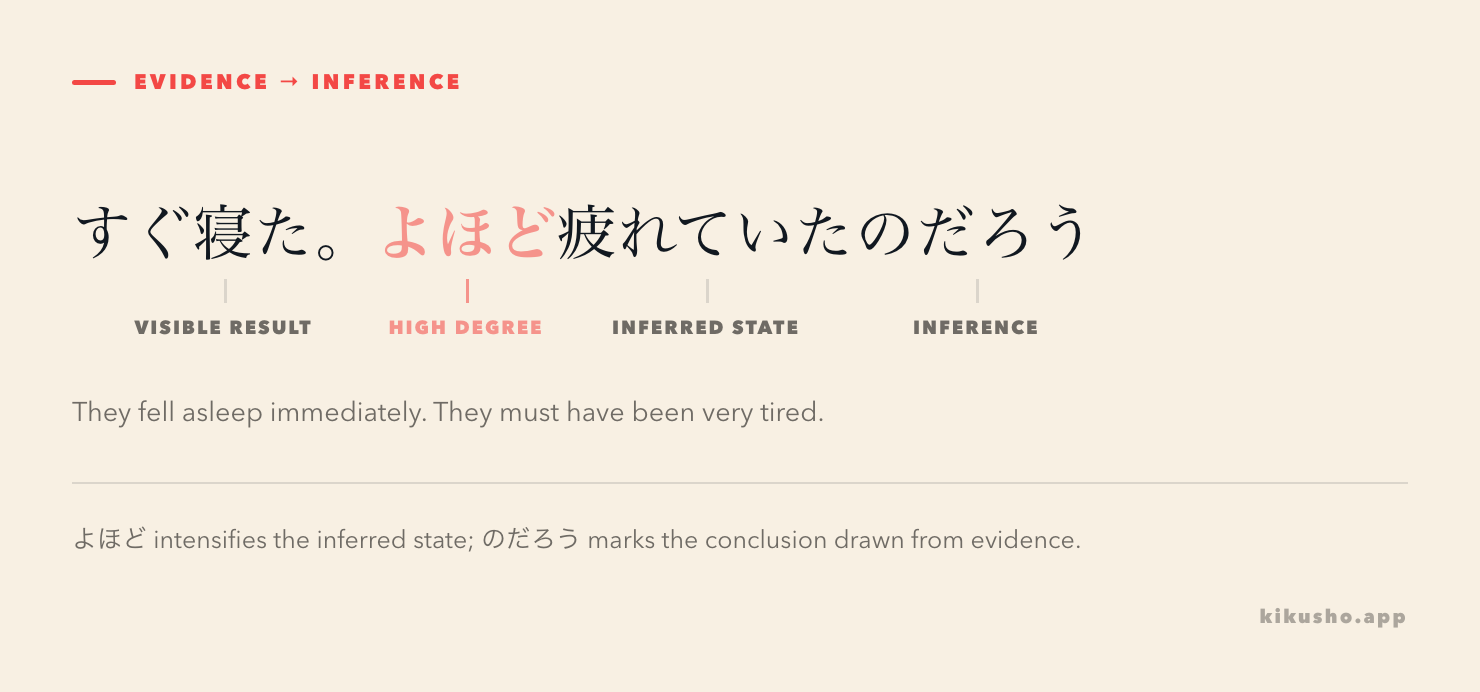
よほど does not itself mean “must.” It intensifies 疲れていた. The ending のだろう marks the speaker's inference, while the immediate sleep supplies the evidence. English often combines those jobs as “must have been very tired.”
The same logic works with らしい, ようだ, のだと思う or a context that already makes inference clear:
あの店はよほど人気があるらしく、開店前から列ができている。
あの みせは よほど にんきが あるらしく、かいてんまえから れつが できている。
“That shop seems extremely popular; a line forms before it opens.”
彼女が自分から謝るなんて、よっぽど反省したんだね。
かのじょが じぶんから あやまるなんて、よっぽど はんせいしたんだね。
“For her to apologize on her own, she must really have reflected on what she did.”
TCJ's Japanese-teacher explanation illustrates this inference with a person who always carries a camera, leading to よほどカメラが好きらしい. Hane's N2 lesson likewise describes a strong reason inferred from a situation. For a wider comparison of evidence and probability markers, see どうやら, 恐らく and 果たして.
A strong impulse can stop just before action
Another frequent frame is よほど/よっぽど + volitional + かと思った. The speaker came close to choosing an action or strongly felt like doing it. Later context normally shows that the action did not happen.
店員の態度が悪くて、よっぽど何も買わずに帰ろうかと思った。
てんいんの たいどが わるくて、よっぽど なにも かわずに かえろうかと おもった。
“The clerk's attitude was so bad that I seriously considered going home without buying anything.”
留学生活が苦しくて、よほど帰国しようかと思ったが、友達に励まされて残った。
りゅうがくせいかつが くるしくて、よほど きこくしようかと おもったが、ともだちに はげまされて のこった。
“Life abroad was so difficult that I nearly decided to return home, but my friends encouraged me and I stayed.”
The volitional forms 帰ろう and 帰国しよう present the contemplated decision. The following と思った locates that decision in the speaker's thoughts. よほど raises its intensity. Translate the whole frame, not the adverb alone.
This structure does not guarantee that the action was avoided. A later clause could say the speaker finally did it. Without such a clause, however, よほど~ようかと思った commonly invites the “came close, but did not” reading. TCJ explicitly describes this use as a strongly felt action that was not carried out, and JLPT Sensei gives both 言ってやろうかと思った and 会社を辞めようかと思っている examples.
よほどのこと names an exceptional circumstance
Before a noun, よほど takes の:
よほどの理由がない限り、締め切りは延ばせません。
よほどの りゆうが ない かぎり、しめきりは のばせません。
“Unless there is a very compelling reason, the deadline cannot be extended.”
彼が会議を欠席するなんて、よほどのことがあったに違いない。
かれが かいぎを けっせきするなんて、よほどの ことが あったに ちがいない。
“For him to miss the meeting, something serious must have happened.”
よほどのこと does not identify the event. It classifies it as exceptional enough to explain behavior or overturn a normal expectation. In よほどのことがない限り, the normal plan will remain in force unless such an exceptional circumstance occurs.
A Japanese Language Stack Exchange discussion of よほどのこと shows this evidence-based reading and the common ない限り frame. TCJ also gives よほどのことがない限り、参加します, in which attendance is expected unless something unusual intervenes.
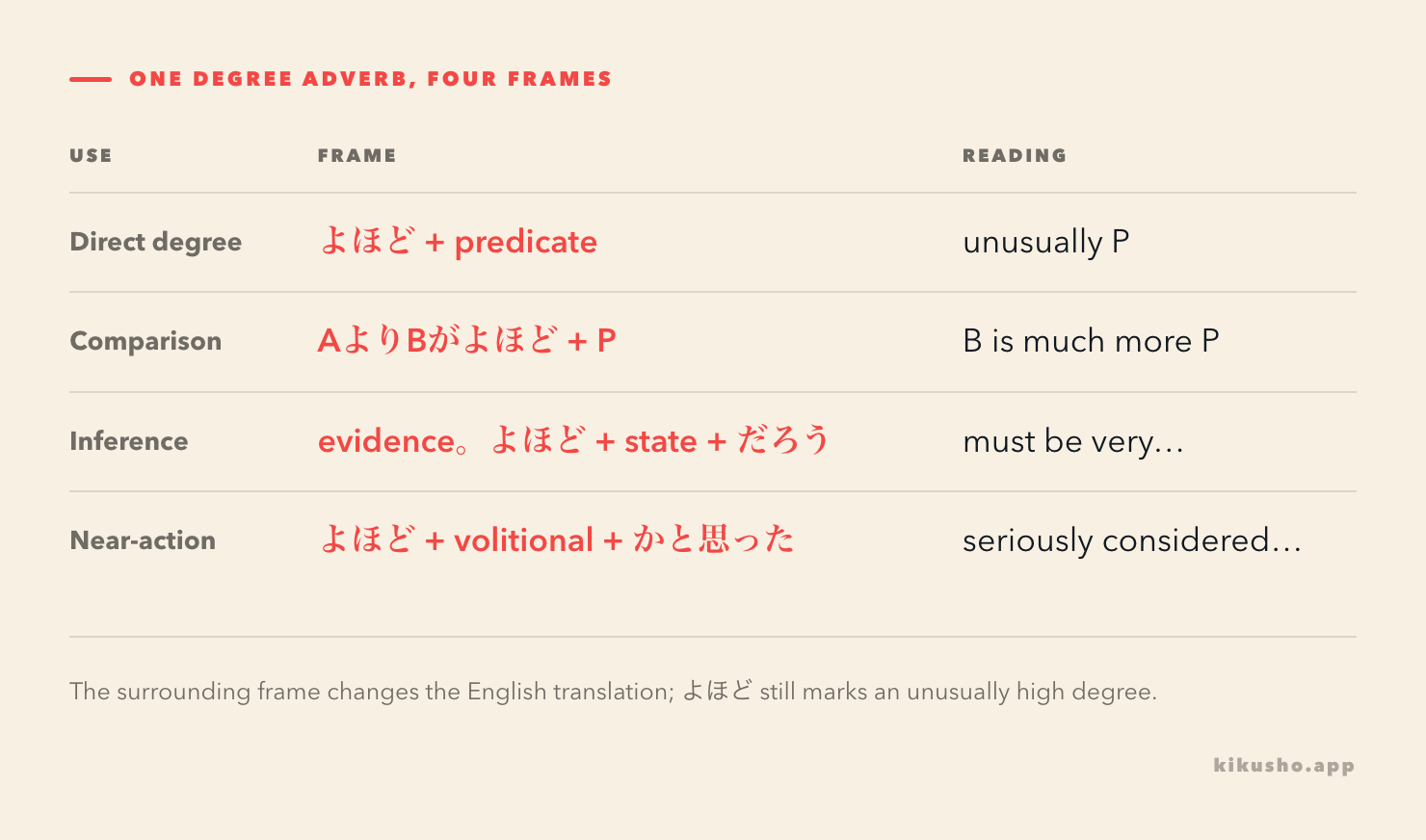
| Use | Reliable frame | Reading strategy |
|---|---|---|
| direct degree | よほど + predicate | unusually or considerably P |
| comparison | AよりBのほうがよほど + predicate | B is much more P than A |
| inference | evidence。よほど + state + だろう/らしい | the evidence suggests a very high degree |
| near-action | よほど + volitional + かと思った | seriously considered or nearly did it |
| noun modifier | よほどの + noun | an exceptional or compelling noun |
よっぽど changes the register, not the grammar
The small っ gives よっぽど a punchier spoken rhythm. Kotobank's usage history describes よっぽど as the emphatic form and よほど as the plainer form. In current use, よっぽど is common in conversation, reactions and forceful comparisons:
そんな説明より、図を見たほうがよっぽど早いよ。
そんな せつめいより、ずを みた ほうが よっぽど はやいよ。
“Looking at the diagram is much quicker than listening to that explanation.”
For an essay, notice or business report, choose よほど unless you deliberately want to reproduce spoken voice. Do not treat the pair as two separate constructions. Both can appear in direct degree, comparison, inference and near-action frames.
Also avoid a mechanical swap with とても. とても疲れた simply reports being very tired. すぐ寝た。よほど疲れていたのだろう reasons backward from a result. The second sentence's logic would be weakened if the context that supports the inference disappeared.
The あまりにも and ほど lesson covers another way to mark a striking degree. あまりにも directly judges a degree as excessive or surprising. よほど often compares it with an expectation, or infers it from evidence. Both can be translated as “so” in the right context, but their sentence logic differs.
N2 is the supported study placement
JLPT Sensei, Hane and other Japanese-learning references teach よほど/よっぽど at N2. The Kikusho inventory assigns the exact item g-3118507fa24f to this lesson and records no placement disagreement.
The official JLPT FAQ says that vocabulary, kanji and grammar lists are no longer issued for the revised test. For this lesson, N2 records the agreement among the checked teaching references and Kikusho's inventory; it does not predict the contents of an individual test paper.
Six questions before the answer key
Answer every question, then open the single explanation block below them.
Question 1
Choose the most natural completion for a strong comparison: 電話で説明するより、図を見せたほうが( )分かりやすい。
| Choice | Completion |
|---|---|
| ア | よほど |
| イ | たまたま |
| ウ | あまり~ない |
| エ | めったに |
Question 2
Which sentence most clearly presents an inference from visible evidence?
- ア:彼はとても疲れました。
- イ:彼は疲れるほど働きます。
- ウ:彼は帰宅するとすぐ寝た。よほど疲れていたのだろう。
- エ:彼は疲れたら寝ます。
Question 3
Complete the noun phrase: 彼が約束を破るなんて、( )事情があったに違いない。
- ア:よほど
- イ:よほどな
- ウ:よほどの
- エ:よほどで
Question 4
Build “I seriously considered going home without saying anything” from all four pieces, then identify the piece at ★.
__ __ ★ __。
- ア:よっぽど
- イ:何も言わずに
- ウ:帰ろうかと
- エ:思った
Record both the complete sentence and the label occupying ★.
Question 5
Your colleague writes formal report prose as 以前よりよっぽど効率が上がった. Revise only the register-sensitive form while keeping the meaning “Efficiency improved much more than before.”
Question 6
Read the context and choose the best pair for 甲 and 乙.
田中さんは毎日終電まで働いている。甲、仕事が忙しいのだろう。昨日は乙会社を辞めようかと思ったそうだ。
- ア:甲 よほど / 乙 よほど
- イ:甲 とても / 乙 めったに
- ウ:甲 かなり / 乙 あまり~ない
- エ:甲 たまたま / 乙 とても
Answers and explanations
1
ア:よほど. The AよりBのほうが frame establishes a comparison, and よほど says the gap in clarity is unusually large. The other choices do not express that degree comparison.
2
ウ:彼は帰宅するとすぐ寝た。よほど疲れていたのだろう。 Falling asleep immediately is the observed result. よほど疲れていた supplies the exceptional degree, and のだろう marks the inference drawn from that result.
3
ウ:よほどの. Before a noun, よほど takes の. よほどの事情 means an exceptional or compelling circumstance that could explain behavior outside the person's norm.
4
The complete sequence is よっぽど何も言わずに帰ろうかと思った。 The order is ア → イ → ウ → エ, so ウ:帰ろうかと belongs at ★. The volitional 帰ろう, question particle か and と思った present the contemplated choice; よっぽど makes that impulse strong.
5
Use 以前よりよほど効率が上がった。 よっぽど is natural in conversation, while よほど better fits the careful written register of a formal report. The degree and comparison remain unchanged.
6
ア:甲 よほど / 乙 よほど. Working until the last train every day supports an inference that the work is unusually busy. The second よほど strengthens the contemplated action in 会社を辞めようかと思った. Both blanks use the same high-degree adverb in different surrounding frames.
Read outward from よほど
When you meet よほど or よっぽど, first identify the predicate whose degree it raises. Then inspect the rest of the sentence. A comparison frame creates “much more,” evidence plus だろう creates “must have been very,” and a volitional plus かと思った creates “seriously considered.” The translation changes because the sentence changes; the core idea remains a degree well beyond the ordinary expectation.
Common questions
What do よほど and よっぽど mean in Japanese?
They mark a degree as far beyond what is ordinary or expected. Depending on the sentence, English may use “very,” “much,” “really,” “must have” or “almost.” The surrounding structure supplies the best translation.
What is the difference between よほど and よっぽど?
The meaning is shared, but よっぽど is the more conversational and often more forceful form. よほど fits both careful speech and writing. Modern Japanese normally writes both in kana rather than as 余程.
Why can よほど mean “must have” in English?
よほど still marks a high degree, but the speaker infers that degree from visible evidence. In すぐ寝た。よほど疲れていたのだろう, falling asleep immediately supports the conclusion that the person must have been very tired.
What does よほど~ようかと思った mean?
It says the speaker seriously considered or came close to taking an action but usually did not take it. よほど帰ろうかと思った means “I very nearly decided to go home” in a context that later shows the speaker stayed.