
On this page
These five words — 全然, ちっとも, ほとんど, ずいぶん and 最も — all answer one question, how much?, which is why a vocabulary list files them together and why that list quietly misleads you. Two of them will not stand in a sentence unless the verb is negative, one flips its meaning depending on whether the verb is negative, and the rest simply mark a point high on a scale. Learn them as a flat row of glosses and you will put 全然 in front of a plain verb and write a sentence no one says.
A word list is the wrong home for these
A list gives each word a gloss and stops: ぜんぜん, "not at all"; ちっとも, "not in the least"; ずいぶん, "quite a lot"; ほとんど, "almost"; もっとも, "most". What the gloss cannot carry is the rule fastened to the word. 全然 and ちっとも are negative-polarity items: the clause has to end in a negative for them to be grammatical at all. That is not vocabulary, it is grammar, hiding inside what looks like five more words to memorise, and a list is the one format that cannot show it to you. Grouping them is the point, the same way five N4 compound verbs are one pattern to learn rather than five words to file apart.
The words also sit on a single line, from none at one end to the most at the other, and once you can see that line you can see which words carry the negative rule and which do not. This is why keeping a word in the sentence it came in beats keeping the gloss alone: the sentence is where you find out that ちっとも cannot appear without a ない somewhere after it.
One note on level first. These are usually met around N4, but the lists disagree. The JLPT vocabulary lists this lesson draws on place all five at N4; Jisho tags ずいぶん and 最も a level higher, at N3, along with the related かなり below. The JLPT publishes no official word syllabus, so read the level as a rough study stage, not a fixed fact.
The set, from "not at all" to "the most"
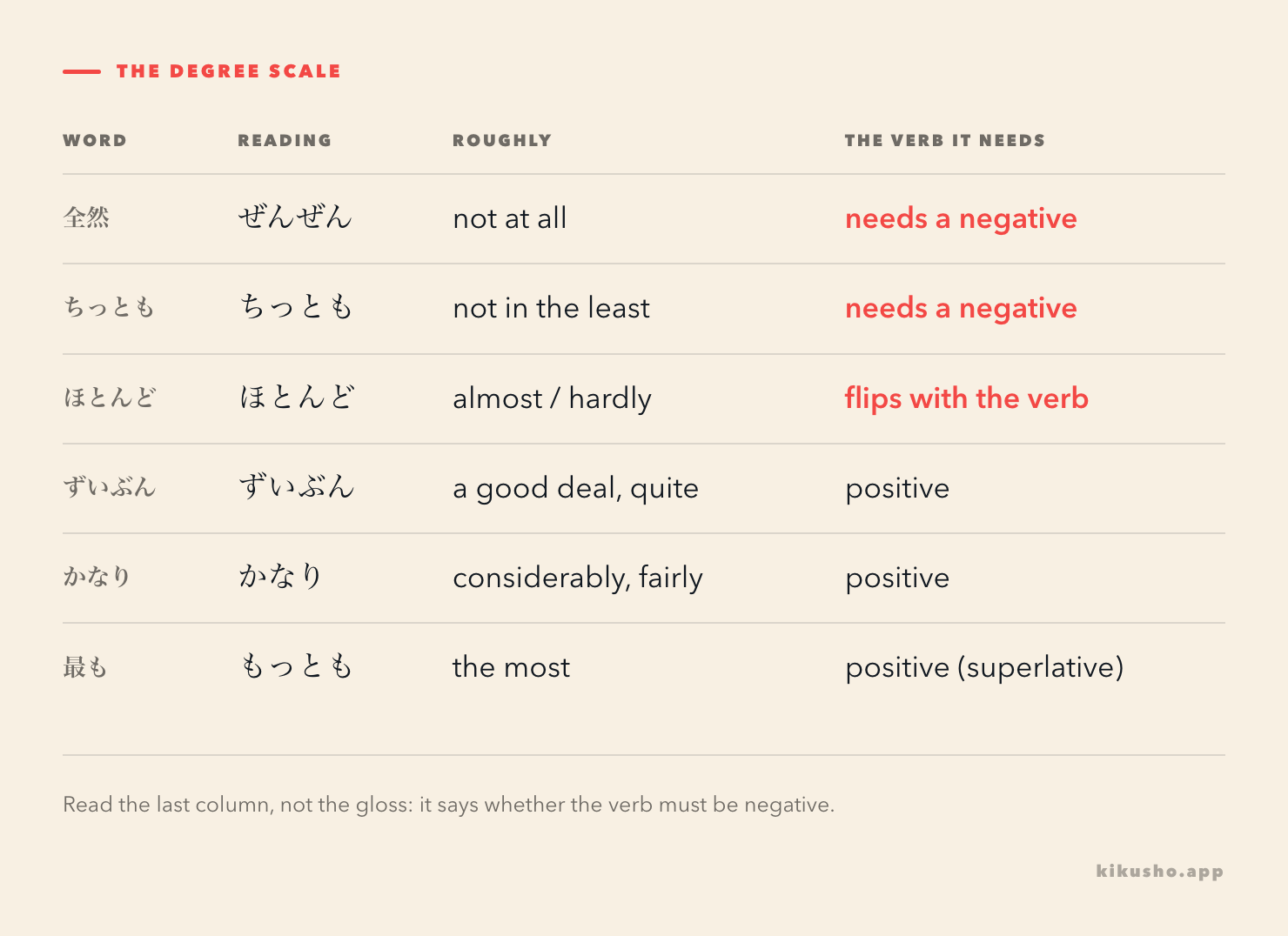
| Word | Reading | Roughly | The verb it needs |
|---|---|---|---|
| 全然 | ぜんぜん | not at all | negative |
| ちっとも | ちっとも | not in the least | negative |
| ほとんど | ほとんど | almost / hardly | flips with the verb |
| ずいぶん | ずいぶん | a good deal, quite | positive |
| かなり | かなり | considerably, fairly | positive |
| 最も | もっとも | the most | positive (superlative) |
Read the last column, not the glosses, and the set falls into three groups. 全然 and ちっとも demand a negative. ほとんど works either way and changes meaning when it switches. ずいぶん, かなり and 最も describe a high positive degree and never take the negative rule. かなり is the one word here most lists push to N3; it belongs on the scale, so it earns its row.
Two of them demand a negative verb
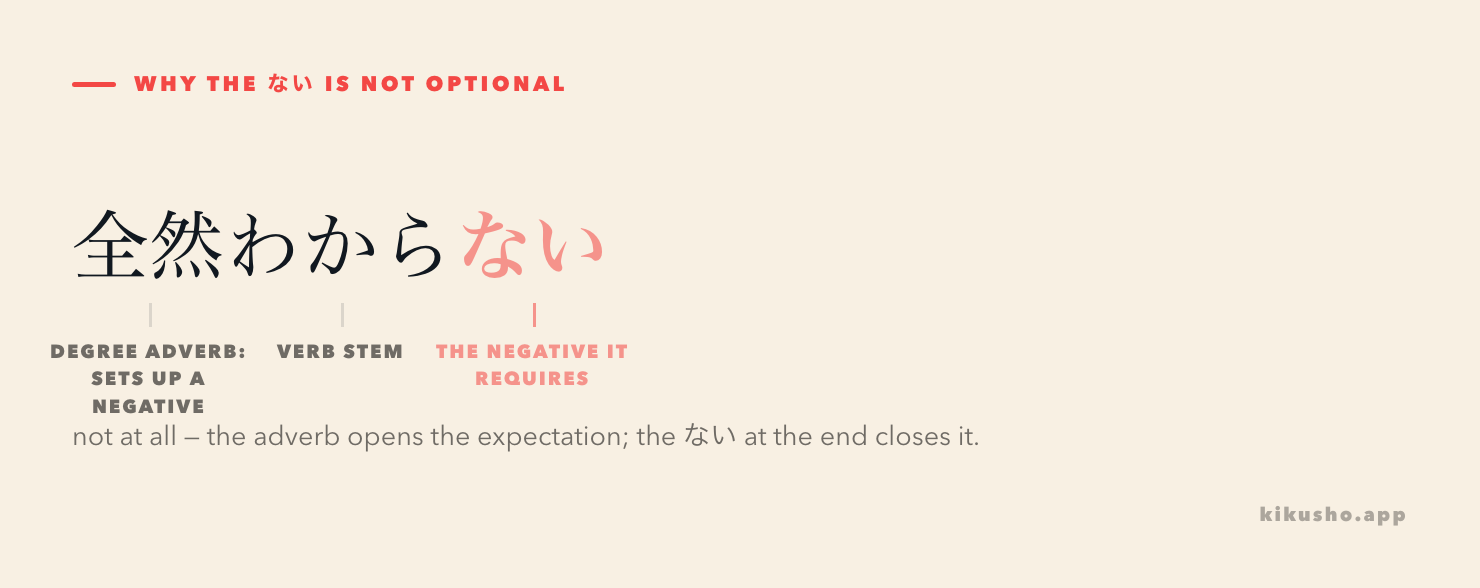
全然 and ちっとも are the negative-polarity pair, and the requirement is not a stylistic preference. 全然わからない means "I don't understand at all"; drop the ない and 全然わかる is stranded, the way English "I couldn't care less" breaks if you delete the "n't". The adverb sets up an expectation of a negative, and the verb has to deliver it.
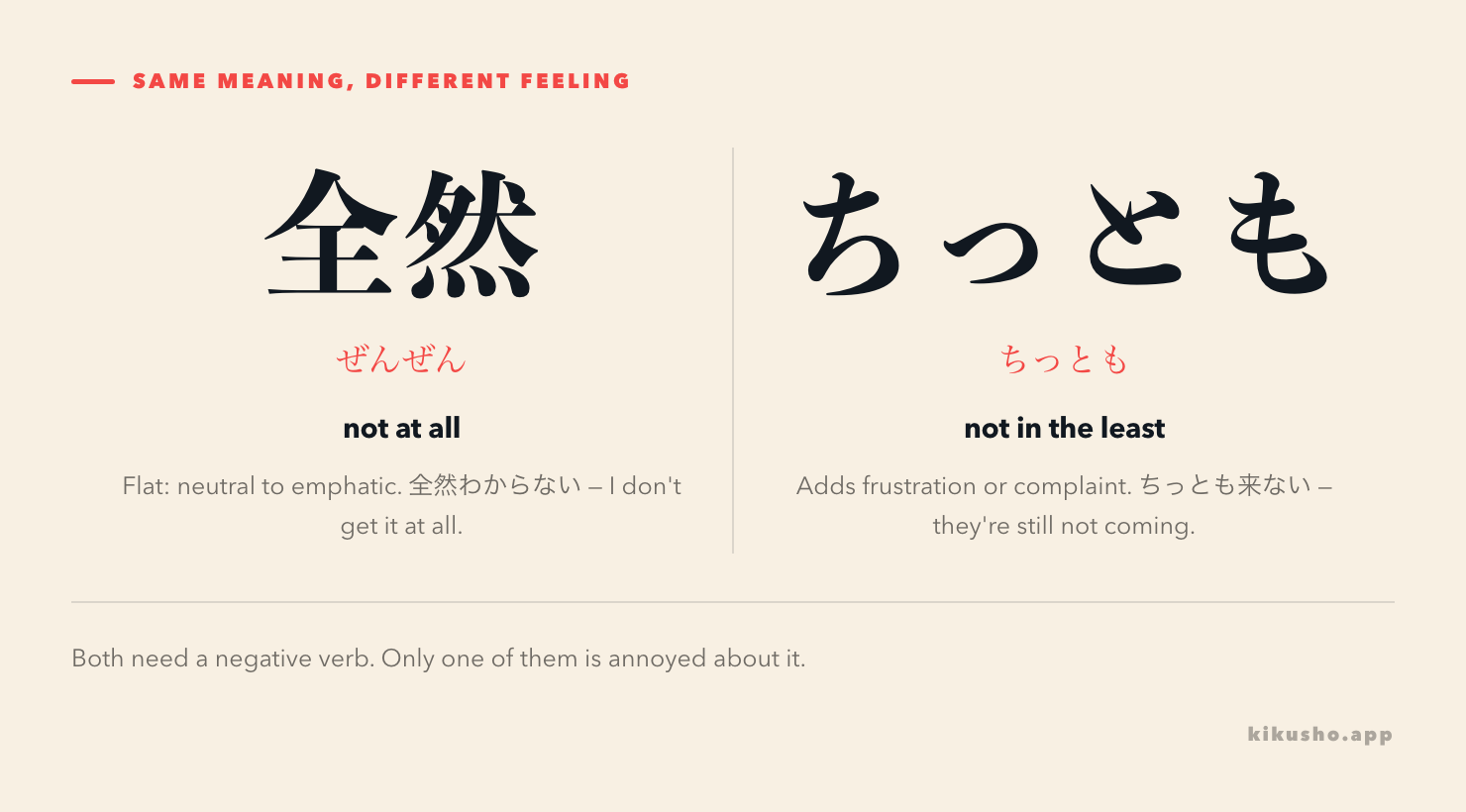
The two are not interchangeable, though. 全然 is flat: neutral to emphatic, a plain "not at all". ちっとも carries feeling. ちっとも来ない is not a neutral report that someone has not arrived; it is closer to "they are still not here" said by a person tired of waiting, with impatience or complaint riding on it. Reach for ちっとも and you are colouring the negation, not just stating it.
There is a twist you will hear constantly. In casual speech 全然 has broken its own rule and reattached to positive words: 全然大丈夫, "totally fine"; 全然いい, "perfectly good". It is technically nonstandard, and it is so common, especially among younger speakers, that it passes without comment in conversation. Keep it out of your writing and your exam answers, and recognise it everywhere else. ちっとも never made that jump. It stays negative.
ほとんど swings both ways
ほとんど is the hinge of the set, the one member that refuses to pick a side. With a positive verb it means "almost" or "mostly": ほとんど終わった, "almost finished"; ほとんど食べた, "ate almost all of it". Put a negative on the verb and the same word means "hardly": ほとんど食べなかった, "ate almost none"; ほとんど寝ていない, "have hardly slept". The word does not change. The verb's ending decides whether you are near the top of the scale or near the bottom.
It is also a noun, which the adverb glosses hide. ほとんどの人 is "most people", ほとんどの場合 is "in most cases" — ほとんど plus の, modifying a noun directly. That the same headword covers "almost", "hardly" and "most of" is exactly the kind of range a one-line list flattens into a single English word and loses.
最も is a superlative, not an intensifier
最も is the word a careless list gets wrong, glossing it "extremely". It does not mean "very". It marks the top of a comparison: 最も高い山 is "the highest mountain", the one higher than all the others, not a mountain that is "extremely high". 日本で最も高い山は富士山だ, "the highest mountain in Japan is Mount Fuji". Wherever English reaches for "the -est" or "the most", Japanese can reach for 最も in front of the adjective.
In conversation almost nobody says 最も. The everyday superlative is いちばん (一番): いちばん高い山 says the same thing in a register you would actually use with a friend. 最も is the written, formal one, at home in an essay, a news report or a ranking. Which to use is a question of politeness and register more than of meaning.
One spelling trap comes with it. もっとも written 尤も is a different word: as an adverb-turned-conjunction it means "reasonable", or "that said, however". The superlative もっとも, the one that means "most", is 最も. Same sound, two kanji, two jobs.
Which ones you'll actually meet, and how to keep them
全然 and ちっとも arrive first in speech, usually attached to a complaint: 全然わからない from a classmate, ちっとも returns in every story about waiting for someone. ほとんど shows up the moment anyone estimates an amount out loud. 最も you will read far more than you hear it, in captions and articles, while いちばん carries the same job in conversation. None of them waits for the chapter that introduces it; they land in a sentence, already carrying the verb that makes them legal.
That verb is the part worth keeping, and the part a bare word card throws away. Save ちっとも on its own with the gloss "not at all" and you have kept half a rule: nothing on the card records that it cannot appear without a ない. The unit worth collecting is the whole clause you met it in — ちっとも覚えていない, 全然大丈夫 — because that is where the negative, or the surprising lack of one, is written down. Kikusho drafts a card from a line you paste, say or photograph, keeping the adverb and its verb together with the reading and a note on register, so the rule travels with the word instead of being the thing you forgot to write down. Pick a single word out of the sentence later, if you want it on its own, once you have seen the frame it needs.
Four questions to fix the rule
Question 1. Which adverb best completes this sentence? 「日本語が___上手になりましたね。」(Your Japanese has gotten ___ good, hasn't it!)
a) ずいぶん b) ちっとも c) 全然 d) ほとんど
Answer 1: ずいぶん. The verb 上手になりました is affirmative, and ずいぶん fits a pleased, slightly surprised "you've come a long way". (b) ちっとも and (c) 全然 both require a negative predicate, so they cannot attach to an affirmative 上手になりました at all. (d) ほとんど上手になった would mean "almost became skilled", which is not a natural thing to say to someone who already has.
Question 2. Which sentence uses the underlined word correctly?
a) 薬を飲んだのに、_ちっとも_良くならない。 b) この店のケーキは_ちっとも_おいしいです。 c) 彼女は_ちっとも_歌が上手です。 d) 今日は_ちっとも_寒いです。
Answer 2: (a). ちっとも良くならない, "doesn't get better in the least", pairs the adverb with a negative verb, which is the only way ちっとも is grammatical. (b), (c) and (d) all attach it to an affirmative predicate (おいしいです, 上手です, 寒いです); unlike 全然, ちっとも has no casual positive use, so all three are simply wrong.
Question 3. The word もっとも, meaning "most", belongs in this sentence: 「富士山は日本で___高い山です。」Which kanji writes it?
a) 最も b) 尤も c) 持も d) 勿も
Answer 3: (a) 最も. The sentence fixes the meaning as the superlative, "the highest mountain", and that word is written 最も. (b) 尤も is also read もっとも, but it is the separate word meaning "reasonable" or "however", not the superlative. (c) and (d) are not words.
Question 4. Which sentence is closest in meaning to 「彼はほとんど寝ていない」? (He has hardly slept.)
a) 彼はよく寝ている。 b) 彼はあまり寝ていない。 c) 彼は全然寝た。 d) 彼はずいぶん寝た。
Answer 4: (b). ほとんど寝ていない combines ほとんど with a negative to mean "hardly slept", which あまり寝ていない, "hasn't slept much", restates. (a) and (d) say the opposite, that he slept well or a good deal. (c) 全然寝た is ungrammatical: 全然 needs a negative, so 全然寝ていない would be possible but 全然寝た is not.
Get the last column of that first table right and the rest follows: before you write one of these words, look at the end of the clause, because half of them have already decided what it has to be.
Common questions
Can 全然 be used with a positive verb, like 全然大丈夫?
In standard Japanese 全然 requires a negative predicate: 全然わからない, "I don't understand at all". In casual speech it has spread to positive words — 全然大丈夫, "totally fine"; 全然いい, "perfectly good" — which most speakers accept in conversation, especially younger ones, but which is still treated as nonstandard in writing and on the JLPT. ちっとも never made that jump and stays negative only.
What is the difference between 全然 and ちっとも?
Both mean "not at all" in front of a negative verb, and both are common in casual Japanese. 全然 is neutral to emphatic and has a spreading casual positive use; ちっとも adds feeling — impatience, complaint, disappointment — and is limited to negatives, so ちっとも来ない carries frustration that 全然来ない does not.
Does 最も mean "extremely"?
No. 最も (もっとも) marks the superlative, "most": 最も高い山 is "the highest mountain", the one higher than all others, not a mountain that is "extremely high". Some word lists gloss it loosely as "extremely", but its job is comparison. Everyday speech uses いちばん for the same meaning; 最も is the formal, written form.
Does ほとんど mean "almost" or "hardly"?
Both, and the verb decides which. With an affirmative verb ほとんど食べた means "ate almost all of it"; with a negative ほとんど食べなかった means "ate almost none, hardly any". It is also a noun taking の: ほとんどの人 is "most people".