On this page
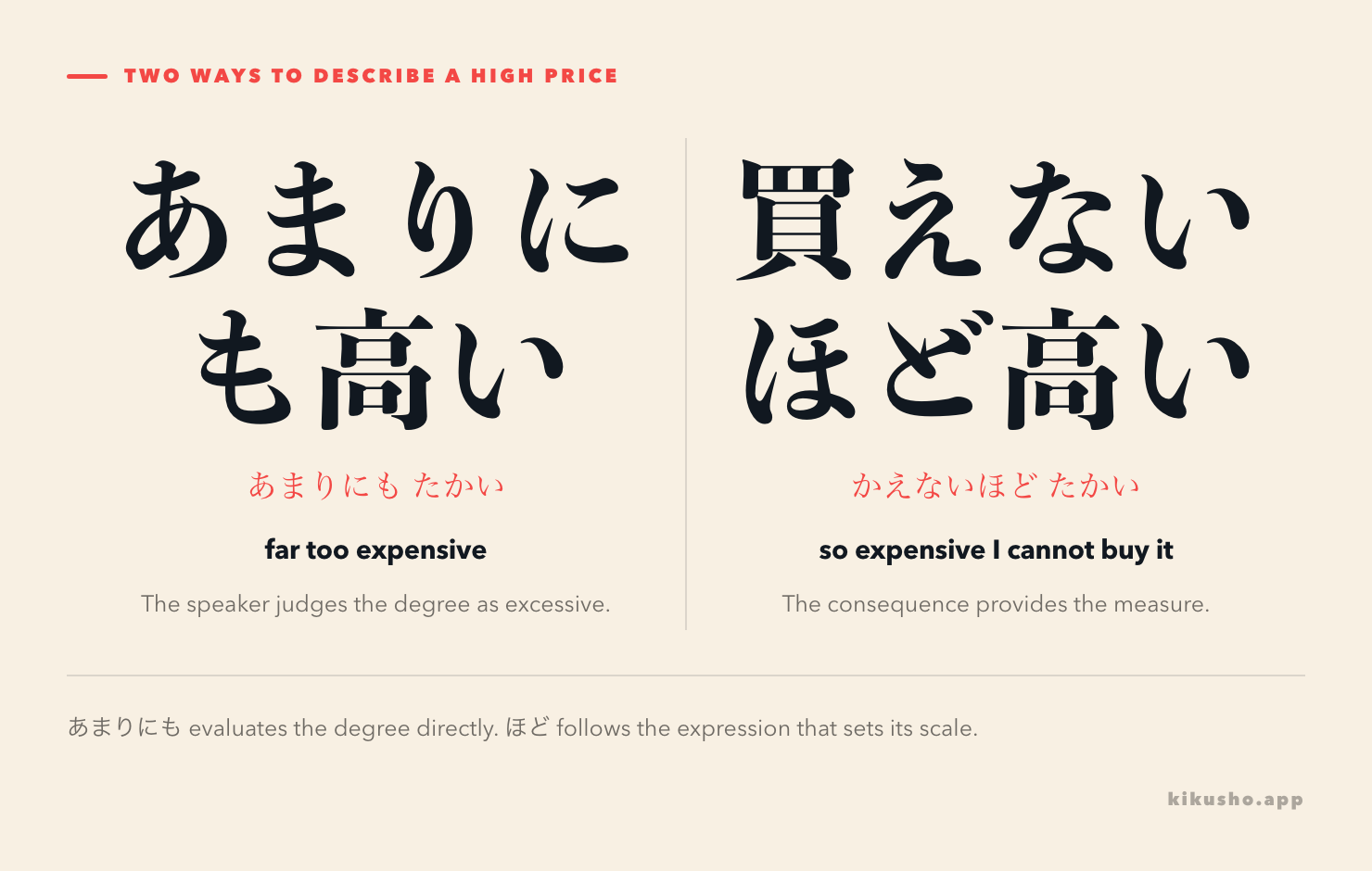
あまりにも marks a degree as strikingly beyond what the speaker considers normal: あまりにも高い means “far too expensive.” ほど does a different job: it measures the degree through a result or benchmark, as in 買えないほど高い, “so expensive that I cannot buy it.”
The contrast is useful because English “so” and “too” can hide it. With あまりにも, the speaker directly judges the intensity. With ほど, the sentence shows the scale on which that intensity is measured. They can even appear together when both ideas matter.
あまりにも puts the speaker's judgment before the predicate
Imagine opening a restaurant menu and seeing one dish at a price that feels unreasonable:
この料理はあまりにも高い。
このりょうりはあまりにもたかい。
“This dish is far too expensive.”
The adjective 高い supplies the scale, and あまりにも says its position on that scale is surprisingly or unacceptably high. The sentence does not need a second clause explaining the consequence. The judgment is already complete.
Tobira's grammar index describes あまりに(も) as indicating an excessively high degree and gives “too,” “excessively” and “so” as working English equivalents. The point is not that the quality must be bad. A beautiful view, a kind response or a delicious meal can also exceed expectations:
展望台からの景色があまりにも美しくて、しばらく言葉が出なかった。
てんぼうだいからのけしきがあまりにもうつくしくて、しばらくことばがでなかった。
“The view from the observation deck was so beautiful that I was speechless for a while.”
The beauty is positive; its degree is exceptional. The reaction in the second clause makes that degree concrete, but it is not required by the grammar.
Put あまりにも before what it intensifies
あまりにも behaves like an intensifying adverb. It comes before a verb, adjective, adverbial expression or larger predicate. The word after it keeps the form that its own sentence requires.
| What follows | Pattern | Example | Meaning in context |
|---|---|---|---|
| い-adjective | あまりにも + い-adjective | あまりにも速い | far too fast |
| な-adjective predicate | あまりにも + stem + だ/です | あまりにも複雑だ | excessively complicated |
| adjective before a noun | あまりにも + adjective + noun | あまりにも急な変更 | far too sudden a change |
| verb or verbal expression | あまりにも + verb | あまりにも変わった | changed surprisingly much |
| manner or amount | あまりにも + adverbial expression | あまりにも簡単に諦めた | gave up far too easily |
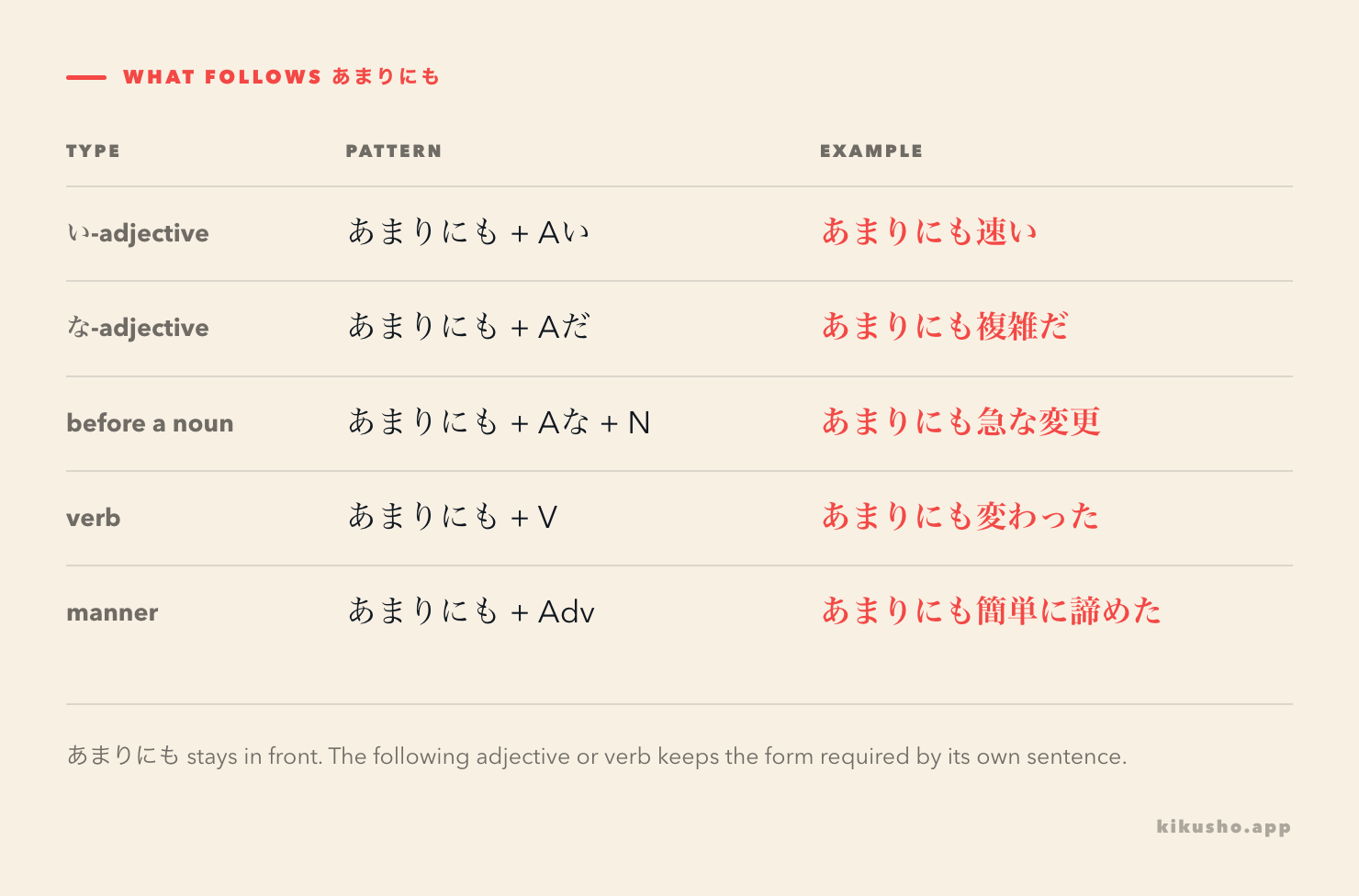
With a な-adjective before a noun, keep な because it belongs to the adjective–noun connection:
あまりにも複雑な説明だったので、要点が分からなかった。
あまりにもふくざつなせつめいだったので、ようてんがわからなかった。
“The explanation was so complicated that I could not identify the main point.”
複雑な説明 remains one noun phrase. あまりにも intensifies 複雑; it does not replace な. Likewise, あまりにも急な変更 keeps 急な before 変更.
With a verb, the excessive degree can concern the action, its repetition or the change it describes:
留学してから彼の考え方はあまりにも変わった。
りゅうがくしてからかれのかんがえかたはあまりにもかわった。
“His way of thinking changed so much after studying abroad.”
The context must make a scale available. 変わった can be large or small, so あまりにも can evaluate its extent. A punctual one-off action with no natural degree is harder to intensify unless the surrounding situation supplies one.
ほど measures the degree with a consequence or benchmark
ほど follows the expression that sets the measuring point. In the price example, inability to buy is the consequence used to describe how high the price is:
この料理は買えないほど高い。
このりょうりはかえないほどたかい。
“This dish is so expensive that I cannot buy it.”
The sentence does not directly call the price unreasonable. It tells you its degree through 買えない, “cannot buy.” That consequence may strongly imply excess, but the grammar itself is a measure.
The measuring expression normally comes before ほど:
| Measure before ほど | Whole phrase | What it establishes |
|---|---|---|
| Plain verb | 立っていられないほど疲れた | tired to the point of being unable to stand |
| い-adjective | 痛いほど握った | gripped to a painful degree |
| な-adjective + な | 不思議なほど静かだ | quiet to a surprising degree |
| Demonstrative | これほど難しい | this difficult; difficult to this extent |
| Expected degree | 思ったほど高くない | not as expensive as expected |
That last pattern is especially important. 思ったほど高くない does not describe an extreme. It compares the actual price with the degree the speaker expected, then says the actual price does not reach it. This is why translating every ほど as “so much that” fails.
The earlier ば~ほど lesson teaches another member of the same degree family: 読めば読むほど, “the more you read.” There, repeated forms link two changing scales. In this lesson, the focus is the single measure before ほど.
The two forms can share one sentence
Because the forms have different jobs, they can coexist:
この料理はあまりにも高くて、私には買えないほどだ。
このりょうりはあまりにもたかくて、わたしにはかえないほどだ。
“This dish is far too expensive—so expensive that I cannot buy it.”
あまりにも supplies the speaker's strong evaluation. 買えないほど supplies a consequence that demonstrates the degree. The second half does not merely repeat the first; it gives evidence for the judgment.
A writer might prefer one when the other is unnecessary:
| Intended message | Natural focus |
|---|---|
| “The delay was outrageously long.” | 待ち時間があまりにも長かった。 |
| “The wait was so long that I missed the last train.” | 終電に間に合わないほど長く待った。 |
| “It was much easier than I had expected.” | 思ったほど難しくなかった。 |
The third sentence cannot use あまりにも without changing the claim. あまりにも難しくなかった is awkward for the intended comparison; あまりにも wants to intensify a predicate directly, while 思ったほど~ない compares actual and expected degrees.
Keep three other forms separate
The spelling あまり appears in several constructions. Their positions and sentence endings tell them apart.
あまり~ない means “not very”
この料理はあまり高くない。
“This dish is not very expensive.”
The negative ない completes the pattern. This sentence lowers the degree of 高い. あまりにも高い raises it dramatically. The あまり~ない and 全然~ない lesson develops that negative contrast.
~あまり links an extreme state to a result
緊張のあまり、名前を言い間違えた。
“I was so nervous that I said the name incorrectly.”
Here あまり follows 緊張の and forms a cause-and-result construction. It does not sit before the predicate it intensifies. The causal ~あまり comparison covers its noun, verb and adjective attachments.
~すぎる conjugates as part of the predicate
この料理は高すぎる。
“This dish is too expensive.”
~すぎる attaches to a stem and then behaves like a verb: 高すぎた, 高すぎない and 高すぎます are all possible. あまりにも stays in front and does not conjugate. It can combine with ~すぎる for deliberate extra emphasis, such as あまりにも高すぎる, though one marker is often enough in a neutral sentence.
あまりに and あまりにも differ mainly in emphasis
Both あまりに and あまりにも can present an excessive degree. The particle も commonly strengthens the sense that the degree crosses an expected limit:
結果があまりに意外で、すぐには信じられなかった。
結果があまりにも意外で、すぐには信じられなかった。
“The result was so unexpected that I could not believe it immediately.”
Both versions work. The second makes the exceptional degree more emphatic. Do not turn that tendency into a mechanical translation in which も always adds a separate English word.
A corpus-based Hokkaido University study of evaluative adverbs treats あまりに(も) as broader in distribution than causal あまり: あまりに(も) can occur in a simple sentence, whereas replacing it with bare affirmative あまり can require a larger cause-and-result structure or sound unacceptable. That structural distinction is more dependable than choosing between them from an English gloss.
Tobira notes a tendency toward formal language. You will meet the expression in explanations, news, essays and careful speech, but it is not restricted to writing. In relaxed conversation, ~すぎる may be the shorter choice when all you need is “too much.”
N3 is a study placement, not an official boundary
The curriculum's assigned reference item is あまりにも, inventory key g-853f30ef3a44. Its retained source observation and JLPT Sensei's current lesson place it at N3, and the inventory records no disagreement for this item.
The title's ほど comparison is here to prevent a common translation error; it is not an extra inventory claim that every use of ほど belongs to this one item. The official JLPT FAQ explains that the exam no longer publishes an exhaustive grammar list. Treat N3 as a useful point in the Kikusho study sequence, not a guarantee about a particular test form.
If you save an example in Kikusho, keep enough of the sentence to preserve the scale. 買えないほど without the high price loses what is being measured, while 思ったほど高くない without 思った loses the expectation. The full sentence tells you whether a degree is judged, demonstrated or compared.
Seven questions to answer before checking the key
These original exercises cover grammar-form selection, sentence composition and text grammar. Complete all seven before moving to the answer block.
Question 1 — grammar-form selection. You want to say “The explanation is far too complicated.” Which sentence directly evaluates the complexity as excessive?
A. 説明はあまり複雑ではない。
B. 説明はあまりにも複雑だ。
C. 説明は複雑のあまりだ。
D. 説明は思ったほど複雑だ。
Question 2 — grammar-form selection. Choose the phrase meaning “a far too sudden change.”
A. あまりにも急変更
B. あまりにも急だ変更
C. あまりにも急な変更
D. 急のあまりにも変更
Question 3 — grammar-form selection. The speaker expected the test to be harder and says, “It was not as difficult as I thought.” Complete the sentence: 試験は思った( )難しくなかった。
A. あまりにも
B. ほど
C. のあまり
D. すぎて
Question 4 — sentence composition. Arrange all four pieces to mean “The scenery was so beautiful that I forgot to take a photo.” Which piece belongs at ★?
__ __ ★ __。
A. 写真を撮るのを忘れた
B. あまりにも
C. 景色が
D. 美しくて
Write the complete four-part sequence before continuing.
Question 5 — sentence composition. Arrange all four pieces to mean “I was so tired that I could not remain standing.” Which piece belongs at ★?
__ __ ★ __。
A. 疲れていた
B. 立って
C. ほど
D. いられない
Keep the consequence intact when you decide the order.
Question 6 — text grammar. Read the exchange and choose the sentence that best completes it.
A:このかばん、予算より高かった?
B:いいえ、____。買うことにしました。
A. 思ったほど高くありませんでした
B. あまりにも高かったです
C. 高さのあまりでした
D. 買えないほど高かったです
Question 7 — text grammar. Read the account and choose the pair for 甲 and 乙.
会場は(甲)静かで、時計の音まで聞こえた。発表者は緊張の(乙)、最初に自分の名前を言い間違えた。
A. 甲あまりにも / 乙あまり
B. 甲あまり / 乙あまりにも
C. 甲ほど / 乙ほど
D. 甲あまりにも / 乙ほど
Check both blanks together, then move to the key.
Answers and explanations
Answer 1. B: 説明はあまりにも複雑だ. あまりにも directly intensifies the な-adjective predicate 複雑だ and judges the degree excessive. A means “not very complicated,” which reverses the scale. C does not supply a noun-plus-の cause before causal あまり. D lacks the negative that would turn 思ったほど into “not as … as expected.”
Answer 2. C: あまりにも急な変更. 急 is a な-adjective, so it keeps な before the noun 変更. あまりにも goes in front of the adjective. A drops the required adjective–noun link; B incorrectly keeps sentence-final だ before a noun; D combines the two different あまり patterns.
Answer 3. B: ほど. 思ったほど難しくなかった compares the actual difficulty with the expected degree and says reality did not reach it. あまりにも would directly intensify what follows and would not build that comparison. のあまり needs a preceding noun state and a following result; すぎて means “being too …, and,” which conflicts with the negative comparison.
For question 4, choose D: 美しくて. The completed sequence is C → B → D → A: 景色があまりにも美しくて、写真を撮るのを忘れた。 あまりにも precedes 美しい, which becomes 美しくて to connect the exceptional beauty with the reaction. 写真を撮るの is the activity that was forgotten.
Answer 5. C: ほど. The order is B → D → C → A: 立っていられないほど疲れていた。 The plain negative potential expression 立っていられない gives the consequence that measures the tiredness. ほど follows that complete measuring expression, then 疲れていた states the quality being measured.
Answer 6. A: 思ったほど高くありませんでした. A answers that the bag was not as expensive as expected, which supports the decision to buy it. D would say it was too expensive to buy, and B would call it excessively expensive; both conflict with the next sentence. C is not a formed cause-and-result construction.
Answer 7. A: 甲あまりにも / 乙あまり. あまりにも静かで directly marks the hall's quietness as exceptional, with the audible clock as evidence. 緊張のあまり uses noun + の + あまり to connect extreme nervousness to saying the name incorrectly. Reversing them breaks both structures: bare あまり does not go directly before 静か in this affirmative simple pattern, while 緊張のあまりにも would leave the noun attachment unfinished.
Common questions
What does amari ni mo mean in Japanese?
あまりにも means “too,” “excessively” or “so,” and marks a degree the speaker finds strikingly beyond what is normal or reasonable. It comes before the predicate or expression it intensifies, as in あまりにも高い, “far too expensive.”
What is the difference between あまりにも and ほど?
あまりにも directly evaluates a degree as excessive. ほど measures a degree against a consequence, example or expectation: 買えないほど高い is “so expensive that I cannot buy it.” A sentence can contain both because they perform different jobs.
Is あまりにも the same as あまり~ない?
No. あまりにも before an affirmative predicate usually marks an exceptionally high or excessive degree. あまり followed by a negative means “not very” or “not much,” as in あまり高くない. The negative at the end is part of that second construction.
Are あまりに and あまりにも different?
Both can express an excessive degree. The も commonly adds emphasis, so あまりにも makes the speaker's “beyond a reasonable degree” judgment more explicit. The exact force still depends on the sentence and context.