On this page
Use として~ない after the smallest countable unit to say that there is “not even one” exception: 一人として答えられなかった means “Not a single person could answer.” The negative may come later in the clause, but it controls the entire expression.
The pattern turns a count into emphatic total negation. Ordinary 一人も答えられなかった reports that nobody could answer. 一人として答えられなかった makes the absence of an exception more deliberate and formal.
Start with the smallest unit, then deny it
The core frame is simple:
minimum quantity + として + negative expression
The quantity names the smallest relevant member of a set. If even that one member does not satisfy the predicate, the whole set is ruled out.
応募者の中に、条件をすべて満たす人は一人としていなかった。
おうぼしゃの なかに、じょうけんを すべて みたす ひとは ひとりとして いなかった。
Among the applicants, there was not a single person who met every condition.
The set is 応募者, the minimum unit is 一人, and いなかった closes the clause negatively. The sentence does not merely say the number was small. It sets the count at zero and stresses that nobody escaped the statement.
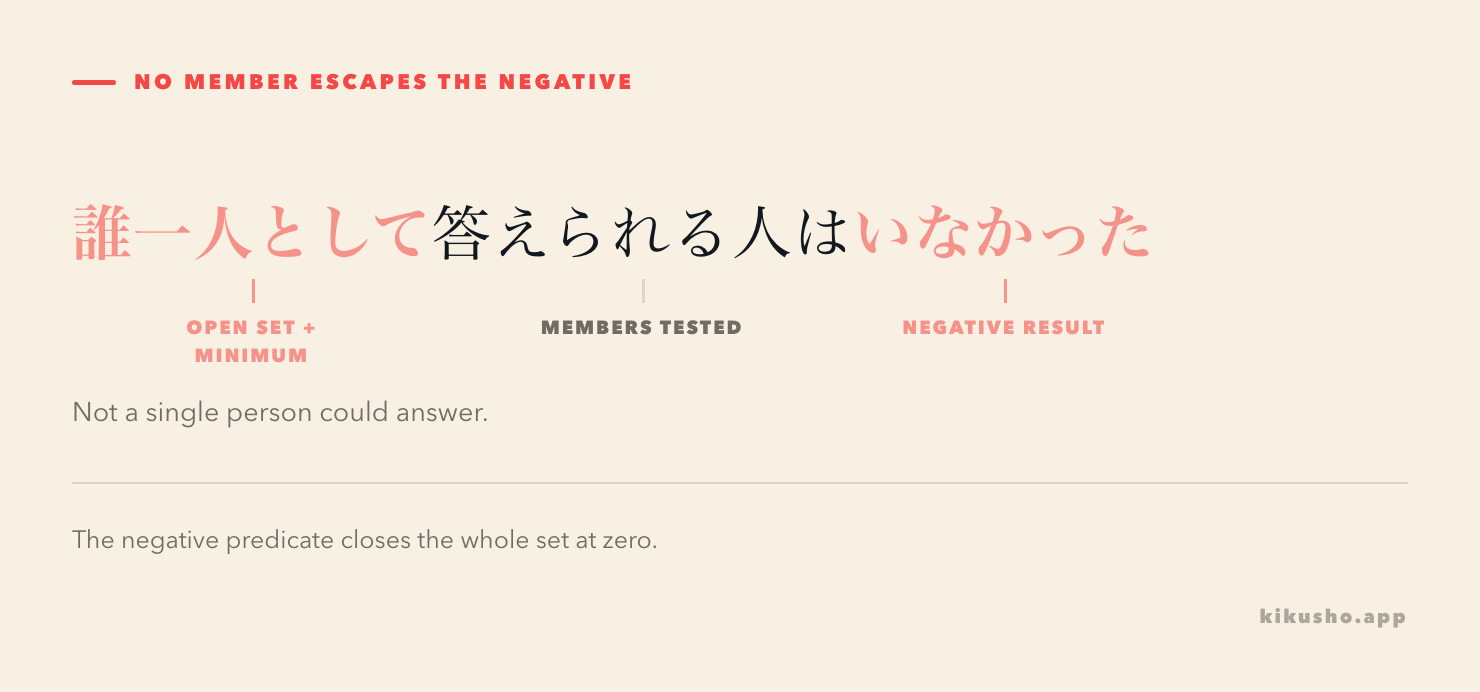
J-nihongo's として~ない reference describes the form as a hard or formal way to state that there is no exception, and gives N + として + negative expression as the structure. JLPT Sensei independently gives the one-plus-counter frame and the “not even one” meaning.
Match the counter to what reaches zero
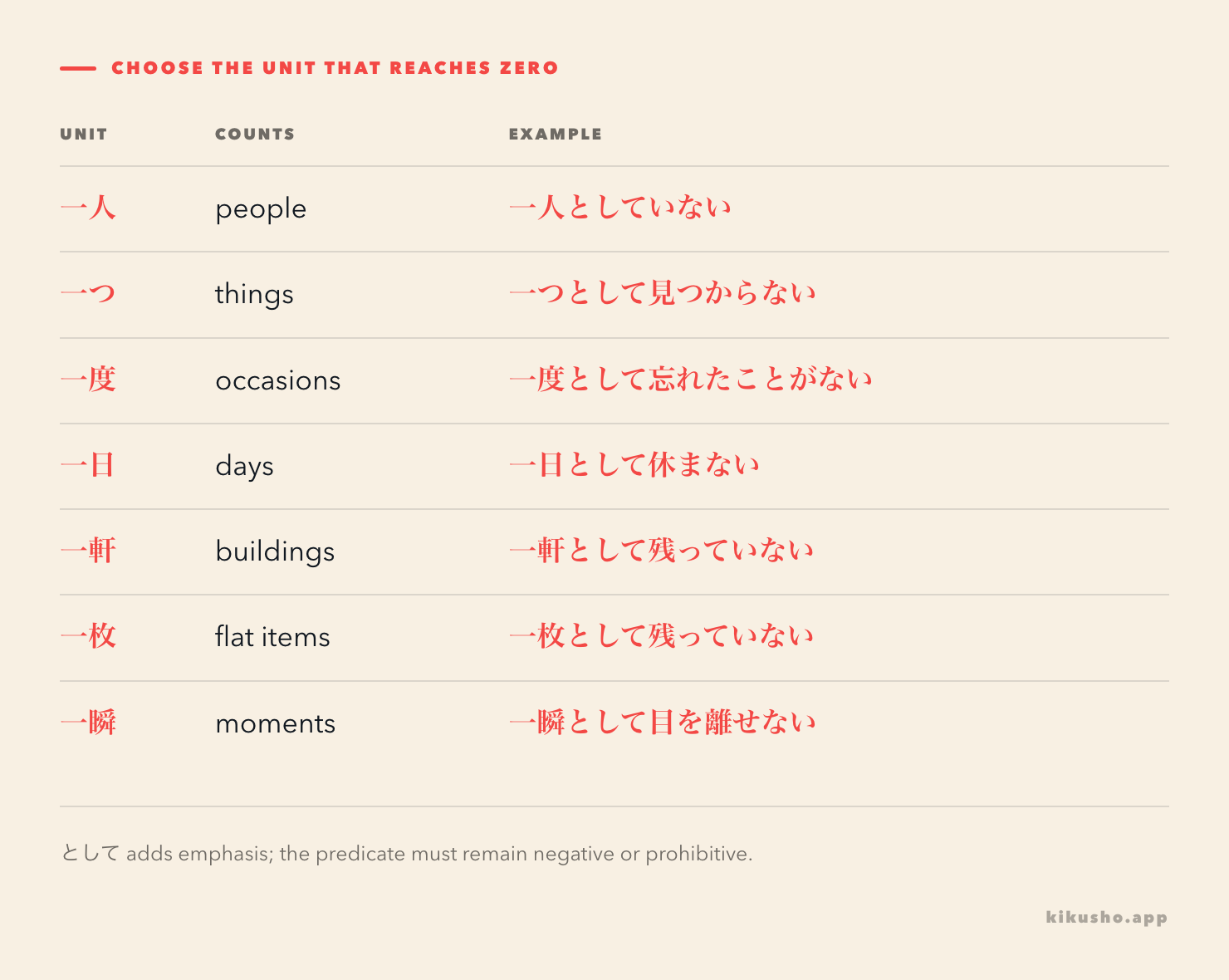
一人 and 一つ are common, but the pattern is not limited to people and objects. Choose the counter that defines the smallest meaningful exception.
| What is counted | Minimum unit | Example frame | What reaches zero |
|---|---|---|---|
| people | 一人 | 一人としていない | people present |
| things or points | 一つ | 一つとしてない | items satisfying the claim |
| occasions | 一度 | 一度として~たことがない | occurrences in a period |
| days | 一日 | 一日として休まなかった | days on which something happened |
| buildings or shops | 一軒 | 一軒として残っていない | locations remaining |
| sheets or photos | 一枚 | 一枚として残っていない | physical items remaining |
| moments | 一瞬 | 一瞬として目を離せない | time available for an action |
彼は三年間、一日として練習を休まなかった。
かれは さんねんかん、いちにちとして れんしゅうを やすまなかった。
For three years, he did not miss even one day of practice.
火事のあと、写真は一枚として残っていなかった。
かじの あと、しゃしんは いちまいとして のこっていなかった。
After the fire, not a single photograph remained.
The second sentence requires 一枚 because photographs are flat objects counted with 枚. 一つとして could still be understood in a broad context, but the specific counter makes the set easier to picture and the Japanese more precise.
誰一人 and 何一つ make the set explicit
A question word can appear before the minimum unit. It does not ask a question here. It opens the set and lets the following negative close it completely.
会議では、誰一人としてその案に賛成しなかった。
かいぎでは、だれひとりとして その あんに さんせいしなかった。
At the meeting, not a single person supported the proposal.
調査で明らかになったことは、何一つとして公表されていない。
ちょうさで あきらかに なった ことは、なにひとつとして こうひょうされていない。
Not a single thing revealed by the investigation has been made public.
Japanese-teacher resource N1et confirms the one + counter attachment and notes that an interrogative can precede it, as in 誰一人として. It also records the pattern's frequent use with time spans such as これまで and 今まで, which naturally invite claims such as “not once so far.”
The question word is optional. 一人として賛成しなかった and 誰一人として賛成しなかった both deny any supporter. 誰 makes the sweep across possible people more visible.
The negative can wait until the end
The tilde in として~ない matters. Material can stand between として and the negative predicate.
この問題に正しく答えられた学生は、一人としていなかった。
この もんだいに ただしく こたえられた がくせいは、ひとりとして いなかった。
There was not a single student who answered this question correctly.
彼の作品には、一つとして同じものがない。
かれの さくひんには、ひとつとして おなじ ものが ない。
No two of his works are the same.
The second translation looks less literal because English describes the relation between the works. Japanese says that among them there is not even one item that is “the same” as another. The result is that every work differs.
Negative scope can appear in several shapes:
| Negative shape | Example | Result |
|---|---|---|
| ない/いない | 一人としていない | not one exists |
| ~ていない | 一つとして公表されていない | not one has been published |
| ~たことがない | 一度として忘れたことがない | has never once forgotten |
| potential negative | 一人として答えられない | not one can answer |
| prohibition | 一瞬として目を離してはいけない | must not look away even for a moment |
The final row has no standalone ない, but てはいけない still prohibits the action. JLPT Sensei includes this prohibitive extension with 一瞬として油断してはいけない. Read the whole predicate instead of scanning only for the characters ない.
Compare it with the ordinary も pattern
The neutral way to deny even one unit is minimum quantity + も + negative.
会場には一人もいなかった。
There was nobody at the venue.
会場には一人としていなかった。
There was not a single person at the venue.
Both counts are zero. も belongs comfortably in daily speech. として focuses attention on the missing exception and therefore suits written reports, emphatic claims and careful narration. The Japanese Stack Exchange explanation of 一つとして characterizes it as a more emphatic and literary negative-polarity expression than one + counter + も.
Do not force として into every zero statement. 冷蔵庫に卵が一つもない is the natural everyday sentence “There are no eggs in the refrigerator.” 一つとしてない would sound marked unless the context deliberately stresses an exhaustive inspection or absence of exceptions.
The ちっとも, 全く and 少しも~ない lesson handles zero on a scale or across a whole proposition. として~ない instead begins with a countable unit. The ろくに~ない comparison covers an action that happened inadequately rather than one whose occurrences or members total zero.
Separate three different として patterns
The same spelling can perform unrelated jobs. Look to the word before として and the logic of the whole clause.
田中さんは教師として働いている。
Tanaka works as a teacher.
Here 教師として marks a role or capacity. Making the verb negative does not create the target N2 pattern: 教師として働いていない means “does not work as a teacher,” not “there is not even one teacher.”
田中さんが来るとしても、会議は延期します。
Even assuming Tanaka comes, we will postpone the meeting.
This としても sets a hypothetical premise. It does not count members. The dedicated としても lesson explains that assumption structure.
Use three tests:
- Is the noun a role, identity or capacity? Read Nとして as “as N.”
- Does a full plain clause come before としても? Read it as an assumed case.
- Does a minimum count such as 一人, 一度 or 誰一人 come before として, with a negative result later? Read the no-exception pattern taught here.
たりとも raises the register again
N1 一+counter+たりとも~ない also denies the smallest unit, often in strict rules and prohibitions.
一行たりとも削除してはならない。
Not a single line may be deleted.
The N2 pattern can express a similar count: 一行として削除されていない, “Not a single line has been deleted.” Yet the sentence design differs. たりとも readily supports an uncompromising rule, while として~ない often reports that every possible exception is absent.
The であれ and たりとも comparison teaches that stricter minimum-unit construction and the fixed 何人たりとも. Do not replace one marker mechanically: compare the register, the type of negative ending and whether the sentence reports a set or imposes a boundary.
N2 is the supported study placement
JLPT Sensei, J-nihongo, Hane, 日本語NET and N1et all teach として~ない as N2. Their examples converge on the minimum-unit attachment, total negation and formal or emphatic tone. The Kikusho inventory has no recorded placement disagreement for this item.
The official JLPT FAQ explains that the test authority does not publish an exhaustive list of grammar, vocabulary and kanji. N2 is therefore a source-supported study placement, not a claim about the contents of one exam paper.
Practice
Keep the set closed until you have answered all six questions.
Question 1
Complete the report: その質問に答えられる人は、一人( )いなかった。
- A. として
- B. としても
- C. にして
- D. だけ
Question 2
Choose the counter that fits photographs: 火事のあと、写真は( )として残っていなかった。
- A. 一軒
- B. 一枚
- C. 一人
- D. 一台
Question 3
What does 彼の作品には一つとして同じものがない imply?
- A. He has produced only one work.
- B. Every work is identical.
- C. No two works are the same.
- D. One work has been lost.
Question 4
Rewrite 三年間、一日も練習を休まなかった with the more emphatic N2 pattern.
Question 5
Which sentence contains role-marking として, not the “not even one” pattern?
- A. 誰一人として反対しなかった。
- B. 一度として約束を忘れたことがない。
- C. 教師として働いていない。
- D. 一軒として店が開いていなかった。
Question 6
A learner writes この一週間、一日として練習を休んだ。 Diagnose the problem and repair the sentence so it means “I did not miss even one day of practice this week.”
Answers and explanations
The minimum unit only reaches zero when the predicate supplies the required negative force.
Answer 1
A. として. 一人としていなかった denies even one person. としても would need an assumed case, and the other choices do not build this no-exception frame.
Answer 2
B. 一枚. Photographs are counted with 枚, so 一枚として残っていなかった says that not a single photo remained. 軒 counts buildings, 人 counts people and 台 counts machines or vehicles.
Answer 3
C. No two works are the same. The sentence denies the existence of even one work that is the same as another. It therefore describes a collection in which every work differs.
Answer 4
One natural answer is 三年間、一日として練習を休まなかった。 一日 is the minimum time unit and 休まなかった supplies the negative result.
Answer 5
C. 教師として働いていない. 教師として means “in the role of a teacher.” Its following verb is negative, but 教師 is not a minimum count. A, B and D each place として after a one-unit expression and deny every exception.
Answer 6
The original sentence is affirmative, so it contradicts the no-exception pattern. A repair is この一週間、一日として練習を休まなかった。 The negative 休まなかった lets 一日として mean “not even one day.”
Let the counter reveal the writer's claim
In connected prose, identify the counter before translating として. 一人 predicts a claim about every person, 一度 about every occasion and 一瞬 about every moment. The negative ending completes the sweep. This two-point scan is faster and more reliable than assigning “as” to every として you meet.
Common questions
What does として~ない mean in Japanese grammar?
It puts として after a minimum counted unit and uses a negative predicate to mean “not even one” or “without a single exception.” 一人としていない means that there is not even one person.
What can come before として~ない?
A minimum quantity or duration comes before として, often 一人, 一つ, 一度, 一日, 一軒, 一枚 or 一瞬. Question words can strengthen the expression in 誰一人 and 何一つ.
Does ない have to appear immediately after として?
No. The rest of the clause may intervene, but its predicate must carry a negative or prohibitive meaning: 一人として答えられる人はいなかった and 一瞬として目を離してはいけない are examples.
Is 一人としていない the same use as 教師として働いていない?
No. 一人としていない uses a minimum count to deny every exception. In 教師として働いていない, 教師として means “in the role of a teacher,” and only the verb happens to be negative.