On this page
午後三時以降 means from three o'clock onward; 出発の直前 places something just before departure. Japanese 以降, 以後, 直前 and 直後 let you distinguish an open period from a moment close to a reference event.
Four nouns that organise time
A notice might give you an opening time, while a travel story tells you that a call arrived moments before departure. Both concern what comes before or after something, but they answer different questions. The first defines a usable period. The second places an event close to another event.
This N2 vocabulary set keeps those two pairs together. N2 follows the four spelling-and-reading records in this curriculum's inventory; its Waller/Tanos-derived lists belong to one source family. Dictionaries check the language below, rather than independently certifying that every meaning belongs exclusively to N2.
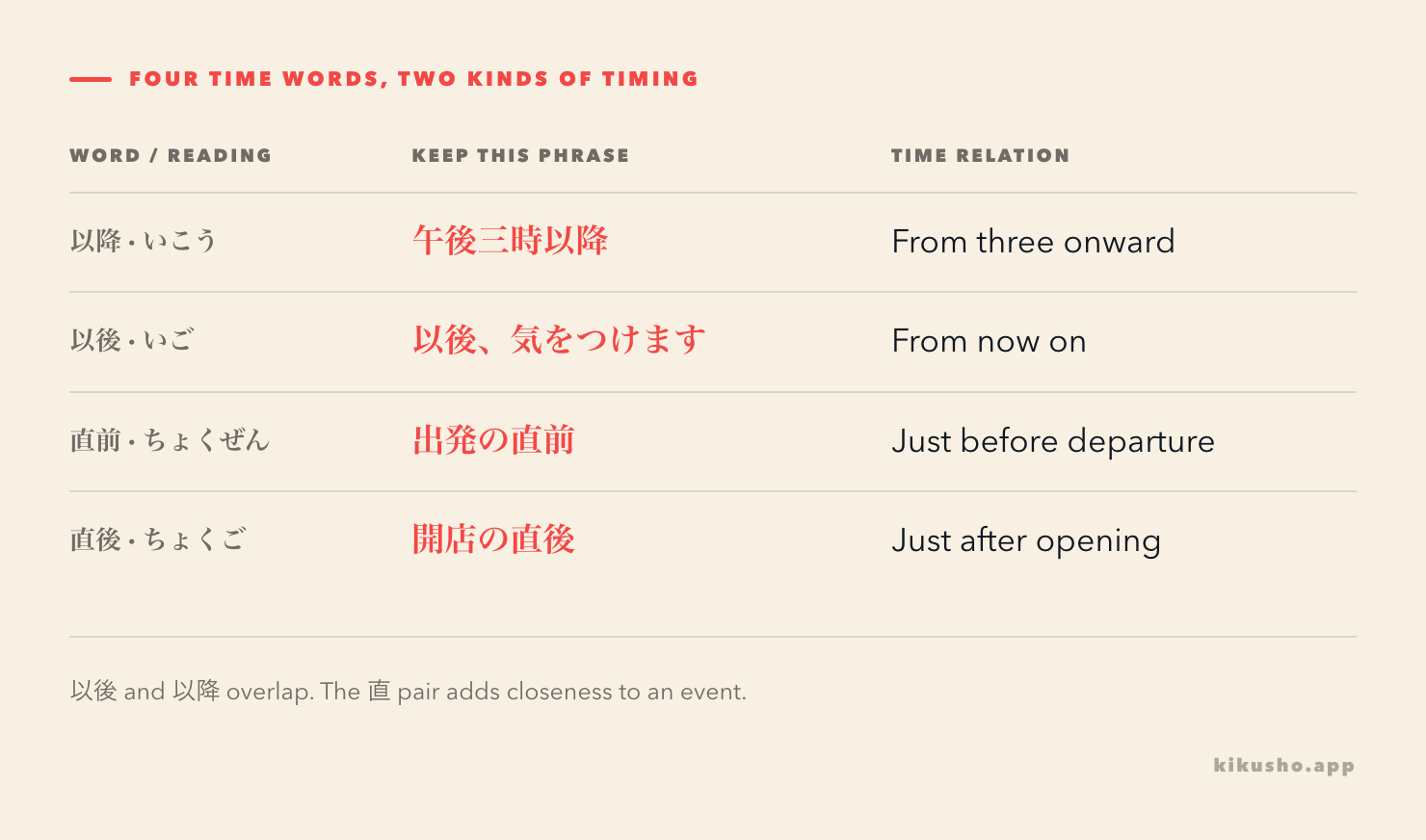
| Word | Reading | Part of speech here | Temporal meaning | Phrase to retain |
|---|---|---|---|---|
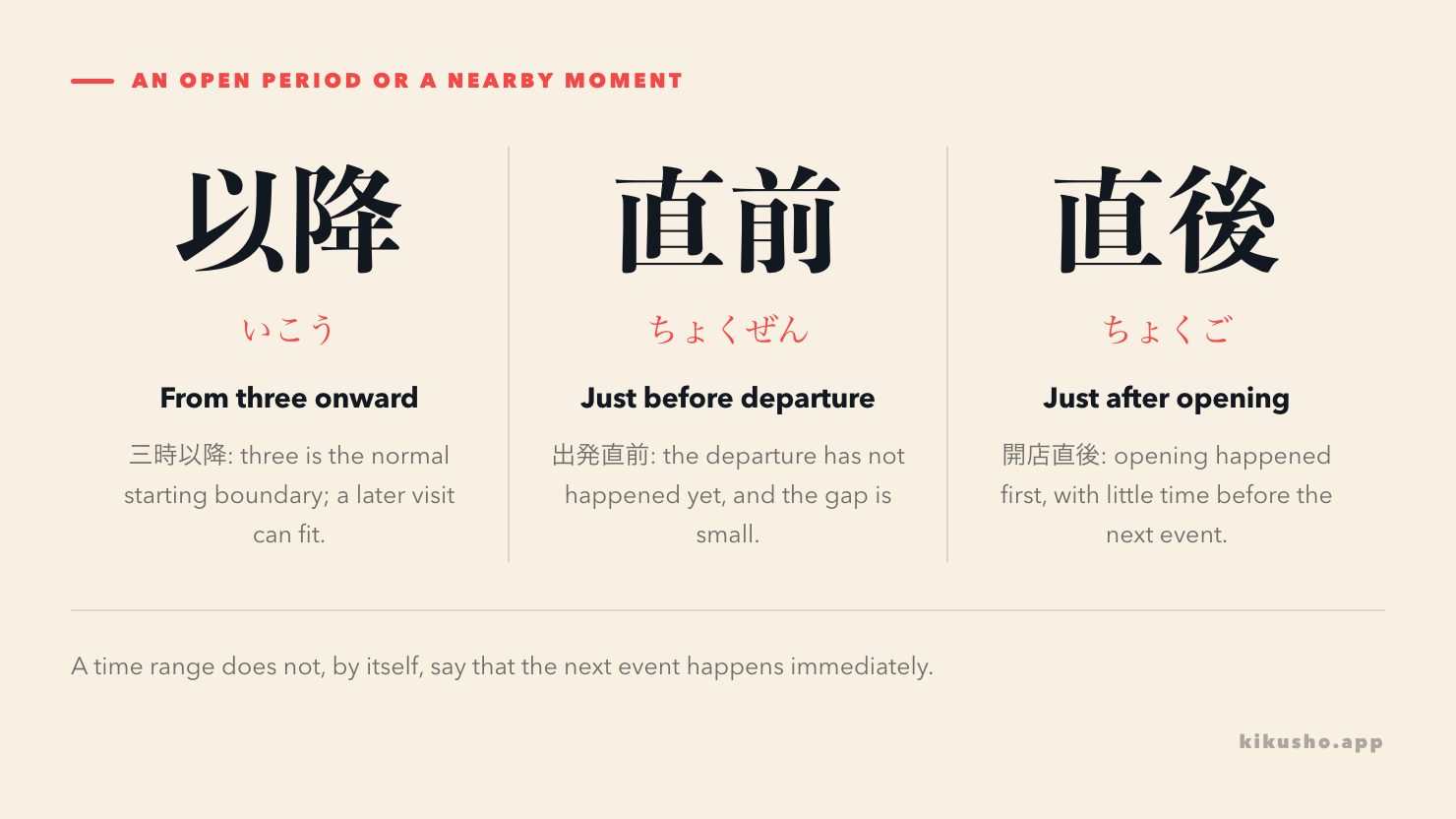
| 以降 | いこう | Noun, used to set a time range | From a specified point onward | 午後三時以降: from three onward |
| 以後 | いご | Noun, also used adverbially | From that time onward; from now on | 卒業以後: after graduation |
| 直前 | ちょくぜん | Noun | Immediately before | 出発の直前: just before departure |
| 直後 | ちょくご | Noun | Immediately after | 開店の直後: just after opening |
Read the complete compounds. 以 is い in this pair; 直 is ちょく, and 前 is ぜん in 直前. The table teaches these readings with these words, rather than a rule that the same characters always keep one pronunciation.
以降 opens a period from a named point
以降(いこう)takes a reference point such as a clock time, month or event and looks onward from it.
午後三時以降なら、電話に出られます。
ごご さんじ いこうなら、でんわに でられます。
I can answer the phone from three in the afternoon onward.
The speaker offers a period of availability. A call at four is compatible with this message; the expression does not demand a call exactly at three. The normal boundary includes three itself. Kanjipedia's 以降 entry, drawn from the Kanken dictionary, explicitly includes the reference point in its definition.
English “after three” can tempt you to exclude three automatically. Retain the Japanese phrase with the actual opening time instead. A second useful combination is 四月以降の予定(しがつ いこうの よてい), “plans for April onward.” Here の connects the time phrase to the noun 予定.
The reference point need not be in the future. Shogakukan's 以降 entry gives both an era and a month as starting points. A historical passage can look onward from an earlier period, while a message can look ahead from a coming date.
以後 overlaps with 以降 and can mean from now on
以後(いご)also describes what follows a reference point. Do not turn the two words into a rigid test of whether the starting date counts.
卒業以後は、別々の町で暮らしています。
そつぎょう いごは、べつべつの まちで くらしています。
Since graduation, we have been living in different towns.
The sentence gives graduation as the point from which the situation is described. It does not say that moving took place within seconds of the ceremony. 卒業以後の生活(そつぎょう いごの せいかつ)is a noun phrase meaning “life after graduation.”
A separate everyday use does not name a date:
説明を聞いていませんでした。以後、気をつけます。
せつめいを きいて いませんでした。いご、きを つけます。
I wasn't listening to the explanation. I'll be more careful from now on.
Here the conversation supplies “now.” The speaker makes a forward-looking commitment; they are not reporting an action completed immediately afterward.
Shogakukan's comparison under 以後 allows both 以後 and 以降 with past or future reference points, normally including the starting point. It notes that 以降 often emphasises the period extending from that point. The same page also records contexts where 以後 does not include the point. This is why an absolute “以降 includes, 以後 excludes” rule fails.
For learning, keep two reliable examples: a named time + 以降, and the commitment 以後、気をつけます. These are useful anchors, not a claim that only one word can ever fit a particular sentence.
直前 and 直後 keep an event nearby
直前(ちょくぜん)places something immediately before the reference event.
出発の直前に、友達から電話がありました。
しゅっぱつの ちょくぜんに、ともだちから でんわが ありました。
A friend called just before departure.
The call happened before leaving, with little time between the two events. に marks when it happened. 出発の直前 is the time phrase; 出発直前 is also an established compact combination. The shorter form is worth recognising in a heading or a notice.
直後(ちょくご)puts something immediately after its reference event.
開店の直後に、最初のお客さんが来ました。
かいてんの ちょくごに、さいしょの おきゃくさんが きました。
The first customer arrived just after the shop opened.
Opening happened first, and the customer's arrival followed soon afterward. Contrast 開店以降, which gives a period from opening onward without itself requiring the arrival to be close to opening.
Shogakukan's 直前 definition and its 直後 definition both express this temporal closeness. They also record spatial senses: right in front and immediately behind. In the two examples here, 出発 and 開店 identify events, so the time interpretation is clear.
“Immediately” does not supply a fixed number of seconds. The relevant scale depends on the event. A last-minute change to a departure and an event just after a major historical transition need different clocks. Ask which event provides the reference and how the passage presents the gap.
Compare a window with a nearby moment
The distinction that matters most is range versus proximity. From three onward may include an appointment at six. Just after three presents a time close to three. Both are later than a reference point, but only one tells you that the gap is small.
Before choosing a word, recover the reference point. If a message says 以後, the current conversation may supply it. If a story says 直前, look for the event about to happen. Reading the time expression with its surrounding sentence prevents “after” from flattening several distinct meanings.
The earlier set of eight everyday time words handles other questions: an unspecified wait, the recent past, or an approaching appropriate time. This set adds a boundary or closeness to a particular event. You can preserve that distinction by saving vocabulary with its sentence.
When adding a phrase by text in Kikusho, keep the reference event in the editable example field. Reviewing 出発の直前に電話があった retains the sequence that a bare English “before” loses. Try the six questions together before opening the explanations below them.
Practice questions
Question 1
A shop diary contains 開店の直後. Select the reading of 直後.
- A. じきご
- B. ちょくこう
- C. ちょくご
- D. ちょっご
Question 2
Write いこう in the phrase 午後三時いこう, meaning from three onward.
- A. 以降
- B. 以後
- C. 意向
- D. 移行
Question 3
A note refers to the moment immediately before departure. Which character completes the compound 出発直( )?
- A. 以
- B. 降
- C. 後
- D. 前
Question 4
The shop opened at ten. Its first customer came in a minute later. Choose the expression that explicitly presents that short gap.
開店( )に、最初のお客さんが来ました。
- A. 以後
- B. 直後
- C. 直前
- D. 以降
Question 5
After missing an instruction, someone says 以後、気をつけます. Which paraphrase best preserves the commitment?
- A. I had been paying attention until now.
- B. I will be careful immediately after the next instruction.
- C. I will be more careful from now on.
- D. I became careful just after that explanation.
Question 6
An office accepts visitors from three onward, including at six. Which instruction preserves that broad afternoon window?
- A. 午後三時以降に来てください。
- B. 午後三時の直前に来てください。
- C. 午後三時の直後に来てください。
- D. 午後三時までに来てください。
Answers and explanations
Check whether the instruction gives a starting boundary or asks for closeness to an event.
Answer 1: C — ちょくご. The compound uses ちょく for 直 and ご for 後. B changes the final reading, while A and D do not give this word's reading. 開店の直後 places the diary event just after opening.
Answer 2: A — 以降. 意向 and 移行 are also read いこう, but mean an intention and a transition respectively. B is 以後(いご), a related time word with a different reading. This question fixes both the pronunciation and the meaning; it does not pretend that 以後 is impossible in every time-range sentence.
Answer 3: D — 前. Adding 前 gives 直前(ちょくぜん), immediately before. 後 would form 直後 and reverse the sequence. 以 and 降 do not complete the requested word. Recognise the established compound rather than freely joining characters that have appeared elsewhere in the lesson.
Answer 4: B — 直後. The customer follows the opening almost immediately. A and D point onward from the opening but do not themselves express the small gap; they are insufficient for the requested emphasis. C would put the customer's arrival before opening. The question tests closeness, not whether a broad later period could also contain the arrival.
Answer 5: C. The speaker intends to change their behaviour going forward. A and D report a past state or change rather than that promise. B adds a future instruction and an immediately following moment, neither of which the original supplies. In this use of 以後, the speaker's present situation provides the starting point.
Answer 6: A. 午後三時以降 permits a visit from three onward, so a six-o'clock visit is compatible with the stated window. B asks for arrival just before three, C just after it, and D by three. None preserves the whole later period. If an actual notice also states a closing time, retain that limit too; 以降 by itself supplies no endpoint.
Common questions
What is the difference between 以降 and 以後?
Both can describe the time from a stated point onward. 以降 often draws attention to the period extending from that point, while 以後 also has a standalone use meaning from now on. Their meanings overlap; do not memorise them as an absolute included-date versus excluded-date pair.
Does 午後三時以降 include three o'clock?
The normal reading is from three o'clock onward, including that starting time. It does not require an event to happen exactly at three. Context can affect a time boundary, so read the whole notice rather than treating an English translation of after as the complete instruction.
Do 直前 and 直後 only describe time?
No. Their common temporal meanings are immediately before and immediately after an event. They also have spatial meanings: directly in front of something and immediately behind it. This lesson practises the temporal uses, where the surrounding event supplies the reference point.
Are these words only used in JLPT N2 texts?
No. N2 is their study placement in this curriculum's reference inventory, not a restriction on where they occur. These time expressions also appear in ordinary messages and notices. The retained level observations share one Waller/Tanos-derived source family, not two independent level checks.