On this page
A katakana word resists guessing because it is not a spelling of the foreign word. It is a Japanese word that was rebuilt to fit Japanese sound before it ever reached the page, and often clipped, borrowed from a language other than English, or quietly moved in meaning along the way. Sounding it out works perfectly. It gives you the Japanese word, which is not always the English one, and is sometimes not English at all.
This is why the katakana chapter feels like a bait and switch. Forty-six characters, and you can pronounce anything on any sign in the country. Then you stand in a hotel room looking at コンセント and it means nothing.
Japanese rebuilt the word before you ever saw it
Japanese counts in moras, not syllables, and nearly every mora is one consonant followed by one vowel. There are no consonant clusters, and no word can end in a consonant except ん. That is not a fact about katakana; it is the shape of the language, and a foreign word has to be made to fit it before it can be pronounced at all.
So strike — one syllable in English, three consonants stacked at the front, a silent letter at the back — comes out as ス・ト・ラ・イ・ク. Five moras. Every consonant that had no vowel was given one, and the word grew to five times its original length before anyone wrote it down.
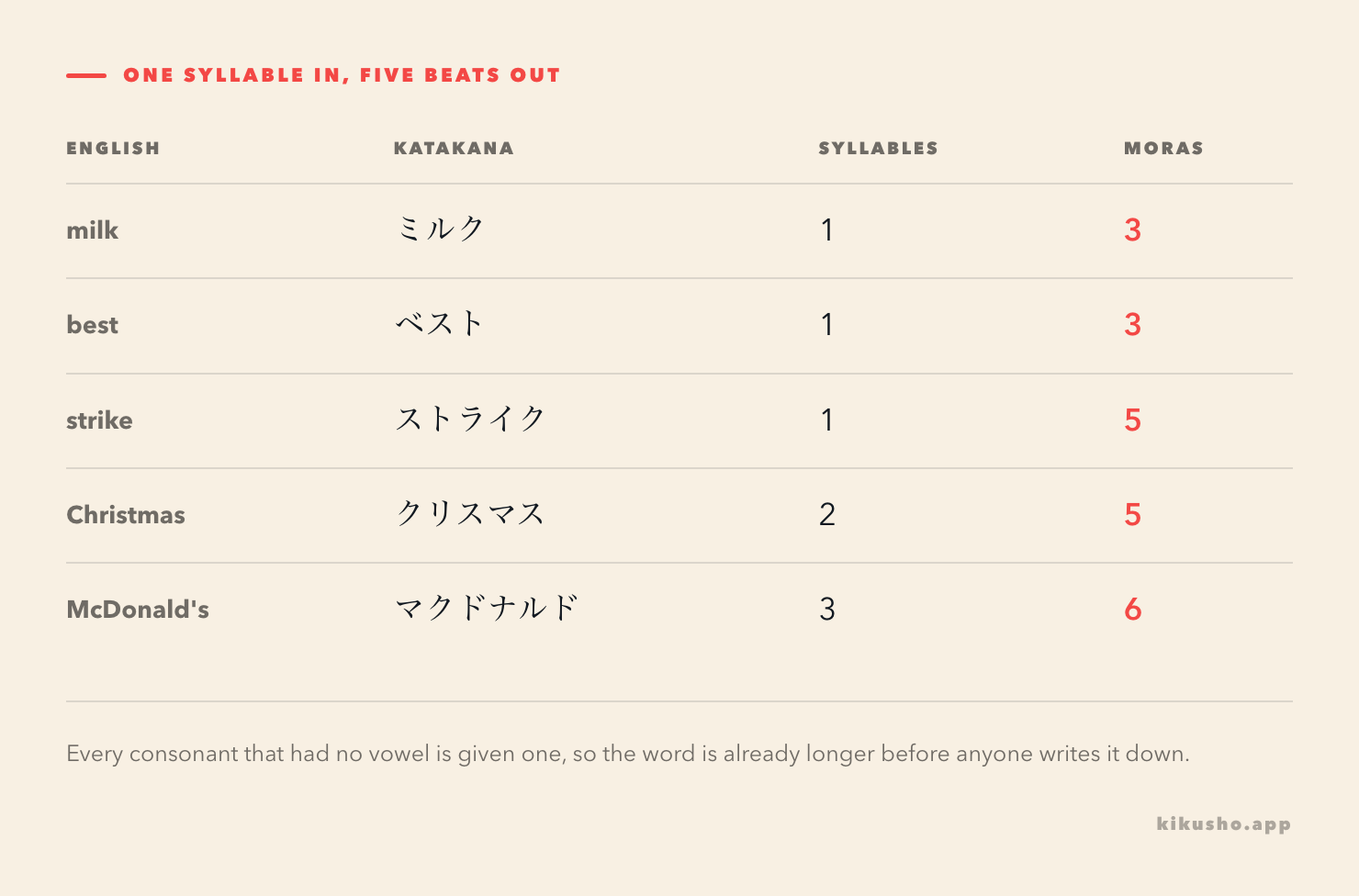
Read the last column against the one before it. There is no ratio between them you can hold in your head, and that gap is most of the difficulty. Meeting ストライク on a page, your eye processes five units; the word you are checking it against has one. Nothing lines up, so recognition can only happen after you have assembled the whole sound, never during.
The rebuild is regular, which is the good news. The inserted vowel is ウ by default: ミルク, ベスト, グラス. After t and d it is オ, because トゥ and ドゥ were not Japanese sounds — cat is キャット, bed is ベッド, hand is ハンド. After ch and j it is イ: match is マッチ, badge is バッジ. English l and r both land in ら行, which is why light and right are the same word written down. Four substitutions, and a good share of first-time borrowings become predictable, which matters mainly because it makes the unpredictable ones stand out as something else.
The word may not have come from English
The other reason decoding fails is that you are checking against the wrong language. Portuguese and Dutch reached Japanese centuries before English did, and German and French were borrowed heavily in the Meiji period, each in its own territory: German for medicine and philosophy, French for food, fashion and the arts. None of those words were replaced when English became the dominant source. They are still the ordinary, only way to say the thing.
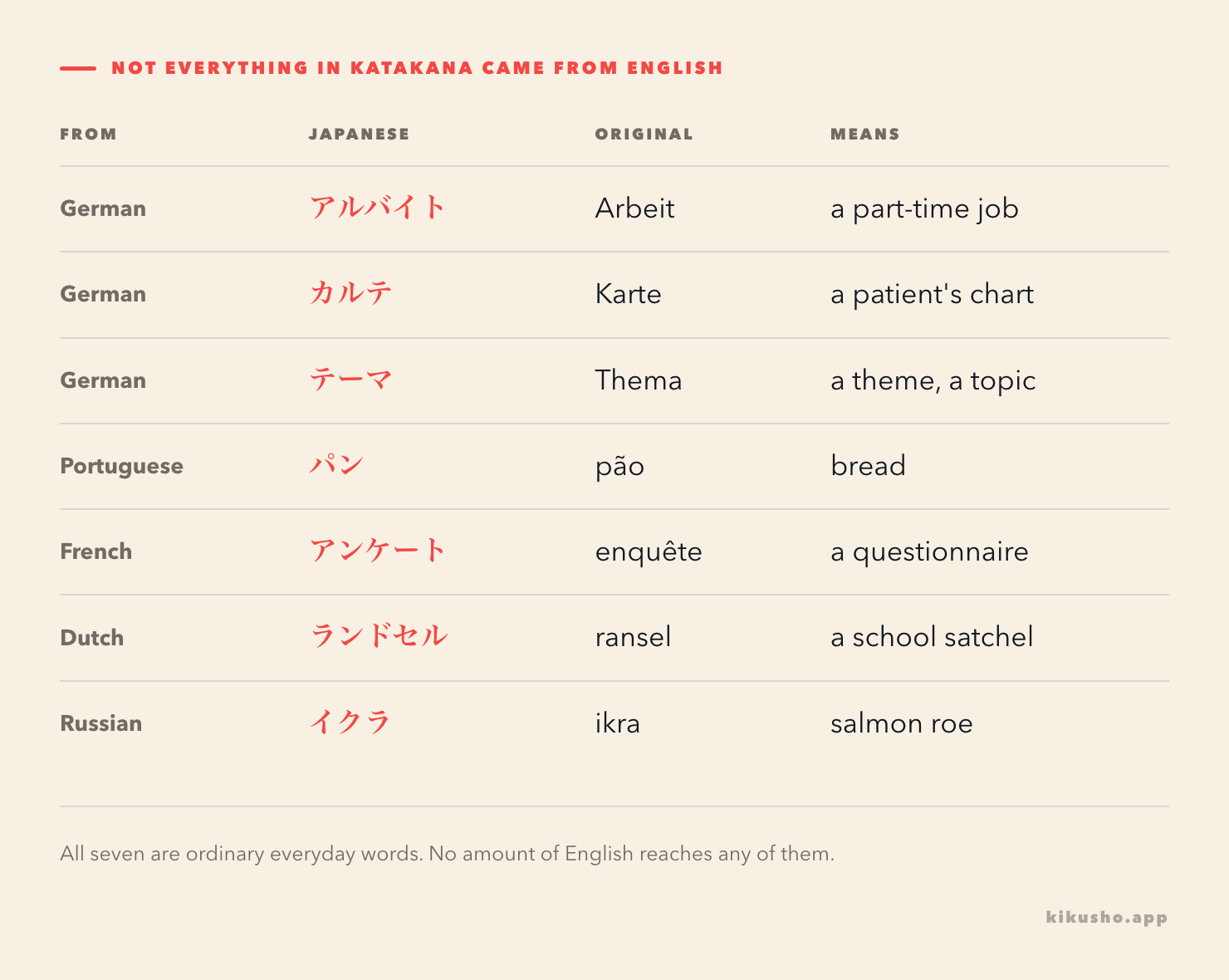
None of these are museum pieces. アルバイト is the word for a part-time job and its clipped form バイト is even commoner. パン is bread, on every bakery in the country. カルテ is what the doctor is writing on while you talk. There is no amount of English that gets you to any of them, and no amount of trying harder either.
Which turns the failure into a diagnostic. A katakana word that will not resolve is usually telling you something specific: it is old, or it came from somewhere else, or it has been cut short.
Long words get cut, and not where you would cut them
Japanese trims borrowings hard, toward a comfortable length of about four moras. Television became テレビ. Building became ビル. Animation became アニメ. Apartment became アパート and department store became デパート, so two words with almost nothing in common in English ended up near-twins in Japanese, separated by a single character.
Compounds usually keep the head of each element and drop the rest. Personal computer gave パソコン, remote control リモコン, air conditioner エアコン — two moras from each half, joined. Others simply stop early: コンビニ is the front of convenience with store dropped entirely, and スマホ keeps スマ from smart and a single ホ from phone.
Once you have seen the pattern the results stop feeling arbitrary. It still does not help the first time, because the syllables Japanese keeps are chosen by mora count, not by which part of the English word carried the stress. Remote control stresses the second and fifth syllables; リモコン keeps neither.
Some of them mean something the English word doesn't
This is the class that catches people who have already solved the first three problems. The decoding works, a word arrives, you are confident, and it is the wrong word — because the borrowing took the sound and then went its own way.
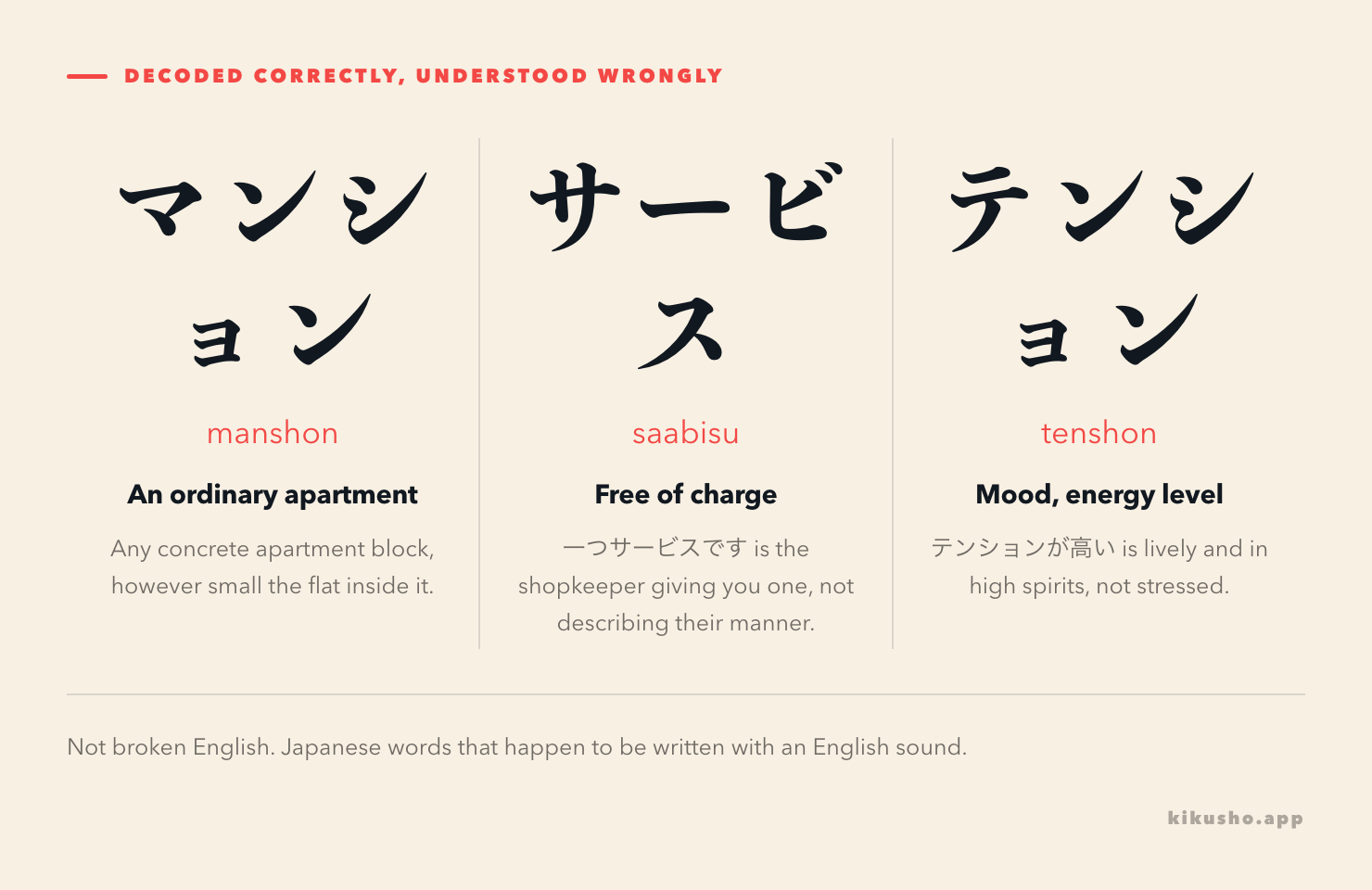
サービス is the one that costs money to misread: 一つサービスです is the shopkeeper telling you one of them is free, not describing their customer care. テンションが高い means someone is lively and in high spirits, not that they are stressed. マンション is any concrete apartment building, and a single room in one is still a マンション.
The family is large. クレーム is a complaint. スマート means slim. ハンドル is a steering wheel, カンニング is cheating in an exam, バイキング is a buffet, コンセント is the socket in the wall. And a whole layer of words was assembled in Japanese out of English parts, by Japanese speakers, for things English never named: サラリーマン, ノートパソコン, ペーパードライバー — someone who holds a licence and never drives.
Calling this broken English gets the relationship backwards. サービス is a Japanese word that happens to be written with the sound of an English one, and its meaning is settled by Japanese usage, the way every word's is. What makes it dangerous is precisely that the decoding succeeds: you get a confident answer, and nothing in the experience tells you to check.
Not every katakana word is a foreign word
Katakana also does jobs that have nothing to do with borrowing, so a word can defeat you because there is no English underneath it to find.
Onomatopoeia and mimetics live there almost by default: ドキドキ for a heart going fast, キラキラ for sparkling, ペコペコ for an empty stomach, ゴロゴロ for thunder or for lying around doing nothing. These are native Japanese, extremely common, and there is no source word in any language. Plant and animal names turn up in katakana too — イヌ, ネコ, サクラ, バラ — in field guides, on packaging, and in casual writing, even though each has perfectly good kanji. And any word at all can be set in katakana for emphasis, roughly the way English reaches for italics.
There is a good trick hidden in the opposite direction. A few loanwords were turned into Japanese verbs by adding る, and they then conjugate natively: サボる is to skip class or slack off, from sabotage, and it gives サボった and サボらない. ググる is to google something. The borrowing is real, but the word has been naturalised so thoroughly that it inflects.
The katakana form is the version that will be understood
The mora count is not a curiosity about writing. It is the word. Say McDonald's with English timing to someone who knows マクドナルド and the six even beats they are listening for are not there; there is a genuine chance you will not be understood. The same is true of your own name, your home town, and every English word you are tempted to drop into a Japanese sentence when the Japanese one will not come.
So the katakana form is worth learning as pronunciation, not as spelling. It is the version that works, and it carries its own pitch pattern with no relation to where the English stress fell — one more thing that is cheaper to store the first time you meet a word than to correct afterwards.
It cuts the other way in listening, and more painfully. A loanword arriving in speech is longer and flatter than the English word you know, and the stress you were waiting for never comes. Words you would have read without hesitating go past unrecognised, which is a strange and specific frustration, and worth knowing is normal.
What to do when a katakana word defeats you
None of this makes the decoding useless. Sounding out katakana is still one of the fastest wins available to a beginner, and on a menu it is often the fastest thing on the page, because カレー and サラダ and ビール really do arrive the moment you say them. Keep doing it. What has to change is the next move when it fails.
The instinct is to try harder: run the syllables again, stretch them, hunt for an English word that might fit. That works only for the words that were going to work anyway. For the rest, the failure has already told you what you needed to know — this word has to be stored rather than derived. It is the same shape as the kanji problem, where what you can look up is the character and what you actually need is the word.
The awkward part is that this always happens away from a desk. コンセント is on a hotel wall, ズボン is on a shop sign, アンケート is on a piece of paper someone has just handed you. Looking it up, checking the reading, writing a card and filing it costs minutes you do not have, so you decide it was not important and walk on. The word you actually met, in the place you actually met it, is gone.
That is the part Kikusho is built to remove. Point the camera at the sign, say it, or paste the text, and a card comes back with the word, its reading, the romaji, the meaning, a note on register, and an example sentence with audio — on a review screen, where you check it before it is saved. A photo takes up to five highlights and returns five cards from the one capture, which is roughly what a shop window or a menu asks for. Reviews run on FSRS and work with no signal at all, which matters for a category of word you tend to meet underground or abroad.
Katakana is the one part of the writing system that promises to be easy, and as a script it keeps the promise. What it never promised is that the word underneath would be one you already know. The characters are the easy part; the words are still words, and they were Japanese before you got there.
Common questions
Why can't I understand katakana words even though I can read katakana?
Because reading katakana gives you the Japanese word, not the English one. A borrowed word is rebuilt to fit Japanese sound before it is written — vowels are inserted between consonants and added to the end, so one English syllable can become five moras — and it is often clipped as well, borrowed from a language other than English, or used with a meaning English does not have. The sounding-out step succeeds; the matching step is what fails.
Which languages did Japanese borrow katakana words from?
English is the largest source today, but Portuguese and Dutch arrived centuries earlier, and German and French were borrowed heavily in the Meiji period, each in its own domain — German for medicine and philosophy, French for food and the arts. Those older words were never replaced. パン (bread) is Portuguese, アルバイト (a part-time job) is German, and アンケート (a questionnaire) is French, and all three are ordinary everyday vocabulary.
Is every katakana word a foreign word?
No. Katakana also writes native onomatopoeia and mimetics such as ドキドキ and ペコペコ, plant and animal names such as サクラ and イヌ, and any word an author wants to emphasise, roughly the way English uses italics. So a katakana word that defeats you may have no foreign source to find at all.
What does it mean when a katakana word matches no English word I know?
Usually one of four things: it came from another language, it has been clipped (リモコン from remote control), it was assembled in Japanese out of English parts (サラリーマン, ペーパードライバー), or it has drifted in meaning (マンション is an ordinary apartment, サービス means free of charge). In all four cases the word has to be learned rather than derived.