On this page
手続き contains 手, but a procedure is not a kind of hand. These seven Japanese body part compounds keep 足、手、目 in their spelling while naming footprints, locations, care, formal processes and ways to recognise or judge something.
The set is 足跡、足元、手入れ、手続き、手前、目印、目安. All seven have N2 placements in our September 2026 planning snapshot, which adapts Jonathan Waller's Tanos materials. Those adaptations are one source family, and the placements are study estimates rather than an official exhaustive JLPT vocabulary list. This page teaches the assigned compound words; it does not claim to cover every idiom involving the body.
Seven compounds, with their readings and partners
The body character can give you a memory cue after you have checked the word. It cannot choose the complete meaning or part of speech for you. 手入れ and 手続き both contain 手 and kana, but one concerns upkeep and the other a procedure.
| Word and reading | Part of speech in the taught use | Meaning | Phrase to keep | Source |
|---|---|---|---|---|
| 足跡(あしあと) | Noun | Footprints or tracks; also a trace of someone's activity | 足跡が残る: footprints remain | Daijisen |
| 足元(あしもと) | Noun | The area at one's feet; also one's footing or immediate situation | 足元に注意する: watch your step | Daijisen |
| 手入れ(ていれ) | Noun; suru verb | Care or maintenance to keep something in good condition | 庭の手入れをする: tend the garden | Daijisen |
| 手続き(てつづき) | Noun; can form a suru verb | A required procedure or formal process | 入学の手続きをする: complete enrolment formalities | Daijisen |
| 手前(てまえ) | Noun for location or social position; separate pronoun senses | This side, before reaching something; also one's position before others | 橋の手前: on the near side of the bridge | Daijisen |
| 目印(めじるし) | Noun | A visible identifying mark or landmark | 目印をつける: add an identifying mark | Daijisen |
| 目安(めやす) | Noun in the approximate-standard sense | A rough standard, target or estimate | 15分を目安にする: use fifteen minutes as a guide | Daijisen |
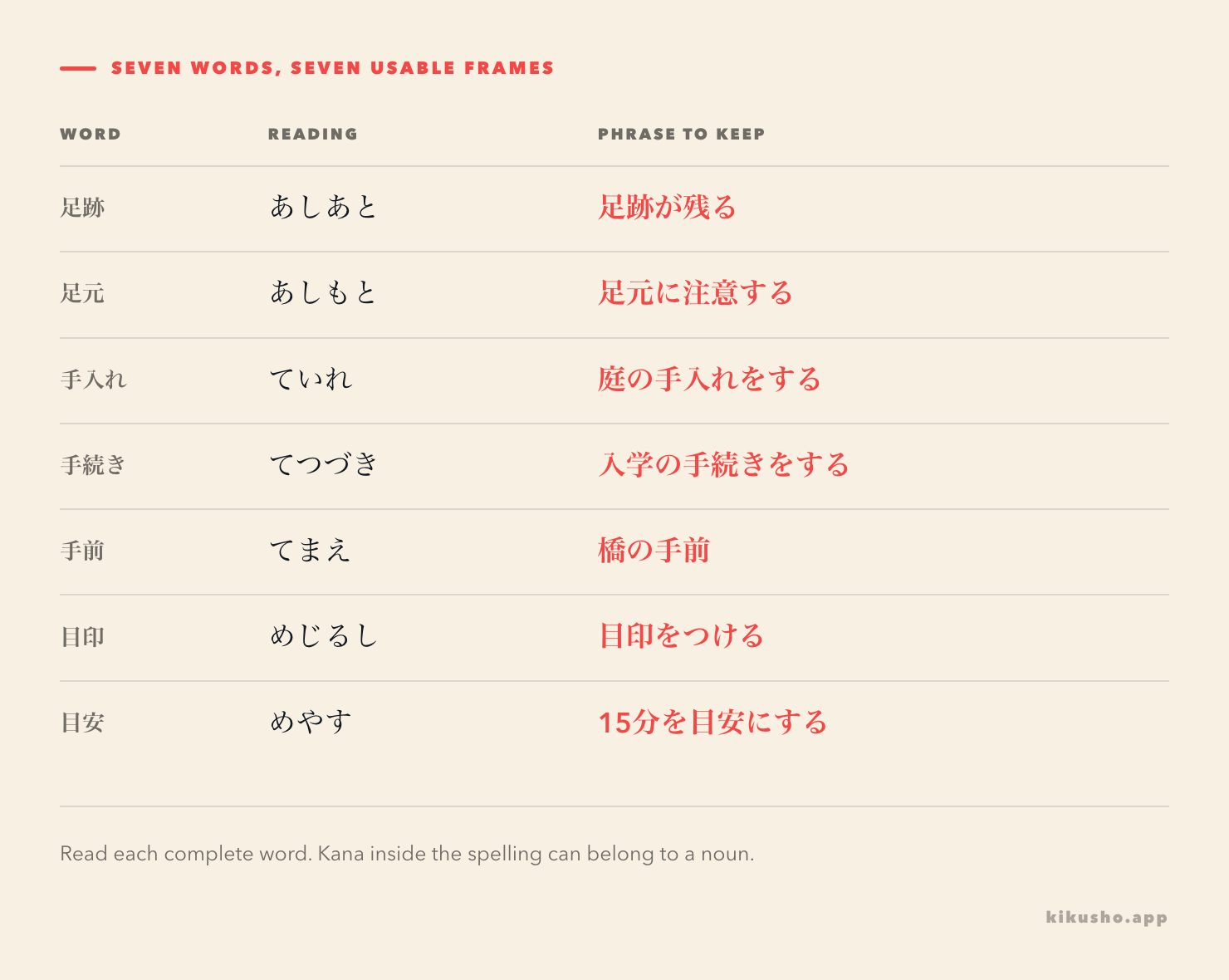
These spellings also resist a visual shortcut. 足元、手前、目安 use native readings here despite being written with two kanji. In 手続き, the kana is part of the noun's spelling; it does not make the word an inflecting verb. The guide to Japanese word boundaries explains why recognising a whole word matters even when its script changes.
足跡 records a trace; 足元 locates the feet
足跡 is the footprint left behind, while 足元 can identify the ground or space around the feet. One names a trace of movement; the other can name where someone is standing now.
砂の上に、子どもの足跡が残っていました。
すなの うえに、こどもの あしあとが のこっていました。
The child's footprints remained in the sand.
The noun is 足跡; 残っていました tells you the marks were still there. You can follow tracks with 足跡を追う(あしあとを おう). The word also has a figurative use for the traces or achievements of someone's activity. Dictionaries additionally list そくせき for the spelling 足跡, particularly in accounts of achievements. That other reading does not replace あしあと as the target of this set.
暗いので、足元に注意して歩きました。
くらいので、あしもとに ちゅういして あるきました。
Because it was dark, I walked while watching my step.
Here, 足元 directs attention to the area around the feet. It can also describe footing or how someone walks, as in 足元がふらつく(あしもとが ふらつく), having an unsteady gait. Further dictionary senses concern one's immediate situation, vulnerability or the recent state of affairs; a business paragraph need not be describing physical feet. The warning sentence above uses the concrete location sense.
Do not exchange the nouns just because both begin with 足. The marks in the sand are 足跡. The place to pay attention to while walking is 足元.
手入れ maintains; 手続き gets a process done
手入れ concerns keeping something in good condition through care, adjustment or repair. It fits a garden, equipment or another thing that needs tending.
毎週、庭の手入れをしています。
まいしゅう、にわの ていれを しています。
I tend the garden every week.
Learn Xの手入れをする as a noun frame. 手入れ can also be a suru verb: 道具を手入れする(どうぐを ていれする), to maintain the tools. The noun does not behave like a na-adjective meaning “well maintained.” To describe the garden that has received care, use 手入れされた庭(ていれされた にわ), a tended garden.
Daijisen also records a police-raiding sense for 手入れ. A crime report can therefore use the same word for a different activity. That sense is separate from the maintenance frames practiced here; the spelling alone does not guarantee a gardening meaning.
手続き instead concerns the steps or formalities needed to do something. The process may involve documents, but the word does not simply mean a document.
入学の手続きは、もう終わりました。
にゅうがくの てつづきは、もう おわりました。
The enrolment formalities are already finished.
The written kana is てつづき, with づ. Dictionaries list the noun as 手続(き), so you may also see 手続 without the final kana. For an everyday frame, 手続きをする carries out the procedure; 手続きが終わる says it is finished. The word can also form 手続きする, though keeping the noun-plus-をする phrase gives you a useful starting point.
A shared verb does not erase the difference. 庭の手入れをする cares for the garden. 入学の手続きをする carries out a formal process. Neither one's presence in a sentence tells you how long the activity takes.
手前 needs a reference point
For location, 手前 means the side nearer to you, or the point before reaching the named destination. The reference point matters: 橋の手前 is before the bridge from the relevant viewpoint or direction of travel.
橋の手前に、小さな店があります。
はしの てまえに、ちいさな みせが あります。
There is a small shop on this side of the bridge.
Hand position is not the subject. 橋の手前 supplies the location, and に places the shop there. If the viewpoint changes, the near side can change too.
The independently authored Kanji Pedia entry for 手前 also distinguishes spatial position from one's standing before other people. In 人の手前, concern about how one appears to that person can be involved. Separate dictionary pronoun senses refer to oneself or address another person. The second-person use can be rough, especially in the reading てめえ. An inherited gloss such as “we, you” is not a safe translation for 手前 in a directions sentence.
Tea-ceremony procedure is another dictionary sense, also written 点前. This set practises the spatial use and recognises the other interpretations; it is not a guide to tea procedure or rough forms of address.
目印 identifies; 目安 gives you a rough standard
Both words can help you find your way through a task, but their taught roles differ. 目印 is a mark you can recognise or an object you use as a landmark. 目安 gives you an approximate standard for making a judgement.
かばんに赤いリボンをつけて、目印にしました。
かばんに あかい リボンを つけて、めじるしに しました。
I attached a red ribbon to the bag to identify it.
The ribbon is the 目印. 目印にする uses something as an identifying mark; 目印をつける adds a mark. A visible building can likewise serve as a landmark, without anyone adding a ribbon to it.
駅までは、歩いて15分を目安にしてください。
えきまでは、あるいて じゅうごふんを めやすに してください。
Use about fifteen minutes as a guide for the walk to the station.
15分を目安にする makes the time an approximate guide. It does not guarantee that every walker arrives in exactly fifteen minutes. Other uses can provide a rough cost or a target value, so 目安 is broader than a time estimate. This is its modern approximate-standard sense, not the historical document and abacus senses that dictionaries also list.
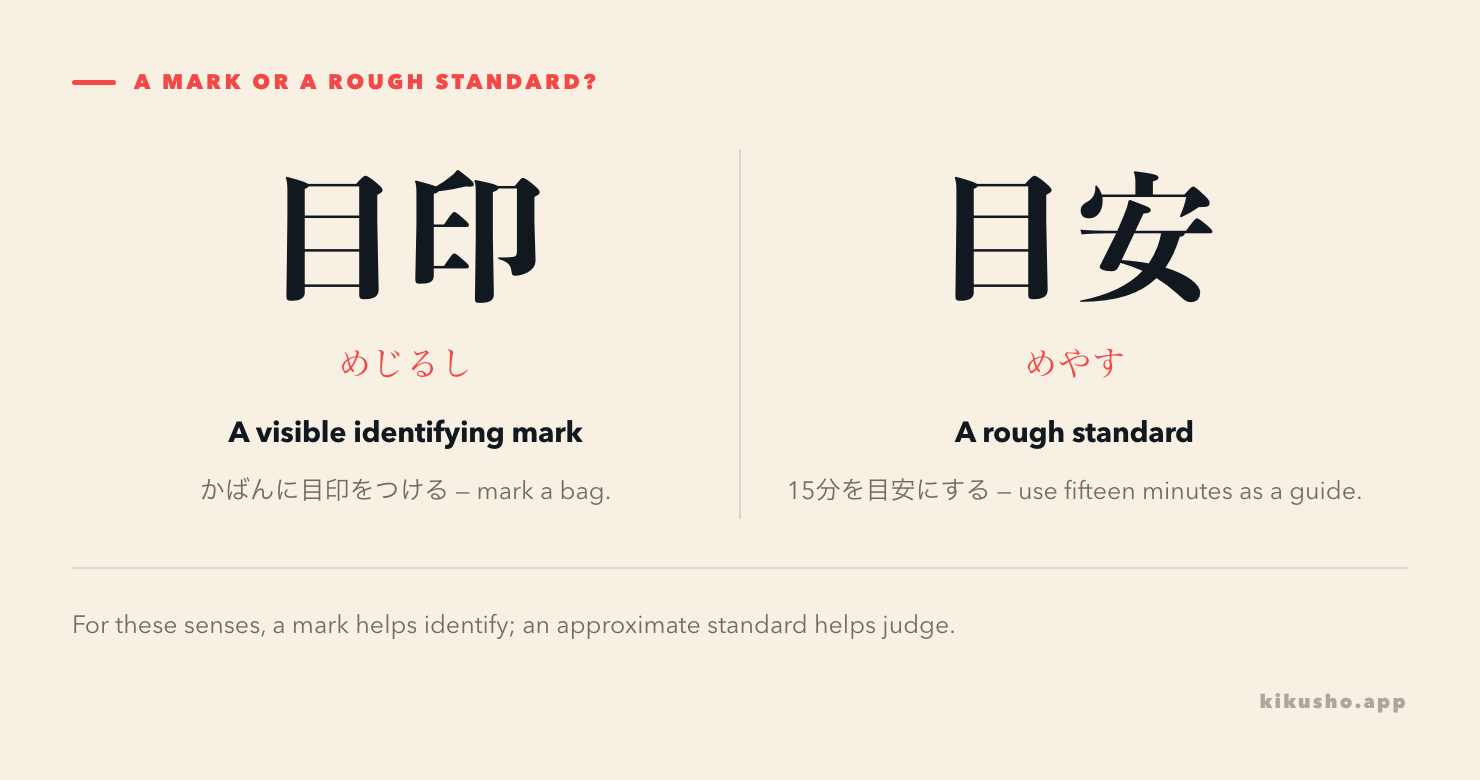
A directions paragraph can contain both. The building is a 目印 for recognising the place. The walking time is a 目安 for planning how long to allow.
Save the meaning that the sentence actually chose
For a vocabulary card, 橋の手前 is more useful than a row of unrelated English translations for 手前. Keep its reference point and the near-side reading together. For 手入れ, the cared-for object tells you why the sentence means upkeep rather than a raid.
In Kikusho, text capture can start that card, and the generated meaning and example are editable. Check whether the example still contains your bridge, garden or identifying mark. A generic example using another dictionary sense would give you a different task at review time.
The preceding N2 set on political and economic vocabulary applies the same check to words such as 予算 and 費用: knowing the domain still leaves the noun's particular job to learn.
Practice
Try the six tasks in order, recording a choice for each. The numbered solutions are collected after the last task.
Question 1
In a warning about the ground around your feet, how is 足元 read?
A. あしもと
B. そくげん
C. あしげん
D. そくもと
Question 2
A learner has completed enrolment formalities: 入学のてつづきが終わりました。 Choose the spelling of the procedure word.
A. 手統き
B. 手継き
C. 手突き
D. 手続き
Question 3
Complete the compound for a footprint left in sand: 足 + ( ) → あしあと.
A. 印
B. 元
C. 跡
D. 前
Question 4
Regular care keeps the garden in good condition. Select the activity in 毎週、庭の( )をしています。
A. 手前
B. 足跡
C. 手入れ
D. 目安
Question 5
目的地までは歩いて15分が目安です。 Which sentence keeps the approximate-time meaning?
A. 目的地まで必ず15分で着きます。
B. 15分前に目的地に着きました。
C. 目的地には15時に着きます。
D. 目的地まで、だいたい15分かかります。
Question 6
Choose a standard maintenance use of 手入れ.
| Option | Sentence |
|---|---|
| A | この道具は手入れくなりました。 |
| B | 毎週、道具の手入れをしています。 |
| C | 手入れな庭を見ました。 |
| D | これは手入れい道具です。 |
Answers and explanations
The compounds keep their particular readings and grammatical jobs when their familiar body characters reappear.
Answer 1: A, あしもと. 足元 names the area around the feet in this warning. The other sequences do not give the taught word's reading. Two adjacent kanji do not force an on-reading compound.
Answer 2: D, 手続き. The word is 手続き(てつづき). The other character choices do not spell this procedure headword. 手続 without き is also a dictionary spelling, but it was not one of the options. The sentence says the enrolment process is finished, not that someone has repaired an object.
Answer 3: C, 跡. 足跡(あしあと) names a footprint or track. 足 + 元 instead gives 足元, the feet's surroundings or footing. A mark can be a 目印, but 印 does not build the requested footprint word with 足 here. 前 is not the second character of 足跡.
Answer 4: C, 手入れ. 庭の手入れをする is tending or maintaining the garden. 手前 supplies a location or another separate dictionary sense, 足跡 a footprint/trace, and 目安 a rough standard. None names the requested upkeep activity in this sentence.
Answer 5: D. だいたい15分かかります says it takes about fifteen minutes, retaining the estimate expressed by 目安. A guarantees a fifteen-minute journey, B reports arrival fifteen minutes earlier, and C gives an arrival time of 15:00. Those claims differ from an approximate walking duration.
Answer 6: B. 道具の手入れをしています uses 手入れ as a noun followed by をする: “I maintain the tools every week.” The word can also be a suru verb, but it does not form the adjective endings 手入れく, 手入れな or 手入れい shown in A, C and D. A tended garden can instead be 手入れされた庭.
Common questions
Are these seven words all Japanese body part idioms?
No. They are compound words containing 足, 手 or 目. 足跡 can literally mean footprints; 手続き means a procedure. Some words have figurative or context-dependent senses, but this set is not a general list of multiword body part idioms.
What is the difference between 手入れ and 手続き?
手入れ(ていれ) is care or maintenance that keeps something in good condition, as in 庭の手入れをする. 手続き(てつづき) is a required procedure or formal process, as in 入学の手続きをする. They share 手 and can take をする, but name different activities.
How do 目印 and 目安 differ?
In the senses taught here, 目印(めじるし) is a visible identifying mark or landmark. 目安(めやす) is an approximate standard or guide for judging something. A ribbon on a bag can be a 目印; an estimated walking time can be a 目安. The time is a guide, not a guarantee.
Can 手前 mean you?
Dictionaries give 手前(てまえ) separate self-reference and second-person senses as well as its spatial senses. Second-person 手前, and especially the variant てめえ, can be rough address. In directions such as 橋の手前, use the near-side meaning rather than a pronoun. It is not a general polite replacement for you.