On this page
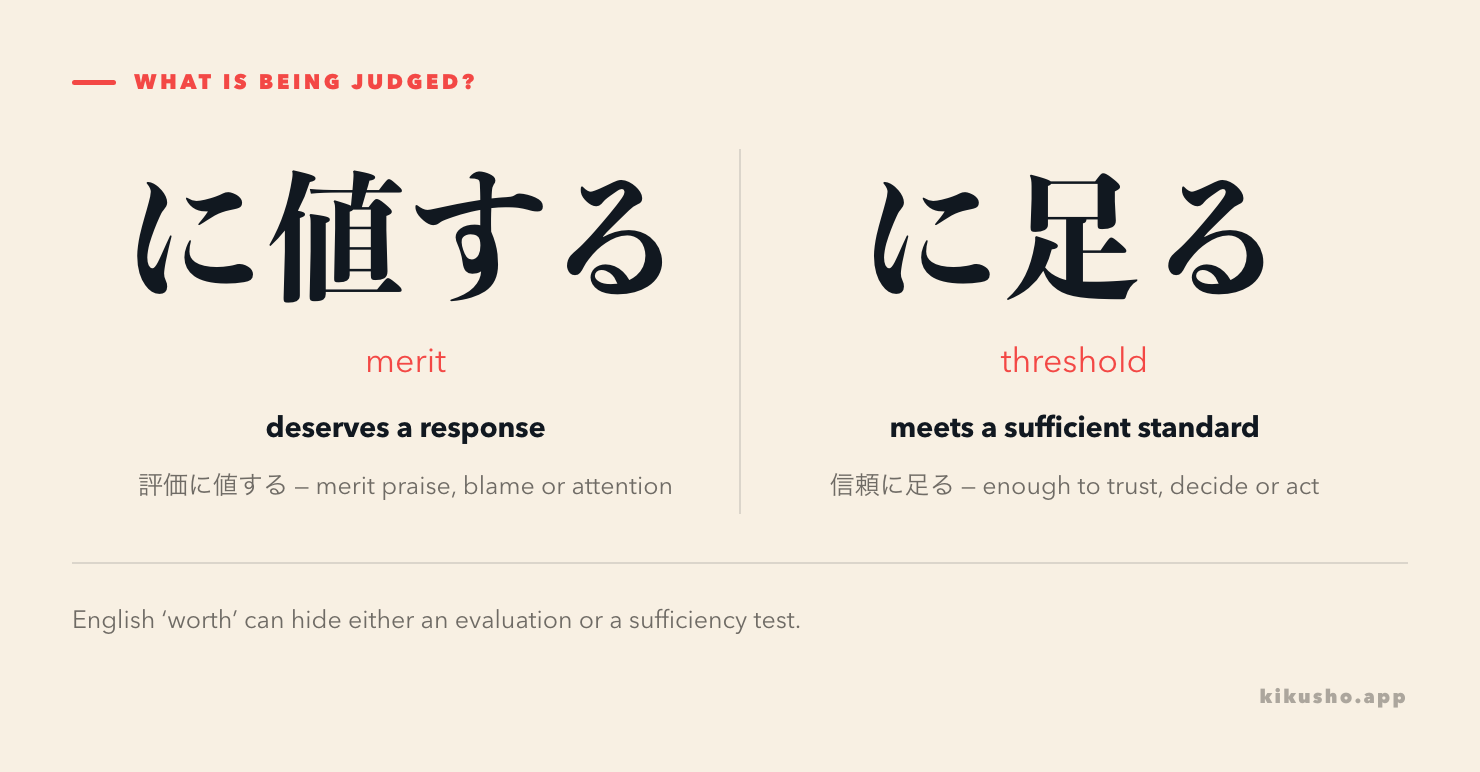
English worth hides two different tests. Use に値する when a person, act or proposal merits praise, punishment or consideration; use に足る when it meets a sufficient standard for trust, proof or action. に足りない/に足らない marks the failure to reach that standard, but it is not a mechanical replacement for every positive に足る phrase.
彼女の研究成果は高い評価に値する。
かのじょの けんきゅう せいかは たかい ひょうかに あたいする。
Her research results deserve high praise.
この証言は信頼に足る内容だ。
この しょうげんは しんらいに たる ないようだ。
This testimony has content sufficient to merit trust.
The first sentence gives the research an evaluation. The second asks whether the testimony clears a threshold. Both can sound like “worthy of” in English, so the deciding question is whether the writer is assigning merit or checking adequacy.
Ask whether the sentence awards merit or checks a threshold
| Form | Core judgment | Dependable shape | Typical setting |
|---|---|---|---|
| N/Vる + に値する | the subject merits N or V | 注目に値する; 検討するに値する | evaluation, praise, blame, reward |
| Vる/suru-noun + に足る + N | the following noun reaches the standard for V | 信頼に足る人物 | formal assessment of adequacy |
| Vる + に足りる | the subject is sufficient for V | 判断するに足りる | formal statement of sufficiency |
| Vる + に足りない/に足らない | the subject is insufficient or not worth V | 断定するに足りない | formal rejection of adequacy |
に値する points toward what should be accorded: attention, respect, criticism, a prize, investigation. に足る points toward a bar that must be cleared: enough credibility to trust, enough substance to discuss, enough grounds to decide.
に値する says that something merits a response
値する(あたいする) means “to be worth” or “to deserve.” A noun or a dictionary-form verb comes before に値する.
この提案は真剣に検討するに値する。
この ていあんは しんけんに けんとうするに あたいする。
This proposal deserves serious consideration.
長年の功績は表彰に値する。
ながねんの こうせきは ひょうしょうに あたいする。
Those many years of achievement merit recognition.
The subject can deserve something favourable or unfavourable. 批判に値する means “deserves criticism”; 処罰に値する means “deserves punishment.” The grammar itself does not praise the subject. It says that the named response is warranted.
The form can end the sentence or modify a noun:
| Position | Example | Reading of the structure |
|---|---|---|
| predicate | この発見は注目に値する | this discovery merits attention |
| before a noun | 注目に値する発見 | a discovery worthy of attention |
| direct negative | 検討に値しない案 | an idea not worth considering |
Use に値しない when you directly deny merit:
根拠のない噂は、真剣に取り上げるに値しない。
こんきょの ない うわさは、しんけんに とりあげるに あたいしない。
A baseless rumour is not worth taking seriously.
に足る sets a sufficient standard
足る(たる) is an older, formal verb meaning “to be sufficient.” In this pattern, it usually follows a dictionary-form verb or a noun that can combine with する, then modifies a person, reason, fact or thing.
彼は重要な仕事を任せるに足る人物だ。
かれは じゅうような しごとを まかせるに たる じんぶつだ。
He is a person sufficiently reliable to entrust with important work.
再調査を始めるに足る証拠が見つかった。
さいちょうさを はじめるに たる しょうこが みつかった。
Evidence sufficient to begin a new investigation was found.
With a suru-noun, する may appear or be omitted:
| Full verbal form | Compact noun form |
|---|---|
| 信頼するに足る人物 | 信頼に足る人物 |
| 尊敬するに足る指導者 | 尊敬に足る指導者 |
| 検討するに足る提案 | 検討に足る提案 |
The compact form does not accept any arbitrary noun. 信頼, 尊敬 and 検討 work because they can form the actions 信頼する, 尊敬する and 検討する. Ordinary concrete nouns do not become this pattern merely by adding に足る.
に足りる uses the modern verb 足りる with the same sufficiency idea:
この資料は状況を説明するに足りる。
この しりょうは じょうきょうを せつめいするに たりる。
These materials are sufficient to explain the situation.
In current teaching materials, に足る is the more recognisable fixed N1 form, especially before a noun. Both are formal; everyday speech normally chooses 十分だ, 信頼できる, 検討する価値がある or another direct expression.
The overlap is real, but the viewpoint changes
With evaluation nouns, either form may be possible:
彼女は尊敬に値する研究者だ。
She is a researcher who deserves respect.
彼女は尊敬に足る研究者だ。
She is a researcher who meets the standard for respect.
The practical result is nearly the same. に値する delivers the evaluative verdict more directly. に足る sounds as if the speaker has measured the person against a standard. That difference becomes clearer when the noun after に足る names evidence, qualifications or grounds.
この記録は、制度を見直すに足る資料だ。
These records are sufficient material for reviewing the system.
Here に足る naturally measures evidential adequacy. 見直すに値する資料 would instead describe the material itself as worth reviewing, changing what action is evaluated.
English word order can hide this contrast. Ask what receives the judgment. In 検討に値する提案, the proposal deserves consideration. In 採用を決めるに足る実績, the achievements are sufficient grounds for deciding to hire.
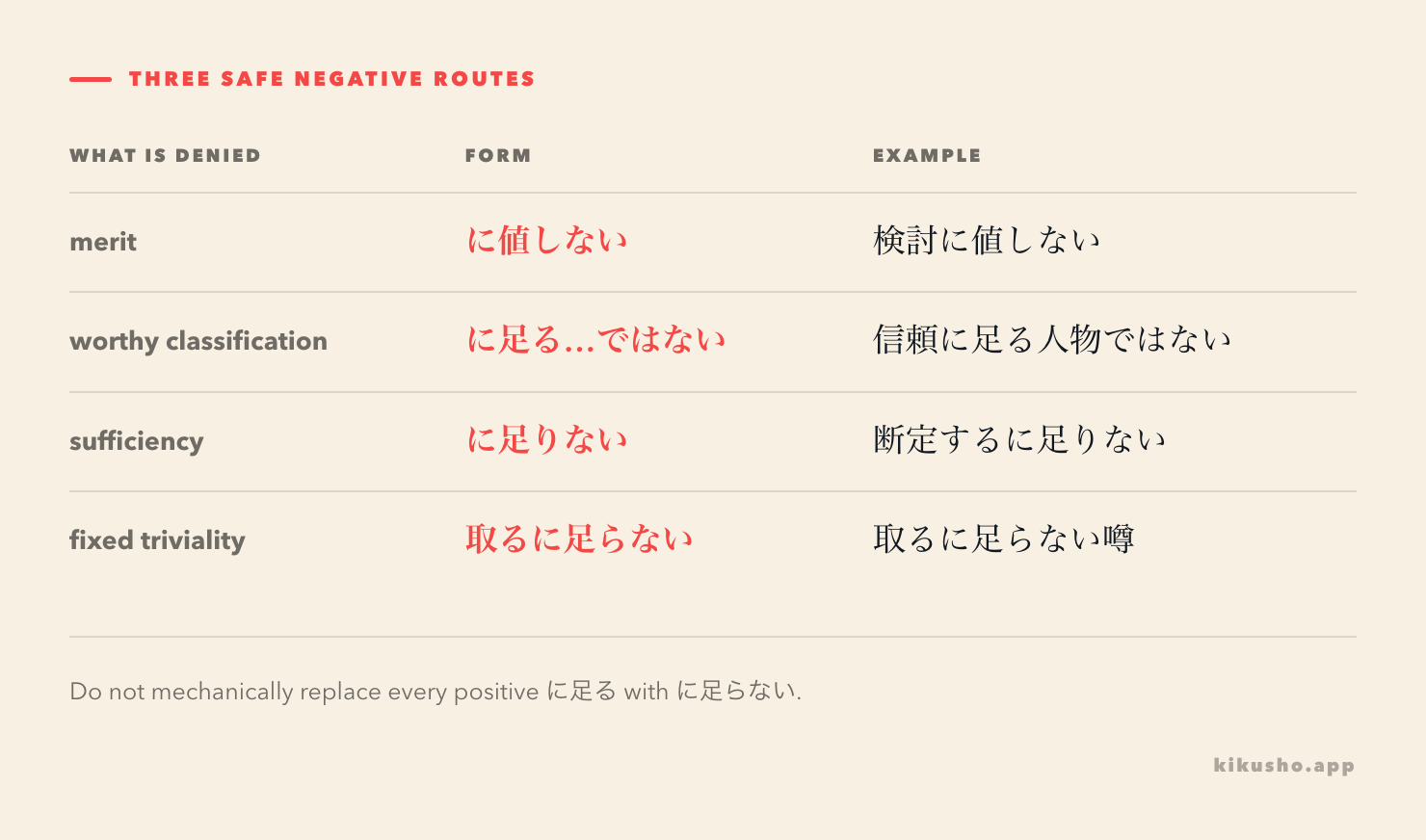
Negative patterns do three different jobs
The safest negative depends on which judgment you want.
に値しない denies merit
この主張は反論するに値しない。
This claim is not worth refuting.
The conjugated verb 値しない directly rejects the need to grant the response.
に足る…ではない denies the positive classification
その説明は、信頼に足るものではない。
That explanation is not something that merits trust.
The positive modifier 信頼に足る stays intact; ものではない negates the following classification. This is a dependable way to negate an attributive に足る phrase.
に足りない says that the evidence or degree falls short
この証拠だけでは、責任があると断定するに足りない。
この しょうこだけでは、せきにんが あると だんていするに たりない。
This evidence alone is insufficient to conclude that there is responsibility.
Vるに足りない is an established formal pattern built on 足りる. It treats the subject as insufficient for the named act. に足らない, from the older verb 足る, also occurs, but its productive range is less consistent across teaching references. Do not turn every Xに足るY into Xに足らないY by reflex.
The most useful fixed expression is 取るに足らない:
取るに足らない噂に時間を使う必要はない。
とるに たらない うわさに じかんを つかう ひつようは ない。
There is no need to spend time on a trivial rumour.
It means “trivial,” “insignificant,” or “not worth taking up.” Learn the whole expression. It is much more stable than inventing new に足らない combinations from an English “not worth.”
Ordinary 足りない is a different construction
会議の時間が足りない。
There is not enough time for the meeting.
Here 時間 is the grammatical subject marked by が, and 足りない simply means that its quantity is insufficient. There is no preceding dictionary-form verb plus に.
Compare:
| Sentence | Structure | Meaning |
|---|---|---|
| 時間が足りない | Nが足りない | the amount of N is insufficient |
| 説明するに足りない | Vるに足りない | insufficient for doing V |
| 説明するに足る資料ではない | Vるに足るNではない | not an N sufficient for doing V |
This visual boundary matters in reading. The characters 足りない alone do not identify the N1 pattern; the preceding Vるに does.
“Worth it” after effort belongs to a different family
に値する and に足る evaluate a subject or a threshold. They do not say that past effort paid off. For that result-facing judgment, use 甲斐がある:
毎日練習した甲斐があって、発表は成功した。
The daily practice paid off, and the presentation succeeded.
The 甲斐がある and せっかく lesson separates a worthwhile result from a valuable opportunity. The ほどのことではない and までもない lesson handles a different negative judgment: a matter is not substantial enough, or an action need not be taken that far.
For review, keep the noun after に足る or the response before に値する on the card. A card that saves only “worth” cannot tell you whether 評価に値する, 信頼に足る人物, or 判断するに足りない belongs in the sentence. Kikusho lets you preserve the whole line and edit the explanation before saving it, so the threshold survives alongside the translation.
N1 placement and reference evidence
JLPT Sensei lists に値する at N1 and supports noun or dictionary-form verb attachment. Bunpro gives the same structure and direct に値しない negative, but places the form at N2. That disagreement is preserved here rather than resolved by pretending an official boundary exists.
For に足る, Bunpro, 日本語NET and 日本語教師のN1et agree on N1, formal register, dictionary-form verb attachment and the sufficient-or-worthy meaning. N1et also recommends negating the following predicate when denying an attributive に足る classification. JLPT Sensei separately records に足りない/に足らない at N1, while Bunpro's に足りない account explains it as a formal insufficiency pattern and notes 取るに足らない as a set phrase. These are study placements; the JLPT authority publishes no exhaustive grammar-item list.
Practice
Choose the judgment first: merit, adequate evidence, or failure to reach the bar. Answer all seven questions before revealing the explanations.
Question 1
Complete the evaluation.
長年にわたる彼女の貢献は、表彰に__。
- ア. 足りない
- イ. 値する
- ウ. 足らない
- エ. 足りるではない
Question 2
Choose the form that says the data meets the standard needed for a decision.
このデータは、方針を変更するに__根拠だ。
- ア. 値しない
- イ. 足る
- ウ. 足らない
- エ. 値した
Question 3
Complete the sentence that says the evidence is insufficient.
この証拠だけでは、事故の原因を断定するに__。
- ア. 値する
- イ. 足るものだ
- ウ. 足りない
- エ. 甲斐がある
Question 4
Which is the safest way to say “He is not a person worthy of trust” while keeping the positive に足る modifier intact?
- ア. 彼は信頼に足る人物ではない。
- イ. 彼は信頼が足る人物ない。
- ウ. 彼は信頼に値する人物ではある。
- エ. 彼は信頼を足らない人物だ。
Question 5
Rewrite with に値しない: “That baseless claim is not worth discussing seriously.”
根拠のないその主張は、____。
Question 6
What does 取るに足らない話 mean, and why should you learn it as a whole expression?
Question 7
Read the passage. Explain the different judgment made by each bold form.
候補者の長年の活動は高い評価に値する。しかし、今回提出された資料だけでは、この候補者を代表に選ぶに足りない。
Answers and explanations
1.
イ. 値する. The contribution merits formal recognition, so 表彰に値する assigns a response the subject deserves. 足りない would express insufficiency and does not fit this evaluation.
2.
イ. 足る. The data is being measured against the threshold needed to change policy. 方針を変更するに足る根拠 means “grounds sufficient to change the policy.”
3.
ウ. 足りない. 断定するに足りない says the evidence falls short of what is needed to reach a firm conclusion. 足るものだ would make the opposite judgment.
4.
ア. 彼は信頼に足る人物ではない. The modifier 信頼に足る remains positive, and ではない denies that he belongs to the class of people who meet that standard. The other choices have incorrect particles, missing predicates or the opposite meaning.
5.
One natural answer is 根拠のないその主張は、真剣に議論するに値しない。 The dictionary-form verb 議論する comes before に値しない, which denies that serious discussion is merited.
6.
取るに足らない話 is a trivial or insignificant matter, literally one not worth taking up. 取るに足らない is especially established as a fixed expression; learning it whole avoids treating に足らない as a freely productive negative for every に足る phrase.
7.
高い評価に値する says the candidate's long activity deserves a high evaluation. 選ぶに足りない says the submitted documents do not provide enough grounds for selection. The first awards merit to the record; the second rejects the adequacy of the current evidence. A person can deserve praise while the available file still fails the decision threshold.
Common questions
What is the difference between に値する and に足る?
に値する directly judges that something merits an action, reward or evaluation. に足る says that someone or something reaches a sufficient standard for trust, consideration or another action, and it is more formal and literary.
How do you negate に足る?
When に足る modifies a noun, the safest negative is often to negate the following predicate, as in 信頼に足る人物ではない. に足りない is also an established formal pattern meaning that something is insufficient for an action.
Are に足らない and に足りない the same?
Both can mean insufficient or not worth doing. 足らない is the negative of the older verb 足る, while 足りない comes from 足りる. Their range is not perfectly free, and 取るに足らない is a particularly common fixed expression.
Is に値する N1 or N2 grammar?
References disagree: JLPT Sensei places に値する at N1, while Bunpro places it at N2. This lesson studies it with the N1 に足る family because the contrast is useful; the JLPT does not publish an exhaustive official grammar list.