On this page
彼はめったに来ない says that he rarely comes. 彼はなかなか来ない says that he is taking a long time to arrive on this occasion. Both end in a negative, but めったに counts rare occurrences while なかなか follows an expected result that is not arriving readily.
The rule is frequency versus resistance
Ask whether you are looking across many occasions or waiting for one result.
| What you are describing | Form | Core meaning |
|---|---|---|
| a habit or event that almost never occurs | めったに + negative | rarely, seldom |
| an expected result that is slow or difficult | なかなか + negative | not readily, cannot seem to |
| a positive evaluation beyond expectation | なかなか + positive | quite, surprisingly |
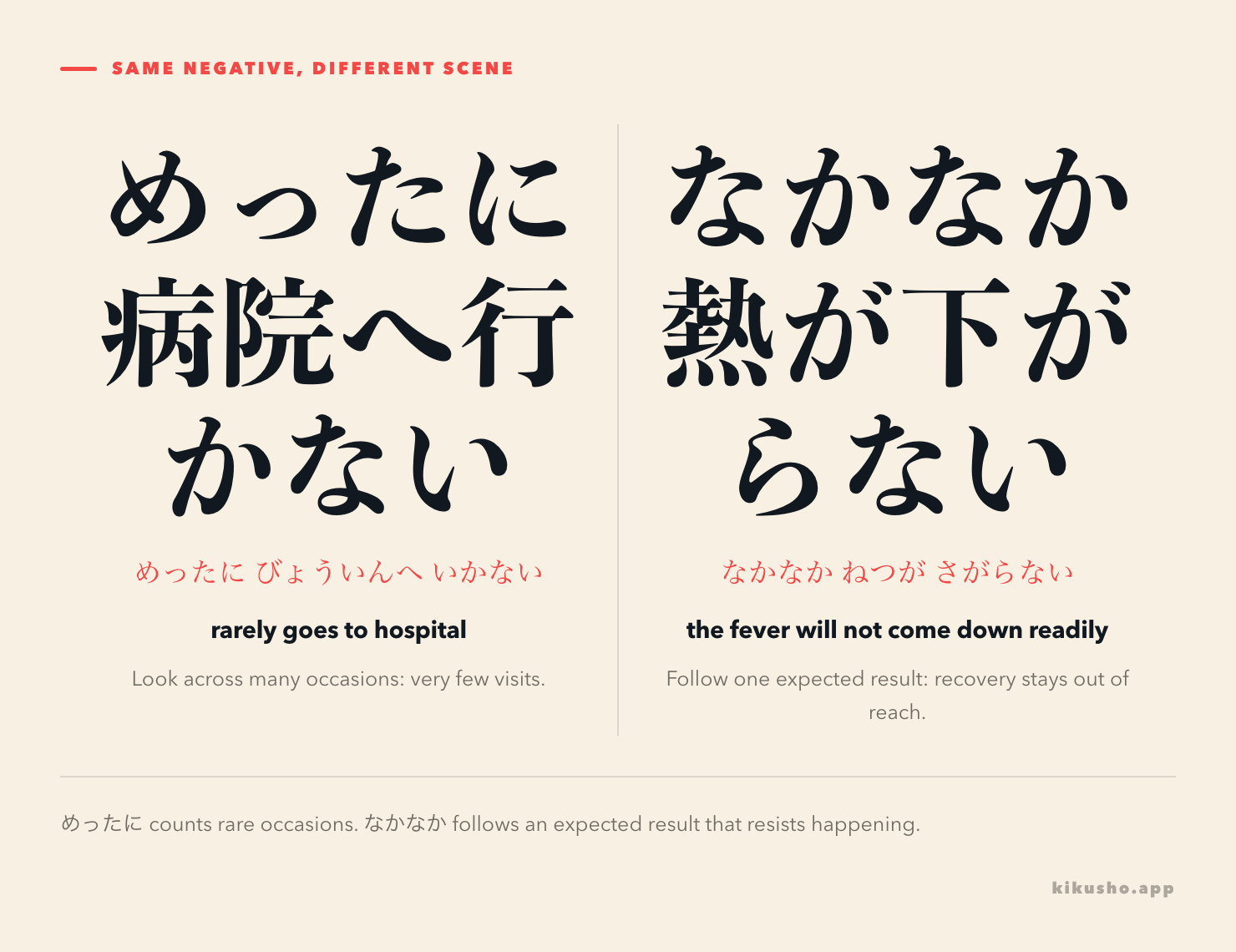
The pair becomes confusing because English can translate both with “hardly.” That gloss hides the question Japanese is answering. めったに会えない can mean opportunities to meet are rare. なかなか会えない says a desired meeting is proving difficult to arrange. The negative is visible in both; the speaker's view of the situation is different.
めったに~ない counts rare occasions
Put めったに before a negative predicate. The negative may be plain, polite or past.
| Shape | Example | Reading |
|---|---|---|
| めったに + Vない | 父はめったに怒らない | My father rarely gets angry. |
| めったに + Vません | 私はめったに外食しません | I rarely eat out. |
| noun は + めったにない | こんな機会はめったにない | An opportunity like this is rare. |
JLPT Sensei's めったに~ない reference records both the verb-negative pattern and the noun pattern N はめったにない. It places the construction at N3. Hiragana めったに is the safest learner spelling, though 滅多に also appears.
The sentence usually invites an imagined series. In 祖父はめったに病院へ行かない, you mentally scan all the occasions on which the grandfather might have gone to hospital and find very few visits. The sentence does not describe today's trip as slow or difficult.
めったに is narrower than あまり. あまり高くない means “not very expensive,” because あまり can measure degree. めったに高くない is unnatural for that intended meaning because めったに measures how rarely an event or state occurs. The larger frequency-adverb scale places it below たまに and shows the negative forms it shares with あまり, ほとんど and ぜんぜん.
なかなか~ない keeps a result pending
With a negative predicate, なかなか presents something expected, wanted or attempted as slow or difficult to achieve.
バスがなかなか来ません。+> バスが なかなか きません。+> The bus is taking a long time to come.
この漢字がなかなか覚えられない。+> この かんじが なかなか おぼえられない。+> I cannot seem to remember this kanji.
薬を飲んでも、なかなか熱が下がらない。+> くすりを のんでも、なかなか ねつが さがらない。+> Even after taking medicine, the fever will not come down readily.
Arrival, remembering and recovery are all endpoints. The speaker expects movement toward them, but the endpoint stays out of reach. A potential negative such as 覚えられない often makes the difficulty especially clear; an ordinary negative such as 来ない can carry waiting and impatience from context.
Meshclass's なかなか lesson describes a degree or duration beyond expectation and supplies both positive and negative examples. Bunpro's なかなか~ない reference emphasizes difficulty or delay, often against effort or expectation. Bunpro places the pattern at N3; Meshclass and several teaching sites place it at N4. Those labels are editorial study estimates because the JLPT publishes no exhaustive grammar syllabus. You need negative forms and potential verbs before studying this contrast, whichever course introduces it first.
This use does not mean that the result will never happen. バスがなかなか来なかった describes the period during which the bus failed to arrive readily. A later sentence can say でも、三十分後にやっと来た, “but it finally came thirty minutes later.” The 急に, やっと and なかなか lesson follows that full timeline from an abrupt event through delay to attainment.
One verb exposes the difference
The verb 来る makes a clean test because either adverb can precede its negative form.
田中さんはめったに会社に来ない。+> たなかさんは めったに かいしゃに こない。+> Tanaka rarely comes to the office.
田中さんはなかなか会社に来ない。+> たなかさんは なかなか かいしゃに こない。+> Tanaka is taking a long time to come to the office.
The first sentence is habitual. It gathers many working days into a pattern. The second naturally creates a present scene: people expect Tanaka, time passes, and he has still not arrived. More context can shift a reading, but the adverb gives the listener a strong starting point.
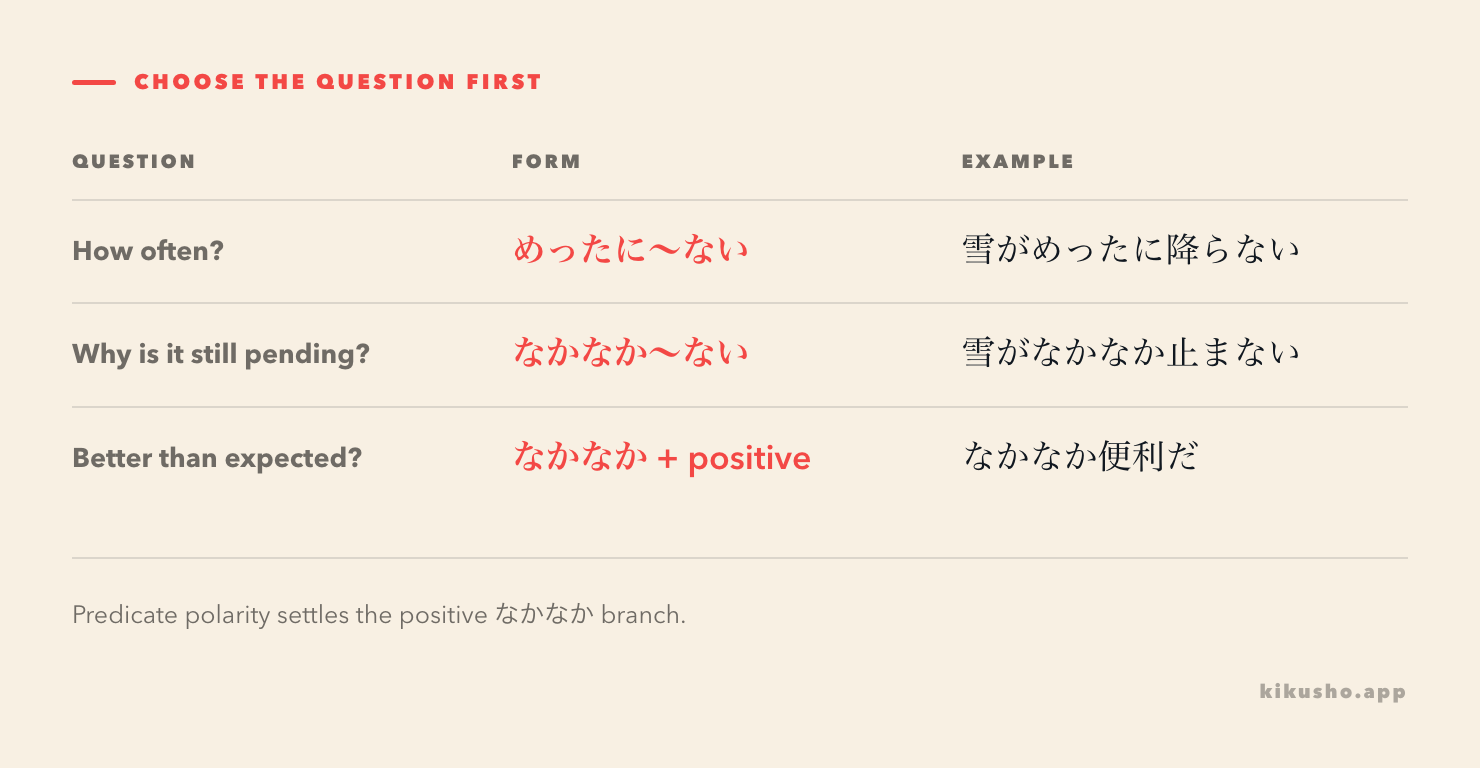
| Question | Best choice | Example |
|---|---|---|
| How often does it happen? | めったに~ない | この町では雪がめったに降らない |
| Why has the expected result not arrived? | なかなか~ない | 雪がなかなか止まない |
| Is the positive result better than expected? | なかなか + positive | この方法はなかなか便利だ |
Weather supplies the same contrast. この町では雪がめったに降らない surveys winters and says snow is rare. 雪がなかなか止まない stays inside one snowfall and says the expected stopping point will not come. Translating both with “hardly” throws away that structure.
Positive なかなか changes the branch
なかなか can modify a positive adjective, adverb or evaluative expression. It then means “quite,” “considerably” or “surprisingly,” often with a sense that the thing deserves more credit than expected.
この本はなかなか面白い。+> この ほんは なかなか おもしろい。+> This book is quite interesting.
彼はなかなか上手に話します。+> かれは なかなか じょうずに はなします。+> He speaks quite well.
Do not treat this as a negative with ない omitted. Polarity selects a different reading:
| Predicate | Reading of なかなか |
|---|---|
| positive: なかなか面白い | quite interesting |
| negative: なかなか理解できない | cannot readily understand |
Positive なかなか can sound evaluative, so it is less neutral than a bare とても. The speaker is often registering that the result is better, stronger or more substantial than first assumed. The negative construction instead keeps an anticipated result from arriving.
The wrong choice changes the scene
Suppose you want to say that a restaurant is so popular that reservations are difficult to get.
人気があるので、なかなか予約が取れない。+> にんきが あるので、なかなか よやくが とれない。+> Because it is popular, reservations are hard to get.
The obstacle explains なかなか. Replacing it with めったに would say that getting a reservation is rare as a matter of frequency. That may be factually close, but it no longer foregrounds the attempt and resistance.
Now imagine someone who almost never books restaurants:
私はめったにレストランを予約しない。+> わたしは めったに レストランを よやくしない。+> I rarely reserve restaurants.
Here the speaker's habit is the point. なかなか予約しない would invite a different story: the person is slow or reluctant to make an expected booking. The choice changes the time frame before it changes the English gloss.
When you save one of these phrases in Kikusho, keep the cue that settles the reading. A calendar-like phrase such as 週末でもめったに行かない preserves frequency; an effort phrase such as 何度読んでもなかなか分からない preserves resistance. A card containing only the adverb loses the evidence you need when both can precede the same negative verb.
Check the scene before choosing
Question 1: grammar choice. Your colleague almost never takes a day off. Complete: 同僚は__休みを取りません。
- なかなか
- めったに
- やっと
- すぐに
Question 2: grammar choice. You have waited twenty minutes and the elevator still has not arrived. Complete: エレベーターが__来ません。
- めったに
- いつも
- なかなか
- たまに
Question 3: meaning. What does この地域では地震はめったにない say?
- An earthquake is slow to stop.
- Earthquakes are rare in this area.
- The earthquake was quite strong.
- People cannot readily remember the earthquake.
Question 4: polarity. What is the most natural reading of この料理はなかなかおいしい?
- This dish is quite tasty.
- This dish is rarely tasty.
- This dish never becomes tasty.
- This dish takes a long time to arrive.
Question 5: sentence composition. Write “Even after trying several times, I cannot readily open this lid” using 何度試しても, このふた, 開ける and なかなか~ない.
Question 6: text grammar. Read: この店にはめったに来ません。今日は来ましたが、料理がなかなか出てきません。 Which statement matches?
- The speaker visits rarely, and today's food is slow to arrive.
- The speaker visits frequently, and today's food arrived quickly.
- The shop rarely opens, and the speaker cannot find it.
- The food is surprisingly good every time.
Question 7: contrast. Which sentence describes a repeated low-frequency habit rather than one delayed event?
- 電車がなかなか来ない。
- この電車はめったに時間どおりに来ない。
- 宿題がなかなか終わらない。
- 痛みがなかなかよくならない。
Answers and explanations
Answer 1. めったに. “Almost never” asks about frequency across many working days, and the polite negative 取りません completes the pattern.
Answer 2. なかなか. The elevator is an expected arrival that remains pending during the wait. めったに would describe how rarely elevators come as a repeated pattern.
Answer 3. Earthquakes are rare in this area. N はめったにない says that instances of the noun are rare. The sentence surveys the region rather than following one earthquake through time.
Answer 4. This dish is quite tasty. The predicate おいしい is positive, so なかなか has its positive evaluative reading, “quite” or “surprisingly.”
Answer 5. 何度試しても、このふたがなかなか開けられません。 Plain 何度試しても、このふたがなかなか開けられない is also correct. The potential negative marks the result that repeated effort has not achieved.
Answer 6. The speaker visits rarely, and today's food is slow to arrive. めったに来ません describes the speaker's rare visits across occasions. なかなか出てきません describes the food's delayed arrival during today's visit.
Answer 7. この電車はめったに時間どおりに来ない surveys repeated runs and says on-time arrival is rare. The three なかなか sentences keep a present arrival, completion or recovery out of reach.
A single verb can support either scene. Keep enough context to see whether the speaker is counting occasions or watching an endpoint resist them.
Common questions
What is the difference between めったに~ない and なかなか~ない?
めったに~ない says an event occurs very rarely across separate occasions. なかなか~ない says an expected or desired result does not happen readily, often despite waiting or effort.
Does なかなか~ない mean never?
No. It presents a result as delayed or difficult to achieve. The result may still happen later, while a separate sentence must tell you whether it finally does.
Can なかなか be used in a positive sentence?
Yes. Before a positive adjective or expression, なかなか often means quite, considerably or surprisingly, as in この本はなかなか面白い.
Can めったに be used without a negative?
In its ordinary adverbial meaning of rarely, めったに is completed by a negative predicate: めったに行かない or めったにありません.