On this page
A Japanese schedule divides a month into 上旬, 中旬 and 下旬, narrows the final stretch with 月末, and calls the event day 当日. 年度 changes the kind of year being counted, while 臨時 tells you that an opening, closure, train or meeting sits outside the regular plan.
These seven N2 words answer different questions about one calendar. Learn the reference frame first: part of a month, end of a month, day of an event, institutional year, or exceptional arrangement.
Seven nouns turn a date into a usable plan
| Word | Reading | Part of speech | What it identifies | Useful combination |
|---|---|---|---|---|
| 上旬 | じょうじゅん | noun, often adverbial | days 1–10 of a month | 五月上旬に発送する |
| 中旬 | ちゅうじゅん | noun, often adverbial | days 11–20 of a month | 来月中旬の予定 |
| 下旬 | げじゅん | noun, often adverbial | day 21 through month end | 九月下旬から始まる |
| 月末 | げつまつ | noun, often adverbial | the end of a month | 月末までに支払う |
| 当日 | とうじつ | noun, often adverbial | the day of the event in question | 当日の受付, 大会当日 |
| 年度 | ねんど | noun | an institutionally defined year | 今年度, 会計年度, 年度末 |
| 臨時 | りんじ | noun; の modifier; adverbial with に | something temporary or arranged outside the regular schedule | 臨時休業, 臨時列車 |
The readings are part of the vocabulary. 上旬 is じょうじゅん, not うえしゅん; 月末 is normally げつまつ in this scheduling use; 当日 is とうじつ. Read the compounds as units rather than rebuilding them from isolated character readings.
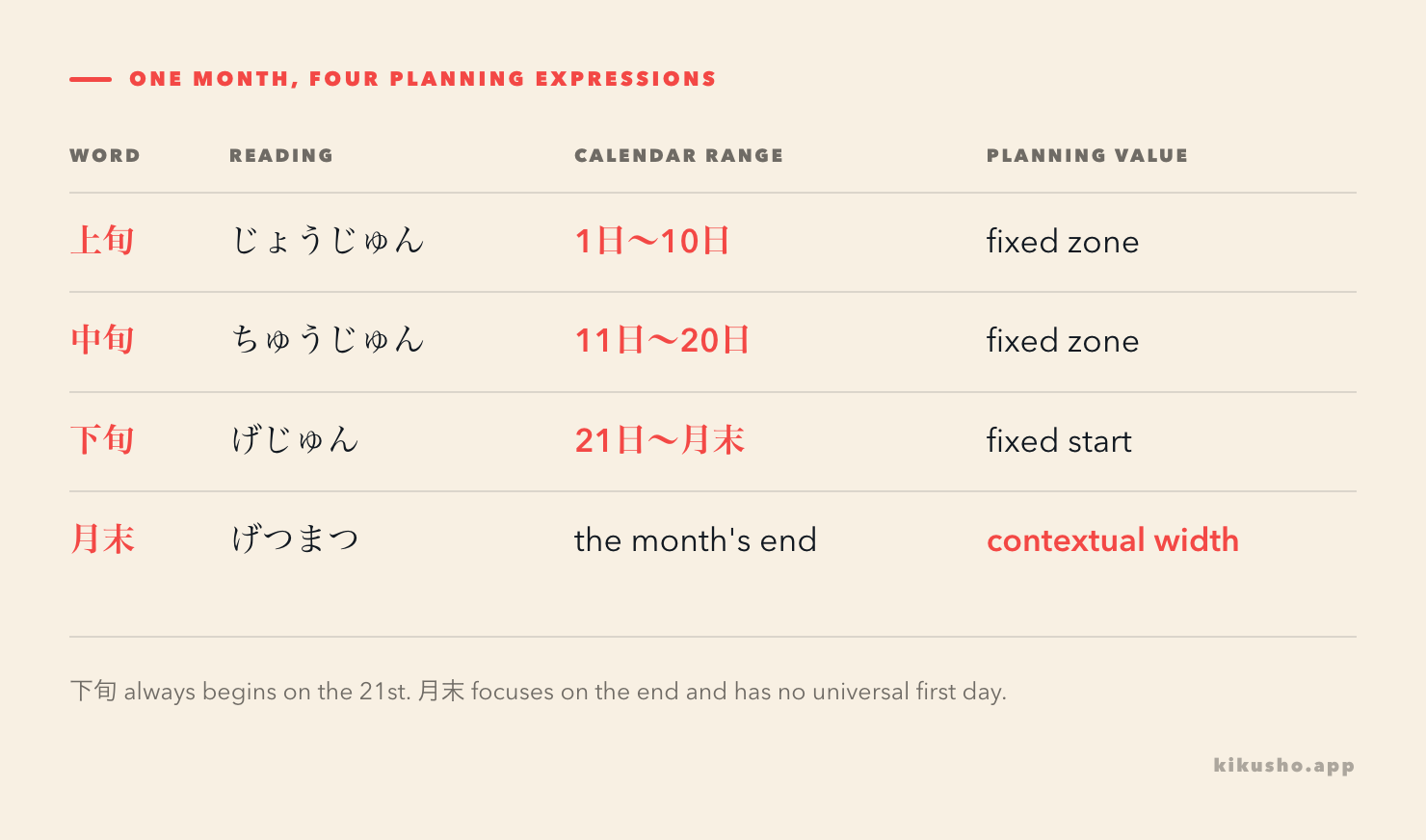
上旬, 中旬 and 下旬 divide every month into three zones
旬(じゅん) is a ten-day unit in these calendar compounds. Shogakukan defines 上旬 as days 1–10 and 中旬 as days 11–20. 下旬 begins on the 21st and continues through the last day.
新しい教材は十月上旬に届く予定です。
あたらしい きょうざいは じゅうがつ じょうじゅんに とどく よていです。
The new teaching materials are expected to arrive in early October.
面接は十一月中旬に行います。
めんせつは じゅういちがつ ちゅうじゅんに おこないます。
Interviews will be held in mid-November.
結果は十一月下旬に発表されます。
けっかは じゅういちがつ げじゅんに はっぴょうされます。
The results will be announced in late November.
These expressions define zones, not exact appointments. 十月上旬に届く allows any arrival date from October 1 through October 10. If the reader must act on one date, the notice should supply that date separately.
The final zone is not always ten days long. It has 8 days in a 28-day February, 9 in a 29-day February, 10 in a 30-day month, and 11 in a 31-day month. The boundary stays the same: 下旬 starts on the 21st.
月末 is narrower than 下旬, but its first day is not fixed
月末(げつまつ) means the end of the month. It can point to the final day or to a short stretch near it, depending on the predicate and the shared situation.
申込書は月末までに提出してください。
もうしこみしょは げつまつまでに ていしゅつして ください。
Please submit the application form by the end of the month.
月末は請求書の処理で忙しくなります。
げつまつは せいきゅうしょの しょりで いそがしく なります。
We get busy processing invoices at the end of the month.
The first sentence treats the end of the month as a deadline boundary. The second describes a recurring busy stretch. Neither sentence tells you that 月末 mechanically begins on the 21st.
That separates it from 下旬, whose range is fixed. A notice saying 発売は六月下旬 allows any date from June 21 to June 30. 六月末に発売 directs attention toward the very end of June. The Mainichi Shimbun language desk makes the same editorial distinction: 下旬 has a dictionary boundary, while 月末 is narrower but lacks one universally agreed first date.
For a legal, payment or travel deadline, do not infer a hidden date from 月末. Look for the exact day, time and whether まで or までに sets the limit. The N3 notice vocabulary lesson continues that reading task with applications and deadlines.
当日 belongs to an event, not automatically to today
当日(とうじつ) means the day when the event under discussion happens or happened. The event supplies the reference.
説明会当日は、開始の三十分前から受付を行います。
せつめいかい とうじつは、かいしの さんじゅっぷんまえから うけつけを おこないます。
On the day of the information session, reception will open thirty minutes before the start.
事故当日は強い雨が降っていた。
じこ とうじつは つよい あめが ふっていた。
It was raining heavily on the day of the accident.
The first 当日 lies in the future from the notice writer's viewpoint. The second lies in the past from the narrator's viewpoint. The dictionary definition covers both: the day on which the relevant matter occurs or occurred.
This is why 当日 and 本日(ほんじつ) are not interchangeable. 本日 means today in formal speech or writing. 当日 needs an event already named or recoverable from context. On the event day itself, the two can point to the same calendar date, but they reach it from different reference frames.
Common compounds show the event connection: 当日券 is a ticket bought for that day's performance or admission, 当日受付 is registration on the event day, and 大会当日 is the day of the tournament.
年度 follows an institution's boundary
年度(ねんど) is a one-year period established for administration, accounting, education, production or another organised purpose. It is distinct from a calendar year simply counted from January through December.
来年度の予算案は二月中旬に発表されます。
らいねんどの よさんあんは にがつ ちゅうじゅんに はっぴょうされます。
Next fiscal year's budget proposal will be announced in mid-February.
今年度の授業は三月末で終わります。
こんねんどの じゅぎょうは さんがつまつで おわります。
Classes for the current academic year end at the end of March.
Shogakukan defines 年度 as a year divided for administrative convenience and lists 会計年度, 年度初め and 年度末. Many Japanese government, school and company contexts use an April-to-March year. The word itself does not guarantee those months: an organisation or industry can define another boundary.
The label usually follows the institution's naming convention. In a common April-to-March system, 2026年度 begins in April 2026 and ends in March 2027. Before converting the label into dates, identify the institution and its rule.
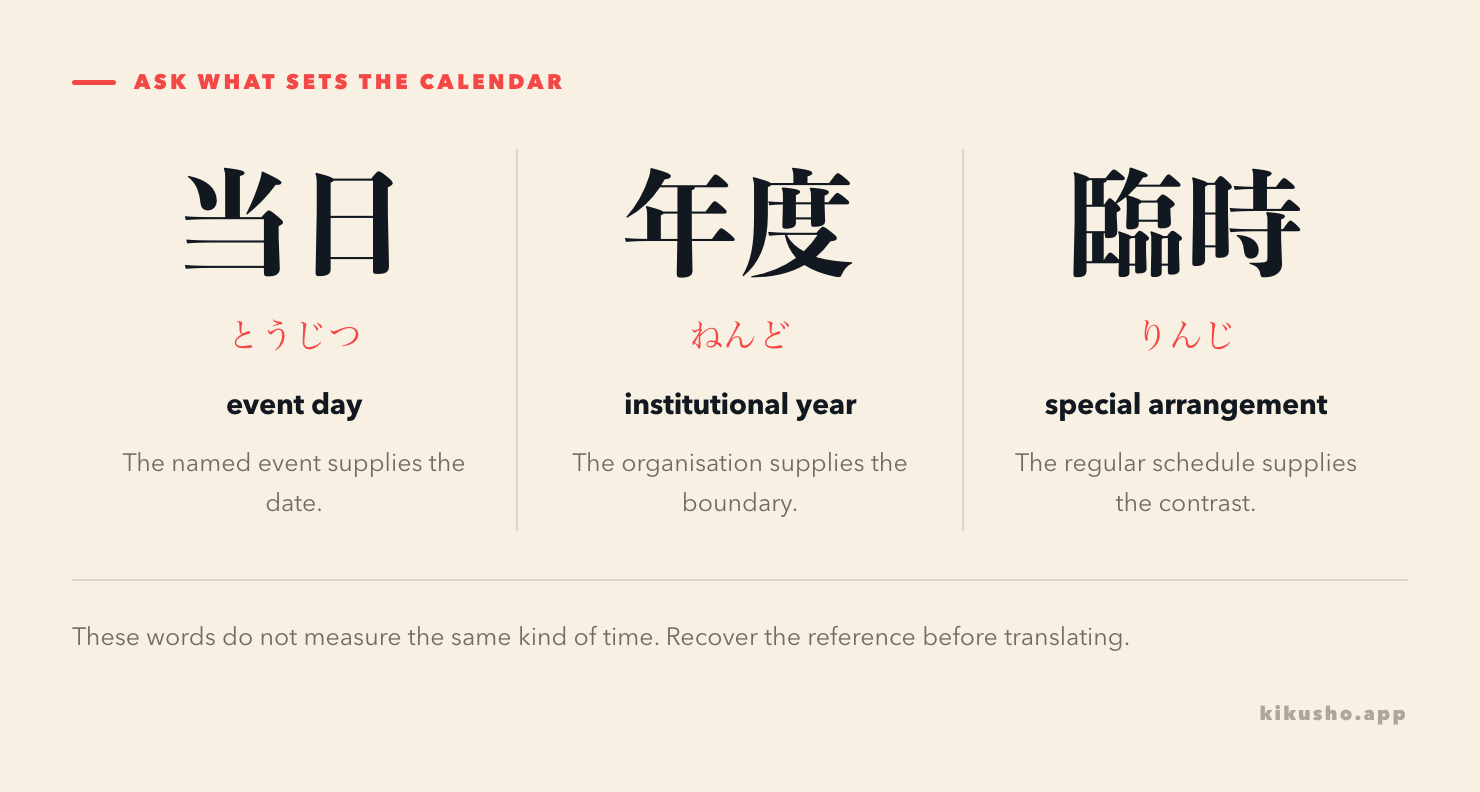
臨時 marks an exception to the regular arrangement
臨時(りんじ) has two related uses. It can mean arranged in response to a particular situation rather than at the regular time, and it can mean temporary for the relevant period. Shogakukan records both senses.
台風のため、店は臨時休業します。
たいふうの ため、みせは りんじ きゅうぎょうします。
Because of the typhoon, the shop will close temporarily.
混雑に備えて、臨時列車が運行されます。
こんざつに そなえて、りんじ れっしゃが うんこうされます。
An extra train will run in preparation for the crowds.
The shop closure departs from normal opening hours. The extra train departs from the regular timetable. Translating both as “temporary” hides the scheduling decision that 臨時 contributes.
The common frames are 臨時の + noun, a fixed compound such as 臨時休業, and 臨時に + verb. You will also meet 臨時総会, an extraordinary general meeting; 臨時職員, temporary staff; and 臨時入口, a temporary entrance.
The N3 word 一時(いちじ) can also mean temporarily, but it normally measures a limited state or period: 運転を一時見合わせる, suspend service temporarily. 臨時 presents the service, staffing or event as a special arrangement outside the ordinary plan. The meanings overlap; the distinction is a useful tendency rather than an absolute ban. The N3 time vocabulary lesson gives the full 一時 comparison.
One notice can change reference frame three times
今年度の公開講座は十月中旬に開かれます。申込期限は九月末です。講座当日は午前九時から受付を行い、参加者が多い場合は臨時の受付窓口を設けます。詳しい日程は八月下旬に発表します。
こんねんどの こうかい こうざは じゅうがつ ちゅうじゅんに ひらかれます。もうしこみ きげんは くがつまつです。こうざ とうじつは ごぜん くじから うけつけを おこない、さんかしゃが おおい ばあいは りんじの うけつけ まどぐちを もうけます。くわしい にっていは はちがつ げじゅんに はっぴょうします。
This fiscal year's public course will be held in mid-October. The application deadline is the end of September. On the day of the course, reception will begin at 9 a.m.; if attendance is high, a temporary reception desk will be added. The detailed schedule will be announced in late August.
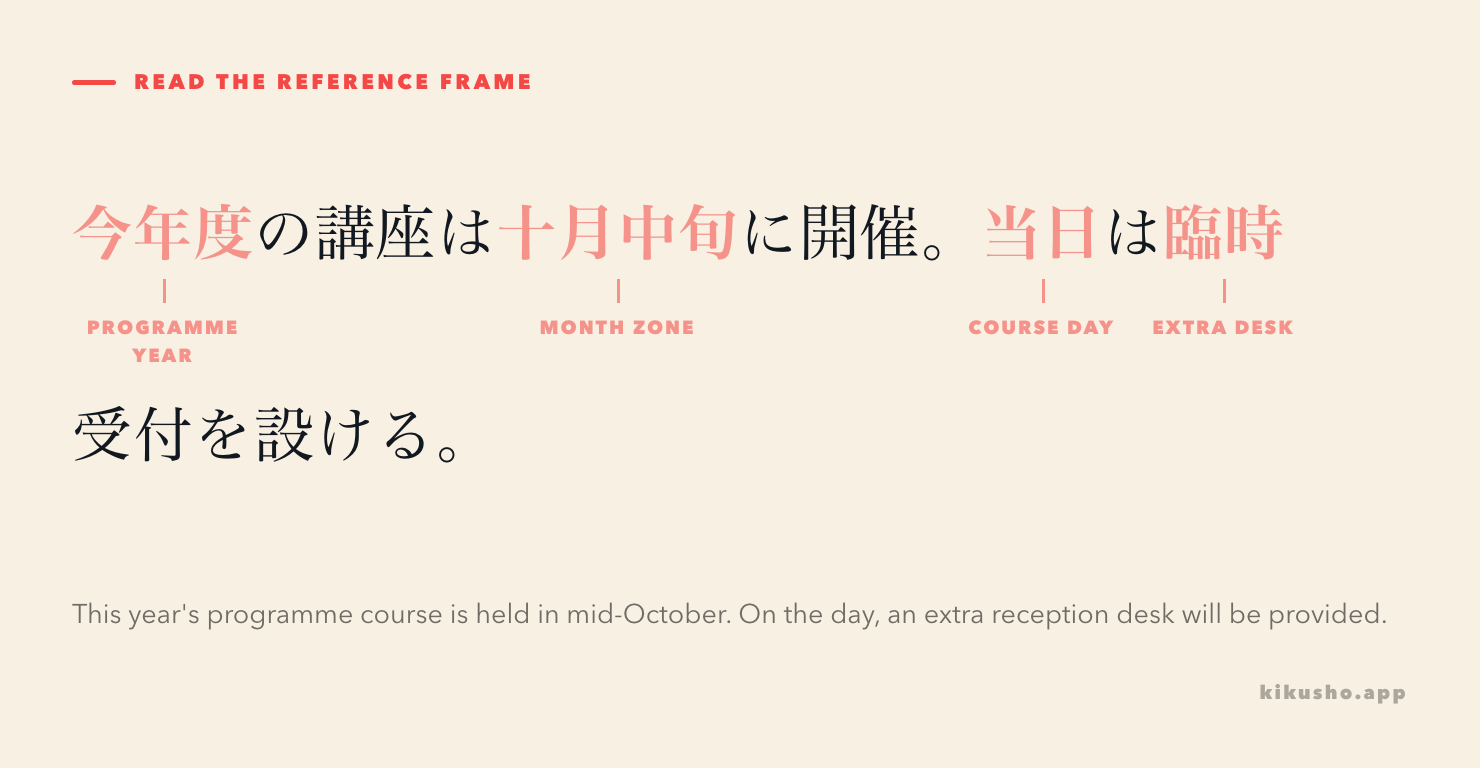
The notice is not one straight timeline. 今年度 identifies the programme cycle. 十月中旬 and 八月下旬 give broad monthly zones. 九月末 supplies an end-of-month deadline, 講座当日 shifts to the course day, and 臨時の受付窓口 adds a conditional exception to the normal arrangement.
Save this kind of notice in Kikusho with the date phrase and the event still attached. A card containing only 当日 = that day loses the event that makes “that” meaningful. Keeping 講座当日は午前九時から受付を行う lets the review ask for the reading, the reference event and the schedule decision at once.
N2 is a study placement, not an official border
Kikusho's September 2026 inventory files this complete seven-word set under N2; its two retained source rows give the same study order. Amiko's current N2 time and calendar list independently includes 上旬, 中旬, 下旬 and 月末 in contextual sentences; Bunpro also places 月末 at N2.
Those labels are study estimates. The JLPT organisers explain in their official FAQ that they no longer publish an exhaustive vocabulary list by level. The durable target is the set of readings and reference frames above: exact ten-day zones, an elastic month end, an event day, an institutional year and an exceptional arrangement.
Practice: read the schedule before opening the answers
Question 1
Write 下旬 in kana.
Question 2
Which dates belong to 四月中旬?
A. April 1–10
B. April 11–20
C. April 21–30
D. Only April 30
Question 3
A publisher promises release at some point from June 21 through June 30. Complete: 新刊は六月__に発売する予定です。
A. 上旬
B. 中旬
C. 下旬
D. 当日
Question 4 · Interpret the deadline
Choose the phrase that most clearly means “by the end of the month” without claiming that the whole period begins on the 21st.
A. 上旬までに
B. 中旬までに
C. 当日までに
D. 月末までに
Question 5
A notice written two months before a concert says 当日は身分証明書をお持ちください. What does 当日 identify?
A. The day on which the notice was written
B. Every day until the concert
C. The day of the concert
D. The final day of the month
Question 6
A school document says 2026年度は2026年4月に始まり、2027年3月に終わる. Which paraphrase is accurate?
A. 年度 must always equal January through December.
B. The school's 2026 institutional year crosses two calendar years.
C. 2027年3月 belongs to 2027年度 in this document.
D. 年度 means only one school term.
Question 7
The regular train schedule does not have enough capacity for a festival, so the operator adds an extra service. Complete: 祭りに合わせて、__列車を運行します。
A. 臨時
B. 月末
C. 当日
D. 年度
Question 8
Read the notice and choose the only supported sequence.
詳しい日程は五月上旬に発表します。申込期限は五月末です。説明会当日は臨時の受付窓口を設けます。
A. The detailed schedule appears after the application deadline.
B. The application closes on May 10.
C. A special reception desk will be available on the session day.
D. The special desk is open throughout the fiscal year.
Question 9
Write one Japanese sentence saying: “This fiscal year's ceremony will be held in late March, and on the day there will be an extra bus.” Use 今年度, 下旬, 当日 and 臨時.
Answers and explanations
Answer 1
げじゅん. 下 is げ and 旬 is じゅん in this compound. The word identifies the period from the 21st through the last day of a month.
Answer 2
B, April 11–20. 中旬 is the fixed middle ten-day zone. A is 上旬, C is 下旬, and D identifies only the final day rather than the whole zone.
Answer 3
C, 下旬. June 21 through June 30 is 六月下旬. 月末 could direct attention to the end of June, but it would not state the requested fixed range beginning on the 21st.
Answer 4
D, 月末までに. 月末 focuses on the month's end, while までに sets the completion deadline. 下旬 would name the entire 21st-to-end zone and is absent from these choices.
Answer 5
C, the day of the concert. The concert supplies the reference event even though the notice was written earlier. 本日 would identify the writer's current day.
Answer 6
B. The school has defined a one-year administrative cycle from April 2026 through March 2027 and labels it 2026年度. The sentence itself supplies the boundary; it does not establish a universal calendar for every use of 年度.
Answer 7
A, 臨時. 臨時列車 is an extra service arranged outside the regular timetable for the festival. The other nouns identify calendar frames and cannot modify 列車 with that meaning.
Answer 8
C. 当日 refers to the explanation-session day, and 臨時の受付窓口 is a special or temporary desk. 五月上旬 precedes 五月末, the notice gives no exact May 10 deadline, and 年度 does not occur in the passage.
Answer 9
One model answer is 今年度の式典は三月下旬に行われ、当日は臨時バスが運行されます。 The institutional year modifies 式典, 三月下旬 supplies the month zone, 当日 returns to the ceremony day, and 臨時バス names transport added outside the regular service.
Common questions
What dates are 上旬, 中旬 and 下旬?
上旬(じょうじゅん)is the 1st through the 10th, 中旬(ちゅうじゅん)is the 11th through the 20th, and 下旬(げじゅん)is the 21st through the last day of the month. 下旬 therefore varies in length with the month.
What is the difference between 下旬 and 月末?
下旬 has a fixed starting boundary: the 21st. 月末(げつまつ)means the end of the month and usually points to the final day or final stretch, but it does not define one universal starting date. State an exact date for a firm deadline.
Does 当日 mean today?
当日(とうじつ)means the day on which the event in question happens or happened. That day may be in the future or the past. 本日 refers to today from the speaker's current viewpoint.
Does 年度 always run from April to March?
No. 年度(ねんど)is a one-year period defined for administration, accounting, school or another institutional purpose. Many Japanese school and government years run from April through March, but the organisation determines the boundary.