On this page
一緒に(いっしょに) says that people share an action; いつも says that an action or state happens regularly. They do not replace each other, and they can sit in the same sentence: 私はいつも妹と一緒に駅まで歩きます, “I always walk to the station with my younger sister.”
The quickest test is to ask what information is missing. If you need to answer “with whom?”, use 人と一緒に. If you need to answer “how often?”, use いつも.
The two adverbs answer different questions
Both forms usually work before a predicate, but their jobs are separate:
| Question | N5 form | Basic pattern | Example |
|---|---|---|---|
| Who shares the action? | 一緒に(いっしょに), together | 人 と一緒に + predicate | 友達と一緒に帰ります。 |
| How often does it happen? | いつも, always; usually; habitually | いつも + predicate | いつも歩いて帰ります。 |
友達と一緒に帰ります(ともだちといっしょにかえります) tells you that the speaker goes home with a friend. It says nothing about whether this happens once or every day. いつも歩いて帰ります(いつもあるいてかえります) tells you that walking home is the speaker's routine. It says nothing about company.
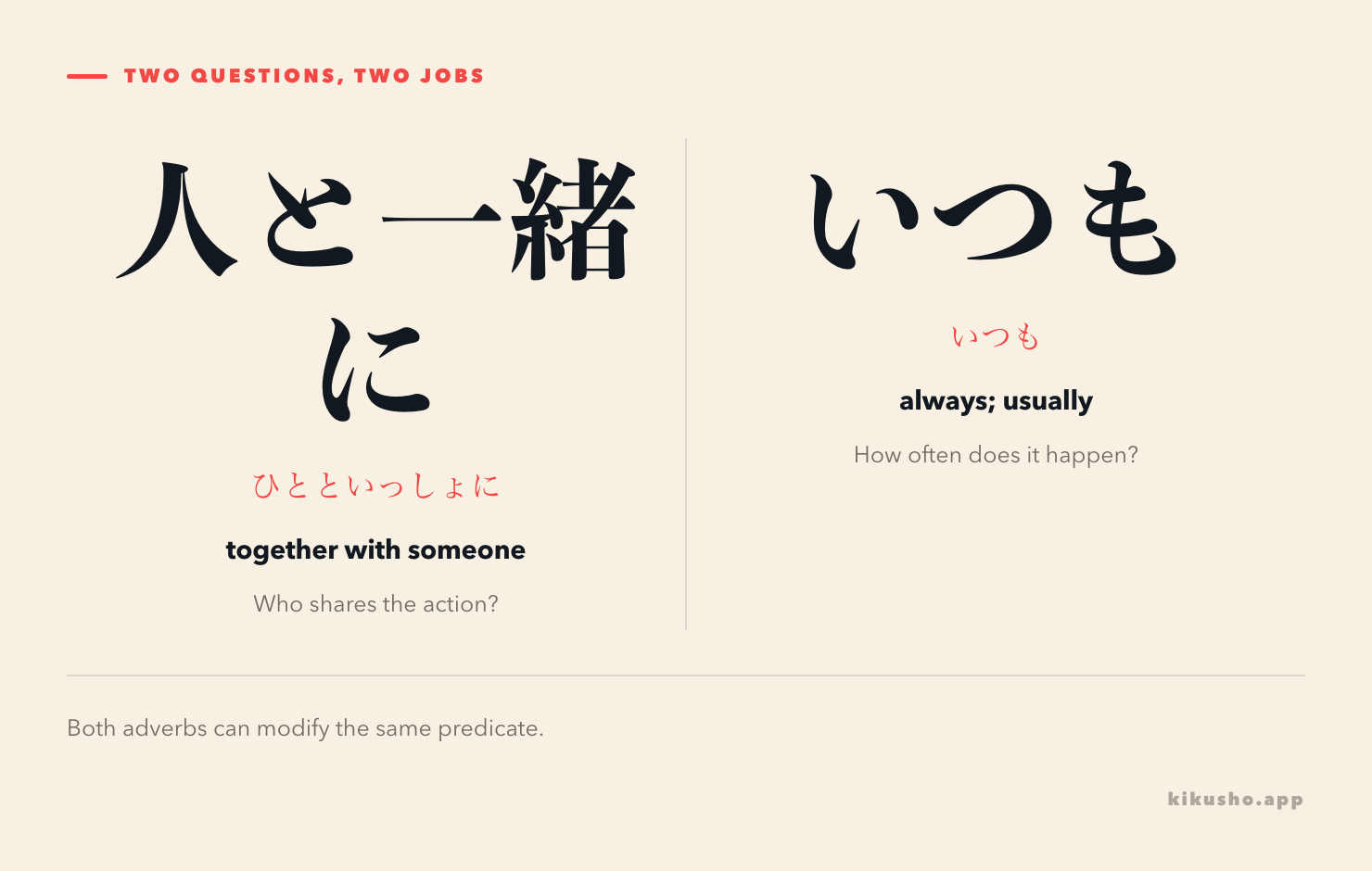
JLPT Sensei lists 一緒に and いつも as separate N5 adverbs. Its examples also place both in one clause, confirming that the pair is compatible rather than a choice between two translations of one idea.
一緒に puts people inside one action
When you name the companion, mark that person or group with と:
人 + と + 一緒に + verb
| Companion | Shared action | Meaning |
|---|---|---|
| 母と一緒に | 買い物に行きます | I go shopping with my mother. |
| クラスメートと一緒に | 勉強しました | I studied with a classmate. |
| 家族と一緒に | 住んでいます | I live with my family. |
In 母と一緒に買い物に行きます(ははといっしょにかいものにいきます), the first particle と marks 母 as the companion. The に already inside 一緒に makes 一緒 work adverbially: the action is performed together. Do not change the companion marker to に. 母に一緒に does not mean “together with my mother.”
You can omit the named companion when the conversation makes it obvious:
一緒に昼ご飯を食べませんか。
いっしょにひるごはんをたべませんか。
Would you like to eat lunch together?
The speaker and listener supply the participants. The lesson on ~ませんか and ~ましょう explains the invitation ending; 一緒に only makes the shared part explicit.
This is ordinary, neutral Japanese. A university open textbook gives 一緒に日本のお菓子も食べます, “we will also eat Japanese sweets together,” in a beginner dialogue in Japanese Introductory 1. That independent example supports the same adverbial use without turning 一緒に into a special invitation ending.
いつも places an action or state inside a routine
いつも can describe repeated action, a habitual state or what is normally true:
| Sentence | What いつも describes |
|---|---|
| いつも七時に起きます。 | getting up at seven as a routine |
| 兄はいつも忙しいです。 | the brother's usual state |
| この店はいつも静かです。 | what the shop is normally like |
As an adverb, いつも takes no particle. It often comes at the start of the clause or after the topic:
- いつも電車で行きます。 I usually go by train.
- 私はいつも電車で行きます。 I usually go by train.
The position is flexible because the predicate stays at the end and the particles keep the noun roles visible. Keep いつも before the action or state it describes. Do not add に by analogy with clock time: いつもに七時に起きます is not the pattern.
English always sounds mathematically absolute, but everyday いつも can also report what normally or habitually happens. Shogakukan's Digital Daijisen, reproduced in Goo's dictionary entry, distinguishes this ordinary conversational word from the more formal 常に(つねに). JLPT Sensei likewise gives “always,” “usually” and “habitually,” not one rigid percentage.
The larger frequency-adverb scale compares いつも with よく, ときどき, あまり and ぜんぜん. This lesson owns the smaller N5 problem: how frequency and companionship occupy the same clause.
Both forms can modify one predicate
Start with the final action and add each layer:
- 図書館で勉強します。 I study at the library.
- 友達と一緒に図書館で勉強します。 I study at the library with a friend.
- いつも友達と一緒に図書館で勉強します。 I always study at the library with a friend.
The full sentence contains four jobs:
| Part | Job |
|---|---|
| いつも | frequency: how often |
| 友達と | companion: with whom |
| 一緒に | manner: together |
| 図書館で勉強します | activity and its location |
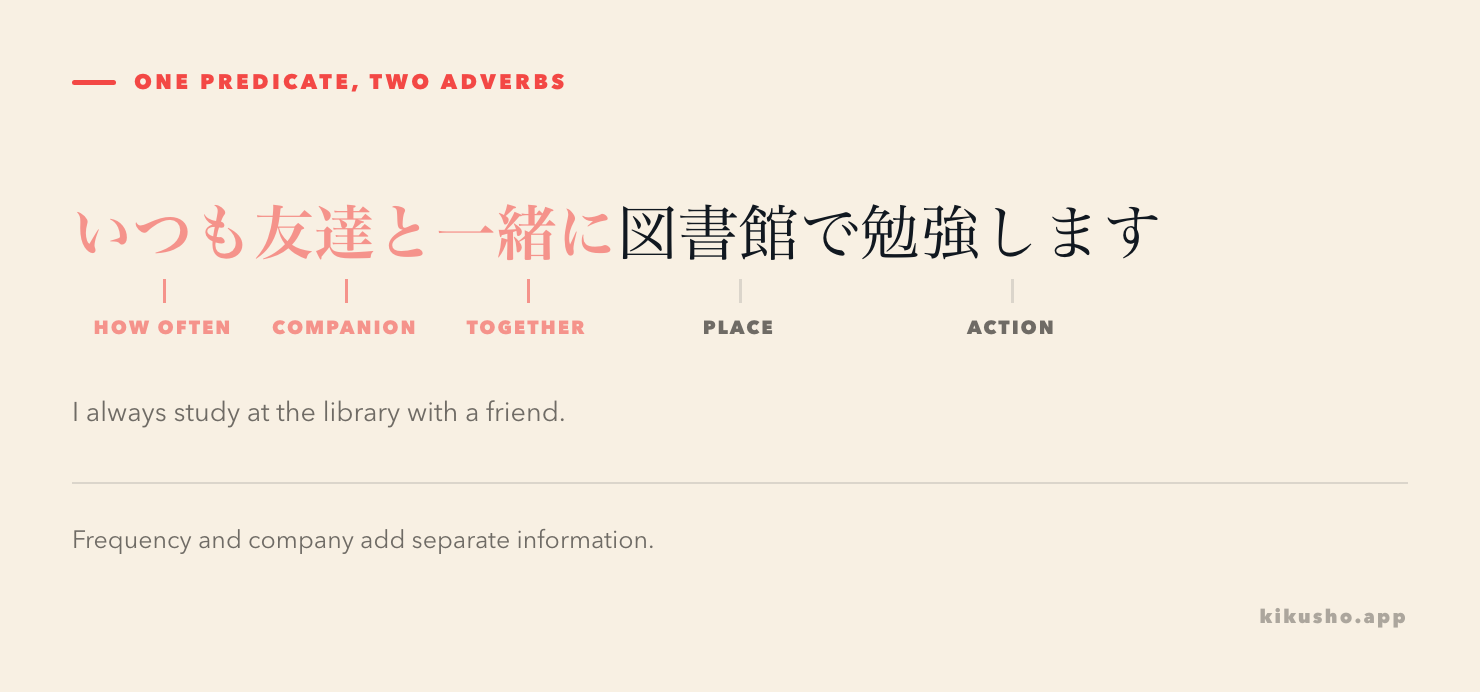
いつも一緒に is therefore a normal sequence. 私たちはいつも一緒に昼ご飯を食べます means “We always eat lunch together.” If you name only one participant, make the companion relation clear: 私は姉といつも一緒に昼ご飯を食べます, “I always eat lunch with my older sister.” Moving いつも earlier does not change the basic roles: いつも姉と一緒に昼ご飯を食べます is also natural.
The wrong choice leaves a different gap
Replacing one form with the other does not merely sound awkward. It changes the answer:
- だれと帰りますか。 Who are you going home with?
友達と一緒に帰ります。 I am going home with a friend. - よく歩いて帰りますか。 Do you often walk home?
いつも歩きます。 I always walk.
Answering the first question with いつも帰ります gives frequency when the listener asked for a companion. Answering the second with 友達と一緒に歩きます gives company when the listener asked for frequency. Both answers can be grammatical sentences, yet neither supplies the requested information.
Two neighbouring forms deserve a boundary too. いつでも means “any time” or “whenever,” so いつでも電話してください means “Call me any time.” いつも電話します means “I always or usually call.” And いつもの before a noun means “the usual”: いつもの店, “the usual shop.” Those uses share sounds with いつも but do different grammatical work.
When you save a line such as 土曜日はいつも友達と一緒に料理します, keep the whole clause on the card. Kikusho can draft the reading, meaning, register note and example from text you paste or photograph; you review every field before saving. Later, the stored sentence still shows which word supplies the routine and which phrase supplies the companion, and its audio remains available offline.
Practice
Finish all seven questions before opening the answer section. The correct choices and explanations are grouped after the final task.
Question 1 — grammar choice. Complete the answer to だれと映画を見ますか, “Who will you watch the film with?”
- ア. いつも映画を見ます。
- イ. 妹と一緒に映画を見ます。
- ウ. 妹にいつも映画を見ます。
- エ. 一緒と妹に映画を見ます。
Question 2 — grammar choice. Complete 私は__七時に起きます so it means “I usually get up at seven.”
- ア. 友達と
- イ. 一緒を
- ウ. いつも
- エ. いつもに
Question 3 — sentence composition. Write “I study Japanese together with my friend” using 友達, 一緒に and 勉強します.
Question 4 — sentence composition. Add いつも to your answer for Question 3 so it means “I always study Japanese together with my friend.”
Question 5 — text grammar. Read the exchange and choose the reply that answers the question asked.
A: 週末は、よくお母さんと一緒に料理しますか。
B: ________。
- ア. いつも一緒に料理します
- イ. お母さんと料理します
- ウ. 台所で料理します
- エ. カレーを料理します
Question 6 — grammar choice. Which sentence means “Call me any time,” rather than “I always call”?
- ア. いつも電話します。
- イ. いつでも電話してください。
- ウ. 一緒に電話します。
- エ. いつもの電話です。
Question 7 — text grammar. In 私たちはいつも一緒に昼ご飯を食べます, identify what いつも tells you and what 一緒に tells you.
Answers and explanations
Answer 1. イ. 妹と一緒に映画を見ます. The question asks for a companion, so 妹 takes と and 一緒に describes the shared action. ア gives frequency instead. ウ uses に where the companion needs と, and エ reverses the particle roles.
Answer 2. ウ. いつも. いつも is an adverb and can stand directly before the clock phrase and predicate. It does not take に. The に after 七時 marks the exact time, which is a separate job.
Answer 3. 友達と一緒に日本語を勉強します. 友達 is the companion and therefore takes と; 一緒に modifies 勉強します. 友達に一緒に would assign the wrong particle to the person.
Answer 4. いつも友達と一緒に日本語を勉強します is a natural answer. 友達といつも一緒に日本語を勉強します is also possible. In either order, いつも gives the frequency and 友達と一緒に gives the company.
Answer 5. ア. いつも一緒に料理します. どのくらい asks how often, so いつも supplies the requested frequency; 一緒に confirms that the speaker and mother share the activity. イ names the companion already present in the question but does not answer frequency. ウ gives a place, and エ gives the dish.
Answer 6. イ. いつでも電話してください. いつでも means “any time,” and ~てください makes the request. ア states a habitual action, ウ says the call is made together, and エ uses いつもの before a noun with the sense “the usual.”
Answer 7. いつも says how often the lunch routine happens: always or as a usual habit. 一緒に says that the people denoted by 私たち share the action. The two adverbs modify the same predicate, 食べます, without competing.
The N5 placement comes from the teaching inventory
JLPT Sensei's N5 grammar index places 一緒に and いつも next to each other at N5, and both assigned inventory rows have no recorded level disagreement. Their core adverbial uses require only beginner predicates and the companion particle と. Nuances such as いつもの + noun, scope under negation and formal 常に remain neighbouring material rather than new assigned items here.
The official JLPT FAQ explains why no complete current grammar or vocabulary list exists. The readings, structures, translations and original exercises on this page were reviewed by Codex, an AI agent, using the cited dictionary, teaching pages and textbook example. This is an AI language review, not a human one.
Common questions
What is the difference between 一緒に and いつも?
一緒に(いっしょに)means together and describes who shares an action. いつも means always, usually or habitually and describes how often a situation occurs. They can appear in the same sentence because they answer different questions.
Which particle comes before 一緒に?
Use と after an explicit companion: 友達と一緒に勉強します, “I study together with a friend.” If the companion is clear from context, 一緒に can stand without a noun and と, as in 一緒に行きませんか.
Does いつも need a particle?
No particle is required when いつも works as an adverb: いつも七時に起きます. It can stand near the beginning of the clause or after the topic, before the predicate it describes.
Can you say いつも一緒に?
Yes. いつも一緒に combines frequency and company: “always together.” For example, 私たちはいつも一緒に昼ご飯を食べます means “We always eat lunch together.”