On this page
For a short health conversation, keep 熱がある for having a fever, 怪我をする for getting injured, 注射を受ける for receiving an injection, and the paired 入院する/退院する for hospital admission and discharge. This N4 vocabulary set adds 血, 歯医者 and the older label 看護婦, with the readings and everyday word partners you need to distinguish a symptom, a visit, a procedure and a hospital stay.
These eight entries connect different parts of a health conversation
You might report a fever, explain an injury, arrange a dental visit or tell someone that a relative has left hospital. Those are different scenes. The vocabulary becomes easier to retrieve when each noun keeps the verb or phrase that locates it in one of them.
This page covers the eight assigned spelling-and-reading entries below. It builds on the N5 body-and-pain phrases, where 頭が痛い and 薬を飲む already have their own explanations. Here the new work is the hospital pair, the injury and injection nouns, the health meanings of 熱 and 血, a dentist's appointment and the register of the older nurse word.
The selection follows Kikusho's dated N4 reference inventory, based on Jonathan Waller's Tanos vocabulary, adapted by Jamie Sinclair and stephenmk. These adaptations share an upstream source; they are not two independent level confirmations. The second adaptation is distributed under CC BY-SA 4.0. The explanations and examples here are newly written.
N4 is a study placement, not a promise about an exam item. Bunpro's page for 退院 currently displays N2, although our source lists put it at N4; its 入院 page displays N4. Keep the useful pair together while recognising that editorial level estimates differ. The official JLPT FAQ describes the decision to stop providing exhaustive specifications of vocabulary, kanji and grammar.
The word, its reading and a phrase to use it in
| Assigned word | Reading | Part of speech; health sense | Word partner |
|---|---|---|---|
| 看護婦 | かんごふ, kangofu | noun; older female-nurse label | 古い本の「看護婦」 (the word in an old book) |
| 怪我 | けが, kega | noun; injury; combines with する | 怪我をする (get injured) |
| 退院 | たいいん, taiin | noun; discharge; combines with する | 退院する (leave after a hospital stay) |
| 血 | ち, chi | noun; blood | 血が出る (bleed) |
| 注射 | ちゅうしゃ, chūsha | noun; injection; combines with する | 注射を受ける (receive an injection) |
| 入院 | にゅういん, nyūin | noun; admission/hospital stay; combines with する | 入院する (be admitted for a stay) |
| 熱 | ねつ, netsu | noun; fever or raised body temperature here | 熱がある (have a fever) |
| 歯医者 | はいしゃ, haisha | noun; dentist; also the dental practice in conversation | 歯医者の予約 (a dentist's appointment) |
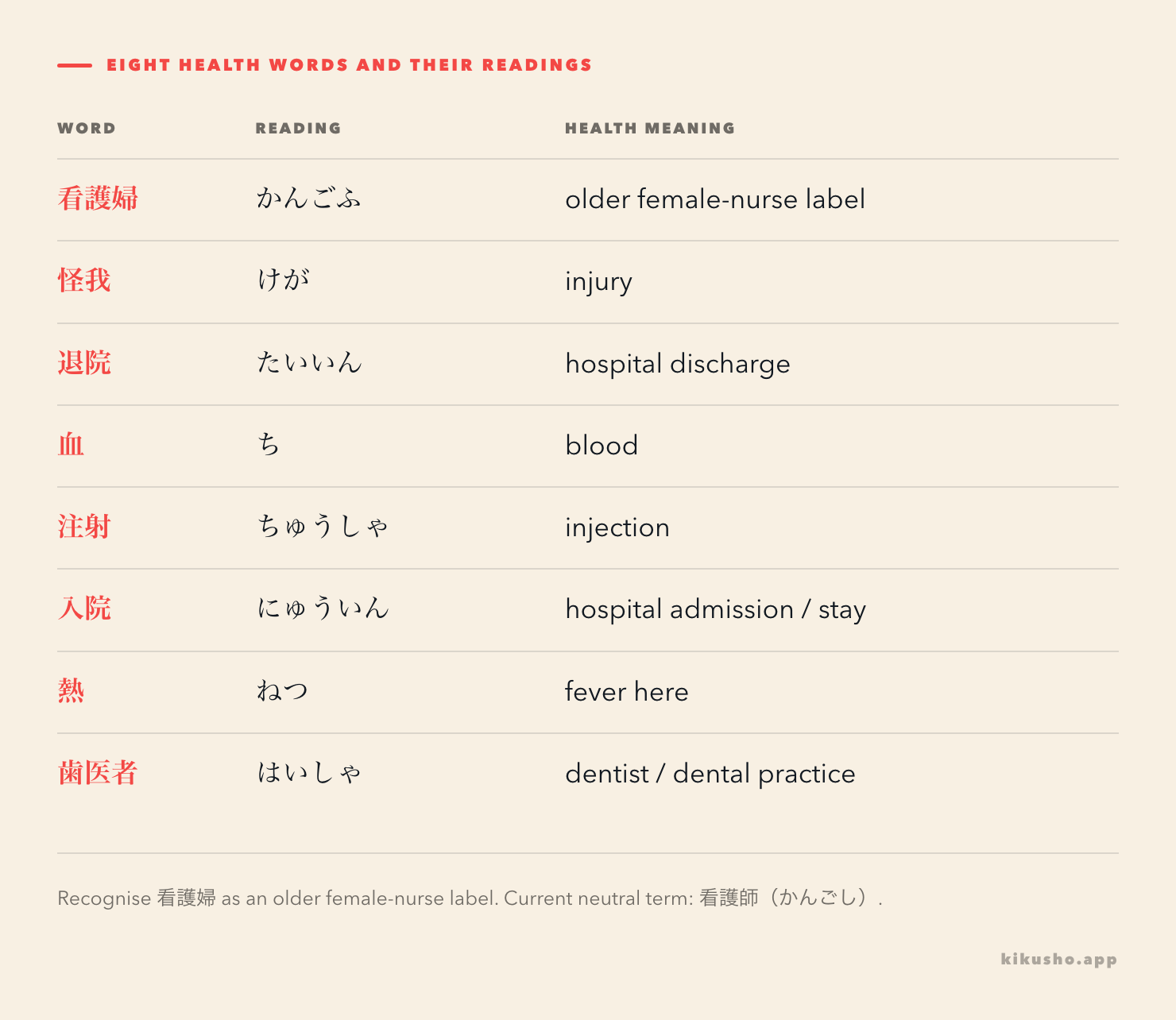
The readings are whole-word information. にゅういん has small ゅ and a long う; ちゅうしゃ has both small ゅ and small ゃ. In たいいん, keep the two written い: 退 is たい, followed by 院 いん. 歯医者 starts with は, the tooth reading, then いしゃ. The kanji-reading guide explains why a compound can mix native and borrowed readings; the N4 compound lesson gives further practice with sound blocks.
Injury, blood and fever need different predicates
怪我 names an injury. To report getting injured, add する:
昨日、足を怪我しました。
きのう、あしをけがしました。
I injured my foot or leg yesterday.
足 can refer to a foot or a leg; the situation identifies the area. 怪我をしました is another way to report that you got injured without naming the part. The dictionary entry for 怪我 marks it as a noun that combines with する. Learning only the English gloss “to injure” would hide that structure and could suggest a verb for injuring somebody else. In these sentences, the person reporting the injury is the person hurt. You will also see the spelling けが.
血 is blood. With 出る(でる), you describe it coming out:
手から血が出ています。
てからちがでています。
My hand is bleeding.
から supplies the place it is coming from. 出ています presents the bleeding as ongoing. Daijisen and the independently edited Kanjipedia entry verify the reading ち and physical blood sense. Blood is not the injury itself: 怪我 names the injury, while 血が出る describes bleeding.
熱 takes ある when you report a fever:
今朝から熱があります。
けさからねつがあります。
I have had a fever since this morning.
今朝(けさ) is “this morning.” The Japan Foundation's Irodori health lesson uses 熱がある among short symptom phrases. The dictionary also records heat and enthusiasm senses, so 熱 does not always concern illness. The health context is what selects fever here. It is a noun in this phrase, not an adjective meaning “hot.”
Admission and discharge describe a stay, not every visit
入院する means being admitted to hospital for a stay. 退院する means being discharged after being an inpatient. Jitenon's 入院 definition includes spending a period in hospital; its 退院 definition specifies somebody who had been admitted. That prior stay is the distinction to keep.
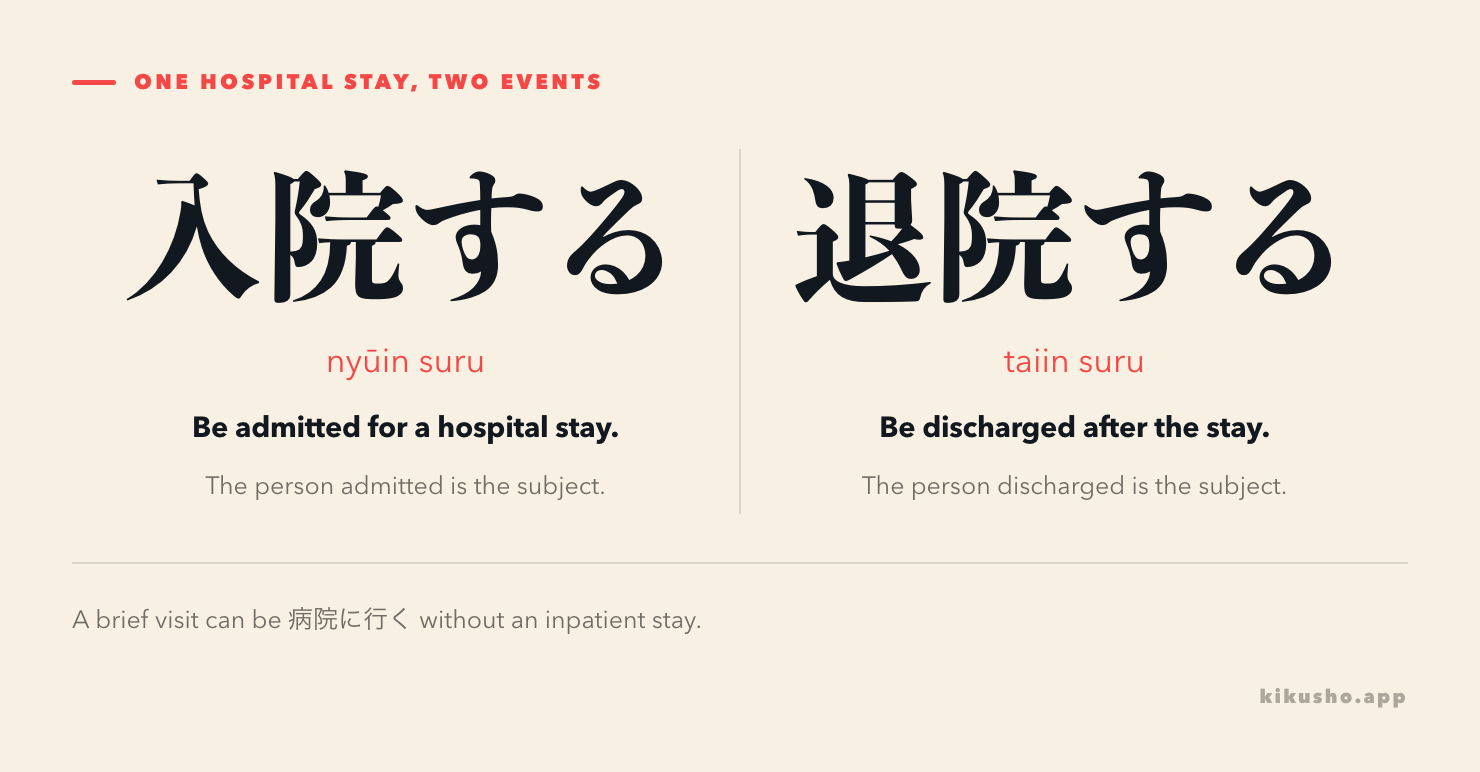
祖母は先週入院して、今日退院しました。
そぼはせんしゅうにゅういんして、きょうたいいんしました。
My grandmother was admitted last week and was discharged today.
祖母(そぼ) is one's own grandmother, and 先週(せんしゅう) means “last week.” 入院して connects the earlier admission to the later discharge. The subject remains the grandmother. 入院する does not by itself mean that this subject hospitalises somebody else; Bunpro explicitly classifies both verbs as intransitive.
For an ordinary visit, 病院に行きます says you are going to the hospital. It does not establish an inpatient stay. Similarly, 病院から帰りました can report returning from hospital without saying you were discharged as a patient. Choose 退院しました when the hospital-stay event is the fact you intend to report.
An injection noun does not identify who receives it
注射 is the injection. The Japanese dictionary gives its する construction, and Shogakukan's bilingual entry distinguishes the act of giving an injection. When you mean receiving one, use a verb that makes that role explicit:
病院で注射を受けました。
びょういんでちゅうしゃをうけました。
I received an injection at the hospital.
受ける(うける) means “receive” in this pairing. で marks where the procedure took place, and を marks what was received. The ALC dictionary results list receiving and giving collocations separately. In a story where the speaker is a patient, retaining 受けました avoids making the listener work out the role from the injection noun alone.
That does not turn every conversational 注射をする into an error: context can supply whose procedure is being arranged. The useful distinction is the explicit wording. 注射を受ける identifies receiving; a clinician saying 患者に注射をする identifies giving it to the patient. This lesson's collocation is the former.
A dentist can be the person or the place you are going
歯医者 is a dentist. In ordinary conversation, it can also refer to the practice, as the Japanese dictionary's second entry explains.
明日、歯医者の予約があります。
あした、はいしゃのよやくがあります。
I have a dentist's appointment tomorrow.
予約(よやく) is the booking; の connects it to the dentist or practice. Shogakukan's 予約 examples include a dental appointment. If you simply report where you are heading, 歯医者に行きます gives “I am going to the dentist.” Neither phrase says you are being admitted for a hospital stay.
Recognise 看護婦 while keeping the current nurse term available
看護婦(かんごふ) is an older label for a female nurse. It remains in the assigned historical study-list record, so deleting it would conceal the word you may encounter. Daijisen and the Japanese national dictionary describe its female reference and older or colloquial status.
The present professional term for either gender is 看護師(かんごし). The health ministry's historical table records the name change taking effect in March 2002, and the current dictionary entry explains the neutral name. Recognising 看護婦 and choosing 看護師 for a current professional description serve different purposes.
For a word taken from an old book, preserve the old form as what the author wrote. In Kikusho's editable register note, record its older female reference and add the current 看護師 reading beside it. That keeps a captured historical line useful without making its job label the default for a conversation today.
Eight attempts before the answer block
N4 vocabulary questions include reading kanji, choosing written forms, meaning in context, paraphrase and usage in the JLPT task table. The original prompts here sample those tasks. Work through the whole set before scrolling to the explanations.
Question 1. An older vocabulary record gives 看護婦. Write its reading in hiragana.
Question 2. Select the written word read ちゅうしゃ that means an injection.
A. 怪我 B. 注射 C. 退院 D. 歯医者
Question 3. Complete a report of hurting your foot or leg yesterday: 昨日、足を(_____)しました。 Select the injury word.
A. 熱 B. 血 C. 怪我 D. 歯医者
Question 4. Interpret the whole account: 祖母は先週入院して、今日退院しました。 Which option preserves both events and their order?
A. The grandmother made a brief hospital visit today, with no stay mentioned.
B. The grandmother became a nurse last week.
C. The grandmother was admitted today, after being discharged last week.
D. The grandmother began a hospital stay last week and was discharged today.
Question 5. Which sentence explicitly says that the speaker received an injection? 患者(かんじゃ)means “patient.”
A. 私は注射を受けました。
B. 私は患者に注射をしました。
C. 私は「注射」という言葉を読みました。
D. 私は歯医者の予約をしました。
Question 6. Choose the noun for a fever in 今朝から(_____)があります。 Keep the requested health meaning.
A. 退院 B. 熱 C. 血 D. 怪我
Question 7. 手から血が出ています reports what is happening. Choose its meaning.
A. The speaker's hand is bleeding.
B. The speaker has a fever.
C. The speaker is being discharged.
D. The speaker is receiving an injection.
Question 8. In 明日、歯医者の予約があります, how is 歯医者 read, and what appointment does it identify?
Pause here if you still need to check an ending or reading. The numbered explanations begin below.
Answers and explanations
Answer 1. かんごふ. The last character is read ふ in this older female-nurse word. The current professional label 看護師 has the different final reading し; replacing that final sound would not read the word printed in the question.
Answer 2. B, 注射. Read ちゅうしゃ. 怪我 is けが, an injury; 退院 is たいいん, discharge; 歯医者 is はいしゃ, a dentist. An English “shot” here is an injection, so the requested sense is also part of the choice.
Answer 3. C, 怪我. 昨日、足を怪我しました reports the injury. 怪我 combines with する, giving polite past しました. 熱 and 血 name fever and blood; they do not supply the injury action in this frame. 歯医者 names a person or practice. The noun's partner matters as well as its translation.
Answer 4. D. 先週入院して places admission last week; 今日退院しました places discharge today. A loses the inpatient stay, B changes the role, and C reverses the dates. The sentence reports those hospital events; it does not by itself prove that every symptom has disappeared.
Answer 5. A. 注射を受けました states receiving the procedure. In B, the speaker gives it to the patient, marked by に. C reports reading the word and D making a dental booking. They are possible reports of other actions, but do not express the receiving event requested here.
Answer 6. B, 熱. 今朝から熱があります says the fever has been present since this morning. 血 is blood, 怪我 is injury and 退院 is discharge. A different noun with あります might form another statement in another setting; the target here is specifically a fever.
Answer 7. A. 血(ち) names blood and 手から says it comes from the hand. 出ています presents the bleeding as ongoing. B would concern 熱, C 退院 and D 注射を受ける, so those options change the event rather than translating it.
Answer 8. はいしゃ, identifying a dentist's appointment. 歯 supplies は and 医者 supplies いしゃ; 予約(よやく) is the booking. It is not the reading いしゃ of 医者 alone, nor a statement about an inpatient hospital stay.
Cover the English column and retrieve a phrase for each current health word. Then change the cue: hear or read the kana, write the word, and decide whether your sentence reports a symptom, a procedure, an appointment or a stay. Keep the older nurse label on a separate recognition cue with its register note visible when you check it.
Common questions
Does 入院する mean any visit to a hospital?
No. 入院する(にゅういんする) means being admitted for a hospital stay. A visit can be 病院に行く without admission. 退院する(たいいんする) is discharge after being an inpatient, rather than simply leaving after a consultation.
Is 怪我 a noun or a verb?
怪我(けが) is a noun meaning injury. With する, 怪我をする or 怪我する means getting injured. 怪我をしました is a polite past report. The bare noun is not a transitive verb meaning to injure someone else.
Should I call a nurse 看護婦 today?
看護婦(かんごふ) is an older female-nurse label, still recognisable in old books and some speech. The current professional term for a nurse of either gender is 看護師(かんごし). Recognise the older word while keeping the current term available for present-day conversation.
Are these eight words an official N4 hospital list?
They are the eight entries assigned to this lesson by Kikusho's reference inventory, whose baseline study lists place them at N4. Other editorial labels can differ: Bunpro's consulted 退院 page displays N2. The JLPT organisers supply no exhaustive official vocabulary specification.