On this page
A notice can announce a rule, add an exception and give a practical detail in three short sentences. The connectors ただし and なお tell you which job each sentence does; したがって, すなわち, 及び and 並びに organise conclusions, restatements and lists in similar formal settings.
These are useful words for reading notices, reports and prepared explanations. Calling them “words that only exist in writing” would go too far. Formal speech uses some of the same vocabulary: a presentation can draw a conclusion, and a ceremony can name two groups of guests. Wasabi's register table groups したがって, すなわち, および and ならびに among formal conjunctions.
Six words tell you how the pieces fit
The shared skill is recognising relationships. You may understand every noun in a paragraph and still mistake an exception for an extra benefit. These connectors help you read what the writer is doing with the information.
| Headword and spelling | Reading | Part of speech here | Sense taught | Useful combination |
|---|---|---|---|---|
| 従って / したがって | したがって | Conjunction | Therefore; consequently | したがって、変更が必要だ: therefore, a change is necessary |
| なお / 尚 | なお | Conjunction; also adverb | A further note; separately, still | なお、詳細は…: further details…; 今もなお: still, even now |
| 但し / ただし | ただし | Conjunction | With this condition or exception | ただし、予約が必要です: however, a reservation is required |
| 即ち / すなわち | すなわち | Conjunction | That is; namely | A、すなわちB: A, that is B |
| 及び | および | Conjunction | And; as well as | 氏名及び住所: name and address |
| 並びに | ならびに | Conjunction | And, in a formal enumeration | 学生並びに教職員: students and faculty/staff |
Readings in the last column: 変更 へんこう, 必要 ひつよう, 詳細 しょうさい, 予約 よやく, 氏名 しめい, 住所 じゅうしょ, 学生 がくせい, 教職員 きょうしょくいん.
This lesson sits in N2 vocabulary, but the words cross study-list boundaries. Our dated reference inventory, derived from Jonathan Waller's lists, places したがって and なお at N3, ただし at N2, and 及び, すなわち and 並びに at N1. The first pair are prerequisites revisited in a reading context; the last three reach ahead. The JLPT FAQ explains why there is no published exhaustive vocabulary specification for the current test. Treat those labels as preparation guidance.
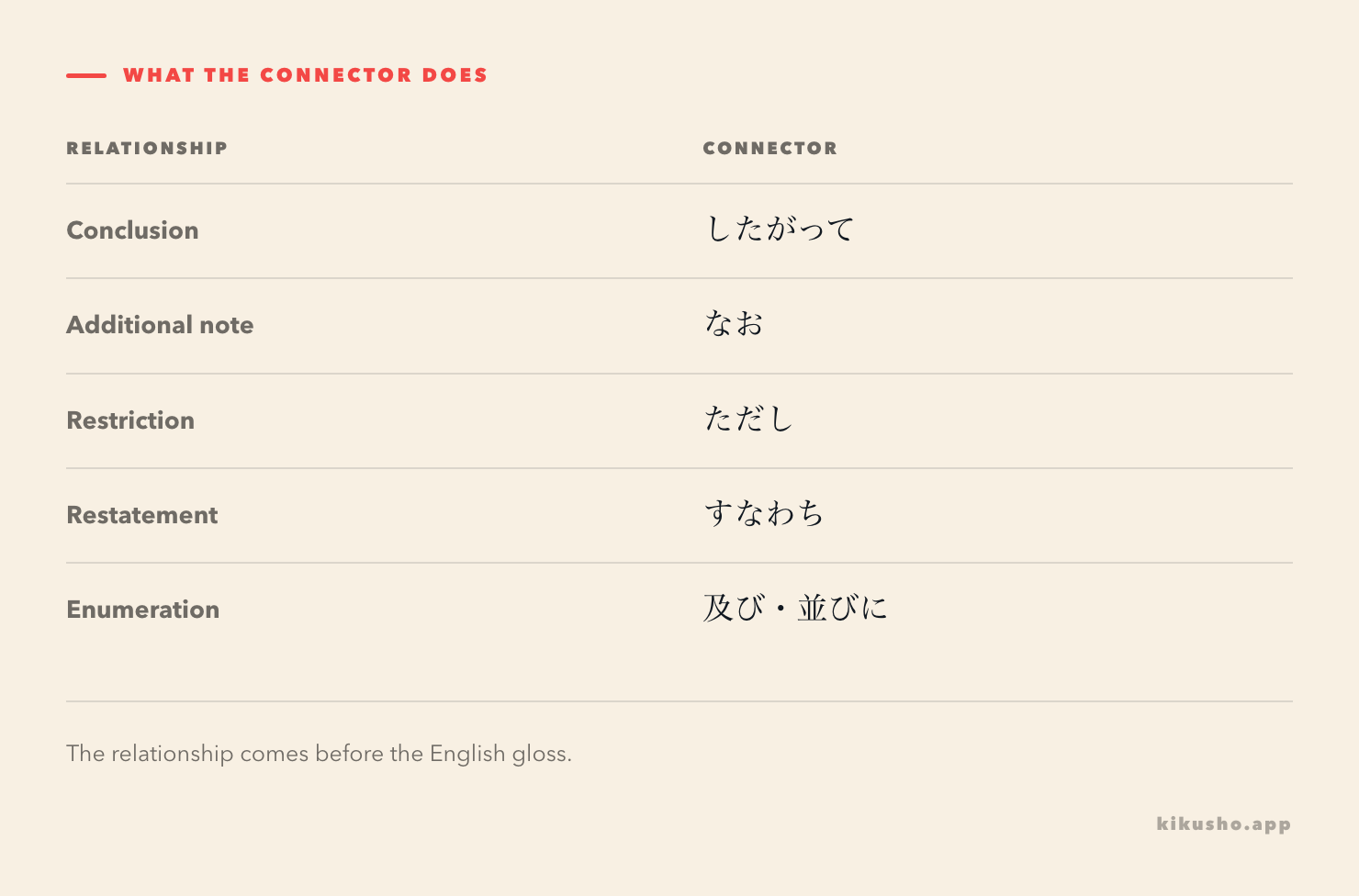
Follow the conclusion, the extra note or the restriction
したがって draws a conclusion
この部屋には窓がない。したがって、外の景色は見えない。
このへやには まどがない。したがって、そとのけしきは みえない。
This room has no window. Consequently, you cannot see the view outside.
The second sentence follows from the first. In the dictionary's conjunction entry, that consequence is the central relationship. This is useful in a reasoned explanation, where a conversational だから may feel less suited to the surrounding prose.
Watch the same spelling inside a clause: 説明に従って書く(せつめいにしたがってかく)means “write following the instructions.” Here 従って is the て-form of the verb 従う, “follow,” with に marking what is followed. It does not mean “therefore.” Sentence position and the preceding particle distinguish the two uses.
なお adds a separate detail
説明会は午後二時に始まります。なお、資料は入口で配ります。
せつめいかいは ごごにじに はじまります。なお、しりょうは いりぐちで くばります。
The information session starts at two in the afternoon. Please also note that materials will be handed out at the entrance.
The materials are an additional practical detail. Their location is not a consequence of the starting time. As Daijisen's entry for なお shows, this sentence-connecting use differs from the adverb in その店は今もなお営業している(そのみせは いまもなお えいぎょうしている), “That shop is still operating.” The adverb describes a continuing situation. An automatic translation of every なお as “furthermore” loses that distinction.
ただし limits the statement just made
この部屋は自由に使えます。ただし、飲食は禁止です。
このへやは じゆうに つかえます。ただし、いんしょくは きんしです。
You may use this room freely. However, eating and drinking are prohibited.
The permission has a boundary. ただし explicitly introduces that qualification, consistent with the dictionary's condition-and-exception sense. Translating it as “however” works here, provided you retain its connection to the preceding permission.
なお can introduce information that happens to include a condition, so the two words are not mechanically forbidden from similar contexts. The useful distinction is the writer's emphasis: ただし foregrounds a restriction; なお announces an added note. For concession in an argument, where a fact holds despite a reservation, compare ものの and とはいえ.
Restating one thing differs from listing two
すなわち gives the same thing another description
一週間、すなわち七日間です。
いっしゅうかん、すなわち なのかかんです。
It is one week, that is, seven days.
The two expressions identify the same duration. In this use, すなわち provides an equivalent formulation. It does not merely select an example from a larger category. “Fruit, namely apples” would misleadingly equate the category with one member unless the context had already restricted the fruit in question. The dictionary entry records reformulation and identity alongside other senses; those are the two relevant to this reading task.
及び and 並びに join items
氏名及び住所を記入してください。
しめい および じゅうしょを きにゅうしてください。
Please enter your name and address.
学生並びに教職員が参加します。
がくせい ならびに きょうしょくいんが さんかします。
Students and faculty/staff will participate.
Both words coordinate the named items. Daijisen's usage note for 及び allows considerable overlap in ordinary formal language, including ceremonial contexts. You cannot infer a rigid hierarchy whenever you encounter 並びに on its own. Its separate entry likewise gives the coordinating sense.
There is a more specific convention in legal drafting: 及び joins the smallest group, while 並びに joins larger groupings. This is a reading convention described by JILPT researcher 木原亜紀生, not a rule that governs every everyday list. The letters below show the structure without requiring you to interpret a legal provision.
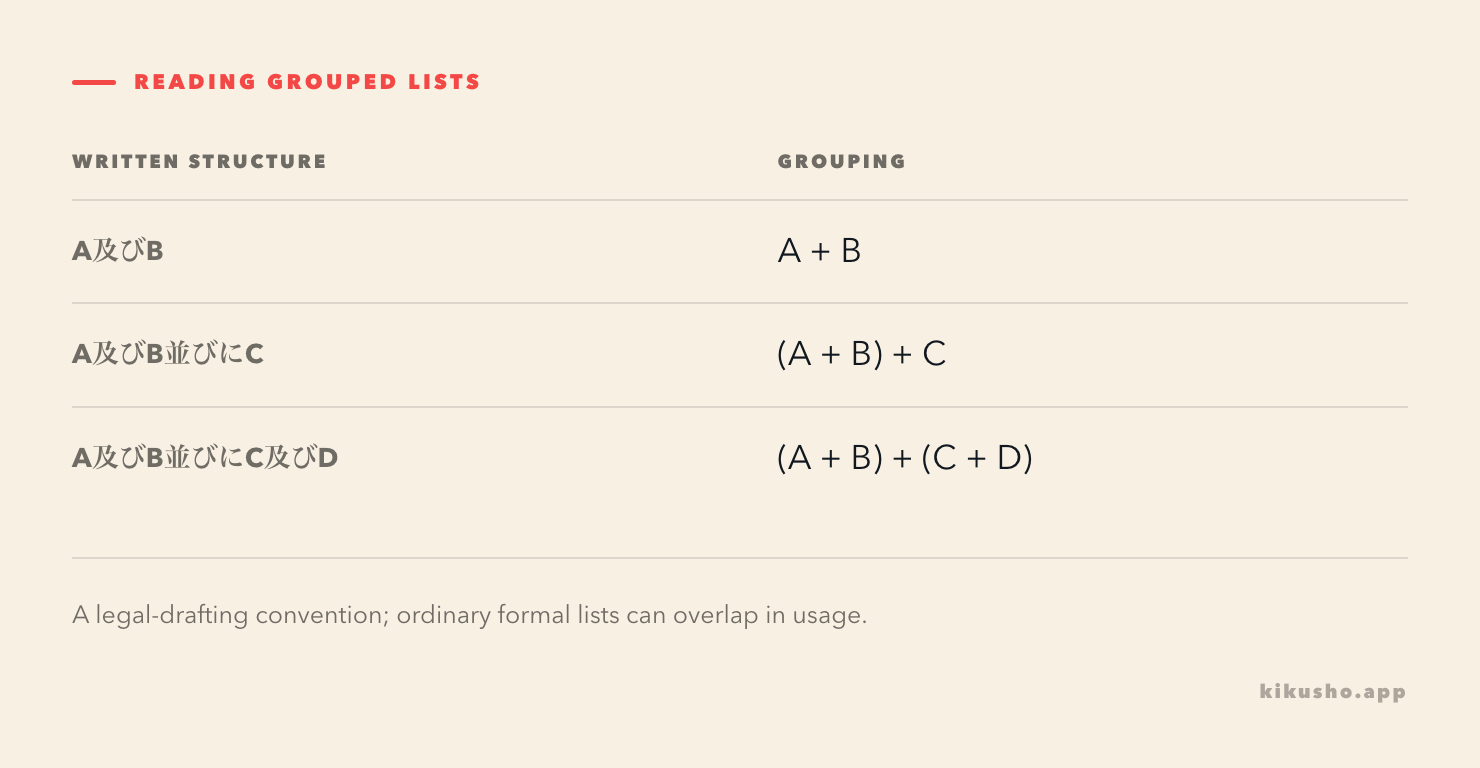
| Structure | How to group it |
|---|---|
| A及びB | A + B |
| A及びB並びにC | (A + B) + C |
| A及びB並びにC及びD | (A + B) + (C + D) |
Two traps survive a vocabulary lookup
Script does not settle register. したがって and すなわち retain their formal functions when written in hiragana. Recognising a kanji spelling helps with reading, but converting every connector into kanji is not how you make prose appropriate. A publication's spelling conventions and a word's social setting are separate questions.
A connector can become part of a noun. The related word ただし書き(ただしがき), a noun meaning a proviso or qualifying note, contains ただし plus 書き. In this compound the か of かき becomes が. Learn the whole reading; this example does not imply that every compound voices its second element.
小さな字のただし書きも読んでください。
ちいさなじの ただしがきも よんでください。
Please read the small-print qualification too.
The dictionary entry for 但書 connects the noun with an added explanation, condition or exception. This related noun is extra vocabulary for the lesson, without a claimed JLPT level.
Start with the notices you already need to read
Read a venue notice for ただし and なお: one tells you what qualifies the main statement, the other directs attention to another detail. In an explanation, follow したがって to the conclusion and すなわち to the reformulation. Registration forms and formal invitations give you reasons to recognise 及び and 並びに. For the nouns and collocations around those connectors, continue with the N2 newspaper vocabulary lesson.
If you save a notice in Kikusho, capture enough of the preceding sentence to preserve the relationship. A card containing only “なお = also” hides precisely what you need to distinguish from “still.” The card's editable example and register note give you somewhere to keep that distinction after a text capture.
Practice: six questions
Choose one option per question. Finish the set before scrolling to the answer section.
Question 1: read the connector
Read 氏名及び住所 aloud. Select the pronunciation for the connector 及び.
- A. および
- B. ならびに
- C. すなわち
- D. したがって
Question 2: recognise the written form
Select the kanji spelling of ただし when it introduces a condition.
- A. 正し
- B. 但し
- C. 直し
- D. 足し
Question 3: build the noun
Complete the noun meaning a qualifying note or proviso.
説明の最後に( )書きがある。
- A. すなわち
- B. 及び
- C. ただし
- D. なお
Question 4: read the condition
この会場では写真を撮れます。ただし、フラッシュは使えません。
Which statement matches the notice?
- A. Every kind of photography is prohibited.
- B. Flash photography is required.
- C. Only flash photography is permitted.
- D. Photography is permitted, but using flash is prohibited.
Question 5: paraphrase the relationship
受付期間は二週間、すなわち十四日間です。
What does the part after すなわち do?
- A. Names an additional period after the two weeks.
- B. Gives the same duration in days.
- C. Explains why applications are necessary.
- D. Gives one example of a shorter period.
Question 6: identify the adverbial use
Which sentence uses なお to mean “still,” describing a continuing situation?
- A. 会場は二階です。なお、入口は一階にあります。
- B. 受付は九時からです。なお、予約は不要です。
- C. その建物は今もなお使われている。
- D. 会議は明日です。なお、資料はメールで送ります。
Answers and explanations
Answer 1
A: および. The notice requests a name and an address. ならびに is the reading of 並びに; the other choices are readings of different connectors. Neither the meaning “and” nor a formal setting changes 及び's reading to ならびに.
Answer 2
B: 但し. The kana spelling ただし is also usable. 正し belongs to the stem of 正しい, “correct”; 直し and 足し are associated with different verbs. They do not spell this qualifying conjunction.
Answer 3
C: ただし. The completed word is ただし書き, read ただしがき. The sentence says, “There is a qualifying note at the end of the explanation.” The other connectors do not form the noun required by this meaning. Notice both the selected element and the voiced が in the completed word.
Answer 4
D. You can take photographs at this venue, with the restriction that you cannot use flash. The first sentence gives permission; ただし then limits it. A erases the permission, while B and C reverse the flash restriction. 撮る is とる; 会場 is かいじょう.
Answer 5
B. Two weeks and fourteen days are equivalent descriptions of the application period. Nothing adds a second period, supplies a reason or singles out a shorter example. Read 受付期間 as うけつけきかん and 十四日間 as じゅうよっかかん.
Answer 6
C. “That building is still being used.” 今もなお marks continuation within one sentence. In A, B and D, なお introduces another piece of information: the entrance location, the lack of a reservation requirement and how materials will be sent. Read 建物 as たてもの and 使われている as つかわれている.
Common questions
Are these Japanese connectors used only in writing?
No. They suit formal prose, but several also occur in presentations and ceremonial speech. Formality describes the setting and relationship, not whether a sentence can be spoken aloud.
Are all six words N2 vocabulary?
This is an N2 reading lesson with material from adjacent levels. The reference inventory places したがって and なお at N3, ただし at N2, and 及び, すなわち and 並びに at N1. These are study-list estimates rather than an official exhaustive JLPT syllabus.
Does なお always mean still?
As an adverb it can mean still, including in 今もなお. As a conjunction introducing another sentence, it adds a further note. Identify its job before choosing an English translation.