On this page
この通りをまっすぐ進み、町の真ん中で右に曲がってください。 An N4 route adds more than another landmark: you can ask for 案内, read the 表 and 裏 of a map, notice something 途中, continue with 進む, or correct a mistake with 戻る.
The eight assigned records are 案内(あんない), 裏(うら), 表(おもて), 進む(すすむ), 通り(とおり), 途中(とちゅう), 真ん中(まんなか) and 戻る(もどる). Learn them as parts of one route, while keeping three contrasts clear: front versus back, forward versus back, and an unfinished path versus its central point.
Eight words divide a route into information, place and movement
| Assigned word | Word class and route sense | Phrase to keep |
|---|---|---|
| 案内(あんない) | noun and する verb: guidance; guide someone | 駅まで案内する, guide someone to the station |
| 表(おもて) | noun: front, face or outside | 地図の表, the front of the map |
| 裏(うら) | noun: back, reverse side or hidden side | 地図の裏, the back of the map |
| 進む(すすむ) | godan intransitive verb: advance, proceed | この道を進む, proceed along this road |
| 通り(とおり) | noun: street, avenue | にぎやかな通り, a busy street |
| 途中(とちゅう) | noun and adverbial noun: on the way; before completion | 駅へ行く途中, on the way to the station |
| 真ん中(まんなか) | noun: exact or understood centre | 町の真ん中, the centre of town |
| 戻る(もどる) | godan intransitive verb: return, go back | 元の場所に戻る, return to the original place |
The N5 map lesson supplies 地図, 角 and 渡る. This lesson takes the next step: following a longer instruction, locating information on two sides of a sheet, and repairing a route after a wrong turn.
案内 can be information or the act of guiding someone
案内 is a noun that also combines with する. The Shogakukan dictionary entry records both leading someone who does not know the way and supplying information. The sentence decides which side is active:
駅員が旅行者を改札まで案内した。
えきいんが りょこうしゃを かいさつまで あんないした。
A station employee guided the traveller to the ticket gate.
案内所で町の地図をもらった。
あんないじょで まちの ちずを もらった。
I received a town map at the information centre.
In the first sentence, 旅行者を marks the person guided and 改札まで names the endpoint. In the second, 案内所(あんないじょ) is a place that provides information. You will also see 案内図, guide map; 観光案内, tourist information; and 道案内, directions or showing the way.
The source gloss “to guide” is therefore incomplete by itself. A sign saying 館内案内 is not an imperative telling the building to guide somebody. It labels information about the inside of the building.
表 and 裏 identify two sides before they describe two streets
For a printed sheet, 表(おもて) is the main or front face and 裏(うら) is the reverse. Shogakukan defines 表 as the principal one of two faces and 裏 as its opposite; Kanjipedia independently gives 裏 for the side opposite the front.
地図の表には町の地図があり、裏にはバスの時刻表がある。
ちずの おもてには まちの ちずが あり、うらには バスの じこくひょうが ある。
The town map is on the front of the sheet, and the bus timetable is on the back.
The contrast extends from objects to a town. 表通り(おもてどおり) is a main or prominent street; 裏通り(うらどおり) is a back street. The difference is about the street's position and public face, not the two asphalt surfaces of one road:
表通りから一本入ると、静かな裏通りがある。
おもてどおりから いっぽん はいると、しずかな うらどおりが ある。
One street in from the main road, there is a quiet back street.
Do not replace 表 with 前 automatically. 建物の前 is the space in front of a building. 紙の表 is the front face of a sheet. The N5 location-word lesson handles 前, 後ろ, 横 and 隣 as positions around a reference point.
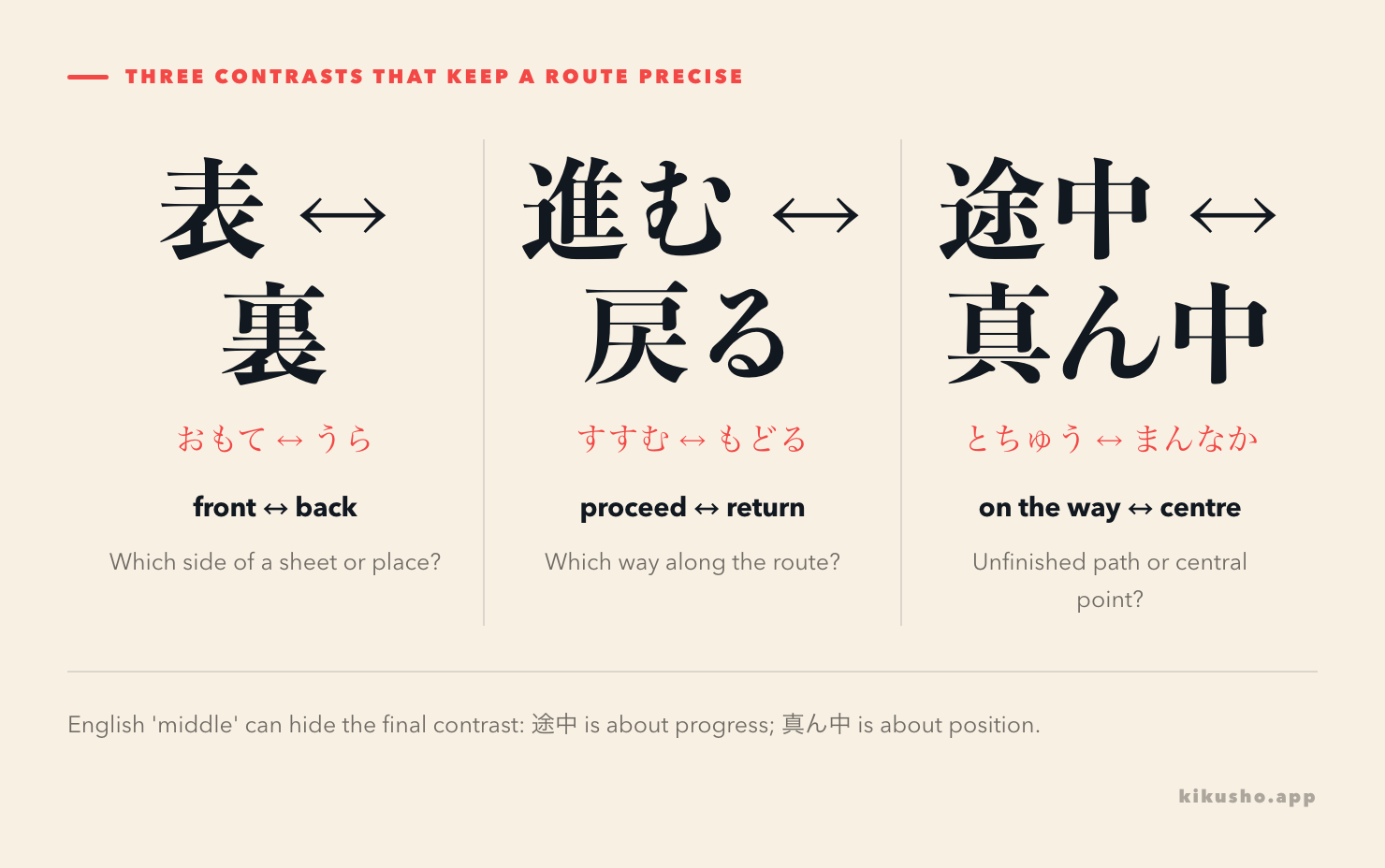
進む and 戻る reverse the route without forming a verb pair
進む(すすむ) describes movement ahead or progress. 戻る(もどる) describes returning to an earlier place, direction or state. Both are intransitive godan verbs:
この通りをまっすぐ進んでください。
この とおりを まっすぐ すすんで ください。
Please proceed straight along this street.
道を間違えたら、案内所まで戻ってください。
みちを まちがえたら、あんないじょまで もどって ください。
If you take the wrong road, please go back to the information centre.
With 進む, 通りを marks the route followed. With 戻る, 案内所まで gives the return endpoint. The verbs oppose each other in this scene, but they are not a transitive and intransitive morphological pair. 進める(すすめる) can move something forward or advance a plan; 戻す(もどす) puts something back:
読み終わったら、地図を元の場所に戻してください。
よみおわったら、ちずを もとの ばしょに もどして ください。
When you finish reading it, please return the map to its original place.
Here the map is the object marked by を, so 戻す is required. 自分が戻る and 地図を戻す describe different participants.
通り is a street here, but the same reading carries another pattern
As an independent noun, 通り(とおり) can mean a road or street used by people and vehicles. The dictionary entry gives にぎやかな通り and also records the voiced compound form どおり in street names such as 銀座通り(ぎんざどおり).
この通りは車が多い。
この とおりは くるまが おおい。
This street has a lot of traffic.
大通りを渡ると、駅が見える。
おおどおりを わたると、えきが みえる。
When you cross the main street, you can see the station.
The same spelling also means “in the same way” or “in accordance with”:
案内図の通りに進んでください。
あんないずの とおりに すすんで ください。
Please proceed as shown on the guide map.
The first この通り names a street because cars travel on it. 案内図の通りに compares your action with the route shown. Learn the construction around the word rather than assigning one English gloss to every 通り.
The dated source inventory itself shows a level disagreement: one Waller-derived list places 通り at N4 for the street sense, while another places the combined street and “in accordance with” entry at N3. JapaneseTest4You also indexes the headword at N3 despite an N4 label in its page URL. This lesson keeps the concrete street sense at N4 and introduces the second sense as a contrast, without claiming an official boundary.
途中 ends before the goal; 真ん中 sits between the edges
途中(とちゅう) locates an event before a route, time span or activity has finished. It does not promise an exact halfway point:
駅へ行く途中で雨が降り始めた。
えきへ いく とちゅうで あめが ふりはじめた。
It started raining on the way to the station.
説明の途中で質問した。
せつめいの とちゅうで しつもんした。
I asked a question during the explanation.
Shogakukan's 途中 entry covers both spatial and temporal progress and specifically associates it with being before the destination. The event may occur near the beginning, near the end or halfway through.
真ん中(まんなか) instead identifies the centre of a place, order or span. Its dictionary entry gives both spatial and sequential centres:
町の真ん中に広場がある。
まちの まんなかに ひろばが ある。
There is a square in the centre of town.
通りの真ん中に立たないでください。
とおりの まんなかに たたないで ください。
Please do not stand in the middle of the street.
Use 途中 when the unfinished journey or activity matters. Use 真ん中 when the relationship to both ends or edges matters. “In the middle” hides that distinction in English.
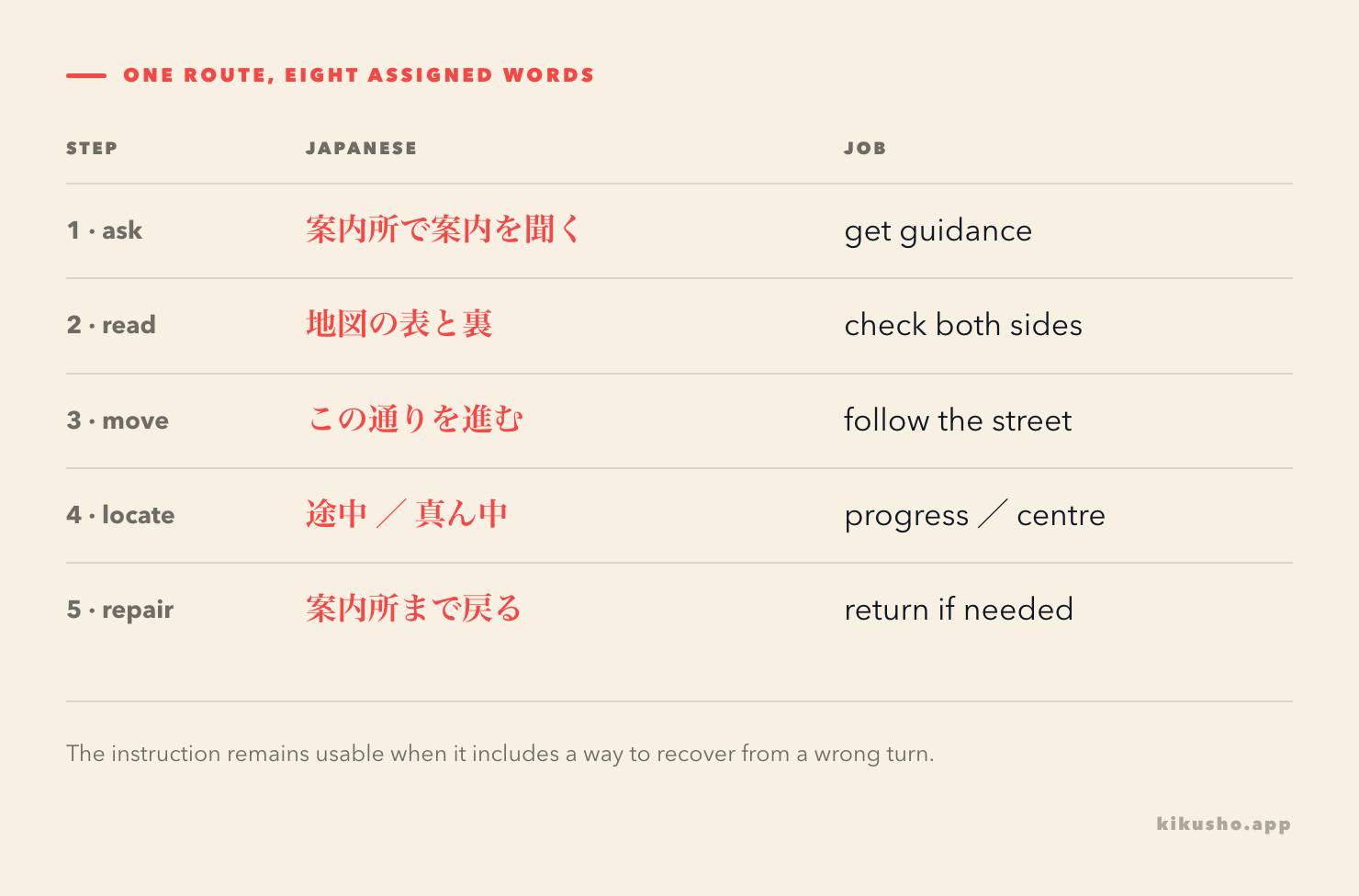
Read the complete instruction as one repairable route
案内所でもらった地図は、表に町の地図、裏にバスの時刻表が印刷されていた。係員は「この通りをまっすぐ進み、町の真ん中にある広場を通ってください。途中で道を間違えたら、案内所まで戻ってください」と案内してくれた。
あんないじょで もらった ちずは、おもてに まちの ちず、うらに バスの じこくひょうが いんさつされて いた。かかりいんは「この とおりを まっすぐ すすみ、まちの まんなかに ある ひろばを とおって ください。とちゅうで みちを まちがえたら、あんないじょまで もどって ください」と あんないして くれた。
The map from the information centre had a town map printed on the front and a bus timetable on the back. The attendant explained: “Go straight along this street and pass through the square in the centre of town. If you take a wrong road on the way, return to the information centre.”
This route is useful to save whole. In Kikusho, keep この通りを進む rather than a bare 進む card, and keep 駅へ行く途中 beside 町の真ん中. The surrounding nouns preserve which kind of path, side or middle the word named.
Independent learner references also group several of these items at N4: Amiko's direction list includes 案内, 進む, 戻る and 真ん中, while the separately published Pass Japanese Test list includes 通り, 途中 and 進む. These are study estimates. The JLPT publishes test specifications and sample formats, not an exhaustive official vocabulary list.
Follow the route before opening the explanations
Question 1: select the reading. Which reading belongs to 案内?
- ア. あない
- イ. あんない
- ウ. あんだい
- エ. あんうち
Question 2: orthography. Which kanji completes the phrase 地図のうら, “the back of the map”?
- ア. 表
- イ. 中
- ウ. 裏
- エ. 道
Question 3: context. Which verb completes a request to continue straight along this street?
この通りをまっすぐ__ください。
- ア. 戻って
- イ. 進んで
- ウ. 案内して
- エ. 終わって
Question 4: place the event on its route. Only one sentence uses 途中 for something that happens before arrival. Which one?
- ア. 町の途中に広場がある。
- イ. 紙の途中に名前を書く。
- ウ. 駅へ行く途中で友達に会った。
- エ. 通りの途中に立たないでください。
Question 5: contrast. You mean the exact centre of town. Complete the sentence.
町の__に広場がある。
- ア. 途中
- イ. 裏
- ウ. 案内
- エ. 真ん中
Question 6: meaning in context. What does 通り mean here?
この通りは車が多い。
- ア. as instructed
- イ. street
- ウ. reverse side
- エ. return route
Question 7: sentence composition. Put the chunks in a natural order to say, “If you take the wrong road, please return to the information centre.”
案内所まで / 道を間違えたら / 戻ってください
Question 8: paraphrase. Which sentence preserves the meaning of 案内図の通りに進んでください?
- ア. 案内図に書かれている道順に従って進んでください。
- イ. 案内図を裏返して戻ってください。
- ウ. 案内所の前の通りで止まってください。
- エ. 案内図の真ん中に進んでください。
Answers and explanations
1. 案内 is read あんない; choose イ. The noun and する verb are 案内(あんない). あない is a historical form recorded in dictionaries, but it is not the modern reading asked for here; the other choices do not read this word.
2. Choose 裏, option ウ. 地図の裏(ちずのうら) is the back or reverse side of a map sheet. 表 is its front face, 中 is inside or middle, and 道 is a road.
3. Use 進んで, option イ. この通りをまっすぐ進んでください asks someone to proceed straight along the street. 戻って reverses the movement, 案内して asks someone to guide, and 終わって means finish.
4. Choose ウ. 駅へ行く途中で友達に会った places the meeting before the trip to the station was complete. ア needs a central-place word such as 真ん中, イ needs a physical position on the paper, and エ normally asks for the centre or side of the street rather than an unfinished journey.
5. Insert 真ん中, option エ. 町の真ん中 identifies the town's centre. 途中 would focus on an unfinished route or process; 裏 is a back side, and 案内 is guidance.
6. It means “street,” option イ. Cars are numerous on this 通り, so the noun names a road used for traffic. In 案内図の通りに, the same reading means “as shown,” but that construction is absent here.
7. 道を間違えたら、案内所まで戻ってください。 The たら clause gives the condition, 案内所まで names the endpoint, and 戻ってください requests the return. 戻る is intransitive because the traveller goes back.
8. Choose ア. 道順に従う means follow the route, so ア restates “proceed as shown on the guide map.” イ turns the map over, ウ stops on a street, and エ treats 真ん中 as a destination that the original sentence never named.
Common questions
What does 案内 mean in Japanese directions?
案内(あんない) is guidance or information and can combine with する to mean guide or show someone around. 旅行者を駅まで案内する means guide a traveller to the station; 案内所 is an information centre.
What is the difference between 途中 and 真ん中?
途中(とちゅう) places something before a journey or activity reaches its end, as in 駅へ行く途中. 真ん中(まんなか) identifies a central position, as in 町の真ん中. Being halfway through and being in the geometric centre are different ideas.
How do you use 進む and 戻る in Japanese directions?
この道をまっすぐ進む means proceed straight along this road. 元の場所に戻る means return to the original place. Both are intransitive godan verbs; 戻す is the transitive verb for putting something back.
Is 通り read とおり or どおり?
The standalone noun is 通り(とおり), a street, as in この通り. In many street names and compounds it voices to どおり, as in 表通り(おもてどおり) and 大通り(おおどおり).