On this page
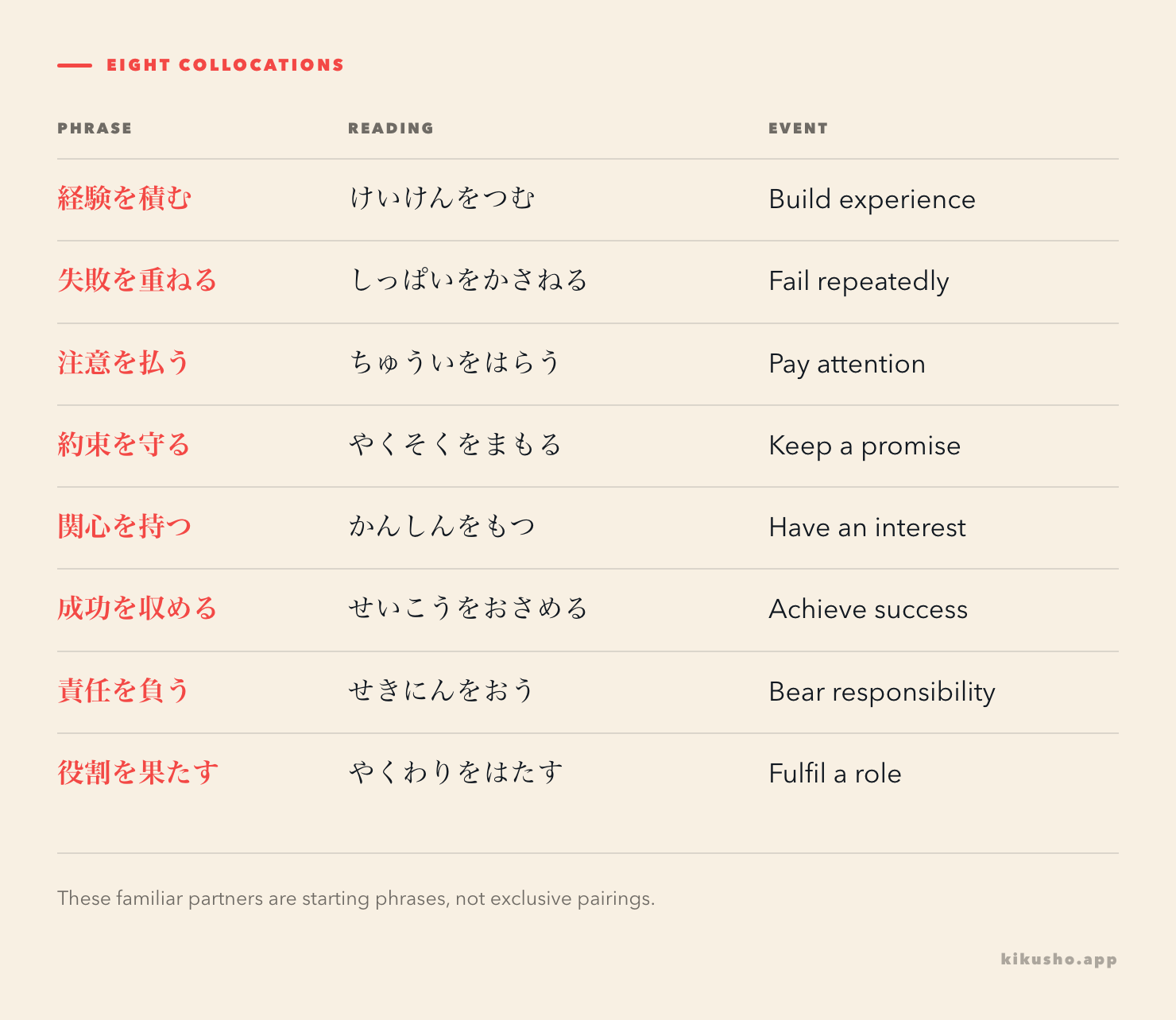
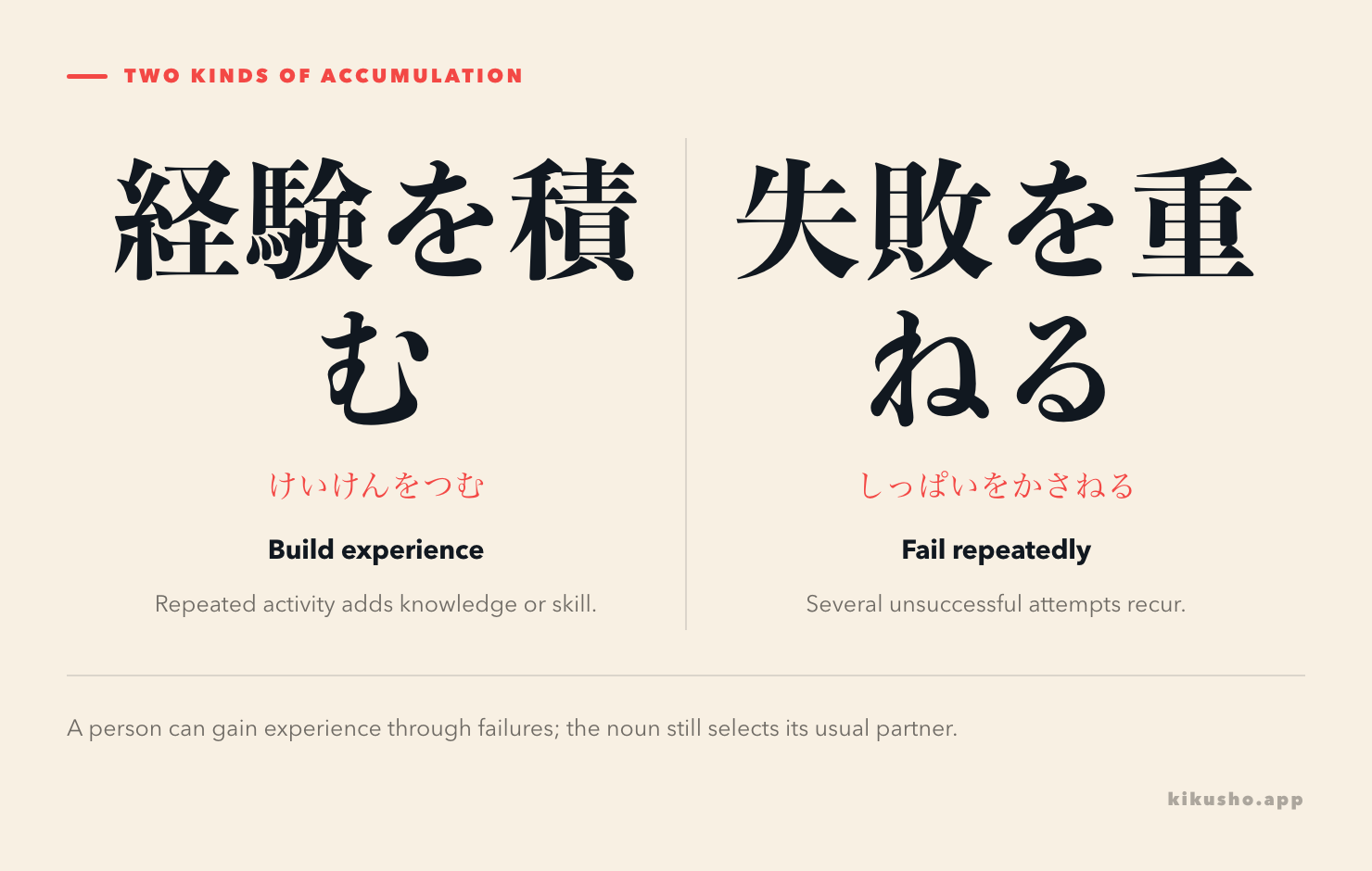
You can 経験を積む, accumulate experience, but repeated failures call for 失敗を重ねる. Japanese noun–verb collocations preserve that choice of partner: learn the noun, its reading and the action expressed by the complete phrase.
Eight phrases connect eleven headwords
This bounded set covers 経験、失敗、注意、約束、負う、関心、成功、責任、積む、守る、役割. Its phrases describe experience gained, failures repeated, attention directed, promises kept, interest held, success achieved, responsibility borne and roles fulfilled. Shared translations such as “have,” “take” or “do” cannot assemble all eight for you.
This is an N2 vocabulary practice lesson using earlier foundations. The planning inventory puts 経験、失敗、注意、約束 at N4, and 負う、関心、成功、責任、積む、守る、役割 at N3. Its Waller-derived lists share one ancestry. They disagree over 負う: N3/N1, and 積む: N3/N2. The current JapaneseTest4You 負う page even has an N2 heading but an N1 level field; its 経験 page says N4 despite “n3” in the URL. Treat these labels as study estimates, not an official exhaustive syllabus.
“Noun; する” below means the word also forms a verb with する. Godan names the conjugation class of the three standalone verbs.
| Headword | Reading | Word class | Sense used here | Familiar phrase |
|---|---|---|---|---|
| 経験 | けいけん | Noun; する | Experience; knowledge or skill gained through doing | 経験を積む: gain experience |
| 失敗 | しっぱい | Noun; する | Failure; an unsuccessful attempt or mistake | 失敗を重ねる: suffer repeated failures |
| 注意 | ちゅうい | Noun; する | Attention; also caution or a warning | 注意を払う: pay attention |
| 約束 | やくそく | Noun; する | Promise or arrangement; also an appointment | 約束を守る: keep a promise |
| 負う | おう | Godan verb | Bear or take on a responsibility | 責任を負う: bear responsibility |
| 関心 | かんしん | Noun | Interest or concern directed toward something | 関心を持つ: have an interest |
| 成功 | せいこう | Noun; する | Success; achieving an intended outcome | 成功を収める: achieve success |
| 責任 | せきにん | Noun | Duty; accountability for an outcome | 責任を負う: bear responsibility |
| 積む | つむ | Godan verb | Accumulate through repeated activity; also stack or load | 経験を積む: build experience |
| 守る | まもる | Godan verb | Keep or abide by; also protect or guard | 約束を守る: keep a promise |
| 役割 | やくわり | Noun | An assigned task, role or expected function | 役割を果たす: fulfil a role |
Read the additional partners as 重ねる(かさねる), 払う(はらう), 持つ(もつ), 収める(おさめる) and 果たす(はたす). They supply the verbs for this set; the page does not survey all their other senses.
Experience builds, while failures recur
経験 can name what you went through and the knowledge or skill that resulted. In 経験を積む, the emphasis is building experience through activity, rather than putting a physical object on a pile.
地元の店で働きながら、接客の経験を積んだ。
じもとの みせで はたらきながら、せっきゃくの けいけんを つんだ。
I gained experience serving customers while working at a local shop.
積む also stacks things or loads them onto a vehicle. トラックに荷物を積む(トラックに にもつを つむ) means loading luggage or goods onto a truck. The truck takes に; the things loaded take を. Daijisen's 積む entry distinguishes these senses and specifically contrasts the partners of 積む and 重ねる.
失敗 names an unsuccessful attempt or a mistake. A series of such attempts can be 失敗を重ねる.
方法を変えないまま、失敗を重ねてしまった。
ほうほうを かえない まま、しっぱいを かさねて しまった。
Without changing my method, I ended up failing repeatedly.
The same person might gain experience through those failures. That does not make 失敗を積む the usual wording for reporting them. 失敗を重ねる selects recurrence; 経験を積む selects experience accumulated. The noun helps you retrieve the intended phrase.
経験する and 失敗する are also standard verbs. 積む is not needed every time you talk about experience, and repeated failures are not the only sense of 失敗. Daijisen and Kanjipedia confirm 経験's event and gained-knowledge senses; Daijisen's 失敗 entry identifies the unsuccessful outcome.
Attention is directed; interest can persist
注意 has attention, caution and warning senses. 注意を払う directs attention or care toward something; it does not describe handing over money.
説明の細かい点にも注意を払ってください。
せつめいの こまかい てんにも ちゅういを はらって ください。
Please pay attention to the small details of the explanation too.
The target takes に, and 注意 takes を. Daijisen's 払う entry separates this attention sense from payment. Kanjipedia's 注意 entry also distinguishes concentration, a warning given to someone, and caution about danger.
関心 is interest or concern. With 関心を持つ, the object of that interest takes に.
私は地域の歴史に関心を持っている。
わたしは ちいきの れきしに かんしんを もって いる。
I am interested in the area's history.
This describes an interest, rather than instructing someone to concentrate on a detail now. Kanjipedia gives the interest sense and the 持つ pairing; Daijisen confirms the directed concern. Avoid replacing the separate verb with a guessed modern 関心する in this phrase.
The established compound 無関心(むかんしん) means having no interest or being indifferent: 地域の歴史に無関心だ, indifferent to the area's history. Daijisen confirms this form. It supplies the formation exercise below; the word-formation lesson explains why adding 無 is not a universal recipe for any noun.
Promises and success need the event kept in view
約束 can be a promise, an agreement or an appointment. 約束を守る means keeping the agreed commitment.
六時までに戻る約束を守った。
ろくじまでに もどる やくそくを まもった。
I kept my promise to return by six.
守る also protects or guards things; a promise selects abiding by the commitment. Kanjipedia's 守る entry explicitly records that pairing. Daijisen's 約束 entry and the JMdict-derived bilingual entry confirm the promise and arrangement meanings.
成功 reports that an intended outcome was achieved. 成功を収める retrieves that outcome with a separate verb.
新しい展示は大きな成功を収めた。
あたらしい てんじは おおきな せいこうを おさめた。
The new exhibition was a great success.
Read せいこう, not さいこう. The verb 収める is ichidan: 収めた, without small っ. This phrase is about obtaining a successful result, not placing success in a cupboard or paying it as a fee. Kanjipedia and Daijisen both record the success pairing.
The する version reorganizes the sentence: 新しい実験に成功した(あたらしい じっけんに せいこうした), succeeded in the new experiment. 実験に identifies what succeeded; 成功を in the exhibition sentence instead names the result obtained. Do not turn every noun in the first table into noun+を+する.
Responsibility is borne; a role is fulfilled
責任 can be a duty attached to a position or accountability for an outcome. 責任を負う means bearing or taking on that responsibility.
班長として、この作業の結果について責任を負っている。
はんちょうとして、この さぎょうの けっかについて せきにんを おって いる。
As team leader, I bear responsibility for the outcome of this work.
負う is おう, and its て-form is 負って(おって). Daijisen and Kanjipedia confirm the responsibility sense. This example does not need the verb's other meanings, such as carrying someone on your back or sustaining an injury.
役割 is the assigned task or expected function. In 役割を果たす, someone performs what that role calls for.
会議では、私は記録係としての役割を果たした。
かいぎでは、わたしは きろくがかりとしての やくわりを はたした。
At the meeting, I fulfilled my role as note-taker.
Daijisen's 役割 entry and JMdict's bilingual entry verify the noun's task and role senses. 役割 asks what part someone performs; 責任 can ask what they are accountable for. Their duty meanings overlap, so these starting phrases do not prohibit 責任を果たす.
The accomplishment-verb comparison develops 果たす alongside 達成する and 遂げる. It also includes 約束を果たす, carrying out what was promised. A noun can have several natural partners when the intended action changes.
Change the ending without losing the pair
The three standalone verbs in this set are godan. Keep both the dictionary reading and the inflected form, especially 負う → 負って.
| Dictionary form | Polite form | て-form | Plain past |
|---|---|---|---|
| 負う(おう) | 負います(おいます) | 負って(おって) | 負った(おった) |
| 積む(つむ) | 積みます(つみます) | 積んで(つんで) | 積んだ(つんだ) |
| 守る(まもる) | 守ります(まもります) | 守って(まもって) | 守った(まもった) |
In a work report you may encounter 責任を負う or 役割を果たす; an account of someone's training may use 経験を積む. Save enough of the encounter to identify the event. In Kikusho, paste the phrase and check the editable meaning and example before keeping the card. Recovering 注意を払う from an explanation and from a safety notice gives that same pairing two concrete settings to recall.
Language checks here use Shogakukan's Daijisen, the Japan Kanji Aptitude Testing Foundation's 漢検 漢字辞典 via Kanjipedia, and the separate JMdict project for the bilingual noun checks. They support readings and senses, rather than official level certification. The exercises are original; this page does not cover every dictionary sense of the eleven words.
Practice questions
Try all eight before scrolling to the explanations. The set samples kanji reading, spelling, word formation, context, paraphrase and usage for N2 preparation.
Question 1
Read the bold verb in this responsibility statement.
私がその責任を負った。
- A. ふった
- B. おいた
- C. おった
- D. まけた
Question 2
Which spelling supplies かんしん in the sense of an interest in local history?
私は地域の歴史に( )を持っている。
- A. 関心
- B. 感心
- C. 成功
- D. 注意
Question 3
Complete the established compound meaning indifferent or having no interest.
彼はその話題に( )関心だ。
- A. 再
- B. 最
- C. 未
- D. 無
Question 4
The speaker built experience through several years of work. Choose the familiar phrase for that accumulation.
店で働いて、接客の経験を( )。
- A. 守った
- B. 積んだ
- C. 払った
- D. 負った
Question 5
An exhibition achieved its intended result. Complete the standard success phrase.
新しい展示は大きな成功を( )。
- A. 負った
- B. 守った
- C. 払った
- D. 収めた
Question 6
Preserve the meaning of 彼女は約束を守った.
- A. 彼女は約束を忘れた。
- B. 彼女は約束の内容を質問した。
- C. 彼女は約束したとおりに行動した。
- D. 彼女は約束を変更した。
Question 7
Which sentence uses 注意 with its familiar attention-directing verb?
- A. 彼は説明の大事な部分に注意を積んだ。
- B. 彼は説明の大事な部分に注意を払った。
- C. 彼は説明の大事な部分に注意を負った。
- D. 彼は説明の大事な部分に注意を収めた。
Question 8
All four sentences use 積む naturally. Select the one where it builds experience through activity, rather than stacking or loading physical things.
- A. 彼は長年、現場で経験を積んできた。
- B. 彼はトラックに荷物を積んだ。
- C. 彼は机の上に本を積んだ。
- D. 彼は箱を二段に積んだ。
Mark one choice per item; revisit the partner as well as the ending when checking.
Answers and explanations
Answer 1: C. The doubled consonant in おった belongs to 負った, the godan past of 負う(おう). A supplies a different sound, B substitutes the past of another verb, and D reads a form of 負ける, to lose. The shared character does not make those the reading of 負った.
Answer 2: A. 関心(かんしん)を持つ describes interest in the local history. 感心 is the same-sounding word associated with admiration, as in 感心する. 成功 is せいこう and 注意 is ちゅうい; neither matches the requested reading and sense.
Answer 3: D. 無+関心 → 無関心(むかんしん) means indifferent. The other initial elements do not form that established word. This tests one attested combination, not a license to attach 無 to any noun. With the subject and topic given, 無関心だ supplies the predicate.
Answer 4: B. 経験を積んだ reports building experience in customer service. The other choices do not express that intended accumulation: 守る keeps or protects, 払う has payment and attention uses, and 負う bears or takes on a burden or responsibility. 積んだ is the past of 積む, with んだ.
Answer 5: D. 成功を収めた reports the successful outcome. 負った would import a bearing sense, 守った keeping or protecting, and 払った payment or attention. None supplies this set's success phrase. 収めた retains the ichidan stem おさめ; it does not become 収めった.
Answer 6: C. Acting as promised preserves keeping the promise. A reports forgetting, B asking about its contents, and D changing it. Those are different actions, even if a person could later keep a promise after asking a question. The original statement asserts fulfillment of the commitment.
Answer 7: B. 注意を払った directs attention to an important part of the explanation. A, C and D transfer partners from the experience, responsibility and success phrases. The endings themselves do not fix those unsuitable pairings. Read the noun and the intended event together.
Answer 8: A. 長年、現場で経験を積んできた describes experience acquired over years in the field. B loads goods onto a truck; C stacks books on a desk; D stacks boxes in two tiers. The three alternatives are valid Japanese, but select physical senses rather than the experience sense requested.
Common questions
Does every noun have only one correct partner verb?
No. A familiar collocation gives you a useful starting phrase, not an exclusive pairing. 約束を守る means keep a promise, while 約束を果たす focuses on carrying out what was promised. Choose a verb that fits the intended event.
Can I add する to all eight nouns in this set?
No. 経験, 失敗, 注意, 約束 and 成功 have standard する uses. The phrases taught for 関心, 責任 and 役割 instead keep a separate verb. 成功を収める and 実験に成功する also organize their nouns and particles differently.
Are these eleven words all exclusive to JLPT N2?
No. This N2 collocation lesson revisits four inventory words placed at N4 and seven at N3. 負う has conflicting N3 and N1 observations, and 積む N3 and N2. Preparation lists estimate levels; the dictionaries verify usage, without certifying an official JLPT word list.