On this page
Five Japanese kitchen words connect ingredients, preparation and the finished flavour: 米 (rice), 味噌 (miso), 焼く (cook by grilling, baking or toasting), 味 (taste) and 苦い (bitter). Learn their readings and sentence roles together, so a bag label, a cooking instruction and a comment about dinner each make sense.
These five words follow food from the cupboard to the table
米 and 味噌 name things you can buy and put into a meal. 焼く names an action performed on food. 味 names the flavour you notice, while 苦い describes one possible flavour. That sequence gives the set a use beyond memorising five English equivalents.
This is an N4 vocabulary lesson with a deliberately small scope. Kikusho's dated reference lists place these five entries at N4; the two underlying vocabulary lists share a source family, so agreement between them is not two independent confirmations. A separately published JapaneseTest4You entry also places culinary 味 at N4. Dictionaries check meanings and readings, rather than proving an exam level. The JLPT publishes no exhaustive vocabulary syllabus.
The simpler flavour adjectives 甘い, 辛い and 薄い, and ingredient names such as 卵, are in the N5 ingredient and taste set. They are useful prerequisites when you want to say more than “bitter”.
Keep the reading, word class and a usable chunk
| Headword | Reading | Word class | Food meaning taught here | Chunk to retain |
|---|---|---|---|---|
| 味 | あじ | noun | taste, flavour | スープの味: the soup's flavour |
| 米 | こめ | noun | rice as grain or staple | 米を洗う: wash the rice |
| 苦い | にがい | i-adjective | bitter | 苦いお茶: bitter tea |
| 味噌 | みそ | noun | miso, a fermented seasoning | 味噌を入れる: add miso |
| 焼く | やく | transitive godan verb | grill, bake, toast, according to context | 魚を焼く: grill fish |
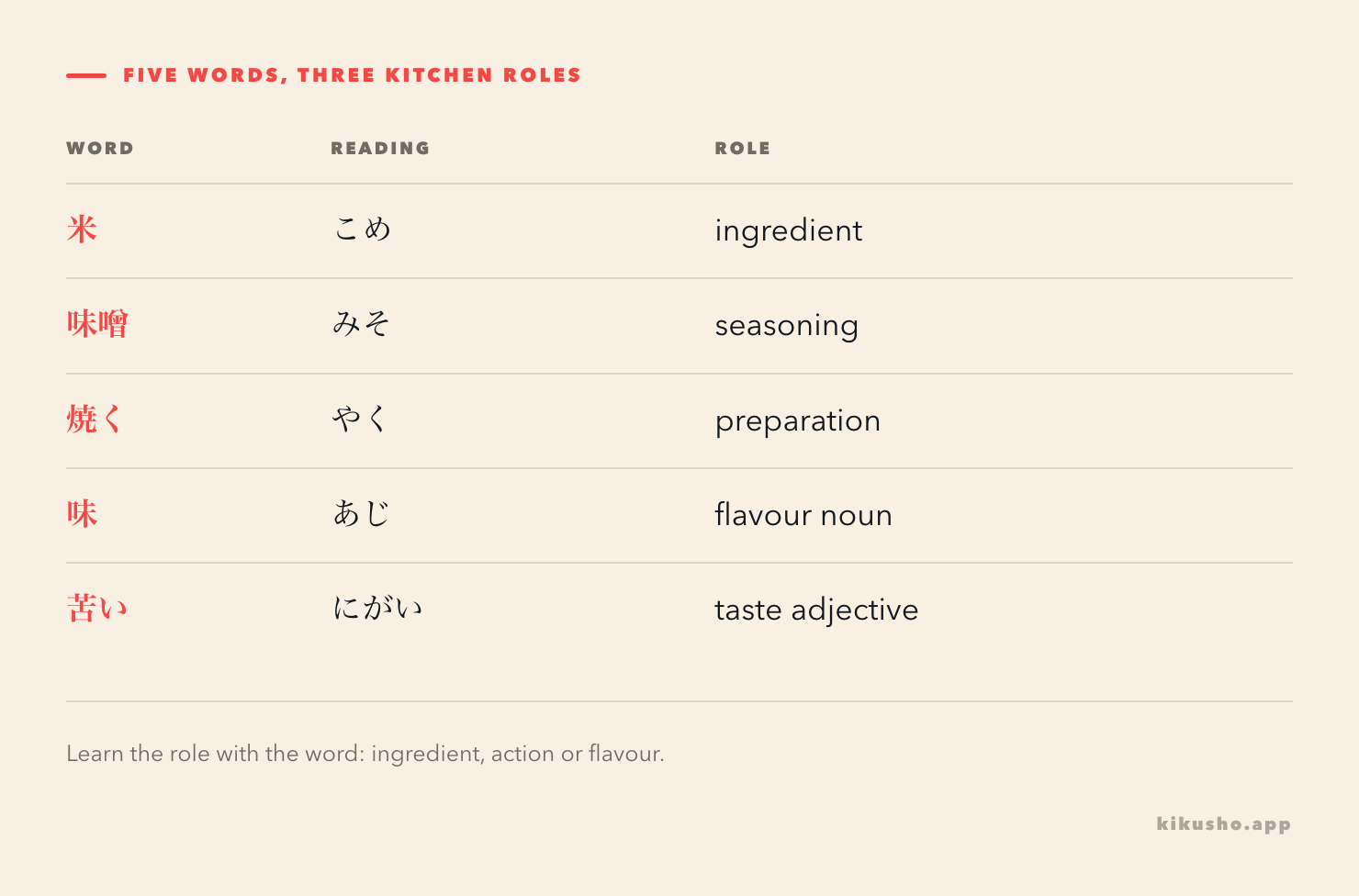
Notice the different readings of 味: the standalone noun is あじ, but 味噌 is the whole word みそ. Reading a compound character by character as あじそ will not recover the word. Likewise, 米 is こめ in this headword; that does not make こめ the reading of every compound containing 米.
米 names the rice you buy and prepare
Imagine the unopened bag on a kitchen shelf:
今日は米を買います。 きょうはこめをかいます。 I will buy rice today.
When preparing those grains, 米を洗う is a useful chunk. 米 is the object marked by を, and 洗う describes washing it. The polite sentence 米を洗います means “I wash the rice” or “I will wash the rice”, depending on the situation.
Kanjipedia defines 米 as the grain after its husk has been removed. For a serving ready to eat, ご飯 is often the word you want. Digital Daijisen records ご飯 as both prepared rice and a meal, which explains why 朝ご飯 can mean breakfast without specifying a bowl of rice.
Use that distinction to picture the scene, rather than turn it into an absolute prohibition. 米 can refer to rice generally as a food or staple; 米を食べる is not automatically a statement about eating raw grains. A shopping bag, a washing step and a served portion make the intended meaning clearer than the English gloss “rice” alone.
The familiar polite form お米 keeps the reading こめ. You may encounter either 米 or お米 in ordinary talk; adding お does not change the ingredient into a different food.
味噌 names a seasoning, not any bean paste
味噌 is miso. The definition includes fermentation: Kanjipedia describes a seasoning made with ingredients such as soybeans, kōji and salt. A generic English “bean paste” loses that distinction and could suggest a different product.
スープに味噌を入れます。 スープにみそをいれます。 I add miso to the soup.
Here スープに marks where it goes, and 味噌を marks what you add. The N4 lesson on verb families and particles develops this 入れる pattern with other things being put somewhere. Keep the seasoning with its action: 味噌を入れる is easier to use in a kitchen than an isolated ingredient name.
Different miso varieties use different kinds of kōji, including rice, barley or soybean kōji. You do not need to learn their names to use this five-word set. The distinction does explain why the one-word gloss “miso” is safer than a recipe-like definition claiming every variety contains the same grain. Daijisen's 味噌 entry lists those variations.
味 is a noun; 苦い describes the flavour
味 identifies what you are discussing:
このスープの味が好きです。 このスープのあじがすきです。 I like the flavour of this soup.
The noun phrase is このスープの味, “this soup's flavour”. 味 is not an i-adjective meaning “tasty”. To describe bitterness, use 苦い:
このお茶は少し苦いです。 このおちゃはすこしにがいです。 This tea is a little bitter.
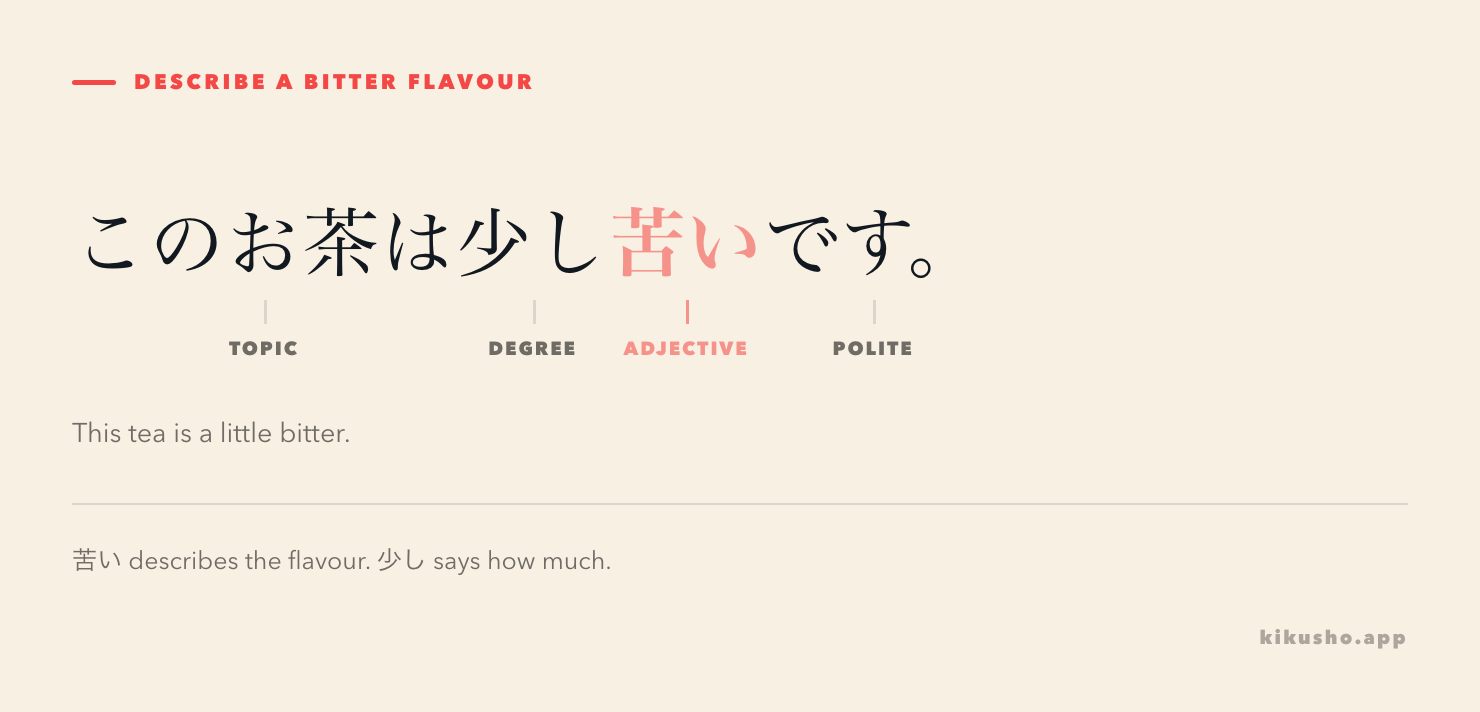
Before a noun, the same adjective attaches directly: 苦い味, “a bitter taste”, or 苦いお茶, “bitter tea”. You do not insert な between 苦い and the noun. Daijisen classifies 苦い as an adjective and includes bitter coffee; Kanjipedia independently records its bitter-taste sense.
Bitterness and preference are separate claims. このコーヒーは苦いですが、好きです。 means “This coffee is bitter, but I like it.” 苦い describes the flavour; 好き supplies the person's preference. Bitter does not by itself mean spoiled, badly made or disliked by every drinker.
Both 味 and 苦い have uses beyond food. The dictionaries also record figurative 味 and unpleasant experiences described with 苦い. Those extensions are outside the culinary senses taught here.
焼く covers more cooking methods than “grill”
For dinner, start with an object and the verb:
夕食に魚を焼きます。 ゆうしょくにさかなをやきます。 I will grill fish for dinner.
魚を names the food receiving the cooking action. Daijisen gives 焼く a food-heating sense, while Kanjipedia illustrates both fish and bread with 焼く. The English verb depends on the preparation: fish can be grilled, bread dough baked and a slice toasted. パンを焼く needs context to distinguish baking bread from toasting it.
| Form | Reading | Example and meaning |
|---|---|---|
| 焼く | やく | 魚を焼く: grill fish |
| 焼きます | やきます | 魚を焼きます: grill fish, politely |
| 焼いて | やいて | 魚を焼いてください: please grill the fish |
| 焼いた | やいた | 魚を焼いた: grilled the fish |
焼く is a godan verb ending in く. Its connecting form is 焼いて and its plain past form is 焼いた. Learn those forms with the object so the whole instruction survives when the ending changes.
The verb also means burning something in other contexts. Conversely, its food sense does not make it a universal substitute for “cook”: boiling a soup or preparing rice calls for a verb suited to that method. This page teaches the culinary 焼く frame, rather than its full range of literal and figurative senses.
Choose one ingredient chunk and one cooking chunk to keep
For your next shopping or cooking session, start with 米を買う, 味噌を入れる and 魚を焼く. After tasting, スープの味 and 苦いお茶 give you a noun phrase and an adjective phrase to recognise. You can use those chunks without waiting to memorise a longer restaurant list.
A package or cooking note is a useful Kikusho capture: select the ingredient or preparation phrase from the photo, then check the drafted card's reading and food sense before saving it. Keep enough of the original phrase to distinguish 米 from a served meal, and 焼く from an unrelated burning sense.
Practice: complete the eight questions before checking solutions
Question 1: read the seasoning. Pronounce the ingredient name 味噌. Which kana spelling represents this seasoning?
A. あじそ
B. みしょう
C. みそ
D. こめ
Question 2: write the grain. Which spelling matches こめ, meaning rice, in こめを買います?
A. 米
B. 味
C. 未
D. 来
Question 3: write the adjective. Choose the standard spelling of にがい in このお茶はにがいです.
A. 苦しい
B. 味い
C. 辛い
D. 苦い
Question 4: add the specified seasoning. A cooking note asks for miso, the fermented seasoning. Complete スープに__を入れます with that ingredient.
A. 米
B. 味噌
C. 味
D. 苦い
Question 5: identify the preparation. You are grilling fish for dinner. Choose the verb that completes 夕食に魚を__ with that action.
A. 焼く
B. 洗う
C. 買う
D. 食べる
Question 6: preserve the meaning. Which paraphrase matches 米を洗います in a kitchen preparation note?
A. I add miso to the soup.
B. I taste the soup.
C. I toast a slice of bread.
D. I wash the rice grains.
Question 7: describe the flavour with an adjective. Which phrase correctly means “a bitter taste”?
A. 味い
B. 苦いな味
C. 苦い味
D. 苦く味
Question 8: form the instruction. Complete 魚を__ください, “Please grill the fish”, with the connecting form of 焼く.
A. 焼って
B. 焼いて
C. 焼んで
D. 焼くて
Finish your spelling and sentence choices before scrolling.
Answers and explanations
Answer 1: C. Read the whole ingredient name as みそ. The standalone noun 味 is あじ, but the compound has its own whole-word reading. こめ is the reading of 米.
Answer 2: A. 米 is the rice noun read こめ. 味 is flavour, and 未 and 来 are different characters. In this shopping sentence, 米を買います means buying rice.
Answer 3: D. 苦い is にがい, “bitter”. 苦しい is a different adjective, read くるしい. 辛い describes a different taste in a food context; 味い is not the standard adjective requested.
Answer 4: B. 味噌 supplies the named miso ingredient. 米 would name rice instead, 味 names flavour, and 苦い is an adjective. Other recipes may add rice; this question specifically requests miso.
Answer 5: A. 魚を焼く expresses grilling the fish in the stated scene. 洗う means wash, 買う buy and 食べる eat. All can occur with 魚を, but none expresses the requested preparation method.
Answer 6: D. 米 is the rice being washed, and 洗います is the polite washing verb. The sentence makes no claim about soup, seasoning or bread. Its timing can be present or future; the paraphrase preserves the action and object.
Answer 7: C. 苦い directly modifies the noun 味. The i-adjective takes no な here; 苦く is its adverbial form and does not directly make the requested noun phrase. 味 itself remains the flavour noun in this sense.
Answer 8: B. 焼く becomes 焼いて before ください: 魚を焼いてください. The polite stem 焼き and the connecting form 焼いて serve different jobs; the other choices do not give 焼く its standard connecting form.
Common questions
Does this page cover every N4 food word?
It teaches five entries: 味, 米, 苦い, 味噌 and 焼く. Other ingredient names, taste adjectives and restaurant expressions belong to separate lessons. N4 is an editorial placement, rather than an official exhaustive word list.
Is 米 the same as ご飯?
米 names rice as a grain or staple, especially when buying or preparing it. ご飯 can name cooked rice or a meal. The distinction helps with concrete kitchen scenes, but 米 can also refer to rice generally as food.
Does 焼く always mean grill?
Its food sense includes grilling, baking and toasting. Choose the English translation from the food and preparation method. It also has non-food senses, including burning something.