On this page
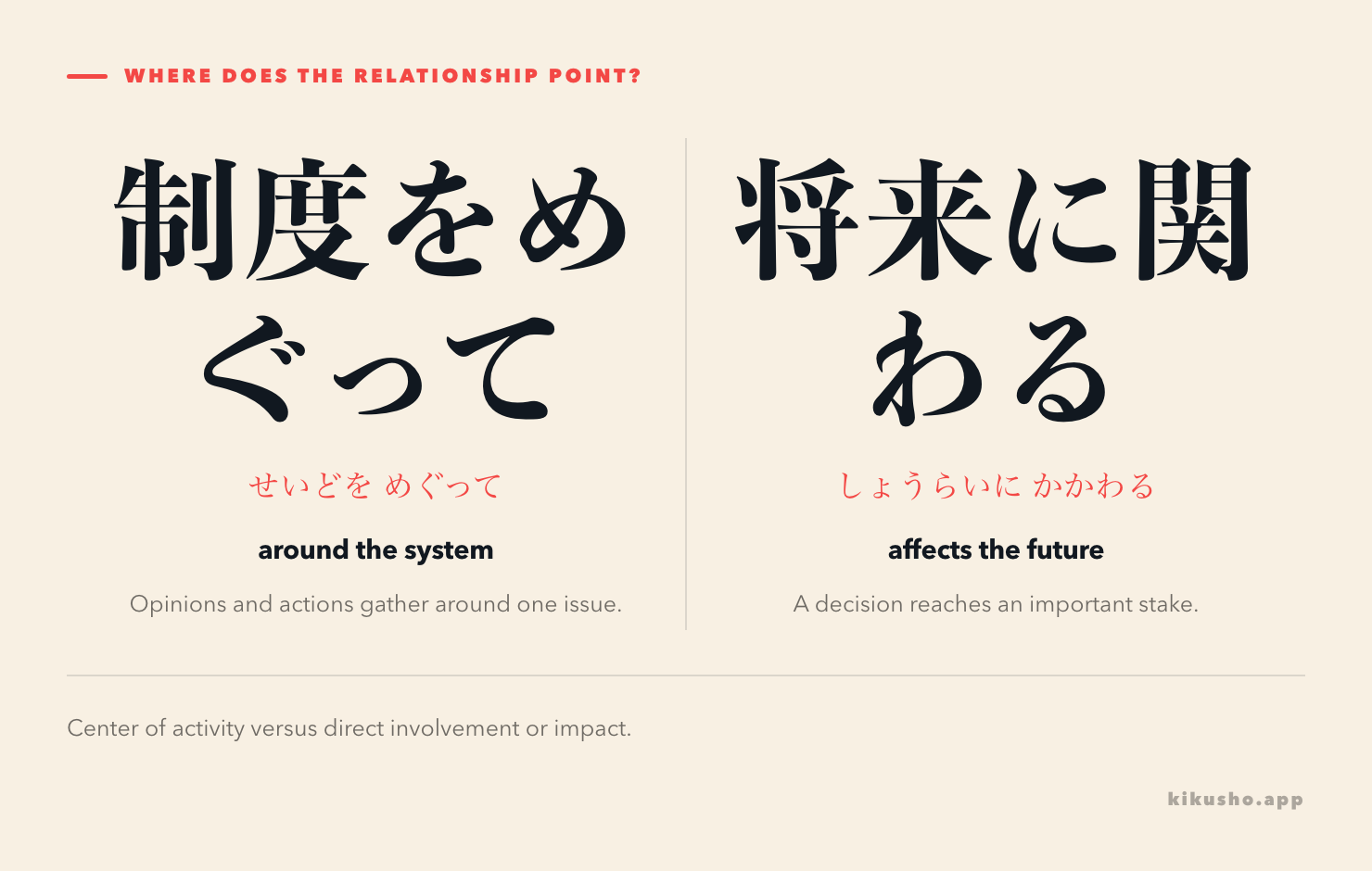
Use Nをめぐって when people, opinions or events gather around a topic as the center of discussion, conflict or competition. Use Nに関わる when someone is directly involved with N, something is related to N, or a decision affects an important stake such as life, reputation or the future.
Ask whether the noun is the center or the affected stake
The English translations overlap around “concerning” and “related to,” but the Japanese sentences organize the relationship differently.
新しい校則をめぐって、生徒と学校の意見が対立している。
あたらしい こうそくを めぐって、せいとと がっこうの いけんが たいりつしている。
Students and the school disagree over the new rules.
The school rules sit at the center. Different sides take positions around them, so をめぐって fits.
この決定は、生徒の将来に関わる。
この けっていは、せいとの しょうらいに かかわる。
This decision affects the students' future.
The future is not a debate topic in this sentence. It is what the decision reaches and may affect, so に関わる fits.
| Question to ask | Form | Relationship |
|---|---|---|
| What issue are several positions or actions centered on? | Nをめぐって | activity around N |
| What is this person connected with or involved in? | Nに関わる | direct relation to N |
| What important value or outcome may be affected? | Nに関わる | impact on N |
をめぐって puts an issue at the center
Attach をめぐって to a noun that gives people something to discuss, contest, investigate, compete for or react to.
予算案をめぐって、議論が続いている。
よさんあんを めぐって、ぎろんが つづいている。
Debate continues over the budget proposal.
父の遺産をめぐって、兄弟の間で争いが起きた。
ちちの いさんを めぐって、きょうだいの あいだで あらそいが おきた。
A dispute arose among the siblings over their father's estate.
代表の座をめぐって、三人の選手が競っている。
だいひょうの ざを めぐって、さんにんの せんしゅが きそっている。
Three athletes are competing for the place on the team.
Discussion is common, but speech is not required. A legal case, political movement, rivalry or competition can all unfold around the named center. What matters is that several positions, participants or developments converge on it.
The construction has three useful shapes:
| Shape | Position | Example |
|---|---|---|
| N + をめぐって + clause | connects to a full statement | 法案をめぐって意見が分かれた |
| N + をめぐる + noun | modifies the following noun | 法案をめぐる議論 |
| N + をめぐり + clause | compact written connection | 法案をめぐり議論が続いた |
をめぐり is especially common in news and formal prose. を巡って and を巡る also appear in kanji, but kana is common in teaching material and general writing.
The Japan Foundation teaching reference defines the pattern through discussion, conflict and opposition and gives both をめぐって and をめぐる. 日本語NET likewise places it at N2 and emphasizes disagreement, discussion and competing opinions. JLPT level labels are study estimates because the test maker does not publish an exhaustive grammar list.
に関わる connects a person, matter or consequence
関わる(かかわる) is a godan verb. The noun before に names what the subject is connected with or what may be affected.
Direct connection or involvement
姉は医療に関わる仕事をしている。
あねは いりょうに かかわる しごとを している。
My older sister works in a field connected with healthcare.
警察は事件に関わった人物を調べている。
けいさつは じけんに かかわった じんぶつを しらべている。
The police are investigating people involved in the incident.
This use covers professional connection, participation and involvement. The relationship can be neutral, helpful or blameworthy; the surrounding nouns and verbs decide.
Impact on an important stake
これは命に関わる問題です。
これは いのちに かかわる もんだいです。
This is a matter involving life and death.
小さなミスでも、会社の信用に関わることがある。
ちいさな ミスでも、かいしゃの しんように かかわる ことが ある。
Even a small mistake can affect the company's reputation.
This second use often appears with 命, 生死, 将来, 信用, 評判, 合否 and 成否. The relationship carries consequences, so a weak translation such as “about” can hide the point.
The verb changes normally: に関わる, に関わって, に関わり, に関わった and に関わらない. It can finish a sentence, modify a noun or link to another clause.
| Form | Example | Function |
|---|---|---|
| Nに関わる + noun | 命に関わる病気 | modifies a noun |
| Nに関わって + clause | 事件に関わって逮捕された | links involvement to a result |
| Nに関わり + clause | 安全に関わり、慎重な判断が必要となる | formal written link |
| Nに関わる。 | この判断は将来に関わる。 | completes the predicate |
Tanosuke's N2 explanation of に関わる separates relation from impact and notes that the impact reading favors important stakes. JLPT Sensei confirms the noun attachment and the forms に関わる, に関わって and に関わり.
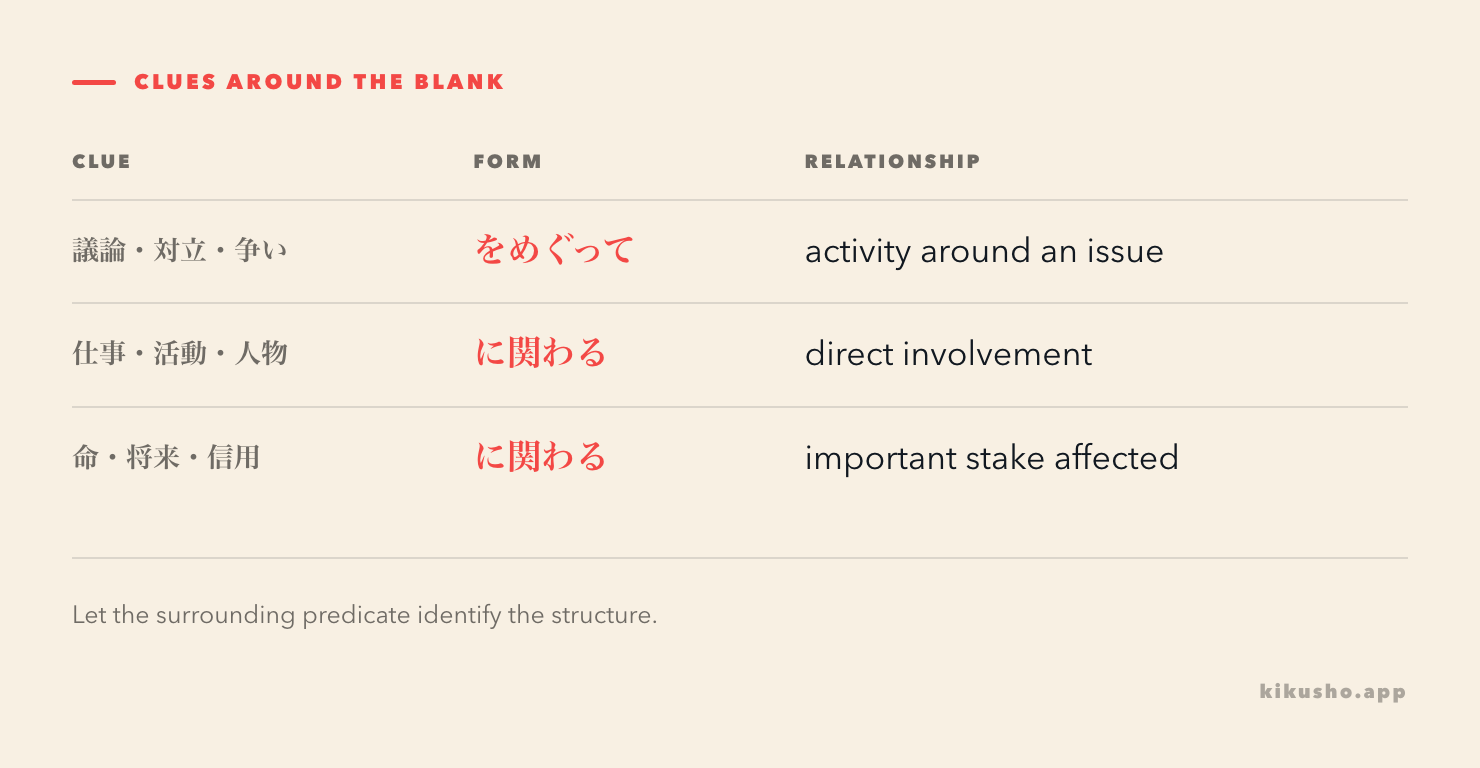
The surrounding predicate chooses the form
Words near the blank usually reveal the intended relationship.
| Surrounding language | Likely choice | Why |
|---|---|---|
| 議論する, 対立する, 争う, 意見が分かれる | をめぐって | several positions organize around one center |
| 仕事, 活動, 人物 with a field or event | に関わる | direct connection or participation |
| 命, 将来, 信用, 評判, 合否 | に関わる | the noun names what may be affected |
Compare two sentences about the same project:
新しい計画をめぐって、住民と市が話し合っている。
Residents and the city are discussing the new plan.
新しい計画は、地域の安全に関わる。
The new plan affects local safety.
The first sentence shows two parties and one shared issue. The second identifies the value that may be affected. Replacing one marker with the other would change the structure, not merely the tone.
Neither form is a general replacement for “about”
For a neutral topic of study, speech or information, use について or the more formal に関して:
日本の教育について調べています。
I am researching Japanese education.
This sentence contains no dispute, rival positions, direct participation or affected stake. 日本の教育をめぐって調べています would promise a larger setting of controversy or developments that the predicate does not supply. 日本の教育に関わって調べています would suggest involvement in the field, rather than simply naming the research topic.
The に関する and について lesson maps the neutral and formal topic markers. A useful boundary is 医療に関する資料, “materials about healthcare,” versus 医療に関わる仕事, “work connected with healthcare.” The first labels content; the second describes participation.
Also keep に関わる separate from にもかかわらず, which introduces an unexpected result despite a fact, and from にかかわらず, which makes a condition irrelevant. Similar spelling does not give the three constructions the same relationship.
For a useful Kikusho review card, capture the clause that exposes the deciding relationship. 計画をめぐって意見が分かれた preserves the competing views; 命に関わる病気 preserves the affected stake. Stopping at 計画をめぐって or 命に関わる shows the attachment while discarding the evidence that makes the choice retrievable.
Practice: decide all six relationships first
Question 1 — grammar choice. Complete: 新しい空港の建設__、住民と市の意見が対立している。
- に関わって
- をめぐって
- についての
- にもかかわらず
Question 2 — noun modification. Choose the form before 議論: 相続税__議論が国会で続いている。
- をめぐる
- をめぐって
- に関わって
- にかかわらず
Question 3 — direct relation. Complete: 兄は環境保護__仕事をしている。
- をめぐる
- に関わる
- にもかかわらず
- を問わない
Question 4 — meaning contrast. Explain why 制度をめぐって議論が続く makes the system a center, while 制度は生活に関わる makes life an affected domain.
Question 5 — text grammar. Read: 再開発計画__住民の意見が分かれている。この計画は地域の安全__ため、市は説明会を開いた。 Fill the blanks with different target forms.
Question 6 — sentence composition. Write two sentences: “The parties are arguing over the inheritance,” then “This decision affects the children's future.” Use 遺産, 争う, 決定, 子どもの将来 and the two target forms.
Answers and explanations
Answer 1: 2, をめぐって. The airport construction is the shared issue around which residents and the city hold opposing positions. に関わって would mark involvement but would not build that centered dispute.
Answer 2: 1, をめぐる. A noun follows the blank, so the attributive form is 相続税をめぐる議論. をめぐって connects to a clause rather than modifying 議論 directly.
Answer 3: 2, に関わる. The sentence describes a job directly connected with environmental protection. No disagreement or competition is presented, so をめぐる would add an unsupported scene.
Answer 4. In 制度をめぐって議論が続く, different views and the continuing debate surround the system as their subject. In 制度は生活に関わる, 生活 follows に and names what the system reaches or affects. One sentence maps activity around a center; the other maps a direct consequence.
Answer 5. 再開発計画をめぐって住民の意見が分かれている。この計画は地域の安全に関わるため、市は説明会を開いた。 The divided opinions license をめぐって. Safety is the important stake affected by the plan, so に関わる belongs in the second sentence.
Answer 6. A model pair is 当事者たちは遺産をめぐって争っている。この決定は子どもの将来に関わる。 The first clause supplies rival parties around an estate; the second connects the decision directly to the children's future.
Common questions
What is the difference between をめぐって and に関わる?
をめぐって places a topic at the center of discussion, disagreement, competition or other activity involving multiple positions. に関わる says that a person or matter is directly connected with, involved in or affects something.
How does をめぐって attach to a noun?
Use noun plus をめぐって before a clause, noun plus をめぐる before another noun, and noun plus をめぐり as a formal written connective. For example, 計画をめぐって議論する and 計画をめぐる議論.
What are the two main uses of に関わる?
It can mark direct connection or participation, as in 医療に関わる仕事, or impact on an important stake, as in 命に関わる病気 and 信用に関わる問題.
Is に関わる the same as に関する?
They overlap in the broad idea of relation, but に関する commonly labels the topic or content of information. に関わる more readily expresses direct involvement or an effect on something important.