On this page
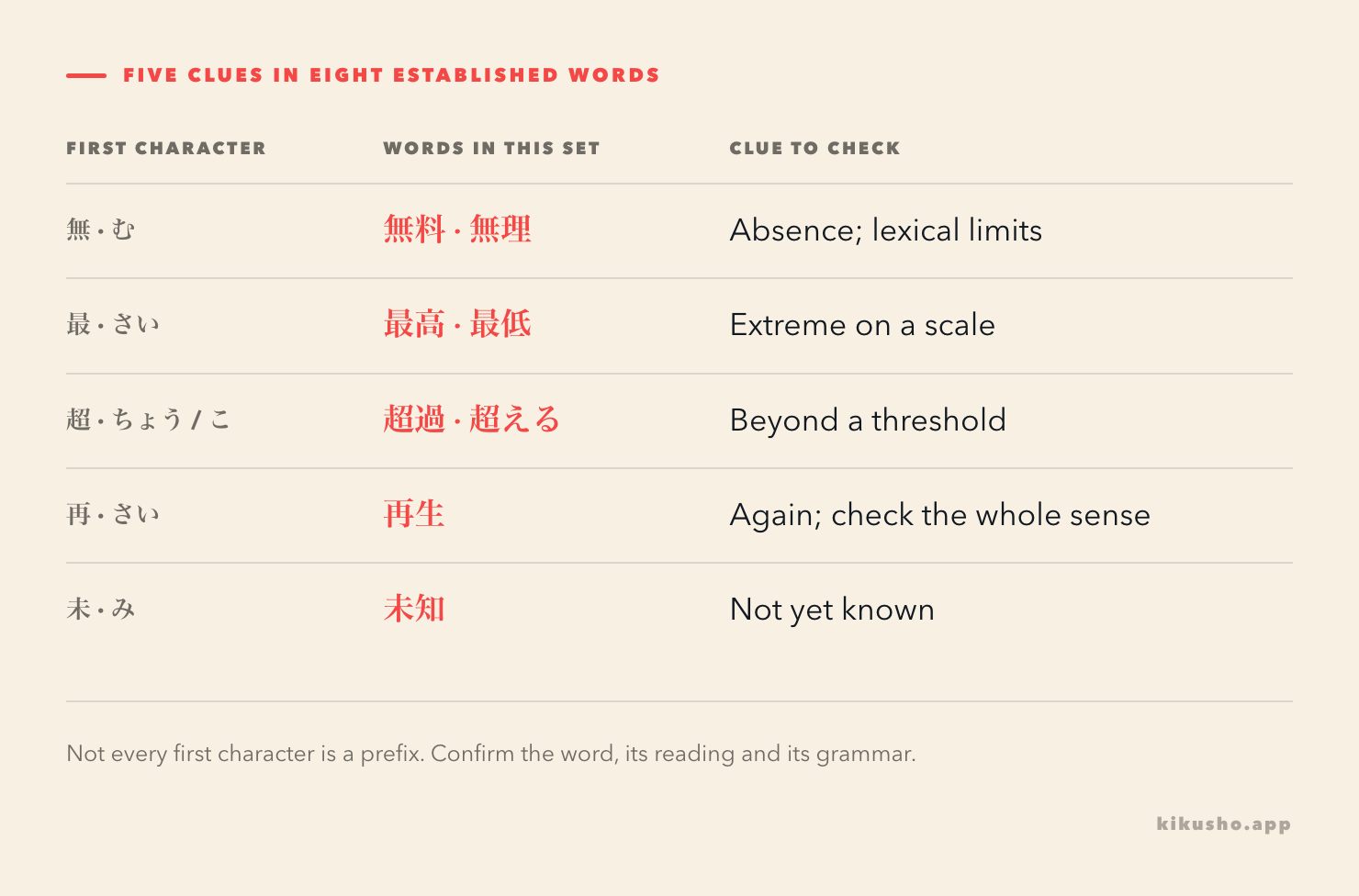
無 suggests absence, 最 an extreme, 超 going beyond, 再 repetition and 未 something not yet true. In Japanese word formation, these clues help you recognise a compound, but the established word still decides its reading, meaning and sentence pattern.
Eight words give the parts a concrete job
This set covers 無理, 無料, 最高, 最低, 超える, 超過, 再生 and 未知. Grouping them exposes two different tasks: recognising what an initial element contributes and checking what the complete word actually does. A sensible-looking pair of characters is not automatically a Japanese word.
The lesson sits in N2 vocabulary as practice in using those clues. Its inventory places 無理 at N4; 超える, 最高, 最低 and 無料 at N3; 超過 at N2; and 再生 and 未知 at N1. 超える has both N3 and N2 source observations. The Waller/Tanos-derived lists are one family, and separately published comparison pages have not established independent list provenance. These are study estimates, not an official exhaustive JLPT syllabus.
| Word | Reading | Part of speech in these uses | Meaning to keep | Useful phrase |
|---|---|---|---|---|
| 無理 | むり | Noun; な-adjective; also する | Unreasonable, not feasible; forcing yourself | 無理な要求: an unreasonable demand |
| 無料 | むりょう | Noun | No charge | 無料で使う: use free of charge |
| 最高 | さいこう | Noun; adjectival uses | Highest; exceptionally good | 最高気温: maximum temperature |
| 最低 | さいてい | Noun; adjectival uses | Lowest; extremely poor | 最低気温: minimum temperature |
| 超える | こえる | Ichidan verb | Exceed a quantity or standard | 二十キロを超える: exceed twenty kilos |
| 超過 | ちょうか | Noun; する-verb | Excess beyond a stated limit | 制限を超過する: exceed the limit |
| 再生 | さいせい | Noun; する-verb | Playback here; other senses include regeneration | 動画を再生する: play a video |
| 未知 | みち | Noun | Not yet known | 未知の分野: an unfamiliar field |
Some initial elements work as prefixes. Shogakukan defines 最 and its prefix use with the sense “most,” and 再 as a prefix adds “again.” That does not make every first character in the table a freely attachable prefix. In particular, 超える is a complete inflecting word, not ちょう followed by a separate word える.
無 removes something, but the finished meanings differ
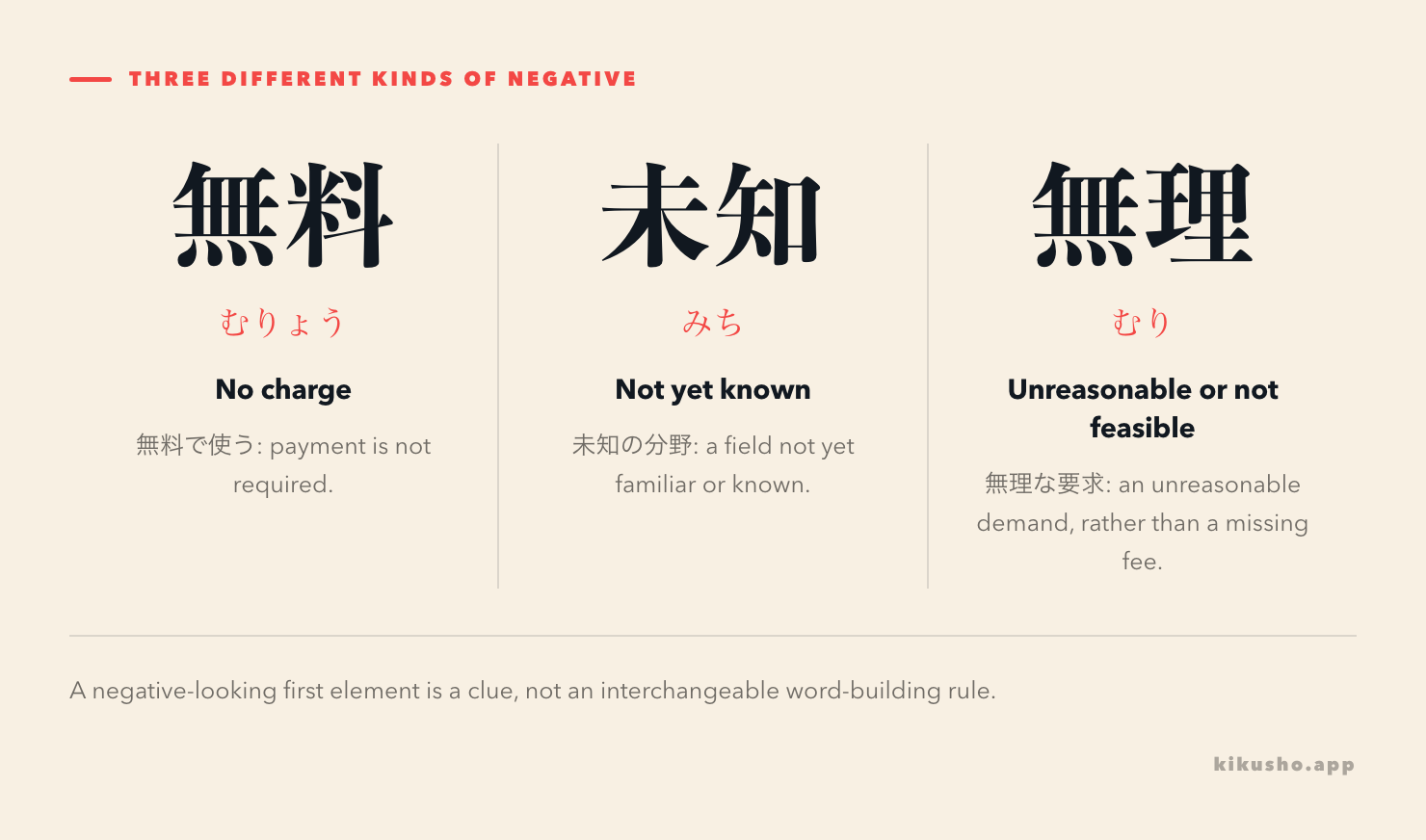
無料(むりょう)makes the absence easy to see: 料 concerns a charge in this word. Shogakukan's 無料 entry describes not having to pay, and also doing something for someone without receiving money.
この地図は、受付で無料でもらえます。
この ちずは、うけつけで むりょうで もらえます。
You can get this map free of charge at the reception desk.
無料の地図 is a free map, and 無料で tells you the cost of obtaining it. English “free” also means unrestricted, but the word here makes a statement about payment. It does not promise that the map can be used without any conditions.
無理(むり)needs more than a literal “no reason” gloss. It can describe something unreasonable or something that cannot realistically be done in the circumstances.
一日でこの本を全部読むのは無理です。
いちにちで この ほんを ぜんぶ よむのは むりです。
Reading this entire book in one day is not feasible.
The speaker judges the proposed task, not the cost of the book. Kanken's 無理 entry and Shogakukan's entry both distinguish unreasonable, forceful and difficult-to-accomplish uses.
Retain 無理な要求(むりな ようきゅう), “an unreasonable demand,” alongside 無理をする, “overdo it” or “push yourself.” 無理に笑う(むりに わらう)can describe forcing a smile. The surrounding verb matters: this is not a mechanical adjective meaning “without reason” in every sentence. Nor does the shared 無 make 無料 and 無理 interchangeable.
最 locates an extreme, which may become an evaluation
最高(さいこう)and 最低(さいてい)give you the high and low ends of a scale. The second parts are 高(こう)and 低(てい)in these compounds, rather than the full adjectives 高い and 低い.
今日の最高気温は三十度でした。
きょうの さいこう きおんは さんじゅうど でした。
Today's maximum temperature was thirty degrees.
朝の最低気温は十八度でした。
あさの さいてい きおんは じゅうはちど でした。
The minimum temperature this morning was eighteen degrees.
A low temperature is not necessarily a bad temperature. In a weather report, the scale is numerical. Shogakukan's 最高 notice and 最低 notice also record evaluative meanings.
この映画、最高だったね(この えいが、さいこうだったね)can mean “That film was wonderful, wasn't it?” It is praise, not a claim about the film's physical height. Calling someone's behaviour 最低 is correspondingly strong criticism, not a neutral measurement. The same pair can serve a factual comparison or a personal judgment; read what is being ranked.
You will encounter noun phrases with の, such as 最高の気分, and adjectival evaluations with な, such as 最低な態度. Keep the chosen phrase with its situation instead of assuming that every word containing 最 uses one identical connector.
超える inflects, while 超過 takes する
超える(こえる)is an ichidan verb. For its polite past, drop the final る and add ました: 超えました. The combined Shogakukan verb entry confirms its verb class; the bilingual 超える entry checks the exceeding sense.
荷物の重さが二十キロを超えました。
にもつの おもさが にじゅっキロを こえました。
The luggage weighed more than twenty kilos.
Exactly twenty is not “more than twenty.” The sentence places the weight beyond that quantity. The verb also occurs with abstract standards, but this example practises a numerical threshold. Physical crossing is often written 越える; recognising a broad source gloss “cross” does not justify ignoring that spelling distinction.
超過(ちょうか)is instead a noun that forms a predicate with する.
荷物の重量が制限を超過しました。
にもつの じゅうりょうが せいげんを ちょうかしました。
The weight of the luggage exceeded the limit.
Shogakukan's 超過 definition includes quantities and time exceeding a fixed limit. 超過料金(ちょうか りょうきん)is an excess charge, a useful label on a notice. The same character is read こ in 超える and ちょう in 超過; it does not give both words the same inflection.
Use を with the threshold in these examples. 超える → 超えました and 超過する → 超過しました are two complete patterns. Do not manufacture a mixed ending by transferring the verb tail from one word to the other.
再生 and 未知 show why the whole word still matters
再生(さいせい)has several senses. With a recording, it means playback: reproducing recorded sound or images, rather than creating them from scratch.
説明の動画をもう一度再生しました。
せつめいの どうがを もういちど さいせいしました。
I played the explanation video once more.
Here もう一度 supplies the explicit second viewing. A 再生 button can also start your first viewing of a recording. The character 再 suggests repetition or restoration, but the media word does not require a previous viewing by this particular person. Shogakukan's 再生 entry also lists revival, regeneration and reprocessing waste; those additional domains are not practised in this set.
未知(みち)means not yet known, rather than a charge being absent or a task being impossible.
私にとって、法律は未知の分野です。
わたしに とって、ほうりつは みちの ぶんやです。
For me, law is an unfamiliar field.
The sentence identifies whose knowledge is limited. Shogakukan's 未知 definition covers both what someone does not yet know and what is not yet known generally. The word does not mean that the field can never be understood.
The prefix readings 無・む and 未・み help distinguish absence from “not yet.” IMABI's prefix table gives these clues alongside 再, 最 and 超. Treat them as aids for checking an established expression, not permission to swap all negative-looking elements freely.
Learn the join and the sentence slot together
For a compound, ask three things: is this the established spelling, how is the whole word read, and what follows it in this sentence? 無料で, 未知の and 無理な answer the last question differently. A matching English negative does not settle Japanese word formation.
The ten N4 kanji compounds give an earlier bounded practice set for combining sound blocks. For a suffix whose sentence behaviour is taught separately, 消極的 and ~的 show why recognising the added element is only part of using the resulting word. The guide to choosing kanji readings explains the wider reading patterns.
When adding one of these words by text in Kikusho, use the editable example field to retain its phrase: 荷物の重さが制限を超えた keeps both the threshold and the inflected verb. In later review, recover that complete construction before trying a different ending.
Practice questions
Question 1
On a media control, how is 再生 read?
- A. さいしょう
- B. さいせい
- C. さいぜい
- D. さいき
Question 2
Choose the written word for みち, meaning not yet known, in みちの分野.
- A. 無料
- B. 無理
- C. 最低
- D. 未知
Question 3
No payment is required to use the guide map. Which element completes the established word in this sentence?
この地図は( )料で使えます。
- A. 無
- B. 未
- C. 再
- D. 最
Question 4
Among seven temperature readings this morning, eighteen degrees was the lowest. Select the word that reports that end of the scale.
朝の( )気温は十八度でした。
- A. 未知
- B. 最高
- C. 最低
- D. 再生
Question 5
A deadline is tomorrow, and the speaker says 全部終えるのは無理です. Which interpretation preserves the judgment?
- A. All the work has already been finished.
- B. Finishing everything is not feasible in the circumstances.
- C. No payment is required for finishing the work.
- D. This is the best result among all the completed tasks.
Question 6
An official notice needs a past predicate using 超過. Which sentence has the correct noun-plus-する form?
- A. 荷物の重さは制限を超過えました。
- B. 荷物の重さは制限を超過いです。
- C. 荷物の重さは制限を超過なです。
- D. 荷物の重さは制限を超過しました。
Question 7
The measured weight was twenty-one kilos. Complete the report with the verb for passing twenty kilos.
荷物の重さは二十キロを( )。
- A. 超えました
- B. 再生しました
- C. 無料でした
- D. 未知でした
Question 8
Friends enjoyed a film. One says この映画、最高だったね. Which reading of the comment fits this setting?
- A. The film had the lowest temperature.
- B. The film cost nothing to watch.
- C. The film was wonderful.
- D. The film's meaning is not yet known.
Answers and explanations
Use the referent, reading and sentence ending together when checking your choice.
Answer 1: B — さいせい. 再 is さい and 生 is せい in this word. The other options change or replace the second reading. On a media control, the complete label means playback; it is not automatically a promise to play only a second viewing.
Answer 2: D — 未知. The pronunciation is みち, and the phrase means a field not yet known. A is 無料(むりょう), B 無理(むり)and C 最低(さいてい). Neither the readings nor the meanings of those alternatives match the requested word.
Answer 3: A — 無. 無 plus 料 gives 無料(むりょう), with no charge. The other elements do not form the requested no-payment word. Knowing that 未 can contribute “not yet” does not make it a substitute here. The following で belongs to the useful phrase 無料で使う.
Answer 4: C — 最低. The context asks for the numerical low, not a criticism. 最高 would report the high end; 未知 concerns knowledge, and 再生 concerns playback or regeneration. Retain 最 with 低 to reconstruct the requested extreme of the temperature scale.
Answer 5: B. 無理 evaluates what can realistically be accomplished. It does not say the work is complete, free of charge or the best result. The deadline supplies the conditions for this judgment; the sentence is not a universal claim that the task could never be finished with more time.
Answer 6: D. 超過 combines with する, whose polite past is しました. A invents a mixed verb ending, B treats the noun like an い-adjective, and C neither forms the required verb nor supplies a valid adjectival predicate. The characters at the beginning do not replace the need to check the whole word's grammar.
Answer 7: A — 超えました. Twenty-one exceeds twenty, and 超える inflects to 超えました. B wrongly talks about playing or regenerating the weight. C and D are copular phrases about cost or knowledge, not the verb this threshold construction requires. A weight of exactly twenty would not satisfy the stated greater-than relation.
Answer 8: C. The friends are expressing praise through 最高. Their comment says nothing about a temperature, an admission fee or an unknown meaning. In a different context, the same word can locate an actual maximum; here, the subject and the friends' reaction identify an evaluation.
Common questions
Can I make any Japanese word negative by adding 無 or 未?
No. These elements occur in established combinations. 無料 means no charge, while 未知 means not yet known. Their different meanings help recognition, but they do not make every newly assembled pair a usable word.
Is the 超 in 超える pronounced ちょう?
No. 超える is read こえる and inflects as a verb, for example 超えました. 超過 is read ちょうか and forms a verb with する, as in 超過しました. The shared character does not require a shared reading or conjugation.
Does 再生 mean I must play a video for a second time?
No. In a media interface, 再生 refers to playback of recorded sound or pictures. It can label the first playback too. Other senses involve revival, regeneration or recycling, so the whole word and its object determine the intended meaning.
Are all eight words independently confirmed as JLPT N2 vocabulary?
No. This N2 practice lesson deliberately includes records placed at N4, N3, N2 and N1 in the curriculum inventory. 超える also has conflicting N3 and N2 observations. The Waller-derived lists share one source family; dictionary checks verify Japanese usage rather than certify JLPT levels.