On this page
Use 区域 for a bounded area, 区分 for a practical division, and 分類 for grouping by shared properties. 順序・先頭・中間 locate actions inside a sequence, while 相違 flags a difference between what two records, maps or accounts say.
These seven N2 words describe one controlled procedure. An evacuation team divides the city, classifies reports, follows an ordered route and checks whether the field record differs from the official map.
Seven words turn a plan into a checked procedure
| Word | Reading | Role in the procedure | Useful frame |
|---|---|---|---|
| 区域 | くいき | bounded place or zone | 立入禁止区域, 区域内 |
| 区分 | くぶん | division according to a criterion | 年齢で区分する, 料金区分 |
| 分類 | ぶんるい | grouping by shared properties | 内容別に分類する |
| 順序 | じゅんじょ | arranged order or procedure | 順序を守る, 順序を変える |
| 先頭 | せんとう | front or first position | 列の先頭, 先頭に立つ |
| 中間 | ちゅうかん | intermediate position or stage | 中間地点, 中間報告 |
| 相違 | そうい | difference or discrepancy | 記録との相違, 相違点 |
The words answer different questions: where is the boundary, what rule divides the whole, what properties group the items, where are we in the sequence, and do the records agree?
区域 is the bounded place
区域(くいき) is a place marked off by a boundary. The boundary may be physical, administrative, legal or operational.
火災現場の周辺を立入禁止区域に指定しました。
かさいげんばの しゅうへんを たちいりきんしくいきに していしました。
The area around the fire scene was designated a restricted zone.
担当区域内の避難所を確認してください。
たんとうくいきないの ひなんじょを かくにんして ください。
Please check the evacuation shelters inside your assigned area.
Shogakukan defines 区域 as a fixed area that has been demarcated. This explains 区域内, inside the zone; 区域外, outside it; 受け持ち区域, assigned area; and 警戒区域, warning or restricted zone.
The word names the bounded space, not the principle used to divide people or data inside it.
区分 divides a whole by an operating rule
区分(くぶん) is a division made according to a criterion. It can name the act of dividing and the categories or sections that result.
避難者を年齢ではなく、必要な支援の種類で区分します。
ひなんしゃを ねんれいではなく、ひつような しえんの しゅるいで くぶんします。
We divide evacuees according to the type of support they need, rather than by age.
申請区分を一般と優先の二つに分けました。
しんせいくぶんを いっぱんと ゆうせんの ふたつに わけました。
We divided the application categories into general and priority.
Useful compounds reveal the chosen rule: 年齢区分, age bracket; 料金区分, fare category; 用途区分, use category; and 所得区分, income bracket. The Cabinet Office's regional report gives a concrete official example: the same prefectures can be assigned to different 地域区分 depending on the report's purpose.
分類 groups items by what they are like
分類(ぶんるい) is classification: grouping items according to shared properties or characteristics.
集まった報告を被害の種類別に分類しました。
あつまった ほうこくを ひがいの しゅるいべつに ぶんるいしました。
We classified the collected reports by type of damage.
写真を建物、道路、河川の三つに分類します。
しゃしんを たてもの、どうろ、かせんの みっつに ぶんるいします。
We classify the photographs into buildings, roads and rivers.
The pattern NをA・B・Cに分類する names the resulting classes. Nを基準に分類する or N別に分類する names the property used. The dictionary entry for 分類 also covers formal classification systems in fields such as biology and libraries.
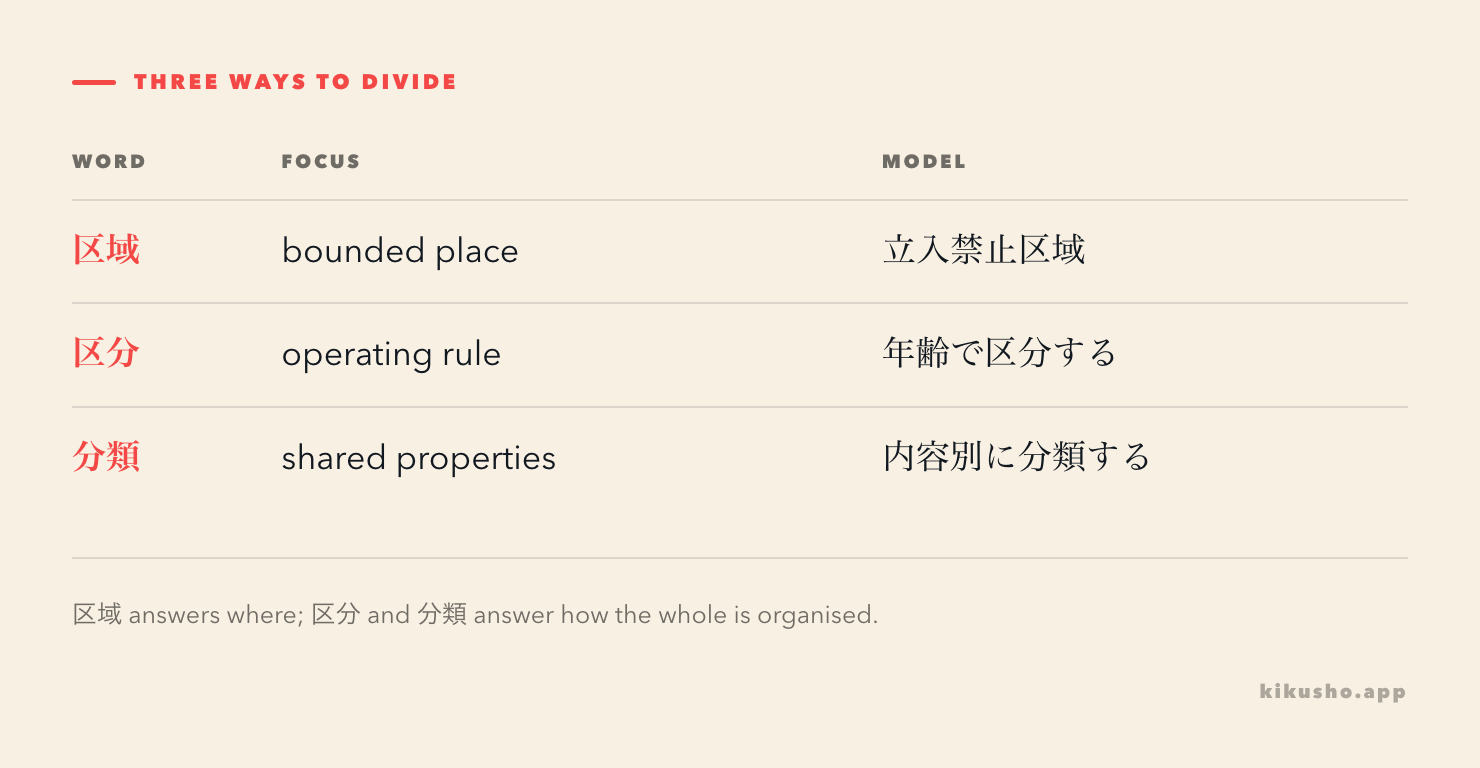
The distinction between 区分 and 分類 is a practical tendency, not a rigid ban. 区分 often starts from one whole and draws operational divisions. 分類 often starts from multiple items and groups them by nature or attributes. An organisation may call the same category system either word depending on what it wants to emphasise.
順序 is both arrangement and procedure
順序(じゅんじょ) is the order in which things are arranged or actions are performed. It can describe a visible sequence, a logical progression or a procedure.
安全を確認してから扉を開けるという順序を守ってください。
あんぜんを かくにんしてから とびらを あけるという じゅんじょを まもって ください。
Please follow the sequence of checking safety before opening the door.
説明の順序を入れ替えると、理由が分かりやすくなります。
せつめいの じゅんじょを いれかえると、りゆうが わかりやすく なります。
Changing the order of the explanation makes the reasoning easier to understand.
Shogakukan's 順序 entry separates an arrangement under a criterion from the procedure or steps used to do something. Common partners are 順序を決める, decide the order; 順序を守る, follow it; 順序を入れ替える, swap it; and 順序よく, in an orderly sequence.
The N3 lesson on order, comparison and relationships teaches 順 as a compact sorting criterion and 順番 as a sequence or a person's turn. 順序 is especially useful when the arrangement itself forms a procedure: change the 作業の順序, then wait for your 順番 to perform it.
先頭 and 中間 locate different parts of the sequence
先頭(せんとう) is the front or first position in a line, group, text or movement.
誘導員が列の先頭に立ちます。
ゆうどういんが れつの せんとうに たちます。
A guide stands at the front of the line.
注意事項を文書の先頭に移しました。
ちゅういじこうを ぶんしょの せんとうに うつしました。
We moved the precautions to the beginning of the document.
The dictionary definition is simply the foremost position. 先頭に立つ can be literal, lead a queue, or figurative, take the lead. 先頭を切る emphasises going first and leading an action.
中間(ちゅうかん) is between two things, between two extremes, or at an intermediate stage.
避難経路の中間地点で人数を確認します。
ひなんけいろの ちゅうかんちてんで にんずうを かくにんします。
We check the number of people at an intermediate point on the evacuation route.
調査の中間報告を来週発表します。
ちょうさの ちゅうかんほうこくを らいしゅう はっぴょうします。
We will present an interim report on the investigation next week.
The first 中間 is spatial. The second marks work still in progress. Shogakukan also records an intermediate degree or position between two extremes. It need not be the mathematically exact halfway point.
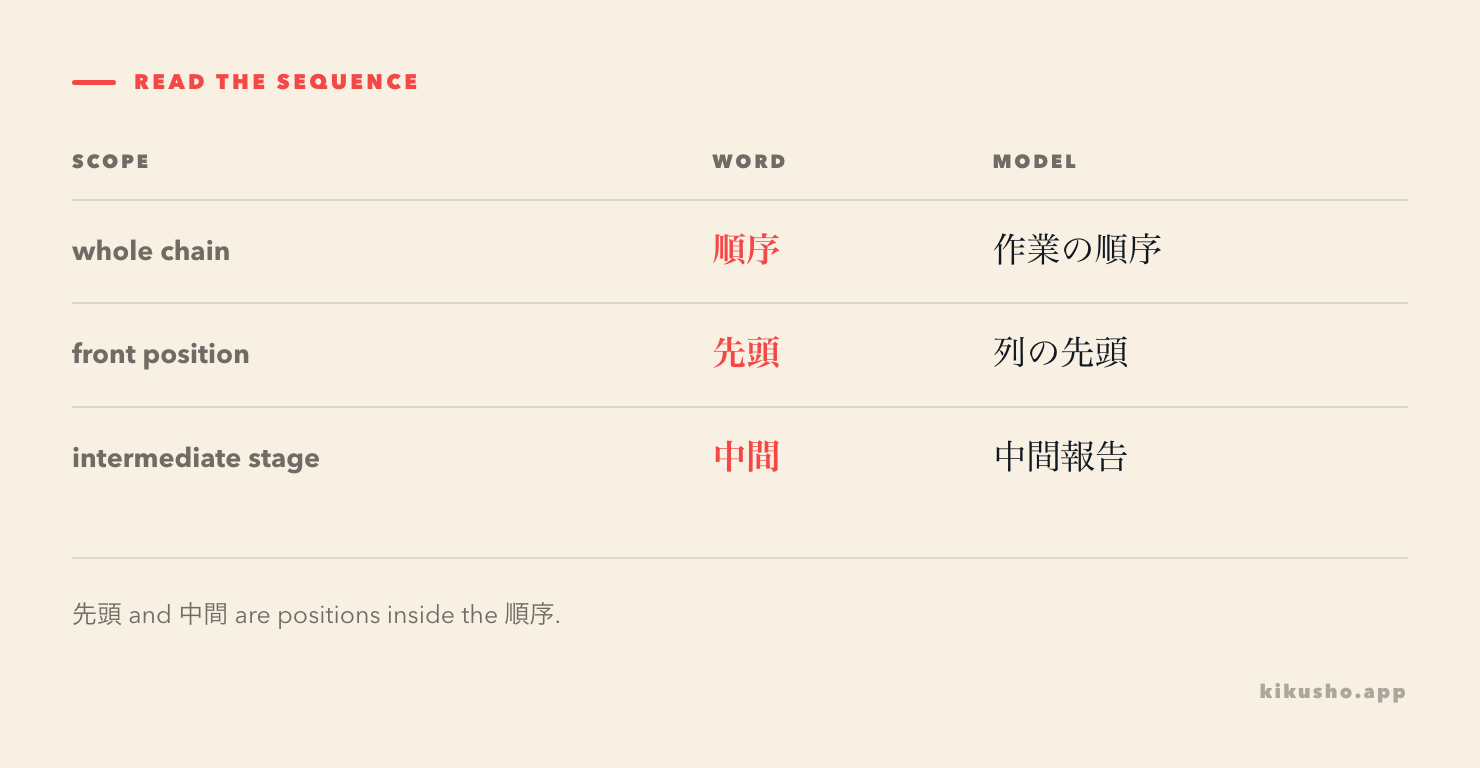
Do not use 先頭 as a general synonym for “first” in time. 最初の会議 is the first meeting; 列の先頭 is the front of the line. A document can have 先頭 because its characters and sections form an ordered line, but an isolated event normally takes 最初.
相違 records a difference that checking reveals
相違(そうい) is a difference or discrepancy between two things expected or useful to compare.
現場の報告と地図の情報に相違がありました。
げんばの ほうこくと ちずの じょうほうに そういが ありました。
There was a discrepancy between the field report and the information on the map.
二つの計画の相違点を一覧にしてください。
ふたつの けいかくの そういてんを いちらんに して ください。
Please list the differences between the two plans.
The productive frames are AとBの相違, the difference between A and B; AとBに相違がある, there is a discrepancy; Nと相違する, differ from N; and 相違点, point of difference. Shogakukan defines it as two things not being the same.
Compared with everyday 違い, 相違 sounds at home in reports, specifications, declarations and careful comparison. It often signals that the difference needs to be checked or resolved.
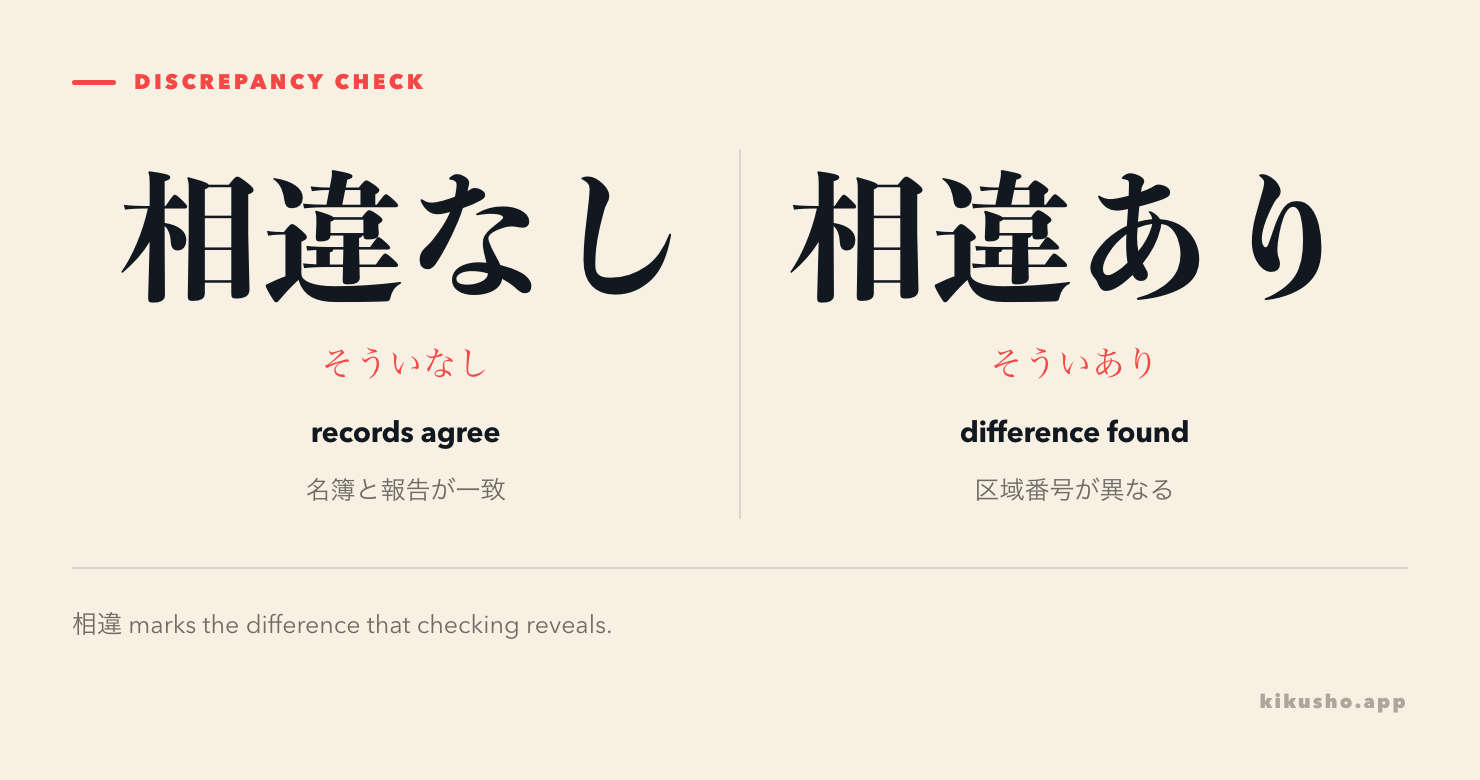
The fixed grammar ending に相違ない grows from the idea of “no discrepancy” but performs another job: it makes a highly confident formal conclusion. The N2 lesson on に決まっている and に相違ない teaches that ending and its register. Here, 相違 remains the ordinary noun that a report can find, list or deny.
Read the evacuation plan as one controlled chain
市を四つの救助区域に分け、避難者を必要な支援によって区分する。届いた報告は被害の内容別に分類する。作業の順序を全員で確認し、誘導員は列の先頭と中間に配置する。中間地点で人数を数え、名簿との相違があれば本部に連絡する。
しを よっつの きゅうじょくいきに わけ、ひなんしゃを ひつような しえんによって くぶんする。とどいた ほうこくは ひがいの ないようべつに ぶんるいする。さぎょうの じゅんじょを ぜんいんで かくにんし、ゆうどういんは れつの せんとうと ちゅうかんに はいちする。ちゅうかんちてんで にんずうを かぞえ、めいぼとの そういが あれば ほんぶに れんらくする。
Divide the city into four rescue zones and divide evacuees according to the support they need. Classify incoming reports by type of damage. Everyone checks the order of operations, and guides are positioned at the front and in the middle of each line. Count the people at an intermediate point and contact headquarters if the count differs from the register.
区域 creates the spatial responsibility. 区分 decides how people enter operational groups, while 分類 organises reports by their content. 順序 controls the whole procedure; 先頭 and 中間 place staff inside it. 相違 triggers the final correction step.
Save short clauses from the plan in Kikusho, preserving the criterion or comparison partner: 支援によって区分する, 内容別に分類する, and 名簿との相違. Those partners make the intended word recoverable during review.
N2 is the inventory placement, not an official word border
Kikusho's September 2026 inventory assigns all seven records to N2, with no retained placement disagreement. Its two baseline rows come from the same Waller/Tanos source family. A current N2 vocabulary compilation independently includes 順序 with the same reading and sequence sense, while the Cabinet Office usage above confirms 区分 in an actual administrative report.
These sources support a useful study placement, not a binding official list. The official JLPT material defines N2 vocabulary question types, including word formation, meaning in context, paraphrase and usage. This page therefore tests the seven words through a procedure rather than asking you to memorise level labels.
Practice: follow the procedure before opening the answers
1 · Zone reading. Write 区域 in kana.
2 · Discrepancy spelling. Choose the word read そうい that means a difference between two records.
A. 総意
B. 相違
C. 創意
D. 添付
3 · Make a compound. Which word combines with 禁止 to form a natural expression for a restricted area?
A. 中間
B. 順序
C. 区域
D. 相違
4 · Division or classification. The organisation divides applicants into age brackets. Complete: 応募者を年齢で__する。
A. 区分
B. 区域
C. 先頭
D. 相違
5 · Group by properties. Which sentence most naturally describes grouping photographs by their subject matter?
A. 写真を撮影場所の先頭にする。
B. 写真を内容別に分類する。
C. 写真を中間報告にする。
D. 写真を区域内に相違する。
6 · Procedure order. A safety manual says to turn off the power before opening the cover. Which noun names that required sequence?
A. 区域
B. 分類
C. 順序
D. 中間
7 · Front or interim. Which pair completes both sentences?
案内係は列の__に立つ。調査が半分ほど進んだので、__報告を出す。
Route α: 中間 → 先頭
Route β: 先頭 → 中間
Route γ: 順序 → 区分
Route δ: 区域 → 分類
8 · Compare the records. Complete: 申請書と本人確認書類に__がないか確認してください。
A. 先頭
B. 区域
C. 相違
D. 中間
9 · Interpret 中間. What does 中間報告 imply?
A. The report must appear at the exact mathematical halfway point.
B. The report is issued while the work is still in progress.
C. The report lists only spatial midpoints.
D. The report has no final version.
10 · Read the operation note. Which statement is supported?
危険区域を二つに区分し、報告を内容別に分類した。確認の順序は同じだったが、二つの名簿には相違があった。
A. The reports were classified by when they arrived.
B. The two registers agreed completely.
C. The dangerous zone was divided into two sections, and the registers contained a discrepancy.
D. The checking order differed between every zone.
Answers and explanations
1 · くいき. 区 is く and 域 is いき in this fixed compound.
2 · B, 相違. 相違 means difference or discrepancy. 総意 means a group's collective will, and 創意 means originality or ingenuity.
3 · C, 区域. 禁止区域 is an area in which an activity is prohibited. The more common full warning compound 立入禁止区域 is a no-entry zone.
4 · A, 区分. Age supplies the practical criterion that divides applicants into brackets. 区域 would require a bounded place.
5 · B. 内容別に分類する groups the photographs by shared subject matter. The other choices assign unrelated roles to the words.
6 · C, 順序. The manual fixes the order in which the two actions must occur.
7 · Route β, 先頭 → 中間. The guide stands at the front of the line; an interim report appears while the investigation is still underway.
8 · C, 相違. The instruction asks the reader to check whether the application and identity document disagree.
9 · B. 中間 can mark an intermediate stage. The word does not guarantee exactly 50 percent, and an interim report normally anticipates later work.
10 · C. 区域 is the bounded danger zone, 区分 divides it, 分類 groups reports by content, and 相違 says the two registers differ.
Common questions
What is the difference between 区域, 区分 and 分類?
区域(くいき)is a bounded physical or administrative area. 区分(くぶん) divides a whole according to a practical criterion and can also name the resulting division. 分類(ぶんるい)groups items into classes according to shared properties. Real usage overlaps, especially in technical systems.
What is the difference between 順序 and 順番?
Both can mean order. 順序(じゅんじょ)often presents an arranged sequence, procedure or logical order. 順番(じゅんばん)can also name an individual's turn. You can change a procedure's 順序 and wait for your 順番.
Does 中間 always mean the exact halfway point?
No. 中間(ちゅうかん)can be a spatial midpoint, but it also means an intermediate position, degree or stage. 中間報告 is an interim report issued while work is still in progress, not necessarily at exactly 50%.
What is the difference between 相違 and に相違ない?
相違(そうい)is a noun meaning difference or discrepancy, as in 記録との相違. The fixed ending に相違ない is a formal way to assert that a conclusion admits no doubt or discrepancy. This lesson teaches the noun; a linked grammar lesson covers the ending.