On this page
に決まっている and に相違ない both present a conclusion as virtually certain. The practical difference is voice: に決まっている is an emphatic, often conversational “of course,” while に相違ない is a stiff, formal “there can be no doubt.”
Compare a friend's prediction with a written finding:
あれだけ練習したんだから、優勝するに決まっている。
あれだけ れんしゅう したんだから、ゆうしょうするに きまっている。
After all that practice, they are certain to win.
調査結果から、故障の原因は部品の劣化に相違ない。
ちょうさけっかから、こしょうの げんいんは ぶひんの れっかに そういない。
From the investigation results, there can be no doubt that component deterioration caused the failure.
The certainty is strong in both sentences. The first foregrounds the speaker's conviction; the second packages the conclusion like a formal determination.
Choose the voice, not a certainty percentage
Do not try to assign the forms different numerical confidence levels. Ask how the speaker wants the judgement to sound.
| Ending | Typical voice | Common setting | Useful English cue |
|---|---|---|---|
| に決まっている | personal, emphatic, sometimes argumentative | conversation, forceful commentary | of course; certainly; it has to be |
| に相違ない | detached, solemn, official | formal prose, reports, declarations | without doubt; there can be no mistake |
| に違いない | a strong inference, often prompted by evidence | careful speech and writing | must be; surely |
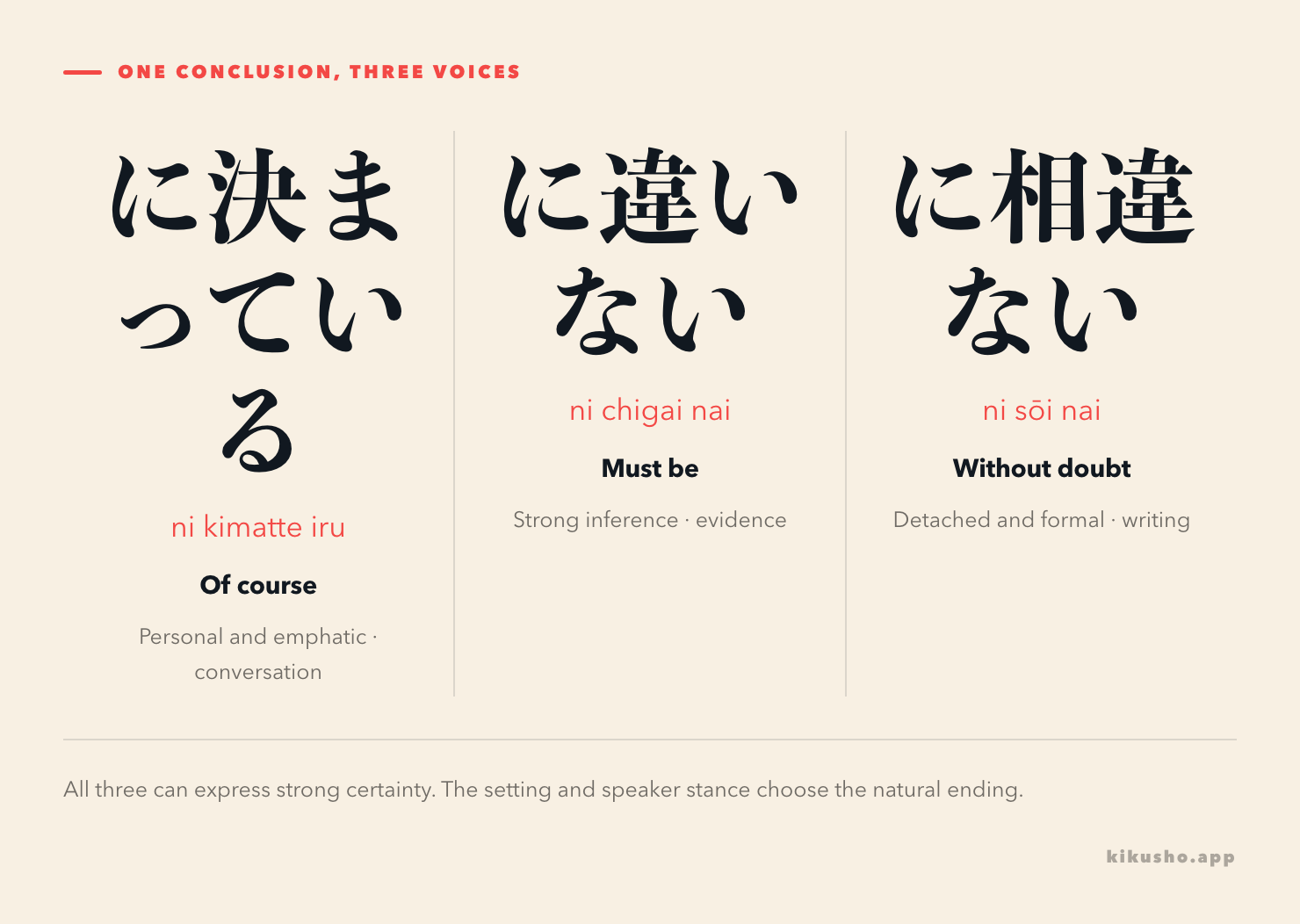
に決まっている(にきまっている, ni kimatte iru) often rejects alternatives as obvious:
そんな条件では、誰も賛成しないに決まっているよ。
そんな じょうけんでは、だれも さんせいしないに きまっているよ。
With conditions like those, of course nobody will agree.
The final よ fits a speaker pressing the conclusion on a listener. Depending on tone, this can sound reassuring, boastful or blunt.
に相違ない(にそういない, ni sōi nai) literally contains 相違, “difference” or “discrepancy.” As a fixed grammar ending, it asserts that the conclusion admits no discrepancy:
記録を照合した結果、署名は本人のものに相違ない。
きろくを しょうごうした けっか、しょめいは ほんにんの ものに そういない。
After comparing the records, there is no doubt that the signature belongs to the person concerned.
This sentence suits a finding or written statement. In an ordinary chat, 本人のものに違いない would usually sound less ceremonious.
Form both endings from a plain predicate
Verbs and い-adjectives keep their plain forms. Nouns and な-adjectives attach directly without plain だ.
| Predicate | に決まっている | に相違ない |
|---|---|---|
| Verb | 来るに決まっている | 来るに相違ない |
| Negative verb | 来ないに決まっている | 来ないに相違ない |
| い-adjective | 高いに決まっている | 高いに相違ない |
| な-adjective | 無理に決まっている | 安全に相違ない |
| Noun | 嘘に決まっている | 事実に相違ない |
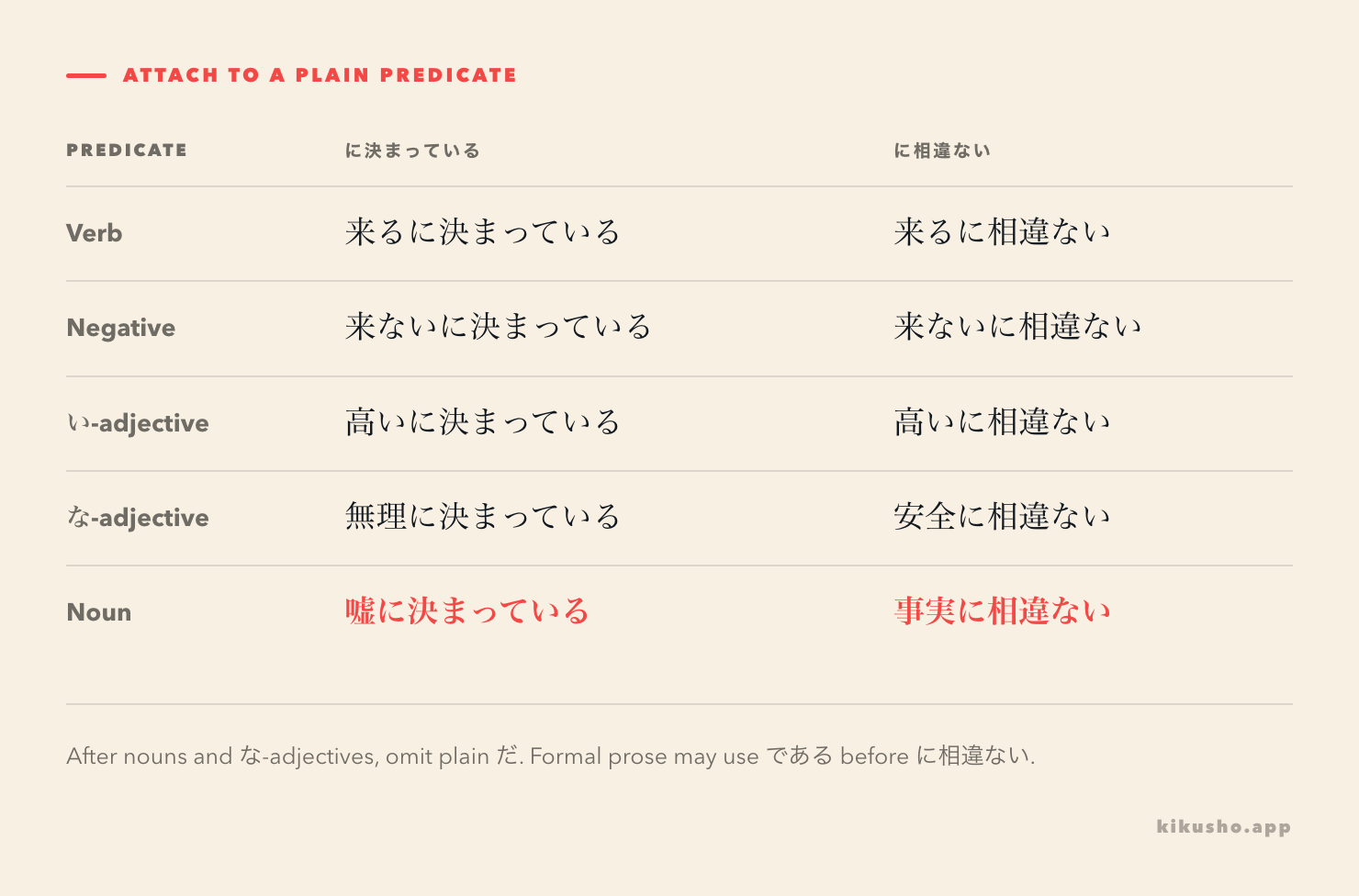
The noun rule is a common test point:
- そんな話は嘘に決まっている。 That story is obviously a lie.
- そんな話は嘘だに決まっている。 Incorrect: remove だ.
- この数字は入力ミスに相違ない。 There can be no doubt that this number is an input error.
Formal prose can insert である before に相違ない, especially after a noun or な-adjective:
この遺物は江戸時代のものであるに相違ない。
There is no doubt that this artefact is from the Edo period.
Treat N + に相違ない as the direct default and recognize N + である + に相違ない as a formal expansion. Do not replace である with plain だ.
に決まっている makes the speaker visible
The pattern often appears when a speaker has already taken a side. A reason may support the claim, but the grammar highlights the speaker's certainty rather than measuring the proof.
毎日練習しているから、上手になるに決まっている。
まいにち れんしゅうしているから、じょうずに なるに きまっている。
They practise every day, so of course they will improve.
何も準備しなければ、当日困るに決まっている。
なにも じゅんびしなければ、とうじつ こまるに きまっている。
If you prepare nothing, you will obviously have trouble on the day.
Because it can imply “anyone should see this,” directing it at another person's judgement may sound confrontational:
そんな方法、失敗するに決まっている。
A method like that is bound to fail.
The polite ending に決まっています changes social politeness but does not remove the forceful stance. When disagreement matters, a softer と思います may be more tactful.
に相違ない belongs mainly to formal writing
Bunpro's reference for に相違ない describes the form as very formal and notes that に違いない usually replaces it in everyday Japanese. The National Institute for Japanese Language and Linguistics likewise treats it as an older expression now ordinarily found in writing.
That register makes it useful in reports, historical narration and official-sounding conclusions:
複数の証言が一致しており、この人物が現場にいたに相違ない。
ふくすうの しょうげんが いっちしており、この じんぶつが げんばに いたに そういない。
Several testimonies agree, so there can be no doubt that this person was at the scene.
この文体から判断すると、同じ作者が書いた作品に相違ない。
この ぶんたいから はんだんすると、おなじ さくしゃが かいた さくひんに そういない。
Judging from the style, the work is undoubtedly by the same author.
The polite official form is に相違ありません:
記載された内容に相違ありません。
I confirm that there is no discrepancy in the information stated.
On a form or declaration, that sentence can confirm correctness rather than infer an unseen fact. The shared idea is still “no discrepancy,” but the document's function determines the translation.
Keep literal 決まっている separate
The sequence 決まっている can also be the ordinary result state of 決まる, “to be decided.” The grammar pattern has an entire proposition immediately before に; the literal use names something that has been settled.
| Sentence | Reading |
|---|---|
| 来週出発するに決まっている | It is certain that they will leave next week |
| 出発の日は来週に決まっている | The departure date has been set for next week |
| 会議の日程はもう決まっている | The meeting schedule has already been decided |
In 出発する + に決まっている, the conclusion “they will leave” is presented as obvious. In 来週に + 決まっている, に marks the selected time, and the verb keeps its literal meaning.
Contrast the evidence-based neighbour に違いない
The boundary is a tendency, not a mechanical rule. Still, this three-way comparison helps you choose a natural voice:
電気が消えている。もう寝たに違いない。
The lights are off. They must have gone to bed.
The observation supports an inference. The full に違いない lesson contrasts that strong inference with a statement that leaves exceptions open.
あんなに疲れていたら、もう寝たに決まっている。
If they were that tired, of course they have gone to bed.
The speaker treats every alternative as unrealistic and makes the personal conviction audible.
状況を総合すると、すでに就寝したに相違ない。
Considering the circumstances as a whole, there can be no doubt that they have retired for the night.
The formal wording sounds like narration or a written determination. Swapping these endings may leave the basic conclusion intact while changing the speaker's social voice.
Level placement and source disagreement
JLPT Sensei lists に決まっている and に相違ない at N2, as does Bunpro for both constructions. Kikusho follows that N2 placement because those independent references agree on the forms and their core functions.
Some teaching sites place に決まっている or the three-way comparison at N3. That disagreement is normal because the JLPT does not publish a complete official grammar list. Use the level as a study sequence, not as a claim that the expression can appear only on one test.
When saving either form in Kikusho, keep the clue and the register with the conclusion. A card with only に相違ない = without doubt will not teach you where the expression belongs. A full report sentence makes its formal written voice part of the memory.
Practice questions
Complete the six tasks in sequence, then reveal their explanations together.
Question 1
Your friend has trained every day and you emphatically predict success in conversation. Choose the best ending.
今度の試合は勝つ( )。
- A. に相違ありません
- B. に決まっているよ
- C. とは限らないよ
- D. ことになっているよ
Question 2
Choose the form that correctly follows the noun 偽物.
値段が安すぎる。これは偽物( )。
- A. だに決まっている
- B. なに決まっている
- C. に決まっている
- D. で決まっている
Question 3
A formal investigation report reaches a firm conclusion. Which sentence best matches that register?
- A. 原因は配線の不具合に相違ない。
- B. 原因は配線の不具合かもしれないよ。
- C. 原因は配線の不具合に決まってるじゃん。
- D. 原因は配線の不具合とは限らない。
Question 4
Which sentence uses 決まっている literally to mean “has been decided”?
- A. 彼なら参加するに決まっている。
- B. そんな案は反対されるに決まっている。
- C. 次の会議の日程はもう決まっている。
- D. この答えは正しいに決まっている。
Question 5
Complete the negative conclusion with the exact plain attachment.
あれほど怒っているから、今日は電話に( )。
Use 出ない + に決まっている.
Question 6
Read the two contexts and assign に決まっている and に相違ない once each.
- A friend dismisses an obviously impossible plan: そんな計画は失敗する( )。
- A written expert assessment states its conclusion: この損傷は長年の摩耗によるもの( )。
Lock in all six responses now; the answers are hidden together to protect the remaining questions.
Answers and explanations
Both target forms express strong certainty. Let the attachment and the social voice decide between them.
Answer 1: B. 勝つに決まっているよ gives the friend's emphatic conversational prediction. A is grammatical but excessively official for this exchange. C refuses certainty, and D describes an arrangement or rule rather than a confident conclusion.
Answer 2: C. A noun attaches directly: 偽物に決まっている. Plain だ is omitted before this ending. B incorrectly inserts な, while D turns 決まっている toward its literal “be decided” use without forming the intended conclusion.
Answer 3: A. 不具合に相違ない fits a formal written determination. B weakens the claim to possibility. C is forceful but colloquial, and D says the proposed cause is not guaranteed.
Answer 4: C. 日程はもう決まっている reports the result of a decision: the schedule has been set. The other three sentences contain a complete proposition before に決まっている and assert that it is obviously true.
Answer 5: 出ないに決まっている. The negative plain verb 出ない remains intact before the ending. The complete sentence predicts with strong conviction that the angry person will not answer the phone.
Answer 6: 1 takes に決まっている; 2 takes に相違ない. The friend's dismissal makes a personal, emphatic stance audible: 失敗するに決まっている. The expert's written finding uses the detached formal conclusion 摩耗によるものに相違ない. The certainty is high in both; the register changes.
Common questions
What is the difference between に決まっている and に相違ない?
Both express a conclusion held with very strong certainty. に決まっている often sounds like the speaker's emphatic, subjective “of course” in conversation, while に相違ない is stiff and formal and appears mainly in writing or official statements.
How do nouns and な-adjectives attach to these patterns?
Drop plain だ and attach the ending directly: 嘘に決まっている and 安全に相違ない. Formal prose may insert である before に相違ない, as in 事実であるに相違ない.
Is に相違ない stronger than に決まっている?
Both can convey near-total confidence. The safer distinction is stance and register: に決まっている is personal and emphatic, whereas に相違ない is formal and detached. The context, not a fixed percentage, supplies the evidence.