On this page
A rush-hour train packed to the doors, a floor polished to a shine, someone slipping out of a room before anyone looks up: Japanese has a single adverb for each of those, and all six here sit at N2. ぎっしり, こっそり, さっさと, せっせと, ぴかぴか and ふわふわ describe the manner of an action or the texture of a thing, and each becomes usable only once you pin it to the verb it rides on, never from its English label alone.
Why these six belong together
Every word on this page is a 擬態語(ぎたいご, gitaigo): a mimetic word that paints a manner or a state rather than copying a real noise. A ringing phone or a barking dog belongs to the neighbouring class, 擬音語(ぎおんご, giongo), and the N3 mimetic adverbs lesson draws that line in full. None of these six makes a sound. こっそり is the quality of a movement done unseen, ぎっしり the density of a packed space, ぴかぴか the look of a gleaming surface. If mimetic words are new to you, the everyday onomatopoeia at N4 are the gentler place to start.
They also split into two grammatical shapes, and the split is the lesson. Four of them end in a small つ plus り or と — ぎっしり, こっそり, さっさと, せっせと — and those stay adverbs, leaning on a verb that carries the meaning. The other two, ぴかぴか and ふわふわ, repeat a syllable and flex: the same word becomes an adverb, an adjective and a verb depending on where you put it. Learn the four as verb partners and the two as shape-shifters, and the set stops being six loose glosses.
The six at a glance
| Word (reading) | The manner or texture it names | A phrase to keep |
|---|---|---|
| ぎっしり(ぎっしり) | Packed full, with no gaps | 予定がぎっしりだ(the schedule is packed) |
| こっそり(こっそり) | Secretly, so no one notices | こっそり抜け出す(slip out unseen) |
| さっさと(さっさと) | Quickly, without dawdling | さっさと帰ろう(let's get going) |
| せっせと(せっせと) | Busily, without a break | せっせと働く(work away steadily) |
| ぴかぴか(ぴかぴか) | Shining; also brand new | ぴかぴかに磨く(polish to a shine) |
| ふわふわ(ふわふわ) | Soft; floating; unsettled | ふわふわのパン(fluffy bread) |
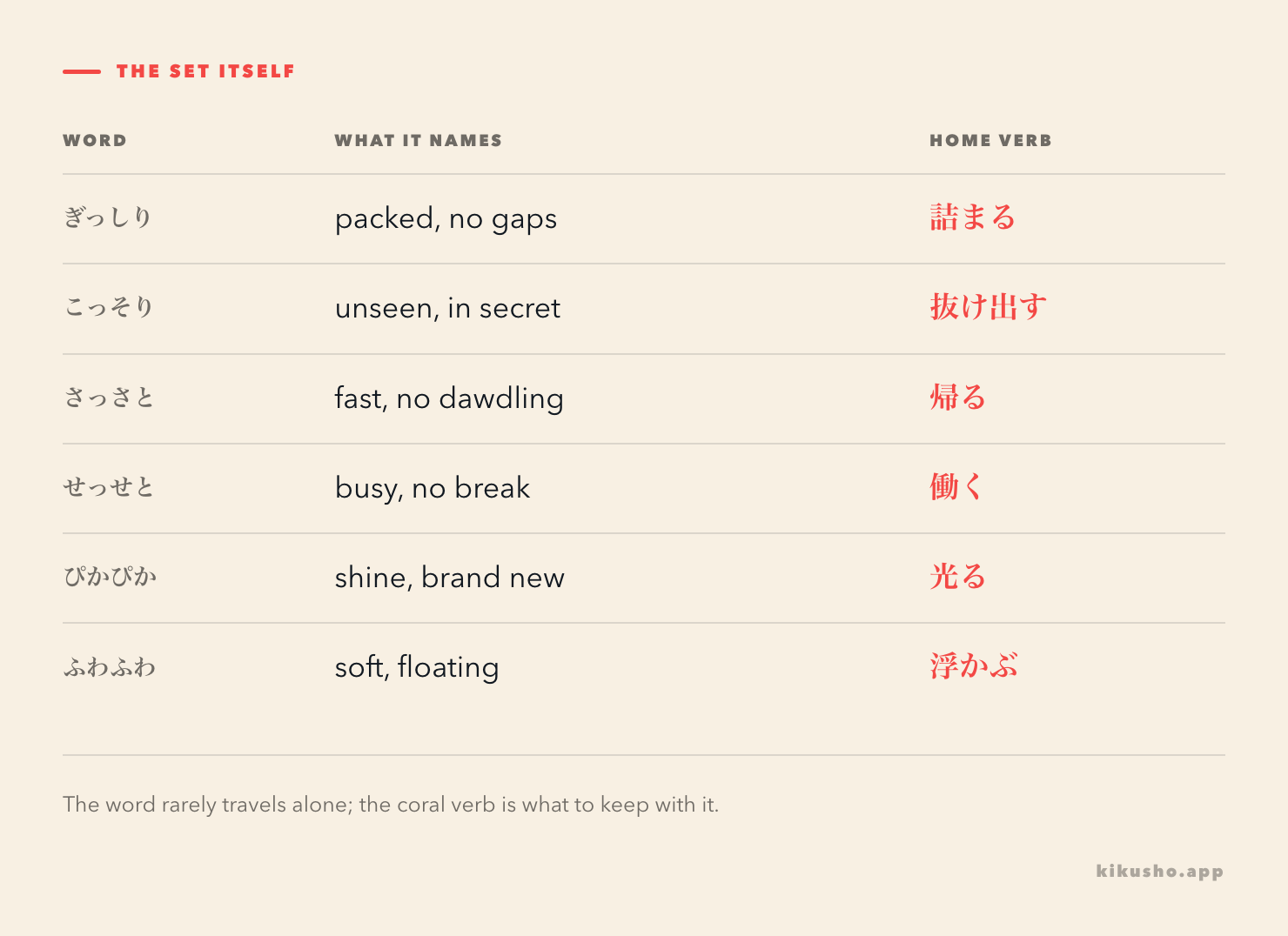
All six carry an N2 label here, taken from the Waller and Tanos vocabulary sets this series relies on. Because those two sets share one ancestor, their agreement is really a single source speaking, and mimetic words in any case spill across every level of real speech. Read the N2 tag as a filing decision, not a wall around the word: children say ふわふわ years before any exam sorts it there.
The pattern: a manner bolted onto a verb
The four -り/-と words share one habit: alone they float, and only the verb they attach to nails them down. こっそり by itself is a vague "unseen"; こっそり抜け出す is a person slipping out of a room. Memorise the pairing, not the single word.
こっそり: doing it so no one notices
こっそり marks an action done without being seen or heard. The secrecy is about evading notice, and the act itself can be harmless or even kind.
授業中(じゅぎょうちゅう)にこっそりスマホを見た。
I secretly looked at my phone during class.
答えをこっそり教えてあげた。
I quietly slipped them the answer.
The monolingual 大辞泉 gives it as 人に知られないように、ひそかに物事をするさま — doing something so people do not find out. It pairs naturally with verbs of moving and hiding: 入る, 出る, 抜け出す, 隠す, 教える. Reach for it when the point is that no one was watching, not that a rule was broken.
さっさと: fast, and without dawdling
さっさと is quick, but it is not the neutral 速く. It carries "get on with it", so it lives in commands and in scenes where someone stops lingering.
さっさと宿題をやりなさい。
Get your homework done, now.
彼はさっさと帰ってしまった。
He left briskly, without hanging around.
Dictionaries record a second, cooler sense here — leaving without regret or ceremony — and you can hear the impatience when it is aimed at a person: さっさとしろ is curt. That edge is the trap. Use it for hurrying yourself or a close friend along; pointed at a stranger it sounds sharp.
せっせと: busy, and without a break
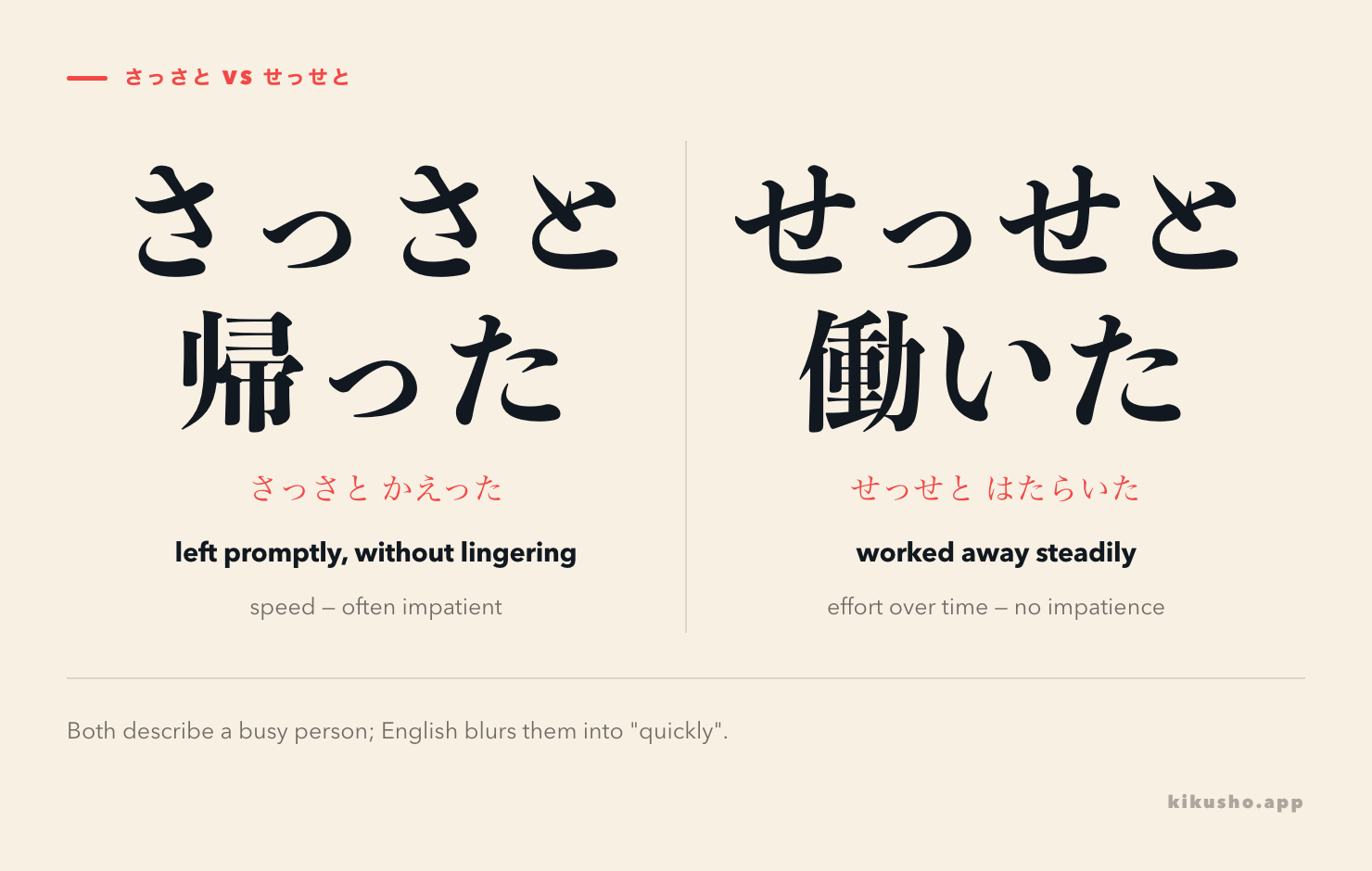
せっせと is the opposite temperament. Where さっさと wants a thing finished fast, せっせと describes steady, willing effort kept up over time, and the tone is admiring.
母は毎日せっせと働いている。
My mother works away, day in and day out.
彼女はせっせと貯金(ちょきん)した。
She saved diligently, bit by bit.
大辞泉 defines it as 物事を休まず熱心に行うさま — doing something eagerly and without rest. It attaches to sustained activities: 働く, 通う, 書く, 貯金する. The confusion with さっさと is the pair worth drilling, because both describe a busy person and English blurs them into "quickly".
ぎっしり: how full a space is
ぎっしり is the fourth adverb, and it points at fullness rather than manner: things packed together with no room left. Its home verb is 詰まる/詰める.
かばんに本がぎっしり詰まっている。
The bag is crammed full of books.
It has one move the other three lack. It can stand as a predicate about a schedule or a container, with だ and no verb of its own: 今週は予定がぎっしりだ, "this week is packed solid." That small freedom is the bridge to the last two words, which take it much further.
ぴかぴか and ふわふわ break the pattern
The reduplicated pair does not stay put as adverbs. Each one flexes across four frames, so the same word can modify a verb, sit before a noun, or become a predicate. Other N2 mimetics behave this way too: すっきり and にこにこ build predicates with する, as the lesson on clear, pounding and smiling states shows.
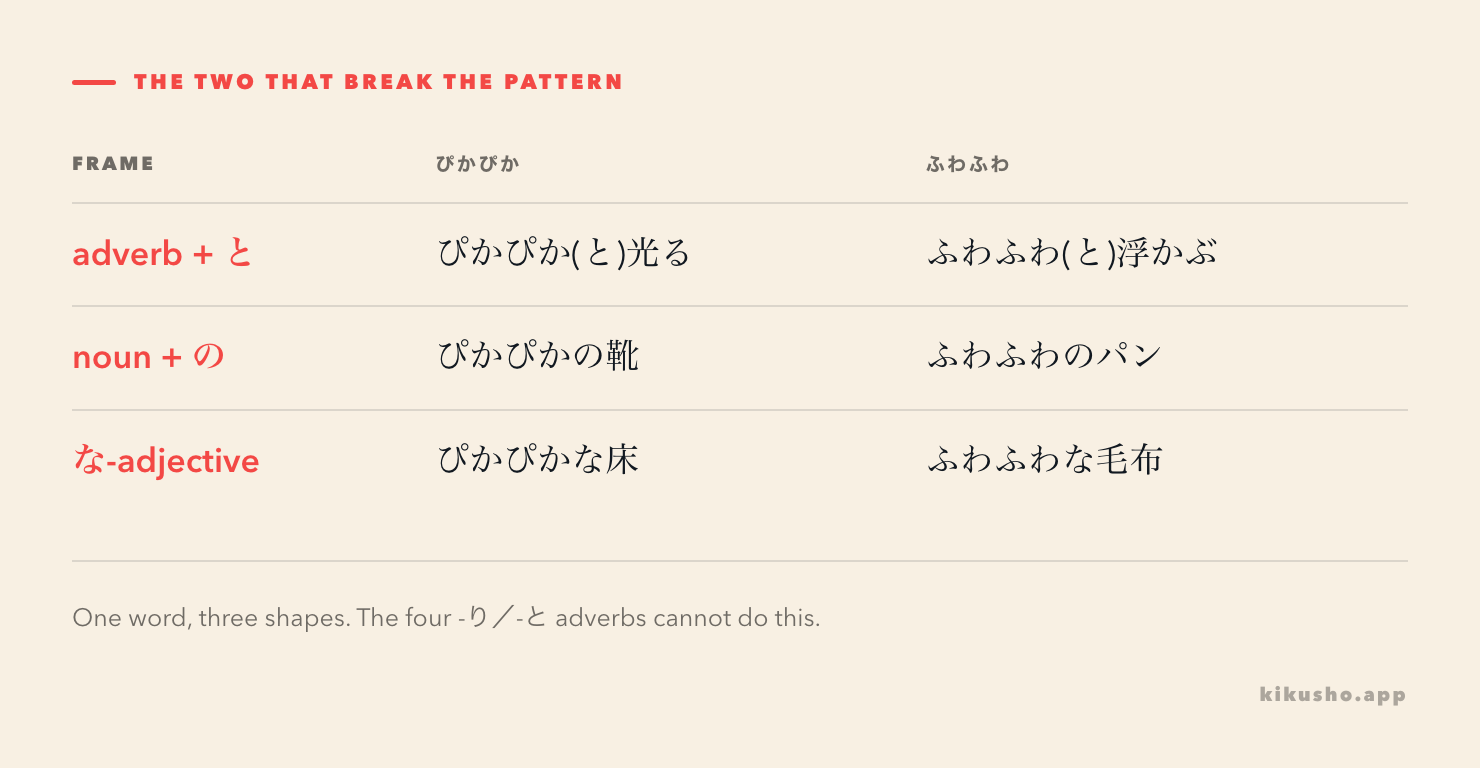
For a concrete object, the の form is the everyday choice — ぴかぴかの靴, ふわふわのパン — while な is also grammatical, and に turns the word into a result you can aim a verb at: 靴をぴかぴかに磨(みが)く, polish the shoes to a shine.
ぴかぴか: a shine, and something brand new
The first sense is light: a surface that gleams or a small light that flashes.
星がぴかぴか光っている。
The stars are twinkling.
The second sense is where learners get caught. ぴかぴか also means brand new, fresh out of the box, and it is idiomatic in one phrase every parent knows: ぴかぴかの一年生(いちねんせい), a shiny new first-grader on the first day of school. 大辞泉 lists both the 強い光を放つ sense and the 真新しい one. A new car, new shoes, a freshly cleaned room can all be ぴかぴか.
ふわふわ: soft, floating, and unsettled
ふわふわ runs through three senses, and the third is the one the glosses drop. First, soft and full of air:
ふわふわのパンケーキを焼いた。
I made fluffy pancakes.
Second, floating lightly:
風船(ふうせん)が空にふわふわ浮かんでいる。
A balloon drifts up in the sky.
Third, and easy to miss, an unsettled state of body or mind. 頭がふわふわする is feeling light-headed, not fluffy; 気持ちがふわふわして落ち着かない is a mind that will not settle. When ふわふわ takes する and points at a person, expect this sense, not the texture.
Which ones you'll meet first
If you are pacing them, front-load the everyday four. こっそり, さっさと, ぴかぴか and ふわふわ turn up constantly in conversation, manga and children's speech, and their verbs are common. ぎっしり follows close behind, because packed trains and packed schedules are daily facts. せっせと is the one you will read more than say — it suits describing someone else's steady effort — so it can wait until the other five are secure.
These words rarely arrive alone. ふわふわ shows up under a photo of pancakes, ぎっしり on a poster about a packed timetable, and what is worth keeping is never the adverb by itself but the verb it was leaning on. When you meet one in the wild, save the whole line: Kikusho turns the sentence you captured into a card with its reading and native audio, so ぎっしり comes back still attached to 詰まっている rather than stranded as "tightly".
Practice questions
Work through all five before you open the solutions.
1. Fill the blank with the right adverb. 「子どもたちが寝ているので、( )部屋を出た。」 ① ぎっしり ② こっそり ③ せっせと ④ ぴかぴか
2. Pick the sentence that uses ふわふわ the way a native speaker would. ① このケーキはふわふわしていておいしい。 ② 彼はふわふわ走って一位になった。 ③ 予定がふわふわで休めない。 ④ 靴をふわふわに磨いた。
3. Which sentence keeps the meaning of 「彼は毎日せっせと働いている」? ① 彼は毎日休まず熱心に働いている。 ② 彼は毎日いやいや働いている。 ③ 彼はときどきしか働かない。 ④ 彼はすぐに仕事をやめた。
4. Which adverb fits the blank? 「電車は朝から人で( )だった。」 ① こっそり ② さっさと ③ ぎっしり ④ ふわふわ
5. In which sentence does さっさと sound natural? ① 用事が終わったので、さっさと帰った。 ② 彼女はさっさとした布団で寝た。 ③ 新車がさっさと光っている。 ④ お金をさっさと貯金した。
Answers and explanations
1. ② こっそり. Leaving so as not to wake sleeping children is acting without being noticed, which is こっそり部屋を出た. ① ぎっしり (packed full) and ④ ぴかぴか (shiny) describe things, not a quiet exit; ③ せっせと (diligently, without rest) names sustained effort, not stealth.
2. ①. 「ふわふわしていておいしい」uses the する form for a soft, airy texture, exactly ふわふわ's home ground. ② forces it onto 走る as a speed word, which it is not. ③ swaps it for ぎっしり's fullness sense. ④ wants ぴかぴか — you polish shoes to a shine, not to a fluff.
3. ① 彼は毎日休まず熱心に働いている. せっせと means diligently and without a break, and 休まず熱心に (without rest, eagerly) keeps that sense. ② いやいや (reluctantly) reverses the willing tone. ③ (only sometimes) denies the steadiness. ④ (quit at once) is closer to さっさと and describes stopping, not working.
4. ③ ぎっしり. A train filled with people from the morning is packed with no room, which is 人でぎっしりだ, one of ぎっしり's predicate uses. ① こっそり (secretly) and ② さっさと (promptly) describe how an action is done, not how full a train is; ④ ふわふわ (soft, floating) is the wrong image for a crush of commuters.
5. ①. 「用事が終わったので、さっさと帰った」uses さっさと for leaving promptly once business is done, its natural home in a scene of not lingering. ② needs a texture word such as ふわふわな布団. ③ describes a gleam, which is ぴかぴか光る. ④ pairs steady saving with the wrong adverb; せっせと貯金した fits, because saving is sustained effort rather than a quick exit.
Common questions
Are ぴかぴか and ふわふわ adverbs or adjectives?
Both, and more. ぴかぴか and ふわふわ work as adverbs with an optional と (ふわふわ浮かぶ), as な-adjectives or の-modifiers before a noun (ぴかぴかの靴, ふわふわのパン), and as する verbs (頭がふわふわする). The four -り/-と words in this set stay adverbs.
What is the difference between さっさと and せっせと?
さっさと means quickly and without dawdling, and often carries impatience: さっさと帰ろう is "let's get going". せっせと means diligently and without a break, describing sustained effort: せっせと働く is "work away steadily". One is about finishing fast, the other about keeping at it.
Does こっそり imply doing something wrong?
No. こっそり means acting so others do not notice, and the action can be harmless or kind: こっそり教える is quietly tipping someone off. The word marks secrecy, not wrongdoing.