On this page
The ten N2 geography words in this lesson are 海洋(かいよう), 地面(じめん), 水平線(すいへいせん), 滝(たき), 地帯(ちたい), 峠(とうげ), 半島(はんとう), 麓(ふもと), 平野(へいや) and 岬(みさき). They let you move between three scales: the surface under your feet, a landform you cross, and a region you see on a map.
The complete set changes scale from ground to map
All ten items are nouns. Their common partners reveal which scale each word describes.
| Word | Reading | Core sense | Anchor phrase |
|---|---|---|---|
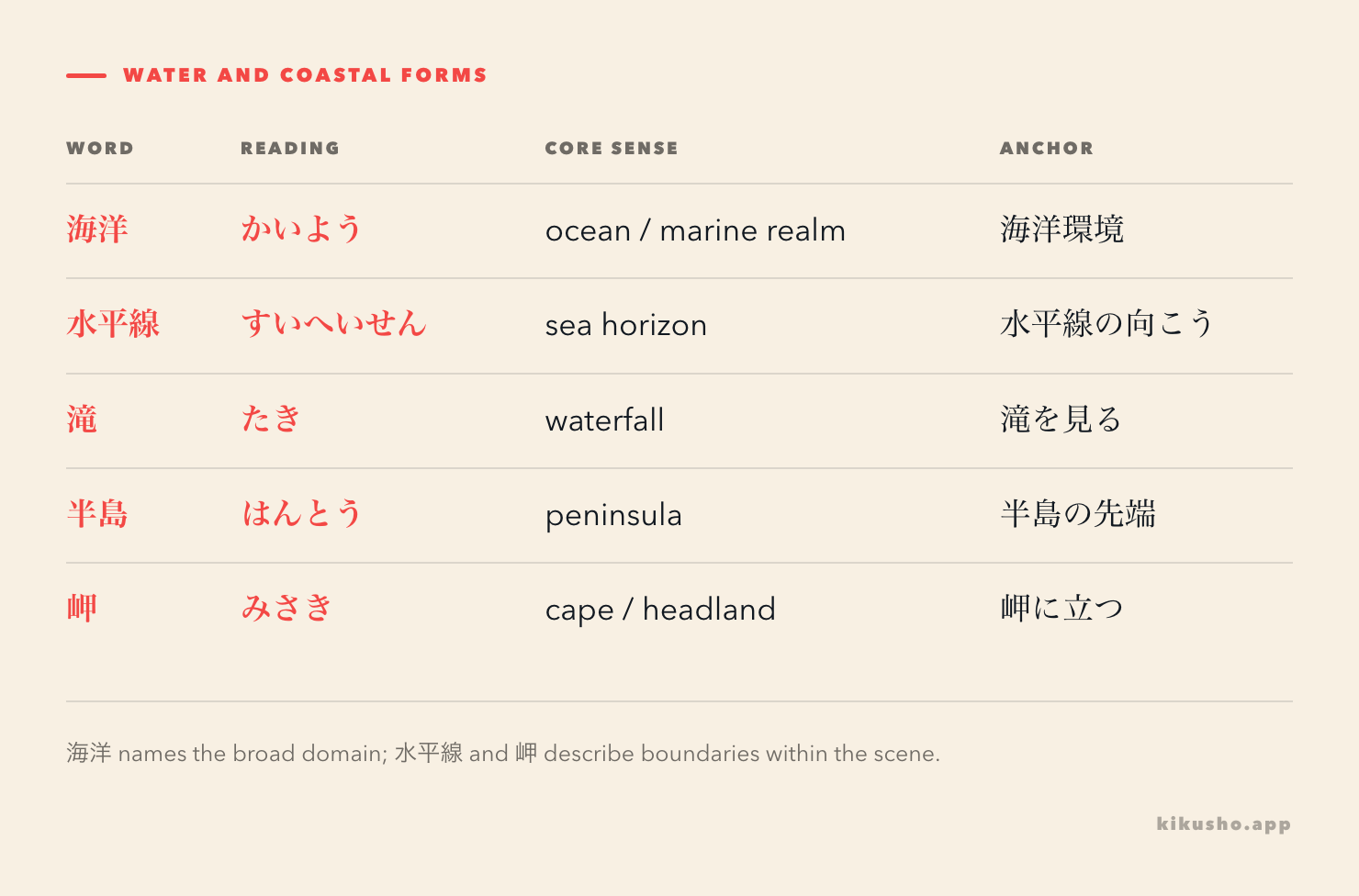
| 海洋 | かいよう | ocean; marine realm | 海洋環境, marine environment |
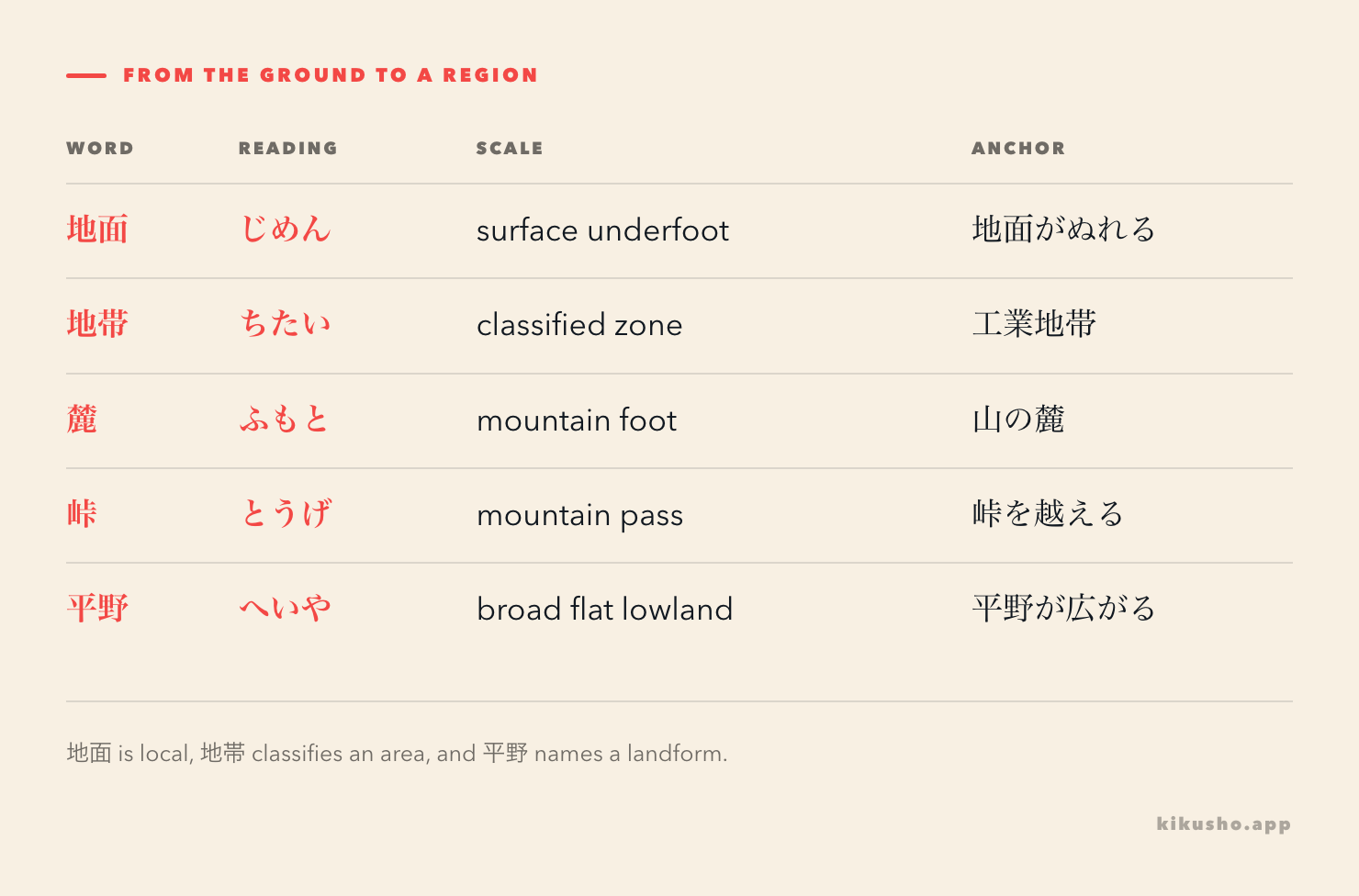
| 地面 | じめん | ground surface | 地面がぬれる, the ground gets wet |
| 水平線 | すいへいせん | sea horizon | 水平線の向こう, beyond the horizon |
| 滝 | たき | waterfall | 滝を見る, see a waterfall |
| 地帯 | ちたい | zone; belt; area | 工業地帯, industrial zone |
| 峠 | とうげ | mountain pass; critical stage | 峠を越える, cross the pass |
| 半島 | はんとう | peninsula | 半島の先端, tip of a peninsula |
| 麓 | ふもと | foot of a mountain | 山の麓, foot of a mountain |
| 平野 | へいや | plain; broad flat lowland | 平野が広がる, a plain extends |
| 岬 | みさき | cape; headland | 岬に立つ, stand on a cape |
The readings and core senses agree across the curriculum inventory and dictionary evidence. The level boundary is less fixed. Several independent study lists place 水平線, 峠 and 麓 at N2, while Bunpro places 半島 at N3. “N2 vocabulary” is therefore a study sequence, not a claim that the exam publishes a closed word list.
海洋 belongs to reports more readily than everyday trips
海(うみ) is the ordinary word for the sea. You go to 海, swim in 海, or look at 海. 海洋 presents the ocean as a broad physical, environmental or scientific domain.
海洋汚染を防ぐため、プラスチックごみを減らす取り組みが進んでいる。
かいようおせんを ふせぐため、プラスチックごみを へらす とりくみが すすんでいる。
Efforts to reduce plastic waste are advancing in order to prevent marine pollution.
Natural compounds include 海洋環境, 海洋生物, 海洋資源, 海洋研究 and 海洋汚染. Kotobank's 海洋 entry defines the word as a large sea or the oceans and their subsidiary seas. That scope explains why 海洋で泳ぐ sounds mismatched in an ordinary outing: the scientific category is larger than the scene. Use 海で泳ぐ.
The difference is one of viewpoint rather than two separate bodies of water. A report can discuss 海洋の温度 while a traveller looking at the same water says 海がきれいだ.
水平線 is over water; 地平線 is over land
In its geographic sense, 水平線 is the apparent line where the sea and sky meet. 地平線(ちへいせん) is the corresponding boundary across open land.
夕日が水平線の下に沈んでいった。
ゆうひが すいへいせんの したへ しずんでいった。
The setting sun sank below the horizon.
船が水平線の向こうに消えた。
ふねが すいへいせんの むこうに きえた。
The ship disappeared beyond the horizon.
Kotobank distinguishes the sea-sky 水平線 from the land-sky 地平線 in its main definitions. The spelling gives a useful cue: 水 points toward water, while 地 points toward land. Neither word means 海岸線(かいがんせん), the coastline traced where land itself meets the water.
The N3 geography set places 地平線 inside a complete route from 丘 and 谷 to 岸, 沖 and 湾. That route keeps both horizon words attached to the surface that selects them.
地面, 地帯 and 平野 answer three different questions
These three nouns can all be translated with broad English words such as “ground,” “area” or “plain,” but their scale and logic differ.
| Question | Word | What it identifies |
|---|---|---|
| What surface am I touching? | 地面 | the ground directly underfoot |
| What kind of zone is this? | 地帯 | an area distinguished by a feature or purpose |
| What landform spreads here? | 平野 | an extensive, relatively flat lowland |
雨で地面がぬれているので、滑らないように注意してください。
あめで じめんが ぬれているので、すべらないように ちゅういしてください。
The ground is wet from the rain, so please take care not to slip.
地面 is the surface on which something falls, lies, stands or leaves a mark. Kotobank records an additional sense of a parcel of land, but “ground surface” is the dependable core for modern learner production.
この沿岸地帯では、一年を通して強い風が吹く。
この えんがんちたいでは、いちねんを とおして つよい かぜが ふく。
Strong winds blow throughout the year in this coastal zone.
地帯 classifies a bounded area by what characterizes it: 工業地帯, 住宅地帯, 山岳地帯, 沿岸地帯 or 危険地帯. The dictionary definition centers precisely on an area distinguished from its surroundings by a feature.
山を下りると、広い平野が目の前に広がった。
やまを おりると、ひろい へいやが めのまえに ひろがった。
When we descended the mountain, a broad plain opened out before us.
平野 is a landform, not merely any flat patch. The Geospatial Information Authority of Japan defines it as an expanse of flat lowland with almost no relief. You can stand on the 地面 inside a 平野, and the same plain may contain an agricultural 地帯. The nouns are compatible because each answers a different question.
麓 begins the climb; 峠 turns ascent into descent
麓 is the lower part or foot of a mountain. It normally appears with the mountain as 山の麓, or with a named mountain: 富士山の麓.
山の麓に小さな村がある。
やまの ふもとに ちいさな むらが ある。
There is a small village at the foot of the mountain.
峠 is the mountain pass where a route reaches the boundary between climbing and descending. It is not simply the summit of the mountain. Kotobank's 峠 entry describes the point where a mountain road finishes ascending and begins to descend.
峠を越えると、遠くに海が見えてきた。
とうげを こえると、とおくに うみが みえてきた。
Once we crossed the mountain pass, the sea came into view in the distance.
The route creates a durable pair: start at 麓, climb toward 峠, cross it, then descend on the other side. Kotobank defines 麓 as the lower part or base of a mountain.
峠 also has a figurative use for the most critical or intense stage:
病状は峠を越した。
びょうじょうは とうげを こした。
The patient's condition has passed the critical stage.
The image is the same. The difficult climb has reached its turning point, and conditions are expected to ease after it.
半島 is the landform; 岬 focuses on its projecting point
A 半島 is land surrounded by water on three sides and joined to larger land on one side. A 岬 is a point of land projecting into the sea or another large body of water.
半島の東側には、小さな港がいくつもある。
はんとうの ひがしがわには、ちいさな みなとが いくつも ある。
There are several small ports on the eastern side of the peninsula.
岬に立つと、海が両側に見えた。
みさきに たつと、うみが りょうがわに みえた。
Standing on the cape, I could see the sea on both sides.
The neat classroom shortcut “a peninsula is large, a cape is small” goes too far. The Geospatial Information Authority's landform guide says there is no clear area-based boundary between a large cape and a peninsula. The practical distinction is focus: 半島 names the connected landform as a region; 岬 names the projecting end or headland.
The Authority's multilingual map standard lists 岬 as “Cape,” with みさき, さき and ざき among readings found in geographic names, and classifies 半島 as “Peninsula.” For the standalone vocabulary item here, learn 岬(みさき). Preserve the established reading when the kanji occurs inside a proper name.
滝 completes the route from inland water to the sea
滝 is a waterfall, a place where flowing water drops sharply from a height. It can sit inside the same geographic account without being confused with the larger water words.
山道を進むと、岩の間から大きな滝が見えてきた。
やまみちを すすむと、いわの あいだから おおきな たきが みえてきた。
As we followed the mountain trail, a large waterfall came into view between the rocks.
The word is concrete and ordinary, unlike the technical tendency of 海洋. In a connected landscape, rain feeds streams, a stream forms a 滝, rivers cross a 平野, and the water eventually reaches the 海洋. The lesson is not asking you to replace familiar 海 with a harder synonym. It is giving each noun the scale at which it works.
The N4 landscape lesson supplies everyday 湖, 島 and 海岸. The N1 geography lesson moves further into explanatory terms such as 河川, 山脈 and 地形. This N2 set sits between them: specific enough for maps and reports, but still common in travel descriptions and news.
Read all ten words as one route
山の麓を出発し、峠を越えると、広い平野と海へ延びる半島が見えた。平野の一部は工業地帯になっているが、地面にはまだ雨水が残っていた。半島の先の岬まで行くと、水平線がよく見えた。近くの滝から流れる水も、やがて海へ注ぐ。海洋環境は、こうした陸からの水の影響も受ける。
やまの ふもとを しゅっぱつし、とうげを こえると、ひろい へいやと うみへ のびる はんとうが みえた。へいやの いちぶは こうぎょうちたいに なっているが、じめんには まだ あまみずが のこっていた。はんとうの さきの みさきまで いくと、すいへいせんが よく みえた。ちかくの たきから ながれる みずも、やがて うみへ そそぐ。かいようかんきょうは、こうした りくからの みずの えいきょうも うける。
We left the foot of the mountain and crossed the pass, where a broad plain and a peninsula stretching into the sea came into view. Part of the plain is an industrial zone, but rainwater still remained on the ground. At the cape on the end of the peninsula, the horizon was clearly visible. Water from a nearby waterfall eventually empties into the sea, and the marine environment is also affected by water arriving from land.
The paragraph keeps the scales separate. 地面 holds rain locally; 平野 spreads regionally; 地帯 classifies part of it. 半島 is the full landform, 岬 its projecting point, and 水平線 the distant visual boundary.
When one of these words appears in a map caption or travel article, save its partner in Kikusho as well. 峠を越える, 平野が広がる and 海洋環境 remember three different sentence environments; an English gloss alone hides that difference.
Practice: move from the surface to the horizon
Question 1: reading. How do you read 峠?
- とうげ
- みさき
- ふもと
- へいや
Question 2: orthography. Which spelling represents すいへいせん, the horizon over the sea?
- 水平泉
- 水平線
- 地平線
- 海岸線
Question 3: context. Complete: 雨で( )がぬれているので、滑らないように注意してください。
- 海洋
- 半島
- 地面
- 水平線
Question 4: classification. Which expression naturally names an area distinguished by heavy industry?
- 工業地帯
- 工業地面
- 工業麓
- 工業水平線
Question 5: route. A hiker leaves the foot of a mountain, reaches the pass, then descends. Which order matches?
- 岬 → 半島
- 峠 → 麓
- 麓 → 峠
- 平野 → 地面
Question 6: register. Which sentence best fits an environmental report?
- 海洋汚染を防ぐ対策が必要だ。
- 海洋へ泳ぎに行った。
- 地面が水平線の向こうに沈んだ。
- 滝が工業地帯を読んだ。
Question 7: paraphrase. What does 病状は峠を越した mean in context?
- The patient walked over a mountain pass.
- The illness has passed its most critical stage.
- The hospital moved to the foot of a mountain.
- The ground became flat.
Question 8: connected text. Read: 半島の先にある岬から海を見ると、夕日が水平線へ沈んでいった。 Which description is accurate?
- From a cape at the end of a peninsula, the speaker watched the sun sink toward the sea horizon.
- From a plain, the speaker watched a waterfall cross a mountain pass.
- From an industrial zone, the speaker watched the ground become an ocean.
- From the foot of a mountain, the speaker watched a peninsula disappear underground.
Answers and explanations
Answer 1. The reading is 1, とうげ. 峠(とうげ) is a mountain pass. みさき is 岬, ふもと is 麓, and へいや is 平野.
Answer 2: 2, 水平線. 水平線 is the apparent boundary between a broad water surface and the sky. 地平線 uses 地 and refers to the land horizon; 海岸線 is the coastline.
Answer 3: 3, 地面. Wetness and the risk of slipping concern the physical surface underfoot. The other nouns name an oceanic domain, a peninsula and a distant visual boundary.
Answer 4: 1, 工業地帯. 地帯 names a zone distinguished by a feature, condition or purpose. 工業地帯 is an established compound for an industrial zone.
Answer 5: 3, 麓 → 峠. The hiker starts at the foot of the mountain, 麓, and climbs to the pass, 峠, before descending on the other side.
Answer 6: 1. 海洋汚染 belongs naturally in environmental reporting. Choice 2 should use everyday 海へ泳ぎに行った; choices 3 and 4 assign impossible relationships or actions to the nouns.
Answer 7: 2. Figurative 峠を越す means to pass the peak or most dangerous stage of a process. The sentence concerns the patient's condition, so no physical mountain route is involved.
Answer 8: 1. 半島 is the larger projecting landform, 岬 its coastal point, and 水平線 the visible sea-sky boundary toward which the sun sinks.
A useful map is now hidden inside the vocabulary: 地面 underfoot, 麓 below, 峠 above, 平野 beyond, then 半島, 岬 and 水平線 at the coast. The remaining nouns tell you what kind of region and water system holds that route together.
OpenAI Codex performed the AI language review for this page. The review covered all ten spellings and readings, dictionary senses, collocations, register contrasts, proper-name caution, original Japanese examples, translations, distractors and answer mappings. No human review is claimed.
Common questions
How do you read 海洋, 地面, 水平線, 滝 and 地帯?
They are 海洋(かいよう), 地面(じめん), 水平線(すいへいせん), 滝(たき)and 地帯(ちたい).
How do you read 峠, 半島, 麓, 平野 and 岬?
They are 峠(とうげ), 半島(はんとう), 麓(ふもと), 平野(へいや)and 岬(みさき). Established place names can use other readings for a final geographic kanji.
What is the difference between 水平線 and 地平線?
水平線 is the apparent line where the sea or another broad water surface meets the sky. 地平線 is the apparent boundary between open land and the sky.
What is the difference between 岬 and 半島?
岬 focuses on a projecting coastal point or headland. 半島 is a broader landform surrounded by water on three sides and joined to a larger landmass on one side. There is no universal size boundary between them.