On this page
The six N4 words in this lesson are 乾く(かわく), 季節(きせつ), 雲(くも), 地震(じしん), 台風(たいふう) and 冷える(ひえる). Learn them in three jobs: 季節 and 雲 name the setting, 乾く and 冷える report a change, and 地震 and 台風 name natural phenomena that can become hazards.
The complete six-word set
| Word | Reading | Job and core sense | Phrase to keep |
|---|---|---|---|
| 季節 | きせつ | noun; season | 季節が変わる, the season changes |
| 雲 | くも | noun; cloud | 雲が出る, clouds appear |
| 乾く | かわく | intransitive verb; become dry | 洗濯物が乾く, the laundry dries |
| 冷える | ひえる | intransitive verb; become cold | 朝は空気が冷える, the air gets cold in the morning |
| 地震 | じしん | noun; earthquake | 地震が起きる, an earthquake occurs |
| 台風 | たいふう | noun; typhoon | 台風が近づく, a typhoon approaches |
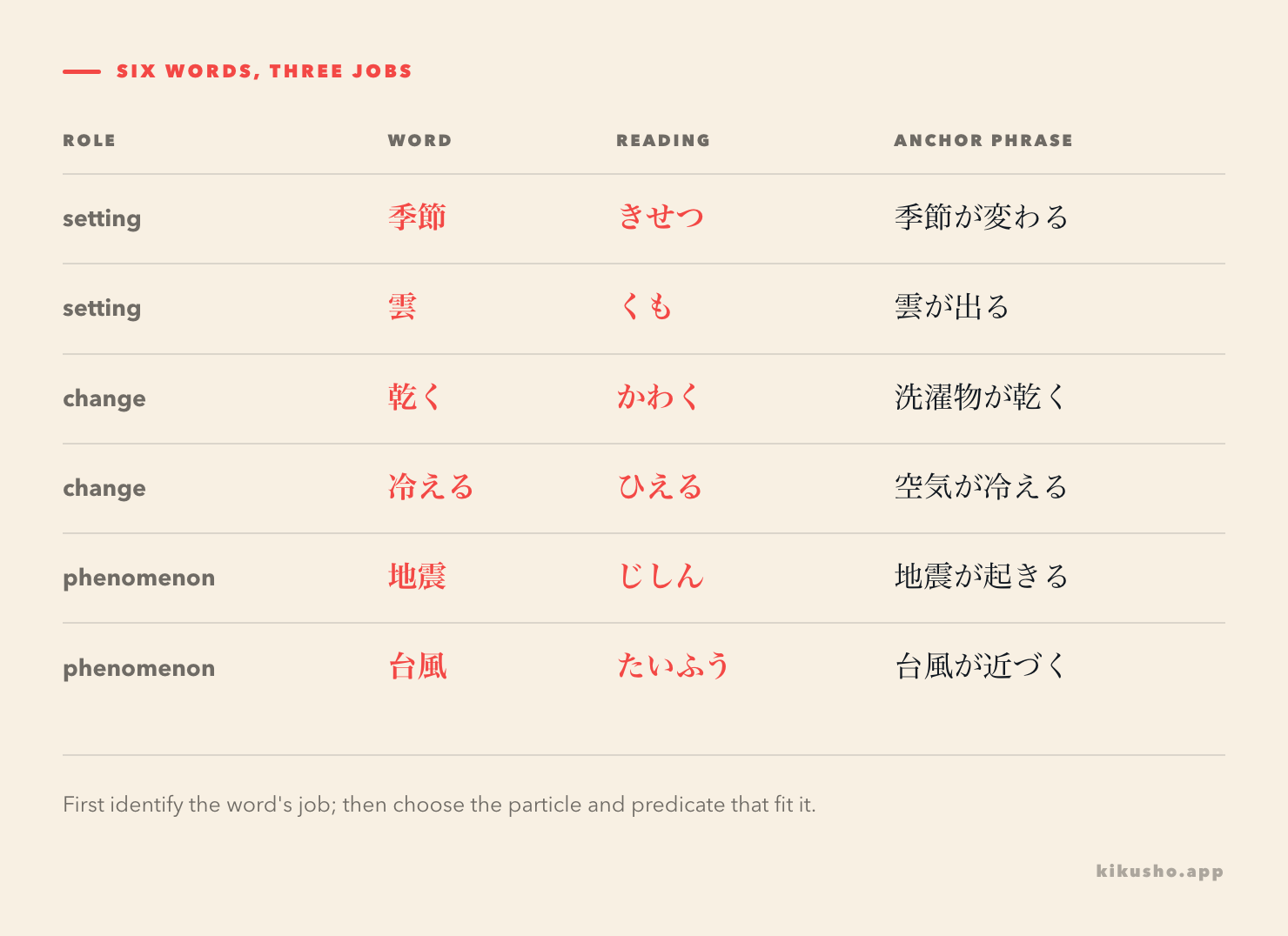
The table is deliberately narrower than a general weather list. The N5 weather lesson already teaches rain, snow, wind, clear skies and cloudy weather. The four-seasons lesson teaches 春, 夏, 秋 and 冬. Here, 季節 gives those four members a category name, while the other five words let a simple report move from ordinary conditions to a possible emergency.
季節 is the category; 雲 is the thing in the sky
季節 means a season or a period of the year distinguished by weather and other recurring conditions. It can name one season without specifying which one:
好きな季節は秋です。
すきな きせつは あきです。
My favourite season is autumn.
季節が変わると、朝の空気が冷えます。
きせつが かわると、あさの くうきが ひえます。
When the season changes, the morning air gets colder.
The first sentence asks about a member of the category. The answer 秋 names the particular season. The second sentence uses 季節が変わる as a time frame for a physical change. The Japan Foundation's Irodori lesson on seasons and weather uses 季節(きせつ) in the same beginner topic area.
雲 is a countable thing you see in the sky, not the weather condition “cloudy.” Kotobank defines 雲 as masses of tiny water droplets or ice crystals suspended in the air. In an everyday sentence, use a counter when the number matters and a verb such as 出る, 広がる or 動く when the scene changes.
空に黒い雲が出てきました。
そらに くろい くもが でてきました。
Dark clouds have appeared in the sky.
Do not substitute 曇り(くもり) in that noun slot. 雲 is a cloud; 曇り is cloudy or overcast weather. A forecast can say 明日は曇りです, while someone looking upward can say 大きな雲があります.
乾く and 冷える describe changes with が
Both assigned verbs are intransitive: the thing that changes is normally marked by が. No person has to cause the change.
風が強いので、洗濯物が早く乾きました。
かぜが つよいので、せんたくものが はやく かわきました。
Because the wind was strong, the laundry dried quickly.
夜になると、空気が冷えます。
よるに なると、くうきが ひえます。
When night comes, the air gets cold.
Shogakukan's definition of 乾く begins with moisture leaving an object. The subject can be laundry, soil, paint or air. 乾いた is the past form, but it also works before a noun to describe the resulting state: 乾いた服, dry clothes; 乾いた空気, dry air.
冷える says that a temperature falls or that something comes to feel cold. The National Institute for Japanese Language and Linguistics verb entry gives the core change as an object's temperature going down. Air, a room, food and a person's body can all be the subject.
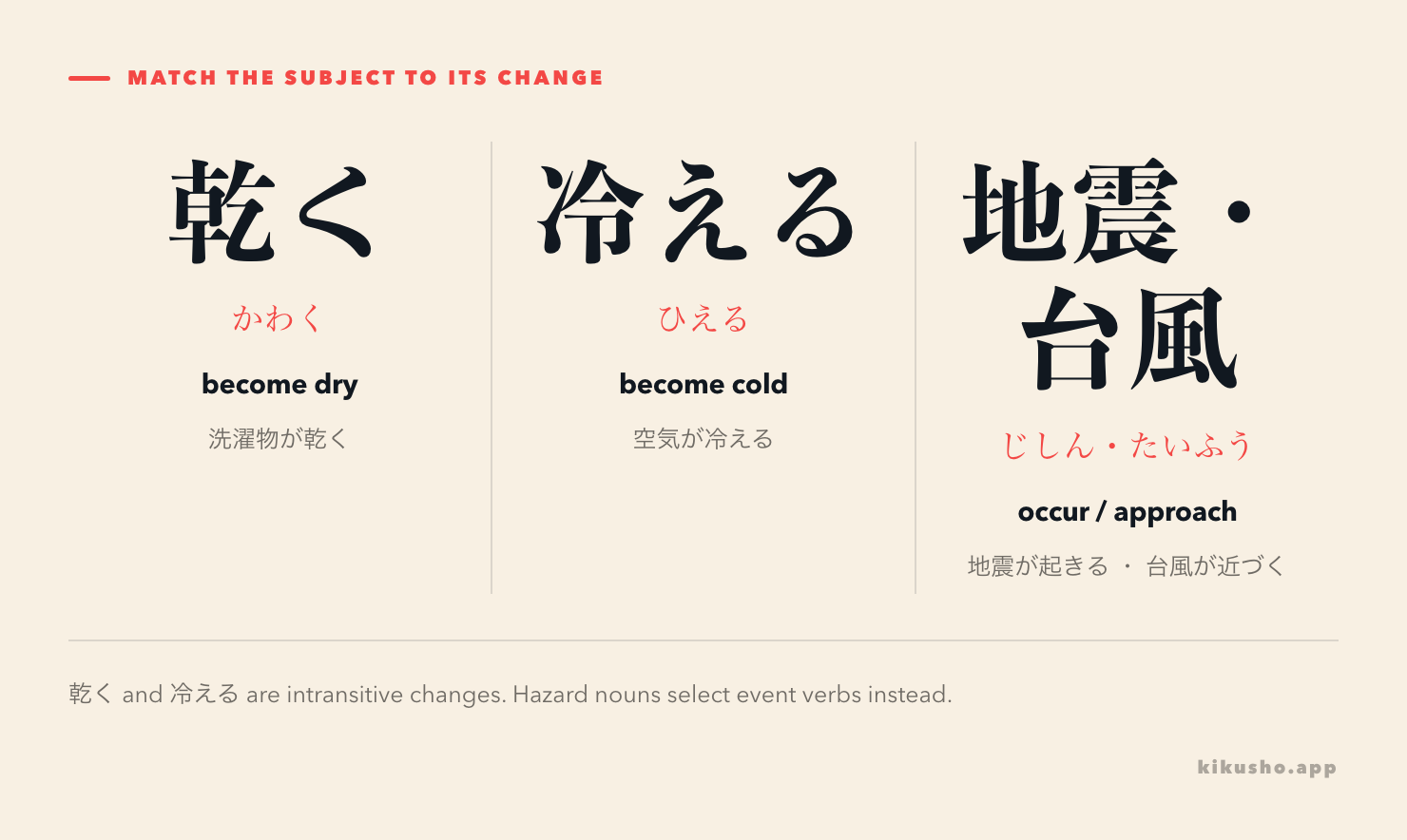
The transitive partners change the particle pattern:
- 洗濯物が乾く — the laundry dries.
- 洗濯物を乾かす — someone dries the laundry.
- 水が冷える — the water becomes cold.
- 水を冷やす — someone cools the water.
This is more useful than memorising four English translations. If the sentence gives the changing thing with が, choose the intransitive form. If an agent acts on an object marked by を, choose the transitive form.
冷める(さめる) is a nearby verb, but it does not replace 冷える everywhere. It commonly describes something hot returning toward an ordinary temperature: スープが冷める, the soup cools. 冷える focuses on becoming cold: 冷蔵庫で水が冷える, the water gets cold in the refrigerator; 夜は冷える, it gets chilly at night.
地震 and 台風 need different event verbs
地震 is an earthquake. In an everyday account, 地震が起きる or 地震がある reports its occurrence. Formal reporting often uses 地震が発生する. Kotobank's 地震 entry distinguishes the earthquake's magnitude, マグニチュード, from the local shaking intensity, 震度; the beginner word 地震 itself names the phenomenon.
昨日の夜、小さな地震がありました。
きのうの よる、ちいさな じしんが ありました。
There was a small earthquake last night.
台風 is a typhoon in the north-western Pacific or South China Sea. The Japan Meteorological Agency's explanation uses a maximum wind speed threshold of about 17 metres per second for the Japanese classification. An N4 learner does not need the number to use the word, but it shows why 台風 is a defined storm type rather than a loose synonym for any windy day.
大きな台風が日本に近づいています。
おおきな たいふうが にほんに ちかづいています。
A large typhoon is approaching Japan.
Useful collocations follow the storm through time: 台風が発生する, a typhoon forms; 台風が近づく, it approaches; 台風が来る, it comes; and 台風が通り過ぎる, it passes. Do not use 地震が近づく as the ordinary counterpart. An earthquake occurs; a typhoon has a track and can approach.
The title groups both words under natural hazards, but a precise distinction helps. Kotobank defines 自然災害 as social or economic damage caused by abnormal natural phenomena such as typhoons and earthquakes. 地震 and 台風 name the phenomena; 災害 focuses on harm. In everyday learner material, “disaster vocabulary” often groups the phenomena and their consequences together. Recognise that convenient grouping without assuming that the words are exact synonyms.
Read the six words as one short report
季節が変わり、朝は空気が冷えるようになりました。昼は風があるので、洗濯物がよく乾きます。今日は空に黒い雲が出ています。天気予報では、台風が近づいているそうです。先週は小さな地震もありました。
きせつが かわり、あさは くうきが ひえるように なりました。ひるは かぜが あるので、せんたくものが よく かわきます。きょうは そらに くろい くもが でています。てんきよほうでは、たいふうが ちかづいているそうです。せんしゅうは ちいさな じしんも ありました。
The season has changed, and the morning air has started to get cold. Because it is windy during the day, the laundry dries well. Dark clouds are in the sky today. According to the forecast, a typhoon is approaching. There was also a small earthquake last week.
The paragraph does not invent a causal chain. The cloud does not prove that a typhoon will arrive, and the earthquake is a separate past event. Grammar marks each job: 季節, 雲, 台風 and 地震 are nouns; 冷える and 乾く carry tense and polarity as verbs.
That separation matters in short exam questions. A blank before です may need a noun. A clause with 洗濯物が and the meaning “became dry” needs a form of 乾く. A forecast about a storm moving toward a place selects 台風が近づく, while an event that suddenly happened selects 地震が起きる.
What the N4 label means here
Kikusho's September 2026 reference inventory places all six exact spelling-and-reading records at N4, with agreement between its two imported baseline lists. Those lists share a source family, so their agreement is not counted twice. A separate Japanese Compass N4 list includes 季節, 雲, 地震 and 台風, while independent study pages place 乾く at N4 and list 冷える in an N4 vocabulary index.
Since the 2010 revision, the organizers have withheld a fixed catalogue of vocabulary, kanji and grammar items; the official JLPT FAQ gives their reason for that policy. “N4” is therefore a supported study placement, not a promise that one word list defines every test form. The dictionary and government sources above verify readings, meanings and real usage; the learning lists support the level estimate.
The N3 climate vocabulary lesson continues from 冷える to the transitive 冷やす, then separates air temperature, object temperature, humidity, dew, frost, fog, thunder and storms.
When one of these words appears in a forecast, message or short reading, save the complete clause in Kikusho and check the drafted card before keeping it. 台風 alone recalls a translation. 台風が近づいています also recalls the event verb, the direction of change and the sentence shape that makes the word usable.
Practice the seasonal report
Question 1 · reading
Write the kana reading of 季節, the category noun “season.”
Question 2 · orthography
Which written word is たいふう, “typhoon”?
- A. 地震
- B. 雲
- C. 台風
- D. 季節
Question 3 · noun contrast
A speaker points to one large cloud in the sky. Complete 空に大きな__があります.
- A. 曇り
- B. 雲
- C. 季節
- D. 地震
Question 4 · intransitive change
Complete the sentence meaning “The laundry dried”: 洗濯物が___.
- A. 乾きました
- B. 乾かしました
- C. 冷やしました
- D. 台風でした
Question 5 · choose the particle
Which sentence naturally means “The water became cold”?
- A. 水を冷えました。
- B. 水が冷えました。
- C. 水に冷やしました。
- D. 水で乾かしました。
Question 6 · event collocation
Which pair describes a storm moving closer to Japan?
- A. 地震が乾く
- B. 季節が起きる
- C. 台風が近づく
- D. 雲が冷やす
Question 7 · paraphrase
What does 季節が変わると、朝の空気が冷えます mean?
- A. When the season changes, the morning air gets colder.
- B. The earthquake dries the air every morning.
- C. A typhoon changes into a cloud.
- D. The laundry cools the season.
Question 8 · precise meaning
Which explanation is accurate?
- A. 雲 and 曇り are always interchangeable.
- B. 地震 and 台風 both normally take 近づく.
- C. 乾く and 冷える are nouns in this lesson.
- D. 地震 and 台風 name phenomena, while 自然災害 focuses on resulting harm.
Answers and explanations
Solution 1
きせつ. 季節 is the category noun “season.” Keep it distinct from 気温(きおん), the temperature of the air.
Solution 2
C. 台風. 台風 is read たいふう. 地震 is じしん, 雲 is くも, and 季節 is きせつ.
Solution 3
B. 雲. 雲 names an individual cloud. 曇り names cloudy weather, so 大きな曇りがあります does not describe one object in the sky.
Solution 4
A. 乾きました. The laundry is the thing that became dry, so it takes が with the intransitive verb 乾く. 乾かしました would require an agent who dried an object marked by を.
Solution 5
B. 水が冷えました. 冷える is intransitive, and が marks the water whose temperature fell. The transitive pattern would be 水を冷やしました, “someone cooled the water.”
Solution 6
C. 台風が近づく. A typhoon follows a track and can approach a place. An earthquake normally 起きる or 発生する instead of approaching in this everyday pattern.
Solution 7
A. When the season changes, the morning air gets colder. 季節が変わると supplies the recurring condition, and 空気が冷える reports the air's temperature change.
Solution 8
D. 地震 and 台風 name phenomena, while 自然災害 focuses on resulting harm. 雲 and 曇り have different roles, an earthquake does not ordinarily “approach,” and 乾く and 冷える are verbs.
Common questions
How do you read 乾く, 季節, 雲, 地震, 台風 and 冷える?
The readings are 乾く(かわく), 季節(きせつ), 雲(くも), 地震(じしん), 台風(たいふう)and 冷える(ひえる). 乾く and 冷える are intransitive verbs; the other four words are nouns.
What is the difference between 乾く and 乾かす?
乾く describes something becoming dry, as in 洗濯物が乾く. 乾かす is the transitive verb for making or letting something dry, as in 洗濯物を乾かす.
What is the difference between 冷える and 冷やす?
冷える describes something becoming cold, as in 空気が冷える. 冷やす means that someone or something cools an object, as in 水を冷やす.
Are 地震 and 台風 the same as 自然災害?
地震 and 台風 name natural phenomena: an earthquake and a typhoon. 自然災害 names the harmful social or economic consequences caused by phenomena such as earthquakes and typhoons, although everyday wording may group them loosely as disasters.