On this page
以前 looks left of a reference point, while 以来 starts at a past point and reaches forward from it. 一時, 一瞬 and 瞬間 distinguish a temporary period, a tiny span and a particular instant. The remaining words name the past, the present, a recent period, a season, a century, the whole year, or something imagined to last forever.
This N3 set becomes easier when you place every word on one timeline. The earlier N4 Japanese time-word lesson covers 最近, 昔, 将来 and an unspecified しばらく. Here the task is more precise: choose the correct boundary, scale and grammatical frame.
Thirteen words, five jobs
| Word | Reading | Job on the timeline | Useful frame |
|---|---|---|---|
| 以前 | いぜん | before a point; previously | 以前と違う, 8時以前 |
| 以来 | いらい | since a past starting point | 卒業以来, 来日して以来 |
| 過去 | かこ | the past as a domain | 過去を振り返る |
| 現在 | げんざい | the present or current state | 現在の状況, 9月末現在 |
| 近頃 | ちかごろ | lately; a vague recent period | 近頃は忙しい |
| 一時 | いちじ | temporarily; for a period | 一時停止, 一時は回復した |
| 一瞬 | いっしゅん | one extremely brief span | 一瞬目を閉じる |
| 瞬間 | しゅんかん | a particular instant | ドアが開いた瞬間 |
| 時期 | じき | a bounded period or season | 桜が咲く時期 |
| 世紀 | せいき | a century | 21世紀 |
| 年中 | ねんじゅう | throughout the year; always | 年中無休, 年中暖かい |
| 永遠 | えいえん | endless time; eternity | 永遠の愛, 永遠に残る |
| 永久 | えいきゅう | permanence, often practical | 永久保存, 永久歯 |
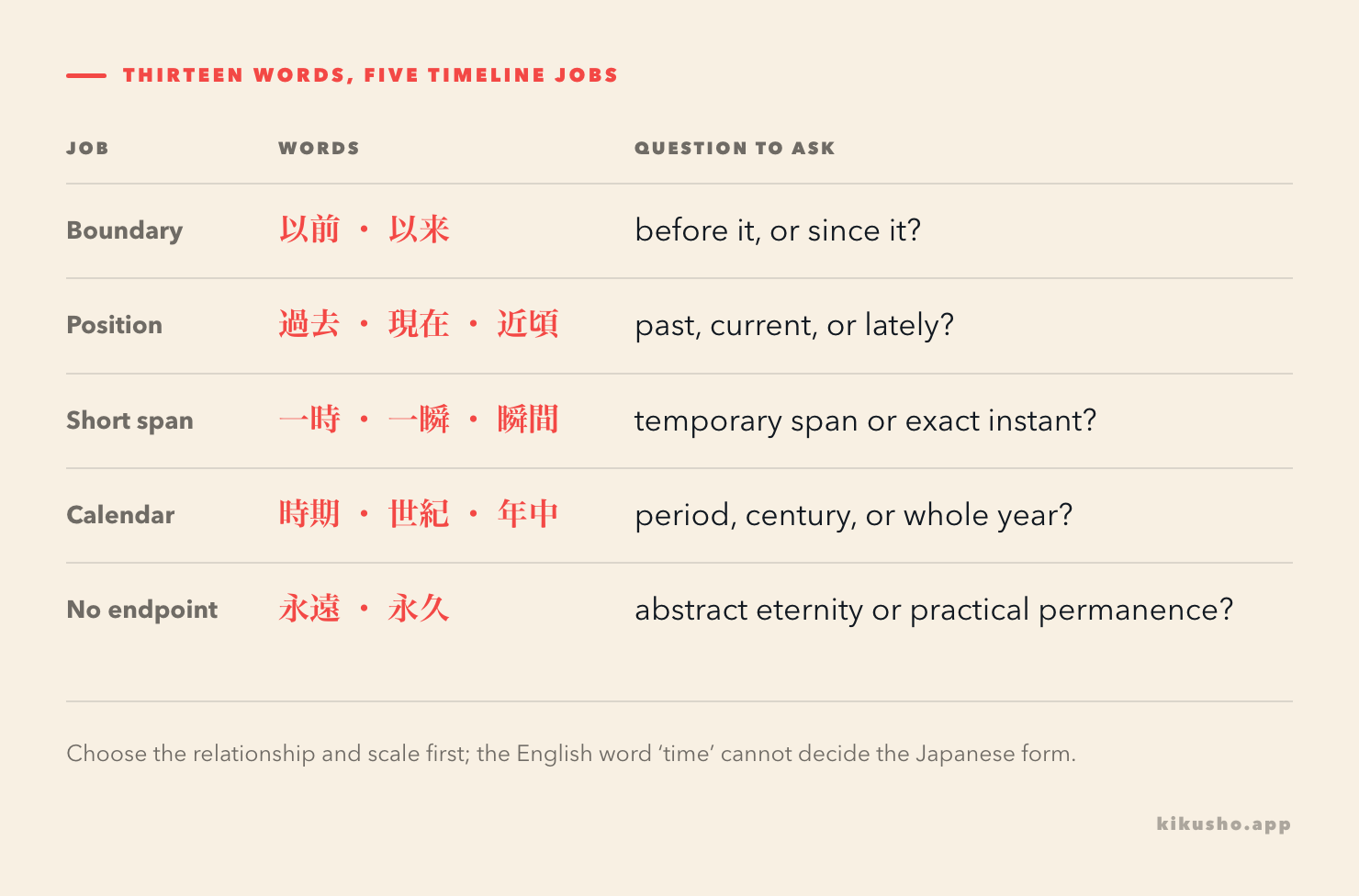
The table is not a scale from shortest to longest. 現在 locates a state, 以来 draws a line from a starting point, and 年中 says something holds across the year. Their grammar tells you what kind of time relation the writer is building.
以前, 以来, 過去 and 現在 place the reference point
以前(いぜん) means before a stated point or previously. It can follow a time noun, as in 八時以前, and it can stand adverbially.
この町には以前、大きな工場があった。
この まちには いぜん、おおきな こうじょうが あった。
There used to be a large factory in this town.
申し込みは金曜日以前に済ませてください。
もうしこみは きんようび いぜんに すませて ください。
Please complete the application by or before Friday.
Kotobank's 以前 entry records both the time before a reference point and the independent “previously” use. Whether a boundary itself is included can depend on the expression and context, so a real deadline should state the exact date and time when precision matters.
以来(いらい) begins at a past event and views the period from there onward. A noun attaches directly; a verb normally appears in the て-form.
卒業以来、彼とは一度も会っていない。
そつぎょう いらい、かれとは いちども あっていない。
I have not met him once since graduation.
この町に引っ越して以来、毎朝川沿いを歩いている。
この まちに ひっこして いらい、まいあさ かわぞいを あるいている。
Ever since moving to this town, I have walked along the river every morning.
The later clause normally describes a continuing state or repeated pattern, not one isolated later act. Kotobank defines 以来 from a past starting point, and the full て以来 grammar comparison explains its attachment and continuity in detail.
過去(かこ) names the past as a whole domain or a completed earlier period. 現在(げんざい) names the present or current state.
過去の記録と現在の状況を比べた。
かこの きろくと げんざいの じょうきょうを くらべた。
We compared past records with the current situation.
以前 needs an understood or stated reference: before then, before marriage, before eight. 過去 treats earlier time as the object of thought: 過去を振り返る, look back on the past. The dictionary entry for 過去 also records its grammar sense, while 現在 can mark an exact reporting point: 九月末現在の会員数, the membership as of the end of September.
近頃 and 時期 give a period without an exact clock
近頃(ちかごろ) means lately or these days. It looks back over a vague period close to the present, often to describe a change or current tendency.
近頃は日が暮れるのが早くなった。
ちかごろは ひが くれるのが はやく なった。
Lately, it has been getting dark earlier.
Kotobank describes a recent period without a clear boundary. This makes 近頃 unsuitable when a report must identify one exact date. 現在 can give the current state at a named reporting point; 近頃 invites the reader to notice a recent stretch.
時期(じき) is a bounded period, season or stage suited to the topic under discussion.
春は新しい生活を始める人が多い時期だ。
はるは あたらしい せいかつを はじめる ひとが おおい じきだ。
Spring is a period when many people begin a new life.
Digital Daijisen defines 時期 as a time with some breadth or a particular occasion. The homophone 時機 focuses on an opportunity or good timing. This lesson's 時期 names the period itself: 梅雨の時期, the rainy-season period; 忙しい時期, a busy period.
一時, 一瞬 and 瞬間 use different sizes and shapes
All three can become “for a moment” in loose translation. Their timelines differ.
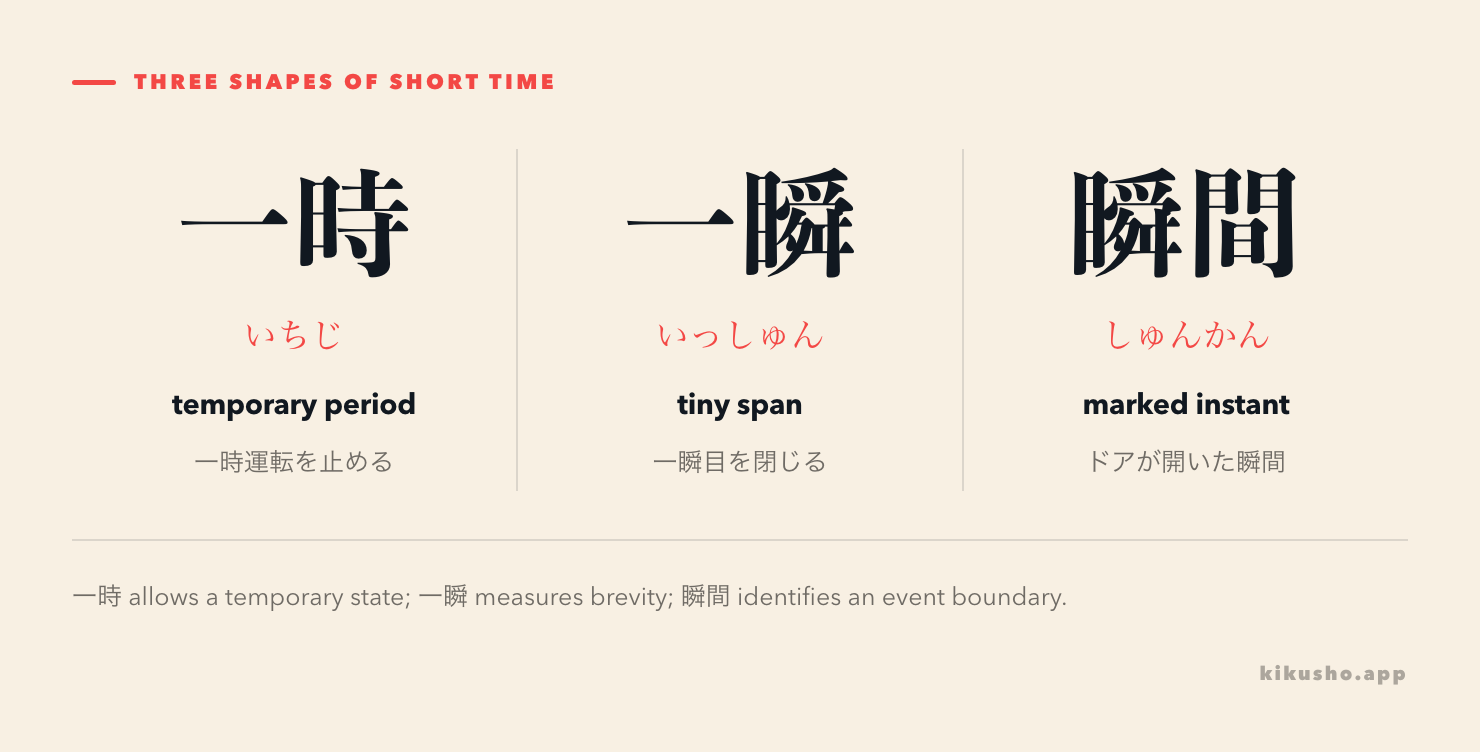
一時(いちじ) marks a temporary state or limited period. It is long enough for a service to stop, weather to change or a condition to improve.
強い雨のため、電車は一時運転を見合わせた。
つよい あめの ため、でんしゃは いちじ うんてんを みあわせた。
Because of heavy rain, the trains temporarily suspended service.
It can also mean one o'clock: 午後一時. Context separates clock time from the temporary-period use. Kotobank lists both, as well as the retrospective frame 一時は, “at one time.”
一瞬(いっしゅん) is an extremely brief interval and can directly modify a predicate.
明かりが消え、一瞬何も見えなくなった。
あかりが きえ、いっしゅん なにも みえなく なった。
The light went out, and for an instant I could see nothing.
瞬間(しゅんかん) identifies a particular instant, often the boundary at which something happens. A clause commonly modifies it.
ドアが開いた瞬間、冷たい風が入ってきた。
ドアが あいた しゅんかん、つめたい かぜが はいって きた。
The instant the door opened, cold air came in.
The 一瞬 entry centres a very short span; the 瞬間 entry centres an instant. A practical test is grammar: 一瞬立ち止まる means stop briefly, while 立ち止まった瞬間 means the moment someone stopped.
世紀 and 年中 widen the calendar
世紀(せいき) divides historical time into centuries.
この建物は十九世紀の終わりに建てられた。
この たてものは じゅうきゅうせいきの おわりに たてられた。
This building was constructed at the end of the nineteenth century.
The century number attaches directly: 二十世紀, the twentieth century; 二十一世紀, the twenty-first. Kotobank's 世紀 entry explains the hundred-year historical division and its broader association with an era.
年中(ねんじゅう) covers the whole year and can work adverbially as “always.”
この温室は年中暖かい。
この おんしつは ねんじゅう あたたかい。
This greenhouse is warm all year round.
The fixed sign 年中無休 means open every day of the year. Kotobank also records ねんちゅう, including the preschool label 年中組. For the assigned “throughout the year” word, learn the reading ねんじゅう.
永遠 and 永久 both reach beyond an ordinary endpoint
Both words can describe something lasting without limit, and their meanings overlap. The difference is a usage tendency.
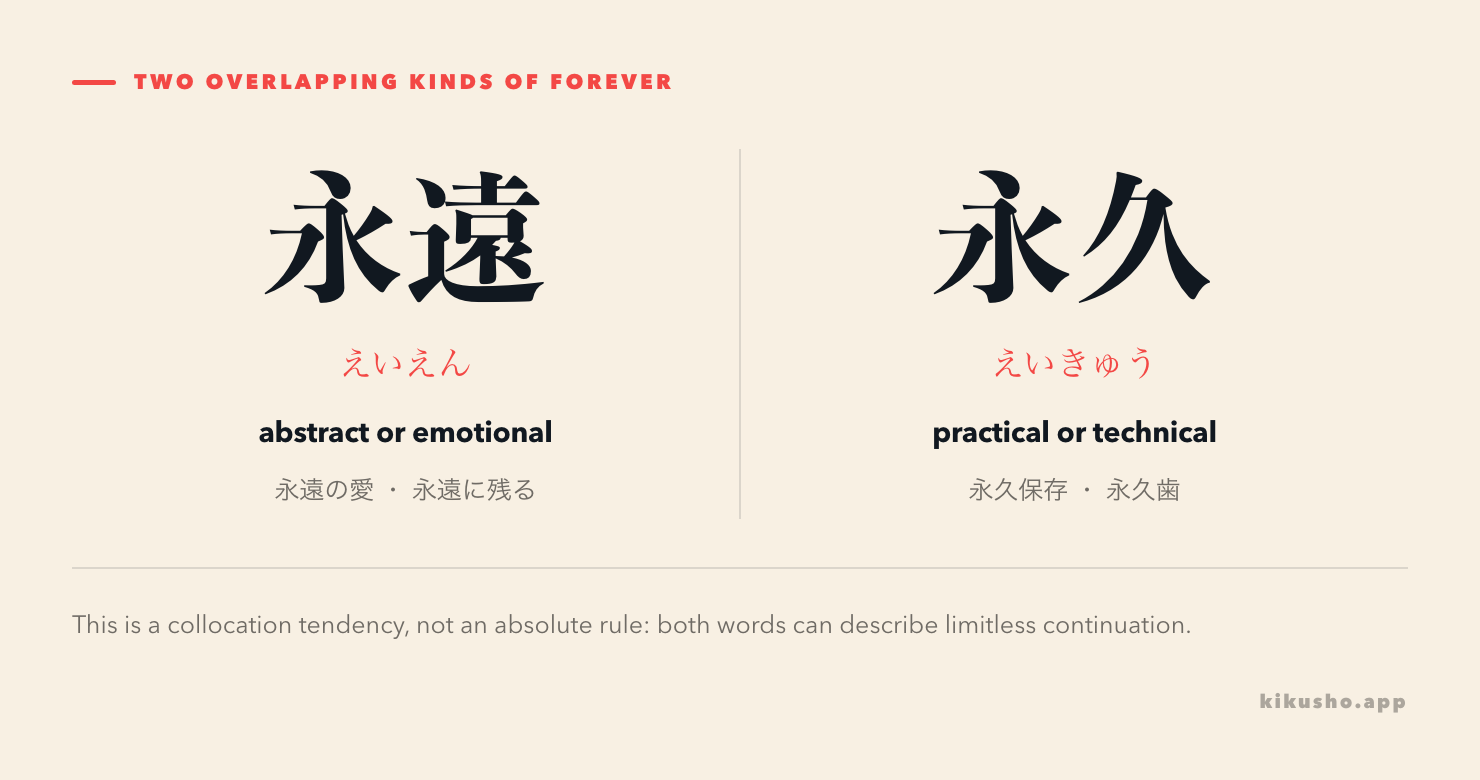
永遠(えいえん) is especially common for abstract, emotional and time-transcending ideas: 永遠の愛, eternal love; 永遠に残る作品, a work that endures forever. Kotobank includes both endless continuation and existence beyond time.
永久(えいきゅう) often appears in practical or technical permanence: 永久歯, a permanent tooth; 永久保存, permanent preservation; 永久磁石, a permanent magnet. The dictionary entry defines unlimited continuation and shows that it overlaps with 永遠.
Do not turn the tendency into a ban. 永久に平和を守る is valid, and both words can appear with に or の. Memorise the strong collocations first: 永遠の愛 and 永久保存.
Read the full timeline in context
この博物館は十九世紀に建てられた工場を利用している。以前は年中機械が動いていたが、閉鎖以来、建物は一時倉庫として使われた。現在は地域の過去を伝える資料を永久保存している。近頃、入口を改修し、ドアが開いた瞬間に展示全体が見えるようになった。一瞬立ち止まる来館者も多い。春は特別展の時期で、町の記憶を永遠に残したいという市民の写真が並ぶ。
この はくぶつかんは じゅうきゅうせいきに たてられた こうじょうを りようしている。いぜんは ねんじゅう きかいが うごいていたが、へいさい いらい、たてものは いちじ そうことして つかわれた。げんざいは ちいきの かこを つたえる しりょうを えいきゅうほぞんしている。ちかごろ、いりぐちを かいしゅうし、ドアが あいた しゅんかんに てんじ ぜんたいが みえる ように なった。いっしゅん たちどまる らいかんしゃも おおい。はるは とくべつてんの じきで、まちの きおくを えいえんに のこしたい という しみんの しゃしんが ならぶ。
The passage changes scale deliberately. 十九世紀 supplies historical scale; 以前 contrasts the factory's former state with now; 以来 starts at the closure and reaches forward. 一時 covers a temporary warehouse period. 瞬間 locates the door-opening boundary, while 一瞬 measures each visitor's brief pause. 永久保存 is an archival policy; 永遠に残す expresses an ideal.
How these words enter the N3 sequence
Kikusho assigns these thirteen spelling-and-reading records to N3 in its September 2026 reference inventory; none carries a stored placement disagreement. Independent N3 preparation pages also list many of these headwords, but those resources ultimately provide study estimates rather than an official boundary.
Because the test maker supplies no current exhaustive word-by-level catalogue, treat N3 as the point where this set becomes useful for reading timelines and reports. The official JLPT FAQ explains why the old test-content specifications are no longer published. The stable targets are the readings, sentence frames and contrasts taught above.
Practice: recover the timeline
1 · Read the past boundary
Write 以来 in kana in 卒業以来.
2 · Build the historical unit
Which spelling matches せいき, “century”?
A. 世紀
B. 世期
C. 世機
D. 世記
3 · Before or since
Choose the pair: この店には__来たことがある。改装して__、毎週来ている。
A. 以来 / 以前
B. 以前 / 以来
C. 過去 / 一瞬
D. 現在 / 時期
4 · Temporary service change
A railway notice says service stopped for a limited period and later resumed. Complete: 大雨のため、運転を__見合わせました。
A. 永遠
B. 年中
C. 一時
D. 世紀
5 · Tiny span or event boundary
Choose the pair: 彼は__目を閉じた。目を開けた__、光が見えた。
A. 瞬間 / 一瞬
B. 一瞬 / 瞬間
C. 一時 / 時期
D. 近頃 / 現在
6 · Exact current report
Which phrase best labels a table containing membership numbers as of September 30?
A. 近頃の会員数
B. 九月三十日現在の会員数
C. 年中の会員数
D. 永遠の会員数
7 · Recent tendency
Which sentence describes a vague change noticed lately?
A. 近頃、朝が涼しくなった。
B. 十九世紀、朝が涼しくなった。
C. 永久、朝が涼しくなった。
D. 一瞬以来、朝が涼しくなった。
8 · Calendar-wide condition
What does この店は年中無休だ mean?
A. The shop closes for one century.
B. The shop is currently closed.
C. The shop has no days off throughout the year.
D. The shop opens for one instant.
9 · Two kinds of forever
Choose the conventional pairing.
A. 永久の愛 / 永遠歯
B. 永遠保存 / 永久の瞬間
C. 永遠の愛 / 永久保存
D. 永久の近頃 / 永遠世紀
10 · Produce a timeline
Write one sentence meaning “I used to live in Osaka, but since moving to Tokyo I have worked from home.” Use 以前 and 以来.
Reveal the timeline decisions
1 · いらい. 以 contributes い and 来 contributes らい in this compound. 卒業以来 sets graduation as the starting point for the following period.
2 · A, 世紀. 世紀 is the standard spelling for a hundred-year historical division. The other choices replace 紀 with characters that form different words or no relevant compound.
3 · B, 以前 / 以来. The first clause says the speaker came before. The renovation then becomes the starting point of a weekly pattern continuing to the present.
4 · C, 一時. 一時見合わせる presents a temporary suspension. 永遠 would deny the later resumption, while 年中 and 世紀 do not describe a limited interruption.
5 · B, 一瞬 / 瞬間. 一瞬 directly measures the brief eye closure. 目を開けた瞬間 names the exact boundary at which the light became visible.
6 · B. A date plus 現在 gives an exact reporting point. 近頃 describes a vague recent period, and the other choices cannot serve as an as-of date.
7 · A. 近頃 covers the recent stretch in which the speaker has noticed cooler mornings. The other sentences combine incompatible time frames or syntax.
8 · C. 年中 covers the whole year, and 無休 means without a day off. The phrase does not state the shop's current open or closed state at this minute.
9 · C, 永遠の愛 / 永久保存. These are strong conventional collocations: abstract endless love and practical permanent preservation. The choice reflects a usage tendency, not a rule that the words never overlap.
10 · One model is 以前は大阪に住んでいたが、東京に引っ越して以来、在宅で働いている。 以前 establishes the former state. 引っ越して以来 sets the move as the beginning of the continuing work arrangement.
When a passage contains several time expressions, draw the reference point first. Then ask whether the word points before it, extends from it, names a temporary span, selects one instant or widens the scale to a season, year, century or imagined eternity.
Common questions
What is the difference between 以前 and 以来?
以前(いぜん)looks to the time before a reference point or means previously. 以来(いらい)starts at a past event and extends from that event to the present or another stated endpoint.
What is the difference between 一時, 一瞬 and 瞬間?
一時(いちじ)is a temporary period long enough for a state or interruption. 一瞬(いっしゅん)is an extremely brief span and can work adverbially. 瞬間(しゅんかん)identifies a particular instant or event boundary.
What is the difference between 永遠 and 永久?
Both can mean endless or permanent. 永遠(えいえん)is especially common for abstract, emotional or time-transcending ideas such as 永遠の愛. 永久 (えいきゅう)is common in practical and technical compounds such as 永久歯 and 永久保存. This is a tendency rather than an absolute rule.
How is 近頃 different from 現在?
近頃(ちかごろ)means lately or these days and covers a vague recent period. 現在(げんざい)means the present or the current state and can identify an exact reporting point, as in 九月末現在.