On this page
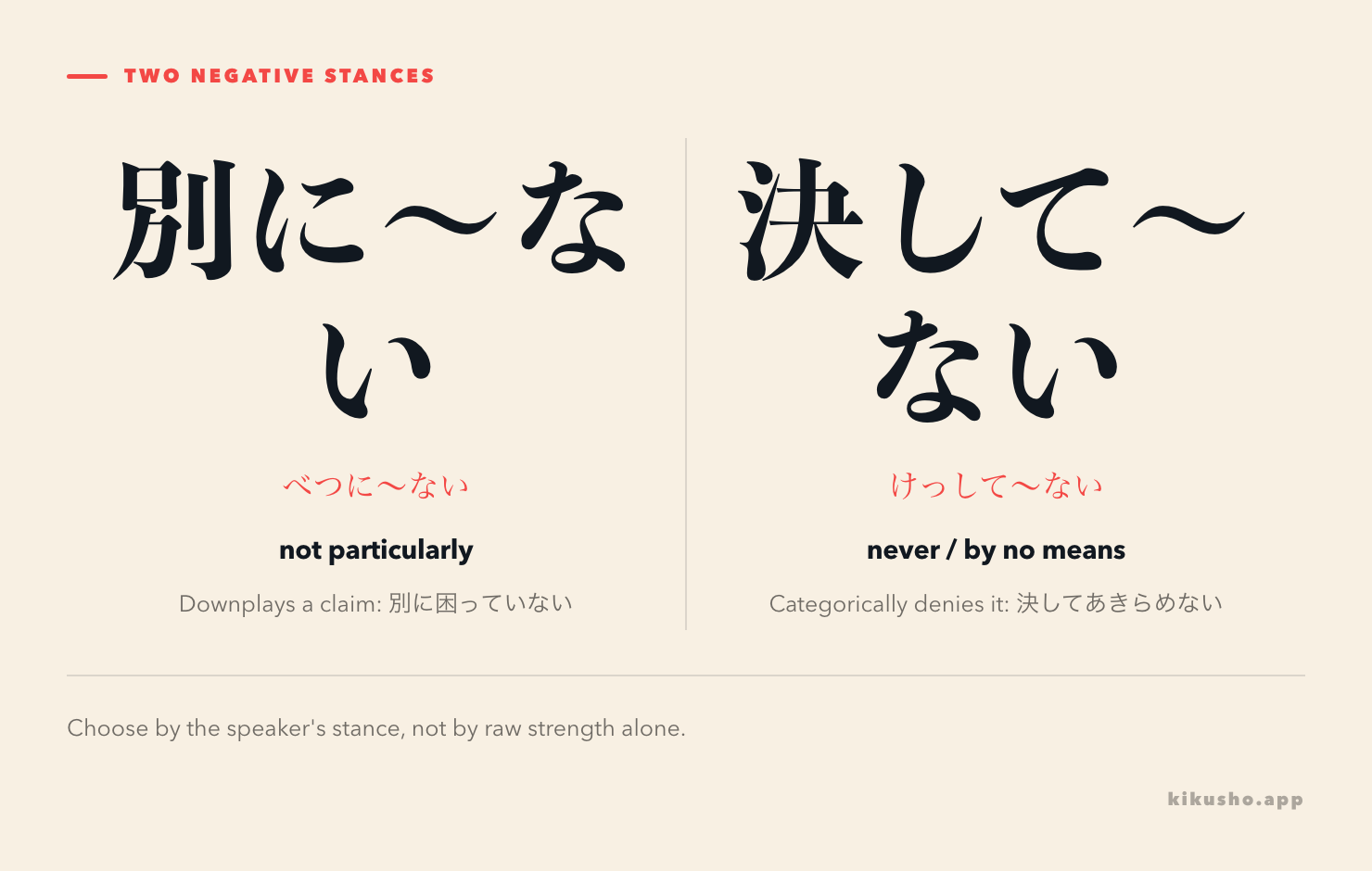
Use 別に~ない to say “not particularly” and 決して~ない to say “never” or “by no means.” 別に困っていない downplays the idea that there is a problem; 決してあきらめない makes an emphatic commitment not to give up.
Both adverbs expect a negative expression later in the clause, but their force runs in different directions. 別に lowers the importance or degree of a claim. 決して raises the strength of the denial.
The test is whether you downplay or rule out the claim
Ask what the speaker is doing with the positive idea behind the negative.
| Form | Treatment of the positive claim | Natural translations |
|---|---|---|
| 別に~ない | it is not especially true or worth singling out | not particularly, not really, it is not like… |
| 決して~ない | it is rejected emphatically across the relevant circumstances | never, by no means, under no circumstances |
この仕事は別に難しくない。
この しごとは べつに むずかしくない。
This job is not particularly difficult.
この仕事は決して簡単ではない。
この しごとは けっして かんたんでは ない。
This job is by no means easy.
The first speaker pushes back against calling the job difficult. The second strongly rejects calling it easy. The two sentences could describe the same job, but the speakers choose different claims to oppose.
Both forms attach to an ordinary negative predicate
The adverb does not conjugate. Build the negative predicate first, then place 別に or 決して before it.
| Predicate type | 別に~ない | 決して~ない |
|---|---|---|
| verb | 別に気にしない | 決して忘れない |
| polite verb | 別に困りません | 決して言いません |
| い-adjective | 別に高くない | 決して安くない |
| な-adjective | 別に特別ではない | 決して安全ではない |
| noun predicate | 別に冗談ではない | 決して偶然ではない |
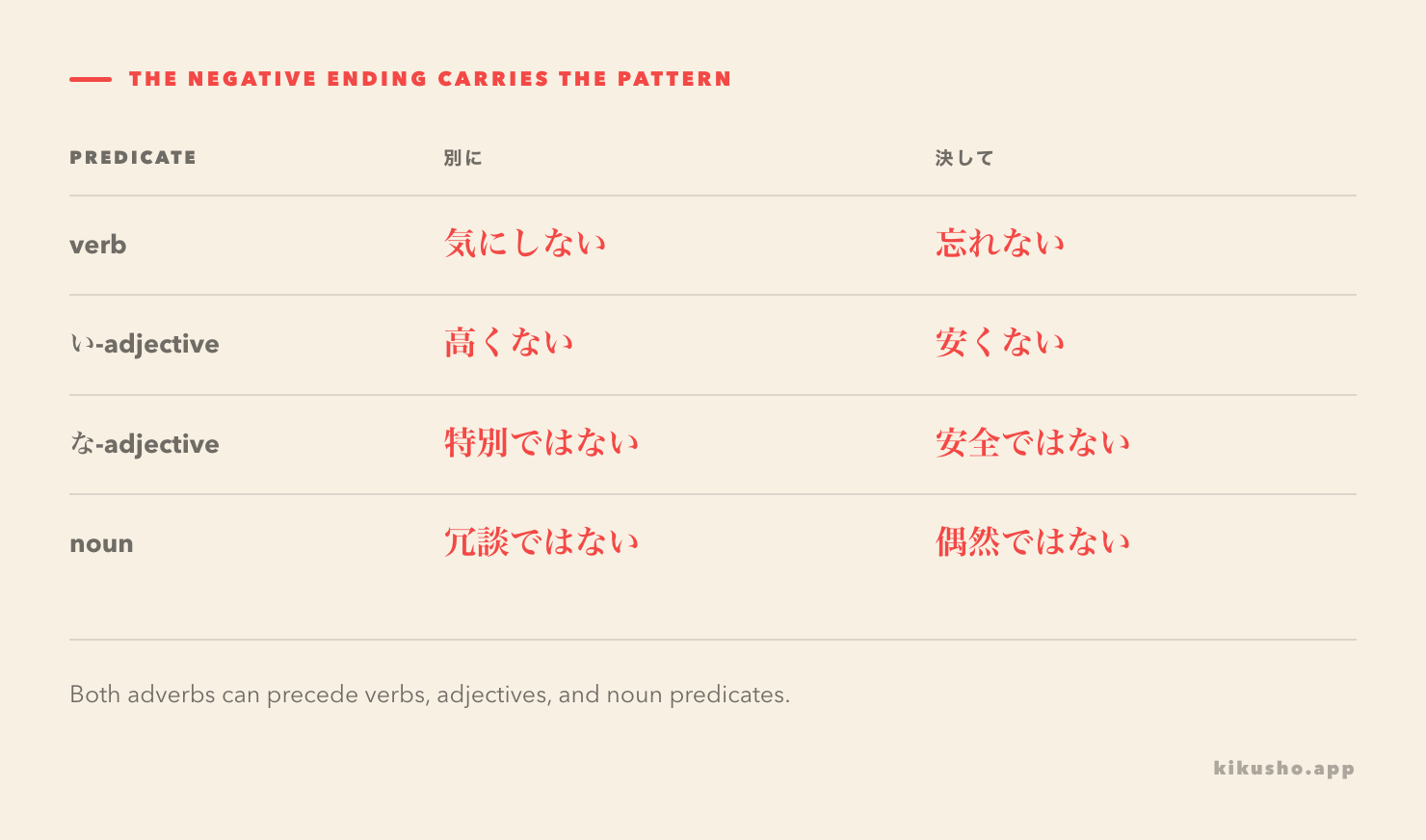
The negative may be farther away than one word. 別に行きたいわけではない ends in わけではない, and 決して入ってはいけない contains the prohibition てはいけない. What matters is that the clause supplies a negative interpretation.
私は別に怒っていません。
わたしは べつに おこって いません。
I am not particularly angry.
この話は決して冗談ではありません。
この はなしは けっして じょうだんでは ありません。
This is by no means a joke.
Do not combine these N3 patterns with an affirmative ending such as 別に好きです or 決して行きます when you intend the meanings taught here. 別に also has literal uses related to separation, and 決して appears inside a few other fixed expressions, but those are separate constructions.
別に~ない is at home in corrections and indifference
別に(べつに) tells the listener that the matter does not deserve the special label being suggested. It often answers an assumption already present in the conversation.
A: 新しい仕事は大変ですか。
あたらしい しごとは たいへんですか。
Is your new job hard?
B: いいえ、別に大変ではありません。
いいえ、べつに たいへんでは ありません。
No, it is not particularly hard.
The answer does not claim that the job is effortless. It refuses to classify it as especially hard.
別に can also detach the speaker from a preference:
私は別にどちらでもかまいません。
わたしは べつに どちらでも かまいません。
I do not particularly mind either way.
Here the negative appears in かまいません, “do not mind.” The speaker is not making a strong prohibition or promise. They are saying no option stands out as a problem.
Kotobank's dictionary entry for 別に defines the negative-paired use as “not enough to single out” and also records the short conversational reply. Bunpro's N3 treatment adds the useful pragmatic point: 別に~ない can sound indifferent or dismissive rather than merely low in degree.
決して~ない is at home in resolve, warnings, and firm denial
決して(けっして) strengthens a negative as categorical within the situation. It suits commitments, warnings, prohibitions, and denials where the speaker wants no weak reading.
私はこの約束を決して忘れません。
わたしは この やくそくを けっして わすれません。
I will never forget this promise.
この薬をほかの人に決して渡さないでください。
この くすりを ほかの ひとに けっして わたさないで ください。
Never give this medicine to another person.
彼の説明は決して十分ではない。
かれの せつめいは けっして じゅうぶんでは ない。
His explanation is by no means sufficient.
English “never” may describe time, but 決して is broader than frequency. In the third example, the claim is about adequacy, not about an event that happens zero times. “By no means” captures the emphatic denial better.
Bunpro's 決して~ない reference treats it as standard but notes that its emphatic “by no means” use is especially at home in writing and forceful statements. The Japan Forum's teacher-facing comparison with 絶対に~ない also shows that strong negatives carry assumptions and stance, not just a mechanical zero.
The same predicate exposes the difference
Put the two adverbs before one negative and the contrast becomes audible.
私は別に行きたくない。
わたしは べつに いきたくない。
I do not particularly want to go.
私は決して行きたくない。
わたしは けっして いきたくない。
I absolutely do not want to go.
The 別に sentence leaves room for persuasion or simple indifference. Going is not a special desire. The 決して sentence makes resistance central and can sound dramatic or resolute.
That difference prevents a common mistake. If a friend asks whether you want tea, 別に飲みたくない can mean you do not especially want any. 決して飲みたくない sounds like a categorical refusal, perhaps because the drink is forbidden or strongly disliked. Stronger grammar can create a story the situation never supplied.
あまり and 全然 measure a different axis
The あまり~ない and 全然~ない lesson compares low degree with complete degree-based negation. These N3 forms add stance.
| Sentence | What it contributes |
|---|---|
| あまり痛くない | the pain is not very strong |
| 全然痛くない | there is no meaningful pain at all |
| 別に痛くない | the pain is not especially worth concern or mention |
| 決して痛くない | the speaker firmly denies that it is painful |
Real conversations can blur these edges, especially when people exaggerate. Still, the test remains useful: あまり and 全然 organize degree; 別に responds to salience or expectation; 決して adds categorical force.
Standalone 別に relies on tone and missing context
In casual speech, the rest of 別に~ない may be omitted when the question supplies it:
A: 何か欲しいの。
なにか ほしいの。
Do you want something?
B: 別に。
べつに。
Not particularly. / Nothing in particular.
The short reply is grammatical because 欲しくない or 何もない is recoverable. It can sound neutral, evasive, or sulky depending on voice and relationship. A fuller 別に何も欲しくないよ makes the content explicit.
決して does not work the same way as a neutral one-word answer. It prepares the listener for a strong negative claim, so stopping after 決して usually leaves the sentence hanging. Keep the negative predicate when learning the pattern.
When dialogue uses either form, capture the prompt and response together. In Kikusho, a photo can preserve the line, its editable reading, and the sentence that created the expectation. That context is what tells you whether 別に sounds relaxed or defensive and what 決して is forcefully rejecting.
Practice
Complete all seven items before consulting the explanations.
Question 1. A friend assumes your new bag was expensive. Choose the reply that means “No, it was not particularly expensive.”
- ア. いいえ、別に高くなかったよ。
- イ. いいえ、決して高くなかったよ。
- ウ. いいえ、別に高かったよ。
- エ. いいえ、決して高かったよ。
Question 2. Choose the strongest promise: “I will never tell anyone this secret.”
- ア. この秘密は別に誰にも言いません。
- イ. この秘密はあまり誰にも言いません。
- ウ. この秘密は決して誰にも言いません。
- エ. この秘密は誰にも言いました。
Question 3. Complete the noun predicate: これは__特別__。
- ア. 別に/ではない
- イ. 別に/です
- ウ. 決して/だ
- エ. 決して/でした
Question 4. Arrange the fragments into “This rule is by no means unreasonable.”
- ではありません
- この規則は
- 不合理
- 決して
Question 5. Which sentence downplays concern rather than measuring a low amount?
- ア. 傷はあまり痛くない。
- イ. 傷は別に痛くない。
- ウ. 傷は決して痛くない。
- エ. 傷は全然痛くない。
Question 6. Which short exchange most naturally allows the predicate after 別に to remain unspoken?
- ア. 「何か食べたい?」「別に。」
- イ. 「絶対に忘れない?」「決して。」
- ウ. 「いつ着いた?」「別に。」
- エ. 「誰が来た?」「決して。」
Question 7. Choose the pair that completes the warning and the casual correction.
このドアは危険ですから、(甲)開けないでください。私は怒っているのかと聞かれましたが、(乙)怒っていません。
- ア. 甲: 決して/乙: 別に
- イ. 甲: 別に/乙: 決して
- ウ. 甲: 決して/乙: 決して
- エ. 甲: 別に/乙: 別に
Answers and explanations
Answer 1. ア. いいえ、別に高くなかったよ. 別に downplays the suggested label “expensive,” and 高くなかった supplies the required past negative. 決して would make the denial much stronger; ウ and エ are affirmative.
Answer 2. ウ. この秘密は決して誰にも言いません. 決して strengthens the promise as categorical. 別に would downplay interest or importance rather than make a vow, あまり weakens frequency, and エ is affirmative past.
Answer 3. ア. 別に/ではない. A な-adjective or noun-like predicate takes ではない. The other choices leave the negative-polarity adverb without a negative ending.
Answer 4. この規則は決して不合理ではありません. 決して appears before the な-adjective 不合理, whose polite negative predicate is ではありません.
Answer 5. イ. 傷は別に痛くない. 別に presents the pain as nothing especially worth concern. あまり marks low degree, 全然 rejects meaningful degree, and 決して makes a firm denial.
Answer 6. ア. 「何か食べたい?」「別に。」 The question supplies a recoverable idea such as 別に食べたくない or 別に何も. The other exchanges ask for time or identity, or leave 決して without the strong negative it prepares.
Answer 7. ア. 甲: 決して/乙: 別に. A danger warning calls for the categorical force of 決して. The second speaker merely corrects an assumption about being angry, which suits 別に.
N3 placement and checked scope
JLPT Sensei lists 別に~ない and 決して~ない at N3, with negative verbs, adjectives, and noun predicates. Bunpro independently assigns both uses to N3 and documents their contrasting pragmatic force.
A Tanos comparison list places 別に~ない at N2, so that item's level is disputed; the inventory records no matching disagreement for 決して~ない. Kikusho uses N3 because two independent teaching references agree there, while noting the later placement rather than hiding it. The prerequisites are ordinary verb and adjective negatives, ではない, and negative requests. No exhaustive official JLPT grammar list settles the boundary.
The two assigned items are the negative-polarity patterns, not every lexical use of 別 or 決する. The practice checks choice, predicate formation, sentence composition, degree versus stance, ellipsis, and a two-sentence context. Each answer stays in this single block so headings and earlier choices do not disclose the solution.
Negative adverbs do more than turn a dial from weak to strong. They tell the listener whether you are measuring degree, brushing aside an assumption, or drawing a line you do not intend to cross.
Common questions
What is the difference between 別に~ない and 決して~ない?
別に~ない downplays a positive claim as “not particularly” or “not really.” 決して~ない strongly rejects it as “never,” “under no circumstances,” or “by no means.” They point in opposite pragmatic directions.
Does 決して always need a negative ending?
In the N3 pattern, 決して pairs with a negative expression such as ない, ません, ではない, or てはいけない. Do not treat it as an ordinary affirmative adverb meaning “definitely.”
Can 別に be used alone?
Yes. In casual conversation, 別に can answer a question when “nothing in particular” or “not really” is recoverable from context. Said abruptly, it can sound guarded or dismissive, so a fuller answer is often clearer.
Is 別に~ない the same as あまり~ない?
No. あまり~ない usually places a quantity, degree, or frequency below “much.” 別に~ない says the matter is not especially so or not worth singling out, often with a tone of indifference or correction.