On this page
To make a Japanese verb negative, build 〜ない in plain style or 〜ません in polite style; for the past negative, use 〜なかった or 〜ませんでした. With a noun or な-adjective statement, use じゃない/ではない and their corresponding past or polite forms instead.
The ending carries the denial. You do not put a separate word meaning English not before the verb, and you do not glue the same ending onto every kind of predicate.
This N5 grammar lesson teaches plain negative verbs, plain past-negative verbs, polite negative verbs and the nominal negative じゃない/ではない. Know your verb groups and ます forms first. JLPT Sensei and Bunpro place the nominal negative at N5; the foundational verb patterns are also taught in beginner courses. These placements are estimates, since the JLPT does not publish an exhaustive item list.
ない needs the base belonging to your verb group
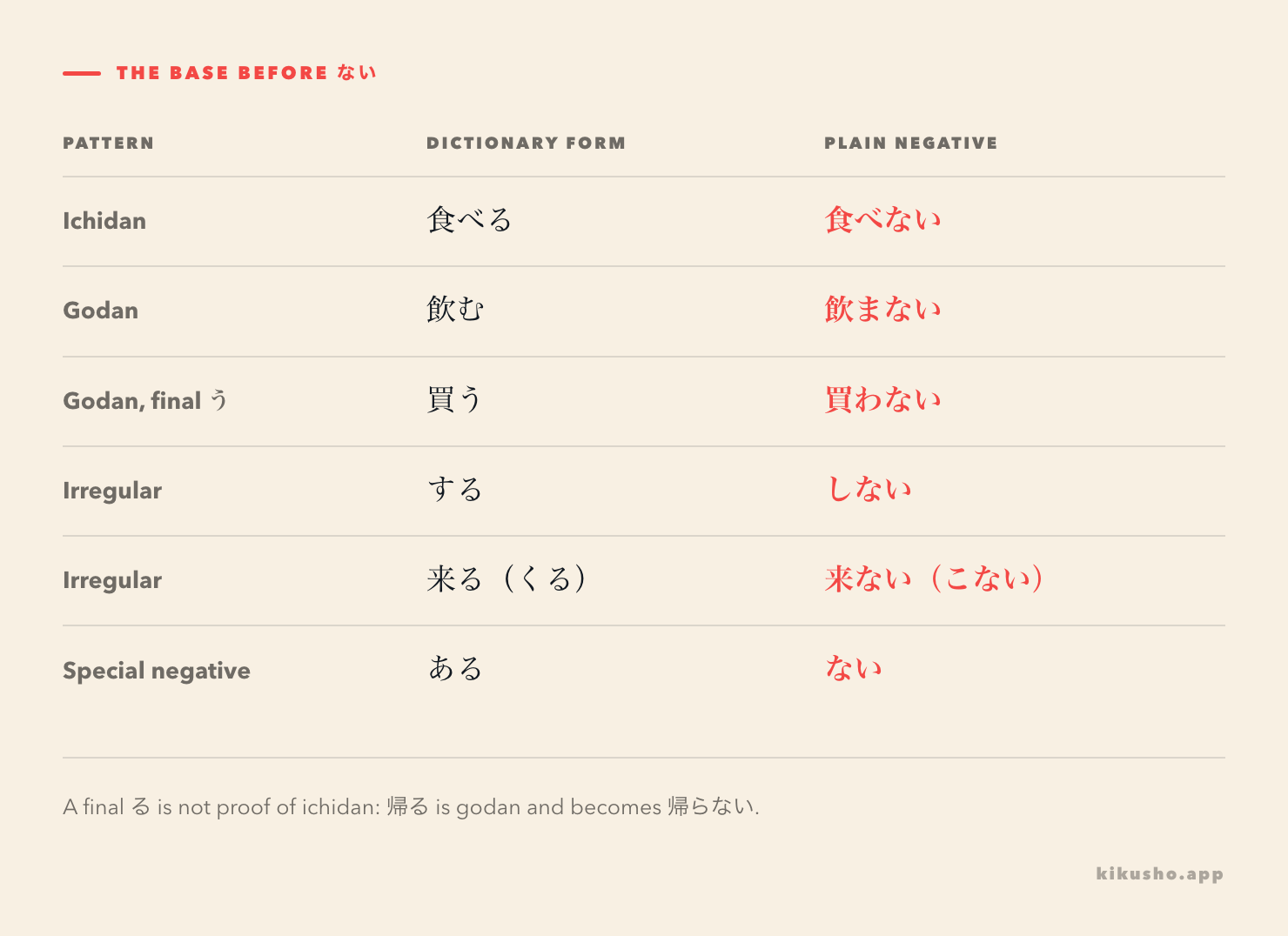
Start from the dictionary form, not from the whole ます form. A verb's class decides what remains before ない.
Ichidan verbs lose る
Remove る and add ない: 食べる(たべる)→ 食べない, eat → not eat; 見る(みる)→ 見ない, see/watch → not see/watch. Thus 今日はテレビを見ない means “I won't watch TV today.” 今日 is きょう.
This rule applies to ichidan verbs, not to every word ending in る. 帰る(かえる), go home, is godan: 帰らない, not 帰ない. TUFS's verb-class explanation contrasts the two bases and lists common godan verbs that resemble ichidan ones.
Godan verbs move to the あ-row
Replace the final う-row kana with the corresponding あ-row kana, then attach ない. A final う has its own row in this rule: it becomes わ, not あ.
| Dictionary ending | Negative ending | Example and reading | Meaning of the base verb |
|---|---|---|---|
| う | わない | 買う(かう)→ 買わない | buy |
| つ | たない | 待つ(まつ)→ 待たない | wait |
| る | らない | 帰る(かえる)→ 帰らない | go home |
| ぬ | なない | 死ぬ(しぬ)→ 死なない | die |
| ぶ | ばない | 呼ぶ(よぶ)→ 呼ばない | call |
| む | まない | 飲む(のむ)→ 飲まない | drink |
| く | かない | 書く(かく)→ 書かない | write |
| ぐ | がない | 泳ぐ(およぐ)→ 泳がない | swim |
| す | さない | 話す(はなす)→ 話さない | speak |
The つ row gives 待たない, not 待つない or 待ちない. The final-う exception gives 買わない, not 買あない. These are changes to the verb's base, not extra particles. TUFS's plain-form reference supplies the nine ending patterns; Tofugu's ない guide independently checks the formation and exceptions.
する, 来る and ある need special attention
する, do, becomes しない. 来る(くる), come, becomes 来ない(こない). Keep the reading with the form: きない is not the negative of 来る.
ある normally follows the godan pattern, but its plain negative is simply ない, not あらない. いる follows the ichidan pattern and becomes いない. The ある/いる lesson explains what exists in each construction; here the point is the negative shape.
ません uses the ます base, not the ない base
If you know the polite affirmative, replace ます with ません. No new verb-class decision is needed at that stage.
| Dictionary form | Polite affirmative | Polite negative |
|---|---|---|
| 食べる | 食べます | 食べません |
| 飲む | 飲みます | 飲みません |
| 来る | 来ます(きます) | 来ません(きません) |
| する | します | しません |
For godan 飲む, the two negative bases differ: 飲まない, but 飲みません. You cannot make the polite negative by writing 飲まません or 飲みない. The difference is visible before the negative ending arrives.
あした、学校へ行きません means “I won't go to school tomorrow.” あした means tomorrow, 学校(がっこう)means school, and 行く(いく)means go. 行きません fits polite ます style; 行かない gives the same basic denial in plain style. TUFS teaches ません and its non-past uses as the ordinary polite negative.
You will also hear 行かないです in conversation. That adds です to the completed negative rather than changing the verb to ます style. It is common spoken Japanese, but 行きません is the dependable form when an exercise specifically asks for the ます-style negative. Neither register makes a wrong stem correct.
Make the plain negative first, then make it past
The plain past negative grows out of the negative you already built. Change the final い of ない to かった:
- 飲む → 飲まない → 飲まなかった: drink → do not drink → did not drink.
- 見る → 見ない → 見なかった: watch → do not watch → did not watch.
- 来る → 来ない → 来なかった(こなかった): come → do not come → did not come.
You can think of the ending as ない → なかった, provided you keep the correct verb base. 昨日、コーヒーを飲まなかった means “I didn't drink coffee yesterday.” 昨日 is きのう. The negative base is 飲ま, and the past-negative ending is なかった.
Do not start with affirmative past 飲んだ and append ない: 飲んだない is not the negative past. This route also avoids having to relearn the affirmative past's sound changes for every negative. Tofugu's past-negative page explains the order of formation.
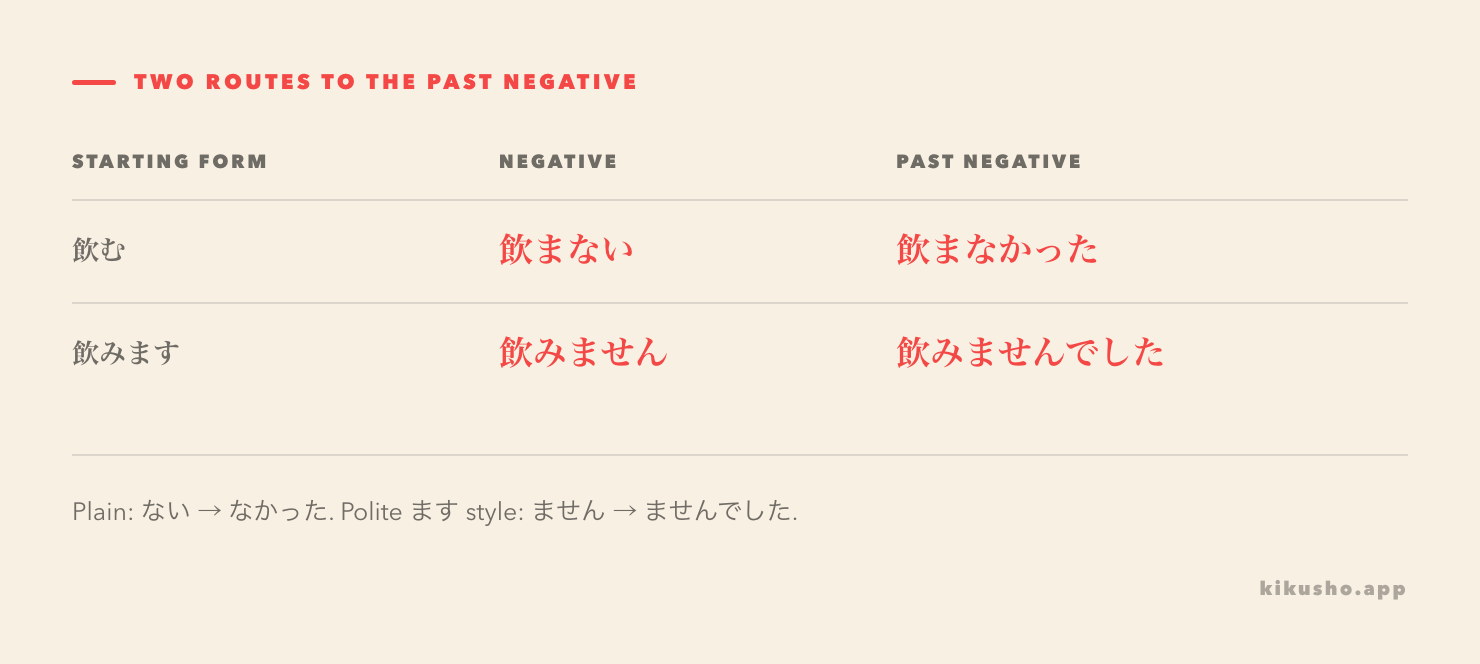
The polite past negative takes a different route: 飲みません → 飲みませんでした. Add でした after ません. Use 昨日、コーヒーを飲みませんでした when reporting the same past event in polite style. TUFS's past-tense lesson gives that construction.
じゃない and ではない deny a noun or な-adjective predicate
The verb recipe does not apply directly to a sentence ending in a noun. この人は先生です, “This person is a teacher,” becomes この人は先生じゃない, “This person is not a teacher,” in plain conversational style. Read 人 as ひと and 先生 as せんせい.
Attach じゃない or its fuller form ではない after the noun or the な-adjective stem. 先生ない and 先生ません do not do that job. For な-adjectives, keep the stem without the noun-attaching な: 便利じゃない, “not convenient,” rather than 便利なじゃない. 便利 is べんり.
| Style | Non-past negative | Past negative |
|---|---|---|
| Plain, conversational | 先生じゃない | 先生じゃなかった |
| Plain, fuller form | 先生ではない | 先生ではなかった |
| Common polite conversation | 先生じゃないです | 先生じゃなかったです |
| Formal polite | 先生ではありません | 先生ではありませんでした |
じゃ contracts では. The fuller form is more formal, but plain ではない does not itself turn the sentence into polite です/ます style. The table separates that distinction. You may also meet じゃありません and じゃありませんでした as polite alternatives.
For じゃないです, the past is じゃなかったです, not じゃないでした. For ではありません, the past is ではありませんでした. JLPT Sensei's nominal-negative table and Tofugu's じゃない/ではない guide check these forms and styles.
An い-adjective has its own negative, such as 高くない, “not expensive.” For that formation and the distinction from な-adjectives, use the two adjective classes. 高いじゃない? can appear as a conversational request for agreement, “It's expensive, isn't it?”; it is not the ordinary negation “not expensive.” Here the table teaches statements of negation, rather than every question containing じゃない.
A negative event is different from an unfinished one
日曜日は働かない, “I don't work on Sundays,” describes a habitual negative; あしたは働かない, “I won't work tomorrow,” describes a future plan. Read 日曜日 as にちようび and 働く as はたらく. Non-past ない can serve both meanings because the time expression anchors it.
With a finished past period, 昨日は働かなかった means “I didn't work yesterday.” It reports a non-event in that past period. A negative is not a claim that the opposite action took place: not drinking coffee does not tell you what someone drank instead.
If a colleague asks about an action still pending now, まだです, “Not yet,” may be the simple reply. To say “I haven't eaten yet,” Japanese normally uses まだ食べていません, a continuing state rather than a completed past-negative event. That construction needs the て-form plus いる; do not replace it with まだ食べなかった in this lunch-time context. The Tofugu past-negative guide checks the distinction. Learn the present negative and past negative here; save the continuing-state form as a separate next step.
For a card in Kikusho, keep the time word beside the negative verb. Pasting a diary line with 昨日 gives 飲まなかった a past event to retrieve. Check that the generated example preserves the time and the stem before saving it. A second example about あした then asks for a different form, rather than another translation of the same English not.
Practice
Write all your answers before checking the shared solutions below. These exercises are original.
Question 1. Choose the plain negative of 待つ(まつ), “wait.”
- ア. 待つない
- イ. 待ちない
- ウ. 待たない
- エ. 待ない
Question 2. A learner writes 帰ない for “do not go home.” Correct the form and identify the verb group of 帰る(かえる).
Question 3. Arrange all four pieces into a polite report meaning “I didn't write a letter yesterday”: 手紙を / 書きませんでした / 昨日 / 私は. Use topic → time → object → verb order. 手紙(てがみ)means letter.
Question 4. Make この人は先生です negative in plain conversational style, using the contraction taught in this lesson.
Question 5. Choose the pair that matches the time words and keeps polite ます style. The friend did not come yesterday; tomorrow the speaker will meet the friend but will not watch a film.
昨日、友達を待ちました。でも、友達は___。あしたは友達と会います。でも、映画は___。
友達(ともだち)means friend, 会う(あう)means meet, and 映画(えいが)means film.
- ア. 来ませんでした / 見ません
- イ. 来ません / 見ませんでした
- ウ. 来ないでした / 見ません
- エ. 来ませんでした / 見まない
Question 6. Give the plain past negative of する and the reading of 来なかった.
Question 7. Choose the translation of この店はレストランじゃない. 店(みせ)means shop or establishment.
- ア. This establishment is not a restaurant.
- イ. This restaurant did not open yesterday.
- ウ. I do not eat at this restaurant.
- エ. I will not come to this restaurant.
Question 8. Make 飲みます negative while keeping ます style, then put that negative in the past.
Answers and explanations
Answer 1. ウ. 待たない. 待つ is godan. Its final つ becomes た before ない. ア leaves the dictionary ending intact; イ uses the ます-base sound ち with the wrong negative ending; エ drops the kana without supplying the godan base.
Answer 2. 帰らない; godan. A final る does not by itself identify ichidan. 帰る takes the godan る→ら change before ない. 帰ない would apply the wrong group's deletion rule.
Answer 3. 私は昨日、手紙を書きませんでした。 書き is the ます base of 書く, followed by the polite past-negative ending ませんでした. The requested order puts the object 手紙を before the final verb. A plain version would use 書かなかった instead.
Answer 4. この人は先生じゃない。 The noun predicate 先生 takes じゃない. この人は先生ではない is also grammatical, but it uses the fuller form rather than the requested contraction. 先生ない and 先生ません do not negate a noun predicate.
Answer 5. ア. 来ませんでした / 見ません. 昨日 identifies a past event; あした identifies the future plan, expressed with the non-past negative. イ reverses the times. ウ incorrectly attaches でした to plain 来ない; エ takes the ま from ます as part of the stem and invents 見まない. The stem of 見る is 見. 来ませんでした is read きませんでした, while its plain counterpart 来なかった is こなかった.
Answer 6. しなかった and こなかった. First build しない and 来ない(こない), then change ない to なかった. するなかった and きなかった miss the irregular negative bases.
Answer 7. ア. This establishment is not a restaurant. じゃない denies the noun classification レストラン. The sentence contains no verb meaning open, eat or come, and no past or future time word. Its negative ending cannot supply those actions.
Answer 8. 飲みません → 飲みませんでした. Replace ます with ません on the same stem, then add でした for the past. 飲まない and 飲まなかった would be correct plain forms, but would change the requested style.
Common questions
How do I make a Japanese verb negative?
For an ichidan verb, remove る and add ない. For a godan verb, change the final う-row sound to its あ-row counterpart, except final う becomes わ. する becomes しない and 来る becomes 来ない, read こない. In polite ます style, replace ます with ません.
What is the difference between ない and ません?
Both can express a non-past negative. A verb ending in ない is plain; a verb ending in ません is in polite ます style. They use different bases with godan verbs, such as 飲まない and 飲みません.
How do I say did not in Japanese?
Build the plain negative first, then replace its final い with かった: 食べない becomes 食べなかった. In polite style, add でした after ません: 食べませんでした. Do not append ない to a verb's affirmative past form.