On this page
予約すればいい recommends an option that is still open. 予約すればよかった regrets a choice after the chance has passed, while 早く予約すれば、安く買えたのに imagines the better result that the missed condition would have produced.
The quickest test is time plus viewpoint. Ask whether the speaker is choosing a next step, judging their own past choice, or comparing reality with an unrealized outcome.
The rule in one table
All three patterns begin with a condition, but the words after it tell you what the speaker does with that condition.
| Form | Basic shape | Speaker's move | Natural translation |
|---|---|---|---|
| ばいい | Vば + いい | presents an available option as good | should; can; it would be good to |
| ばよかった | Vば + よかった | looks back at a better choice not taken | should have; I wish I had |
| ば~のに | condition + unrealized result + のに | contrasts reality with what could have followed | if only; would have; could have |
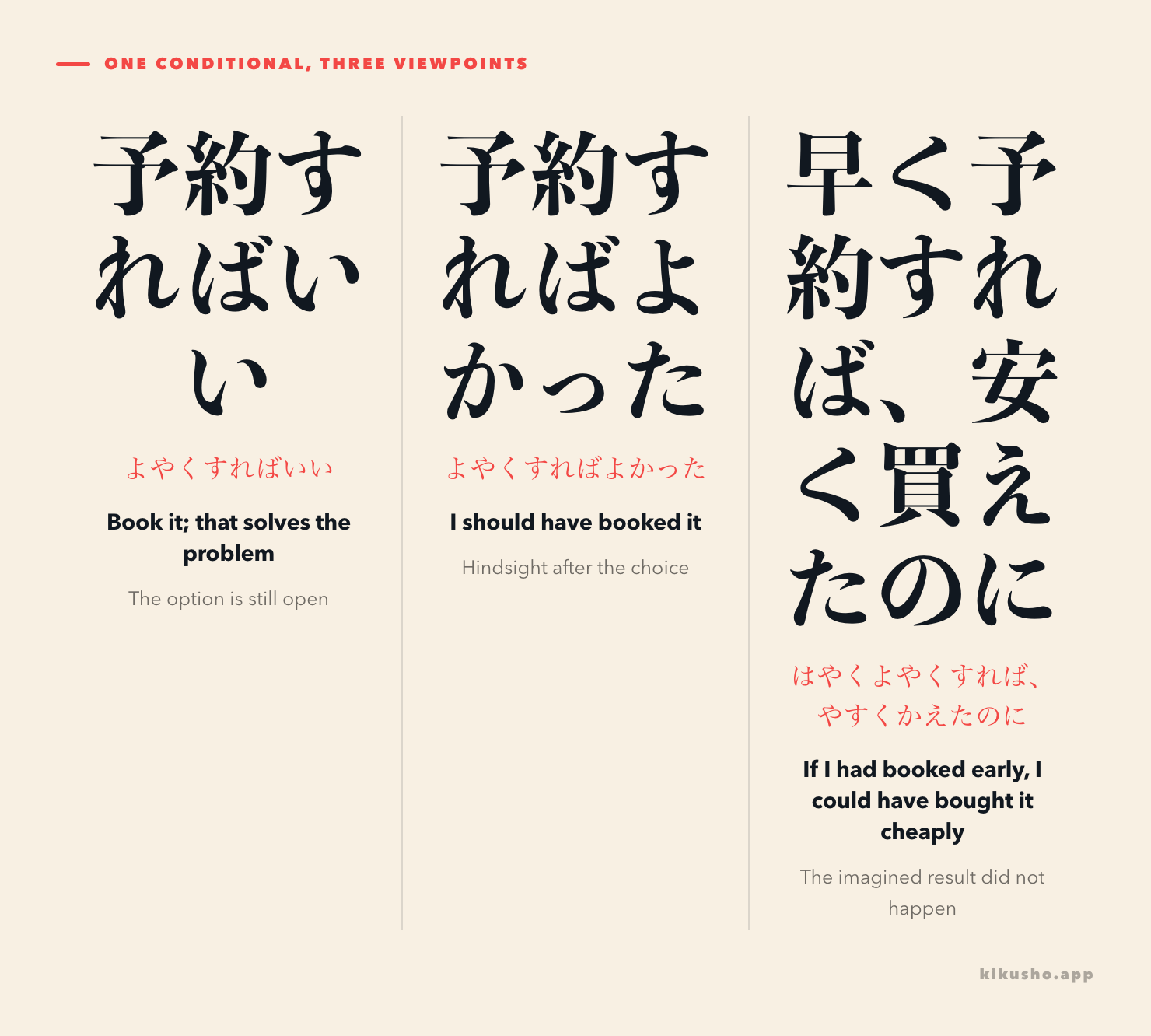
The forms are related, but they are not interchangeable tense variants. いい evaluates a route from the present. よかった evaluates it from hindsight. A following のに sets the imagined route against the situation that became real.
Build the ば condition first
For verbs, attach いい, よかった, or the rest of a counterfactual sentence to the ordinary ば-form. The ば and なら lesson explains the wider conditional contrast; this lesson starts after the ば-form has been chosen.
| Dictionary form | Affirmative ば-form | Negative ば-form |
|---|---|---|
| 書く(かく), write | 書けば | 書かなければ |
| 読む(よむ), read | 読めば | 読まなければ |
| 食べる(たべる), eat | 食べれば | 食べなければ |
| する, do | すれば | しなければ |
| 来る(くる), come | 来れば(くれば) | 来なければ(こなければ) |
The negative matters because it reverses the imagined action:
- 買えばよかった。 I should have bought it.
- 買わなければよかった。 I wish I had not bought it.
The second sentence does not mean “I should not buy it now.” The purchase already happened; the speaker wishes the condition “not buy” had been true.
Use ばいい while the option is still open
Vばいい presents doing V as a satisfactory route. It can answer a practical question:
A: 申込書はどこに出せばいいですか。
もうしこみしょはどこにだせばいいですか。
Where should I submit the application form?B: 一階の受付に出せばいいですよ。
いっかいのうけつけにだせばいいですよ。
You can submit it at the reception desk on the first floor.
In questions, どうすればいいですか and 何をすればいいですか ask someone to supply the good option. In statements, the same form can sound matter-of-fact: 分からなければ、先生に聞けばいい means “If you do not understand, you can ask the teacher.”
That directness needs context. 休めばいい can be helpful when someone asks what to do, but dismissive if it sounds like “just take a break.” A reason or と思います gives the recommendation more room: 今日は休めばいいと思います presents it as the speaker's judgment.
The existing lesson on ~たほうがいい covers another advice pattern. 薬を飲んだほうがいい compares courses and often sounds like a more pointed recommendation. この薬を飲めばいい presents taking this medicine as the solution or sufficient step. English may translate both with “should,” so the surrounding problem matters more than that single word.
Use ばよかった after the choice has closed
Change いい to its past form よかった, and the evaluation moves into hindsight:
電車に遅れた。もっと早く家を出ればよかった。
でんしゃにおくれた。もっとはやくいえをでればよかった。
I missed the train. I should have left home earlier.
The speaker did not leave early. That unrealized action is understood from the regret. The sentence does not need 後悔している, “I regret it,” because the comparison with the better past choice already supplies that stance.
Negative ばよかった is easy to misread. Start from the reality, then negate it inside the condition:
あんなメールを送らなければよかった。
あんなメールをおくらなければよかった。
I wish I had not sent that email.
The email was sent. The desired alternative was not sending it. This differs from ~てしまう, which first marks an action as completed and lets context suggest regret. 送ってしまった reports the completed, now troublesome event; 送らなければよかった explicitly evaluates the unchosen alternative as better.
Use ば~のに when the missing result is the point
The full counterfactual pattern has two parts:
condition in ば-form + unrealized result + のに
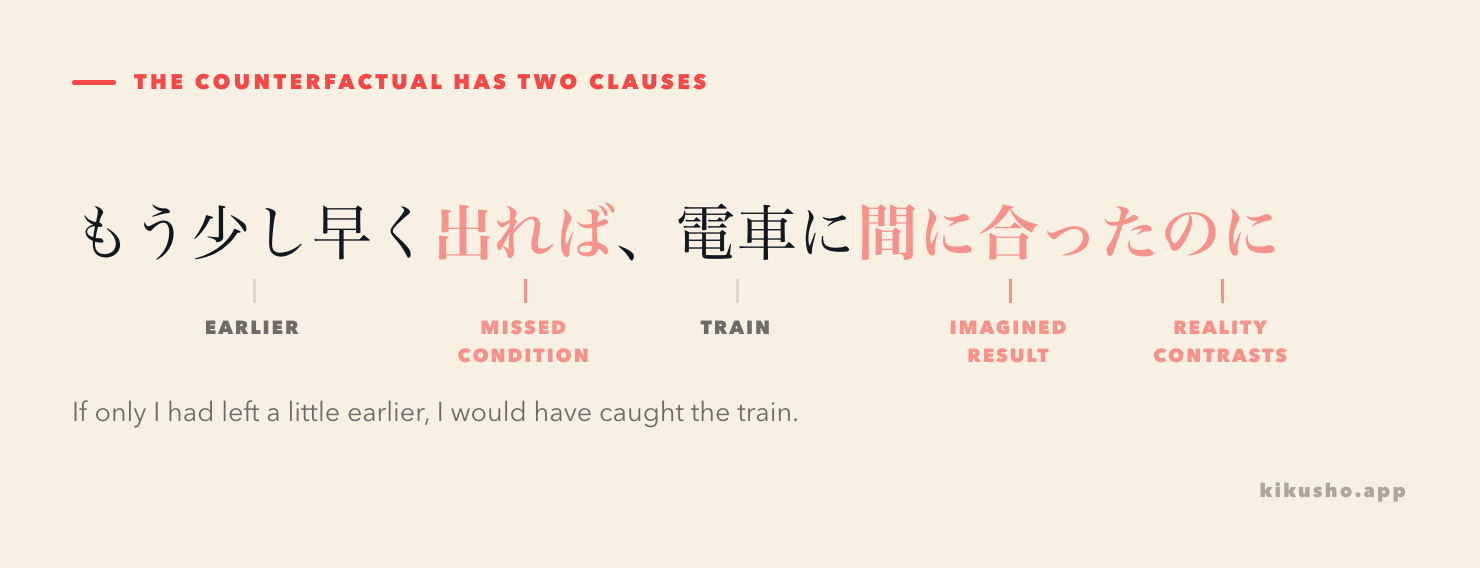
もう少し早く出れば、電車に間に合ったのに。
もうすこしはやくでれば、でんしゃにまにあったのに。
If only I had left a little earlier, I would have caught the train.
Reality supplies the reverse: the speaker did not leave early and did not catch the train. のに closes the imagined result with disappointment at the contrast. It can also describe a present unrealized possibility:
もう少し静かなら、ここで勉強できるのに。
もうすこししずかなら、ここでべんきょうできるのに。
If only it were a little quieter, I could study here.
Here a な-adjective uses なら. An い-adjective uses ければ: もっと安ければ、買えるのに, “If only it were cheaper, I could buy it.” The result before のに may be past, present, or potential; what stays constant is the clash between the imagined condition and reality.
Where ばよかったのに overlaps
Vばよかったのに places のに after the hindsight judgment. It is especially common when the missed action belongs to another person:
来られないなら、早く連絡してくれればよかったのに。
こられないなら、はやくれんらくしてくれればよかったのに。
If you could not come, you should have contacted me earlier.
Without のに, 早く連絡してくれればよかった can still state that earlier contact would have been preferable. With のに, the speaker leaves the disappointing reality in the foreground. Said gently, it can express sympathy about a missed chance. Said sharply to the person responsible, it can sound like blame.
Present ばいいのに works the same way with a still-open situation: 一緒に来ればいいのに can mean “You should come with us” with a shade of “but you are not doing so.” It is more emotionally marked than a neutral answer such as 一緒に来ればいいですよ.
That is why subject and relationship matter. For your own private regret, plain ばよかった is the safe core pattern. Toward someone else, ばよかったのに comments on what they failed to do, so politeness at the end does not remove the possible reproach.
When you save one of these lines in Kikusho, keep the sentence before it too. The same ending can be practical advice, sympathy, or irritation depending on who missed the action and whether the chance remains open. A card with that small scene preserves the distinction better than an isolated “should” gloss.
Practice
Answer every question before opening the explanations. The questions come first so the answer to one cannot reveal the next.
Question 1. A colleague asks where to send a form. Choose the answer that presents reception as the available solution.
- ア. 受付に出せばいいですよ。
- イ. 受付に出せばよかったです。
- ウ. 受付に出さなければよかったです。
- エ. 受付に出せたのに。
Question 2. You bought shoes that hurt your feet. Complete the regret: こんな靴は__。 Use 買う(かう) and mean “I wish I had not bought shoes like these.”
Question 3. Put these parts in a natural order to mean “If I had checked the map, I would not have got lost.”
- 迷わなかった
- 地図を
- のに
- 見れば
Question 4. Read the exchange and choose the form that best fits the blank.
A: パスワードを忘れました。どう__ですか。
B: このボタンから変更できます。
- ア. すればいい
- イ. すればよかった
- ウ. しなければよかった
- エ. すれば間に合ったのに
Question 5. Your friend says after the event, 昨日の映画、見なかった。 Reply with disappointment about their missed chance: “You should have watched it. It was excellent.” Use 見る(みる) and include のに.
Question 6. In the paragraph, choose the best expression for the final blank.
駅に着いたとき、電車はもう出たあとだった。出発時間を勘違いしていた。家を出る前に時刻表を__。
- ア. 確認すればいい
- イ. 確認すればよかった
- ウ. 確認しなければよかった
- エ. 確認すれば間に合うのに
Answers and explanations
Answer 1. ア. 受付に出せばいいですよ. The action is still available and solves the colleague's problem. イ looks back at a missed action, ウ regrets submitting it, and エ implies an unrealized ability or result without answering the practical question.
Answer 2. こんな靴は買わなければよかった. The purchase happened, so the desired alternative must be negative: 買わない becomes 買わなければ before よかった. 買えばよかった would mean that not buying was the mistake.
Answer 3. 地図を見れば、迷わなかったのに. 見れば supplies the missed condition, 迷わなかった names its imagined result, and のに marks the contrast with reality. The natural inference is that the speaker did not check the map and did get lost.
Answer 4. ア. すればいい. どうすればいいですか asks for a next step. イ asks what should have been done after the opportunity has passed, ウ regrets doing something, and エ contains an imagined result that does not fit the open support question.
Answer 5. 見ればよかったのに。すごくよかったよ is one natural answer. 見ればよかった identifies watching as the better missed choice; のに adds disappointment about the friend's absence. Because it comments on another person's choice, a sharp tone could make it sound reproachful.
Answer 6. イ. 確認すればよかった. The train has already departed, and the speaker now identifies checking the timetable as the better past action. ア treats checking as a current solution, ウ says checking would have been a mistake, and エ uses present 間に合う even though this departure can no longer be caught.
Why the level labels disagree
JLPT Sensei and Bunpro both list ばいい at N3. JLPT Sensei also places ばよかった and ば~のに at N3, while Bunpro and the Tanos comparison list place ばよかった at N4. The official JLPT does not publish an exhaustive grammar list, so this lesson keeps the inventory's N3 placement and records the disagreement rather than treating one private list as definitive.
The prerequisite is the ordinary ば conditional. The new work here is choosing the speaker's time and viewpoint, recovering the unrealized reality behind のに, and hearing when hindsight about another person turns into reproach.
Codex, an AI agent, checked the forms, readings, translations, distractors and answer logic against the linked teaching references. No human language review is claimed.
Common questions
What is the difference between ばいい and ばよかった?
Vばいい evaluates an available action as a good option, while Vばよかった looks back at an action that did not happen and presents it as the better choice.
How do you say “I should not have done it” with ばよかった?
Put the verb in the negative ば-form: しなければよかった means “I wish I had not done it.” The negative belongs to the unrealized condition.
What does ば~のに add?
It names a condition and an unrealized or disappointing result: 早く出れば、間に合ったのに means that leaving earlier would have led to arriving in time, but it did not happen.
Can ばよかったのに sound critical?
Yes. When said about another person's missed action, it often carries disappointment or reproach. Tone and context decide whether it sounds sympathetic or accusatory.