On this page
どうしても says that resolve, desire, or inability will not change; なるべく asks for the best practical effort circumstances allow. Use どうしても when the outcome feels fixed, and なるべく when the target is preferred but flexible.
Both are adverbs and can appear before an action phrase. Their force differs. どうしても今日中に終わらせたい commits strongly to finishing today. なるべく今日中に終わらせたい says today is the desired target while leaving room for constraints.
Fixed result and flexible target are different claims
Compare two requests about the same report:
どうしても今日中に提出してください。
どうしても きょうじゅうに ていしゅつして ください。
Please submit it today no matter what.
なるべく今日中に提出してください。
なるべく きょうじゅうに ていしゅつして ください。
Please submit it today if at all possible.
The first treats today's deadline as non-negotiable. The second still requests today, but acknowledges that the listener may face a real limit.
| Adverb | Speaker's stance | Room for circumstances |
|---|---|---|
| どうしても | the desire, decision, result, or inability is fixed | little or none |
| なるべく | move as far as practical toward a preferred target | explicitly allowed |
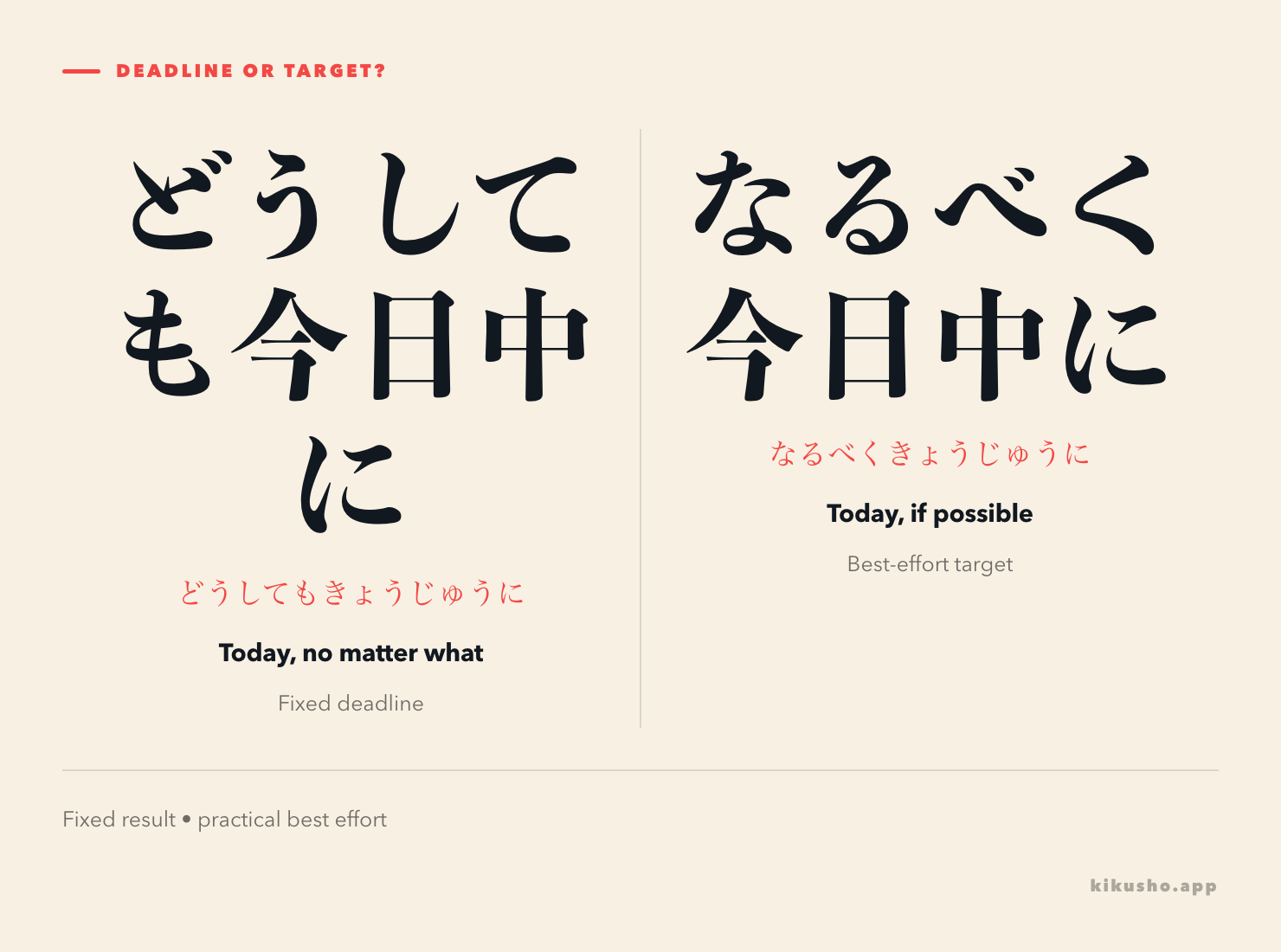
This difference matters for politeness. Adding ください does not make an inflexible deadline gentle. In workplace writing, なるべく早めにお願いします can soften the target, while どうしても必要です states that the need remains unavoidable.
どうしても follows the polarity of what comes next
どうしても is often translated too early. First read the predicate after it.
どうしても京都に行きたい。
どうしても きょうとに いきたい。
I absolutely want to go to Kyoto.
The affirmative desire 行きたい makes どうしても express determination: obstacles will not change the wish.
この名前がどうしても思い出せない。
この なまえが どうしても おもいだせない。
I simply cannot remember this name, no matter how hard I try.
The negative potential 思い出せない makes the fixed result an inability. The speaker has mentally exhausted the alternatives, but the memory still does not return.
この瓶のふたがどうしても開かない。
この びんの ふたが どうしても あかない。
This jar lid just will not open.
| Following expression | Common reading of どうしても | Example |
|---|---|---|
| ~たい / 欲しい | strong desire, “absolutely” | どうしても参加したい |
| decision or need | “no matter what,” “at any cost” | どうしても必要だ |
| ~ない / ~できない | inability despite every approach | どうしても解けない |
| Vと + result | an unavoidable recurring result | 食べるとどうしても眠くなる |
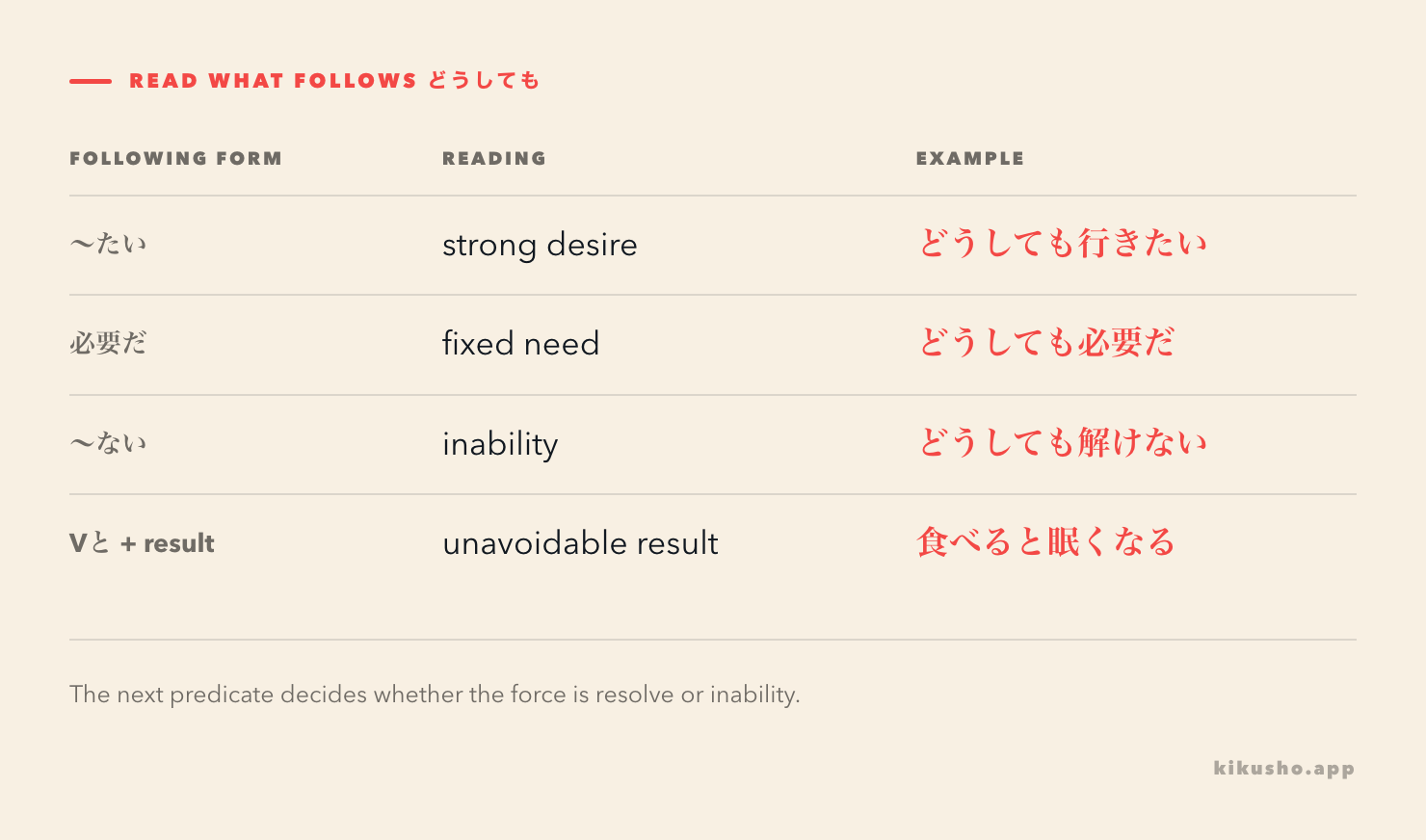
JLPT Sensei's どうしても lesson places the phrase at N3 and illustrates both strong desire and failure despite effort. Bunpro likewise treats it as a standard-register adverb of determination or inevitability, including the Vと、どうしても… pattern.
どうしても is one phrase, not an ordinary question
Learners recognize どうして, “why,” and may try to parse どうしても as a question plus も. In this established adverb, the whole phrase means roughly “whatever one does” or “in any case.” It does not ask for a reason.
どうして遅れたのですか。
Why were you late?
どうしても間に合いません。
There is simply no way I will make it in time.
The presence of も changes the job of the expression. MaruMori's independently authored account traces the phrase to どう + して + も and groups its common readings under strong wanting, strong refusal, inability, and an unavoidable reaction.
なるべく sets the highest practical target
なるべく means “as much as possible,” “as far as possible,” or “wherever practicable.” It normally appears before the action or quality whose degree should approach a practical limit.
健康のために、なるべく毎日歩いています。
けんこうの ために、なるべく まいにち あるいています。
For my health, I walk every day as often as possible.
なるべく静かにドアを閉めてください。
なるべく しずかに ドアを しめて ください。
Please close the door as quietly as possible.
返事はなるべく早めにお願いします。
へんじは なるべく はやめに おねがいします。
Please reply as early as you reasonably can.
The form does not conjugate and does not require a particle after it. It modifies 毎日歩く, 静かに閉める, or 早めに as a whole. Avoid forms such as なるべくに or treating it as the verb なる followed by a separate ending.
Bunpro's なるべく lesson describes a standard-register adverb placed before an action phrase and notes that it sounds softer than できるだけ. Yatta's recent explanation also treats できるだけ as slightly stronger and more frequent in everyday speech, while emphasizing their broad overlap.
When you save a request in Kikusho, keep the deadline or degree after the adverb. A card with only なるべく hides what should be maximized, while なるべく早めに連絡してください preserves both the preferred target and the softened request.
Best effort does not promise success
なるべく commits to an approach, not a guaranteed result.
なるべく間違えないように確認します。
なるべく まちがえない ように かくにんします。
I will check so that I make as few mistakes as possible.
The speaker promises careful checking, but does not claim that zero mistakes are certain. The related ようにする lesson explains how a deliberate effort can become a habit without asserting perfect success.
This also separates なるべく from 必ず, “without fail.” 必ず今日送ります promises that sending will happen today. なるべく今日送ります names today as the preferred practical target.
The two adverbs can appear in the same situation
A speaker can hold one result fixed and leave the method flexible:
この薬はどうしても必要なので、なるべく安い店を探します。
この くすりは どうしても ひつようなので、なるべく やすい みせを さがします。
This medicine is absolutely necessary, so I will look for the cheapest practical option.
The need does not change; the price search works within what is available. This is why “necessity and effort” should not be treated as two grades on one scale.
The previous どんなに, いくら, and たとえ~ても lesson varies a concessive condition while holding a result steady. どうしても instead packages the speaker's determination or inability as a stance, and なるべく sets a practical target.
The study references disagree on なるべく's level
JLPT Sensei places both target expressions at N3, and Bunpro agrees on N3 for どうしても. Bunpro places なるべく at N4, while the older Tanos reference list records it at N2. This is a sequencing disagreement, not a disagreement about its everyday meaning. Kikusho keeps the planned N3 comparison because the contrast between fixed resolve and flexible effort is the learning target. The JLPT authority publishes no exhaustive current grammar syllabus.
Practice
All solutions follow Question 7.
Question 1. You have a strong wish that obstacles will not change. Complete: 私は__この試合に出たい。
ア. なるべく
イ. どうしても
ウ. どうして
エ. できれば
Question 2. A manager wants an early reply but accepts practical constraints. Complete: __早めに返事をください。
ア. どうしても
イ. 必ず
ウ. なるべく
エ. どうして
Question 3. Choose the natural sentence for inability despite repeated attempts.
ア. この問題がなるべく解けない。
イ. この問題がどうして解けない。
ウ. この問題がどうしても解けない。
エ. この問題がなるべくに解けない。
Question 4. Arrange the chunks to mean “Please speak as quietly as possible”: 話してください / なるべく / 静かに
Question 5. Explain how どうしても今日中に終わらせたい differs from なるべく今日中に終わらせたい.
Question 6. In 牛乳を飲むと、どうしてもお腹が痛くなる, what does どうしても contribute?
Question 7. Read the message and choose the entries for 甲 and 乙.
この面接には__参加したいです。そのため、駅には__早めに着くようにします。
ア. 甲: なるべく / 乙: どうしても
イ. 甲: どうしても / 乙: なるべく
ウ. 甲: どうして / 乙: なるべくに
エ. 甲: 必ずしも / 乙: どうしても
Answers and explanations
Answer 1. イ. どうしても. The following 出たい is a strong desire, so どうしても means that the speaker wants to participate no matter what.
Answer 2. ウ. なるべく. The manager sets an early reply as the preferred practical target. どうしても and 必ず would remove the intended flexibility.
Answer 3. ウ. この問題がどうしても解けない. The negative potential predicate makes どうしても describe an inability that remains after trying alternatives. どうして alone asks “why,” and なるべく does not describe fixed failure.
Answer 4. なるべく静かに話してください. なるべく comes before the manner phrase 静かに, which modifies 話してください.
Answer 5. どうしても makes finishing today a firm desire or requirement despite obstacles. なるべく makes today the preferred target while admitting that circumstances may prevent it.
Answer 6. It presents the stomach ache as an unavoidable recurring result whenever the person drinks milk. It does not express a wish or ask why the pain occurs.
Answer 7. イ. 甲: どうしても / 乙: なるべく. Participation is the speaker's fixed strong wish. Arriving early is the best-effort method used to support that goal.
Common questions
What is the difference between どうしても and なるべく?
どうしても presents a result as fixed despite obstacles: strong resolve with an affirmative wish, or inability with a negative form. なるべく asks for the greatest practical effort while admitting that circumstances may limit it.
Why can どうしても mean both “absolutely” and “simply cannot”?
The adverb says that alternatives do not change the result. With 行きたい, the fixed result is a strong wish to go. With 行けない, the fixed result is inability to go despite trying.
Is なるべく a command?
No. It is an adverb meaning as much as possible or wherever practicable. In a request it sets a preferred target, and the request ending supplies the instruction.
Is なるべく N3 or N4?
Published study references disagree: JLPT Sensei places it at N3, Bunpro at N4, and an older Tanos list at N2. Kikusho retains it in this N3 comparison while documenting the disagreement.